Unless you’re a policy wonk, I realize “exciting” may not be the right word to describe new developments in public-finance economics. For nerds, however, three economists at the Joint Committee on Taxation have some important new research on the Laffer Curve. The study, authored by Rachel Moore, Brandon Pecoraro, and David Splinter, concludes that the […]
The picture is firming up, and it’s devastating. Six people are dead at the foot of Mount Maunganui because, over four critical hours on the morning of 22 January, New Zealand’s emergency management system failed. Not just failed, but failed repeatedly, in ways that now look systemic. And what’s becoming clearer with each new revelation […]
This is what I’m seeing: + 2.4 million rent-controlled apartments in a city with a massive housing shortage and 1.4% vacancy rate. + A huge % of these tenants are wealthy, white boomers using the units as pieds-a-terres while they spend their weekends and summers elsewhere. + Meanwhile, the government is using rent control to…
TweetPhil Magness’s new essay on the origins of the vague and derogatory term “neoliberalism” is superb. A slice: While most versions of the neoliberal label still come from the academic left today, the term has come back into favor within a certain, curious strand of the right. Conservative writers such as Patrick Deneen, Adrian Vermeule,…
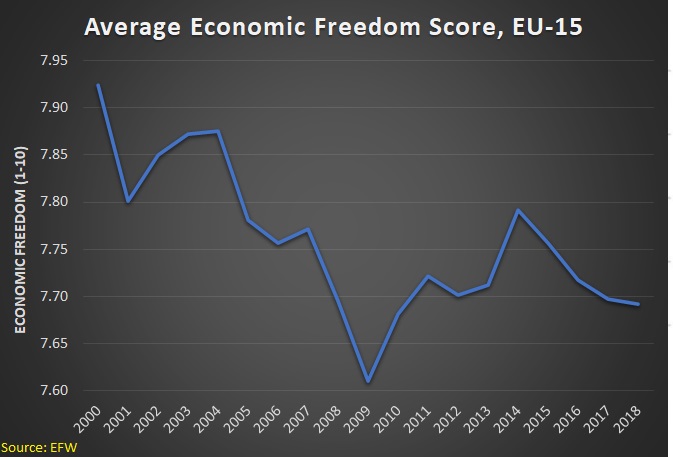
About five years ago, I fretted about the gradual erosion of economic liberty in Western Europe. And I followed up two years ago with similar analysis, grousing that the entire western world was joining Western Europe in the drift toward more statism. When you combine this grim trend with data about demographic decline, which is […]
In this in-depth interview, economist and statistician Ross McKitrick discusses climate models, uncertainty, and whether the public climate debate is as scientifically balanced as often claimed. He also reflects on his role as a co-author of the recent U.S. Department of Energy report.
It is all the more remarkable, then, that within six years Britain’s agricultural output had transformed, more profoundly and at a faster pace than any time since the start of the Industrial Revolution. The most urgent need was to provide a substitute for all that previously imported foreign wheat. In 1939, Britain only had 11.8…
Female Nazi Guards: The Forgotten Perpetrators of the Holocaust When discussing the Holocaust and the atrocities of Nazi Germany, the image that often comes to mind is of male SS officers enforcing brutal policies. However, women also played significant roles in the Nazi regime’s machinery of oppression and genocide. Among these women were the female […]
That is the topic of my latest Free Press column, here is one excerpt: What else are currency values telling us today? The Japanese yen continues a very weak run, now coming in at about 158 to the U.S. dollar. I can recall when it was common for the yen to stand at about 100…
Sara Frueh interviews David Autor on the subject: “How Is AI Shaping the Future of Work?” (Issues in Science and Technology, January 6, 2026). Here are some snippets that caught my eye, but it’s worth reading the essay and even clicking on some of the suggested additional readings: How broadly are AI tools already being…
There’s a website called Tobacco in Australia: Facts and Issues which is written by a few anti-smoking activist-academics. It provides lots of tobacco-related statistics and a bit of editorialising. The website has a whole section devoted to criticising “industry estimates of the extent of illicit trade in tobacco”. It is an article of faith in tobakko…
Why Evolution is True is a blog written by Jerry Coyne, centered on evolution and biology but also dealing with diverse topics like politics, culture, and cats.
In Hume’s spirit, I will attempt to serve as an ambassador from my world of economics, and help in “finding topics of conversation fit for the entertainment of rational creatures.”






Recent Comments