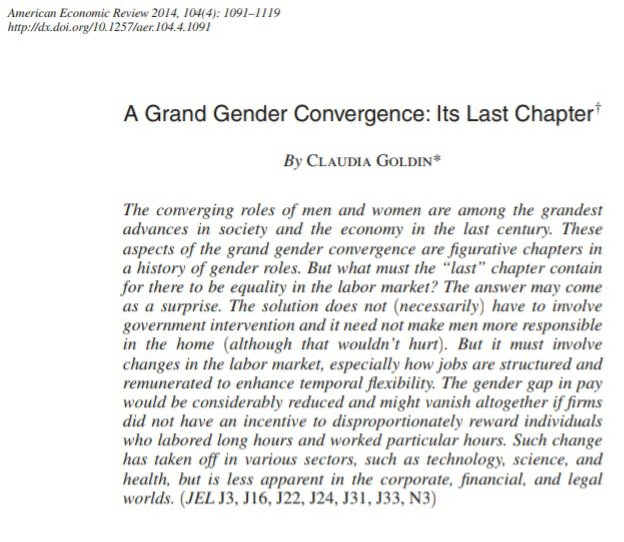
Little wonder @women_nz ignores world’s top female economist
01 Oct 2020 Leave a comment
in applied price theory, discrimination, economic history, economics of education, economics of love and marriage, gender, health and safety, human capital, industrial organisation, labour economics, labour supply, managerial economics, occupational choice, organisational economics, personnel economics, politics - New Zealand, politics - USA, poverty and inequality, Public Choice Tags: gender wage gap, pessimism bias, regressive left
Aftermath: The debate
01 Oct 2020 Leave a comment

I confess that I watched only 45 minutes of last night’s Presidential debate. At that point I couldn’t take the fracas any longer: Trump interrupting both the moderator, Chris Wallace, and Joe Biden; the simultaneous talking so that nothing could be made out; the failure of both candidates to answer questions (typical in these debates); and, of course, Trump’s Mussolini-like posturing. As I expected, there was no light and a lot of heat, but the heat wasn’t even entertaining. It was a slugfest, and a very ugly one. I missed some bits in the second half that are reported in today’s news, including Trump’s reported refusal to condemn white supremacists.
Although I think Biden came off better, he seemed a bit timorous and shaken and sometimes went off topic. And at times even he couldn’t contain himself, calling Trump a “clown” and telling him to “shut up”. Biden refused to…
View original post 1,011 more words
A groveling apology from a professor who simply called for more college football, which is apparently racist
01 Oct 2020 Leave a comment
What follows is one of the most ridiculous and embarrassing instantiations of wokeness I’ve seen anywhere, much less in colleges.
If you want to see the equivalent of a full, self-abasing confession in the religion of Wokeness, then read the second article below from Inside Higher Ed. When I initially read it, without reading the forerunner article, I thought it was a joke—so over the top and groveling was it.
But it wasn’t at all a joke. It was from a professor who had written a pretty innocuous article (with a grad student co-author) on the education website, an article that simply called for college football to resume (with proper pandemic precautions) as a way of bringing people together. Though I’m not a fan of college football, it didn’t ruffle my feathers a bit, as I know many people—especially Ohio State fans—are rabid addicts to college football.
It turns…
View original post 1,977 more words
Jesus ‘n’ Mo ‘n’ blasphemy
01 Oct 2020 Leave a comment
Today is International Blasphemy Day, and there’s a special new Jesus and Mo strip, called “lurid”, in honor of the occasion. (Blasphemy Day is the day in 2005 when the Danish newspaper Jyllands-Posten published the infamous Muhammad cartoons.)
The strip also came with an email message, to wit:
Oops. Sorry I’m a bit late with the mailout this week. I forgot. I also forgot it was Blasphemy Day today, but that’s forgivable because every day is Blasphemy Day at Jesus and Mo dot net!
Help keep this hideous blasphemy going by becoming a patron here: https://www.patreon.com/jandm
You can also buy the latest J&M collection, with a foreword by Jerry Coyne, here.
I remind you that I don’t get any dosh from either writing the intro or from sales of the books; my foreword was a labor of love. But do throw some love toward the creator of this…
View original post 30 more words
America First – Patriots or Nazis? – WW2 Special
30 Sep 2020 Leave a comment
in defence economics, laws of war, politics - USA, war and peace Tags: World War II
All Uphill: Australia Squanders $10Billion on Giant Pumped Hydro Power White Elephant
30 Sep 2020 Leave a comment


Australia has its former PM, Malcolm Turnbull to thank for its largest and most expensive renewable energy boondoggle, the Snowy 2.0 pumped hydro project.
Touted by the patrician and aloof Turnbull and his hapless sidekick, Josh Frydenberg as the Nation’s mega-battery, the heavily-hyped pumped hydro scheme (shelved in the 1970s because it was uneconomic then) has been heralded as the saviour for the Australian wind and large-scale solar ‘industries’.
The line goes something like this: if we use 3 MWh of wind or solar power to pump water through 27 km of tunnels, over an elevation of 900m, later, when power consumers actually need it, Snowy Hydro could return 2 MWh to the grid.
Never mind squandering 1/3 of the electricity originally generated; never mind that with the inclusion of the $85 per MWh REC the cost of the wind or solar power involved exceeds $110 per MWh; never mind…
View original post 1,445 more words
The role of monarchy in modern democracy
30 Sep 2020 Leave a comment


In the 21st century, monarchies remain pivotal parts of several democratic countries across Europe, including the UK. In a new book, edited by Unit founder Robert Hazell and Bob Morris, contributors from across Europe consider the constitutional and political role of monarchy, its powers and functions, how it is defined and regulated, the laws of succession and royal finances, relations with the media, its popularity, and why it endures.
Monarchy has a long history in Europe, being the predominant form of government from the Middle Ages until the First World War. At the turn of the twentieth century every country in Europe was a monarchy with just three exceptions: France, Switzerland and San Marino. But by the start of the twenty-first century, most European countries had ceased to be monarchies, and three quarters of the member states of the European Union are now republics. That has led to…
View original post 1,792 more words
An exchange about Wokeism featuring Sarah Haider and Ayaan Hirsi Ali
30 Sep 2020 Leave a comment
Well, there’s only one letter in the “exchange” so far: from Sarah Haider (co-founder and development director of Ex-Muslims of North America) to Ayaan Hirsi Ali. The exchange will appear bit by bit at the Letter site (click on screenshot below, and you may want to subscribe):

The exchange will not be about Islam, as you might expect (both Haider and Hirsi Ali are vocal ex-Muslims, critical of the faith), but about “wokeism”, which intersected—pardon the word—with Haider’s criticisms of Islam to inspire the coming dialogue. We all know that although Islam is, in general, an oppressive religion, seeing gays as immoral and women as inferior (this of course is not true of all Muslims), it is still defended by the Woke, who regard criticism of the faith’s tenets as “Islamophobia”. The Left’s defense of Islam is based on one reason only: Muslims are seen as “people of color”…
View original post 1,004 more words
Book Review: ‘Snow and Steel: The Battle of the Bulge, 1944-45’
30 Sep 2020 Leave a comment


Snow and Steel: Hitler’s Last Gamble in the West Examined
On November 28, 2014, the Oxford University Press published Snow and Steel: The Battle of the Bulge, 1944-45, an in-depth book about Operation Autumn Mist (Herbstnebel, which can also be translated from German as “Autumn Fog”), the last counter-offensive launched by Nazi Germany on the Western Front and, to date, the biggest land battle in U.S. Army history. It was written by Peter Caddick-Adams, a respected lecturer on military history and defense matters who served in the British Army for 30 years and has written several well-received books about World War II battles, including Monte Cassino: Ten Armies in Hell and Sand and Steel: The D-Day Invasion and the Liberation of France.

In Snow and Steel, Caddick-Adams gives readers an immensely detailed and impeccably researched look at…
View original post 2,144 more words
A century of wind power: why did it take so long to develop to utility scale?
30 Sep 2020 Leave a comment

by Mercedes Galíndez, University of Cambridge
This blog is based on research funded by a bursary from the Economic History Society. More information here

Seventeen years passed between Edison patenting his revolutionary incandescent light bulb in 1880, and Poul la Cour’s first test of a wind turbine for generating electricity. Yet it would be another hundred years before wind power would become an established industry in the 2000s. How can we explain the delay in harvesting the cheapest source of electricity generation?
In the early twentieth century wind power emerged to fill the gaps of nascent electricity grids. This technology was first adopted in rural areas. The incentive was purely economic: the need for decentralised access to electricity. In this early stage there were no concerns about the environmental implications of wind power.
The Jacobs Wind Electricity…
View original post 580 more words
Blaspheming while it is still legal
30 Sep 2020 Leave a comment
in economics of crime, law and economics, liberalism, politics - New Zealand Tags: Age of Enlightenment, free speech, Freedom of religion, political correctness, regressive left

How Did Paul Krugman Get It So Wrong?
30 Sep 2020 Leave a comment
in budget deficits, business cycles, economic growth, economic history, Edward Prescott, Euro crisis, financial economics, fiscal policy, global financial crisis (GFC), great depression, great recession, history of economic thought, inflation targeting, job search and matching, macroeconomics, monetarism, monetary economics, Robert E. Lucas, unemployment Tags: Keynesian macroeconomics, New Keynesian macroeconomics
100% of NZ gender wage gap for high earners is unexplained
29 Sep 2020 Leave a comment
in applied price theory, discrimination, economics of education, gender, health and safety, labour economics, labour supply, managerial economics, minimum wage, occupational choice, organisational economics, personnel economics, politics - New Zealand, poverty and inequality Tags: gender wage gap


Recent Comments