Sinking the Battleship Bismarck – Time-Lapse
28 May 2020 Leave a comment
in defence economics, war and peace Tags: World War II
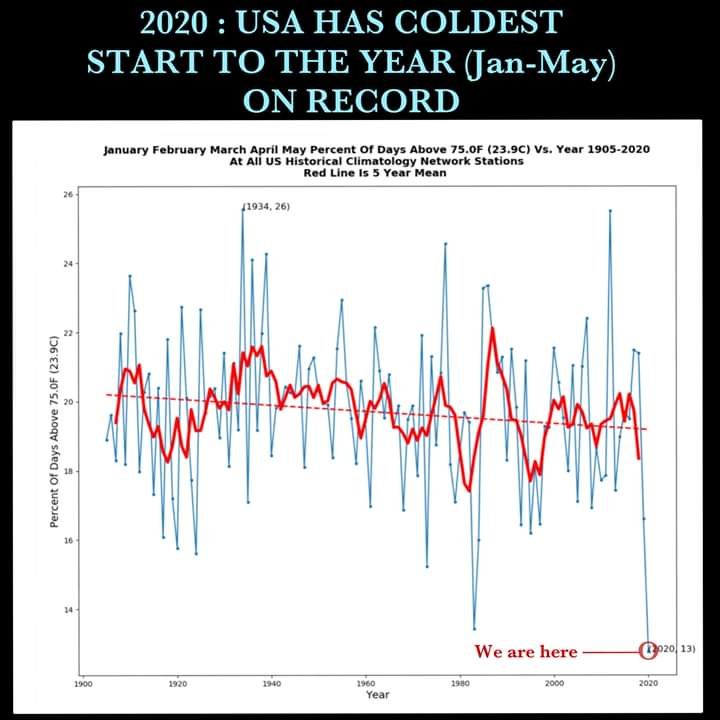
#globalwarming #climateemergency @greenpeaceusa @BernieSanders @SenWarren @Greens @NZGreens @oxfam @AOC
28 May 2020 Leave a comment
in energy economics, environmental economics, global warming Tags: climate alarmists, pessimism bias
Airborne diseases: Tuberculosis in the Union Army
27 May 2020 Leave a comment

by Javier Birchenall (University of California, Santa Barbara)
This is Part F of the Economic History Society’s blog series: ‘The Long View on Epidemics, Disease and Public Health: Research from Economic History’ The full article from this blog was published in ‘Explorations in Economic History’ and is available here
 1910 advertising postcard for the National Association for the Prevention of Tuberculosis.
Tuberculosis (TB) is one of the oldest and deadliest diseases. Traces of TB in humans can be found as early as 9,000 years ago, and written accounts date back 3,300 years in India. Untreated, TB’s case-fatality rate is as high as 50 percent. It was a dreaded disease. TB is an airborne disease caused by the bacteria Mycobacteriumtuberculosis. Tuberculosis spreads through the air when a person who has an active infection coughs, sneezes, speaks, or sings. Most cases remain latent and do not develop symptoms…
View original post 731 more words
Lucien Carrier: The Problems with Institutional Reform in Fragmented Political Landscapes
27 May 2020 Leave a comment

 Clearly, liberal democracy is at a crossroad. Many are dissatisfied with the state of political affairs in their national countries. The news is filled with stories of uprisings in Chile or Bolivia, riots in Hong Kong or Paris, or mass movements in Catalonia or England. People take up the streets for the cause they believe in, may it be climate change, global inequality and poverty, national identity, political corruption and so on… All these various social movements share a common belief that the current democratic arrangements do not work. As most recent elections in Western democracies have shown, the political landscape is fragmented at an unprecedented scale. In France’s 2017 presidential elections, four candidates each obtained roughly one fifth of the total votes. In Spain, after four elections in as many years, no party is yet again able to claim an absolute majority in the lower Chamber…
View original post 1,535 more words
Green-Left Furious at Michael Moore For Exposing Renewable Energy As Complete Fraud
27 May 2020 Leave a comment


There is a particular delight in watching the hard-green-left tear each other apart, which is precisely the result of Michael Moore’s Planet of the Humans.
The film – produced by Moore and made by Jeff Gibbs – has been uploaded to YouTube to allow all and sundry to get the message: renewable energy is the greatest economic and environmental fraud of all time. STT first covered it here: Blood & Gore: Mike Moore’s ‘Planet of The Humans’ Unmasks The Power & Money Behind Renewables Scam
Characters like James Delingpole have spent the last decade attacking heavily subsidised and hopelessly unreliable wind and solar, as the result of crony capitalism gone mad. Tackling the cynical profiteers and pointing to the pointlessness of sources that are entirely dependent upon the weather and time of day, Delingpole has been a bugbear to renewable energy rent seekers and climate cultists, alike.
For his troubles he’s…
View original post 983 more words
Pacific Island states will not longer play the patsies for the climate alarmists
27 May 2020 Leave a comment
The Fiji Hotel and Tourism Association (FHTA) says a staggering 279 hotels and resorts have closed, with over 40,000 tourism workers either laid off or sent on leave without pay. And unlike Australia, Fiji doesn’t have a JobKeeper scheme to fall back on.
Interview of Joshua Angrist: On charter schools, the elite illusion, and the “Stones Age” of econometrics
27 May 2020 Leave a comment

Nice interview of Prof Joshua Angrist of MIT:
As a teenager growing up in Pittsburgh, Joshua Angrist became fed up with high school and said his goodbyes to it after his junior year. Today, at the Massachusetts Institute of Technology, he’s a top researcher in labor economics and the economics of education — with work that includes a series of famed studies of policy choices for K-12 schooling.
Much of his work has been based on ingenious “natural experiments,” that is, episodes in which two or more groups of people were randomly exposed to different policies or different experiences. Such occurrences are an opportunity for Angrist and his co-authors to use the tools of econometrics to assess the effects of those differences — whether that’s a large classroom versus a small classroom or education at a charter school versus education at a conventional public school.
Angrist’s first natural experiment looked at…
View original post 1,003 more words
THE BOMB I
27 May 2020 Leave a comment
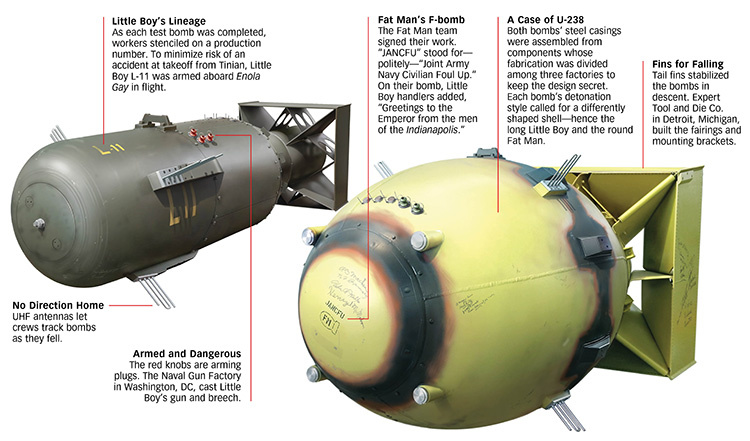
The curious thing about the appointment of Robert Oppenheimer was he had no previous management experience. But the best thing about him was he was smarten enough to understand what was going on in all the research and who was smart but it wasn’t so smart that his work was required on research.


BUILDING THE BOMB
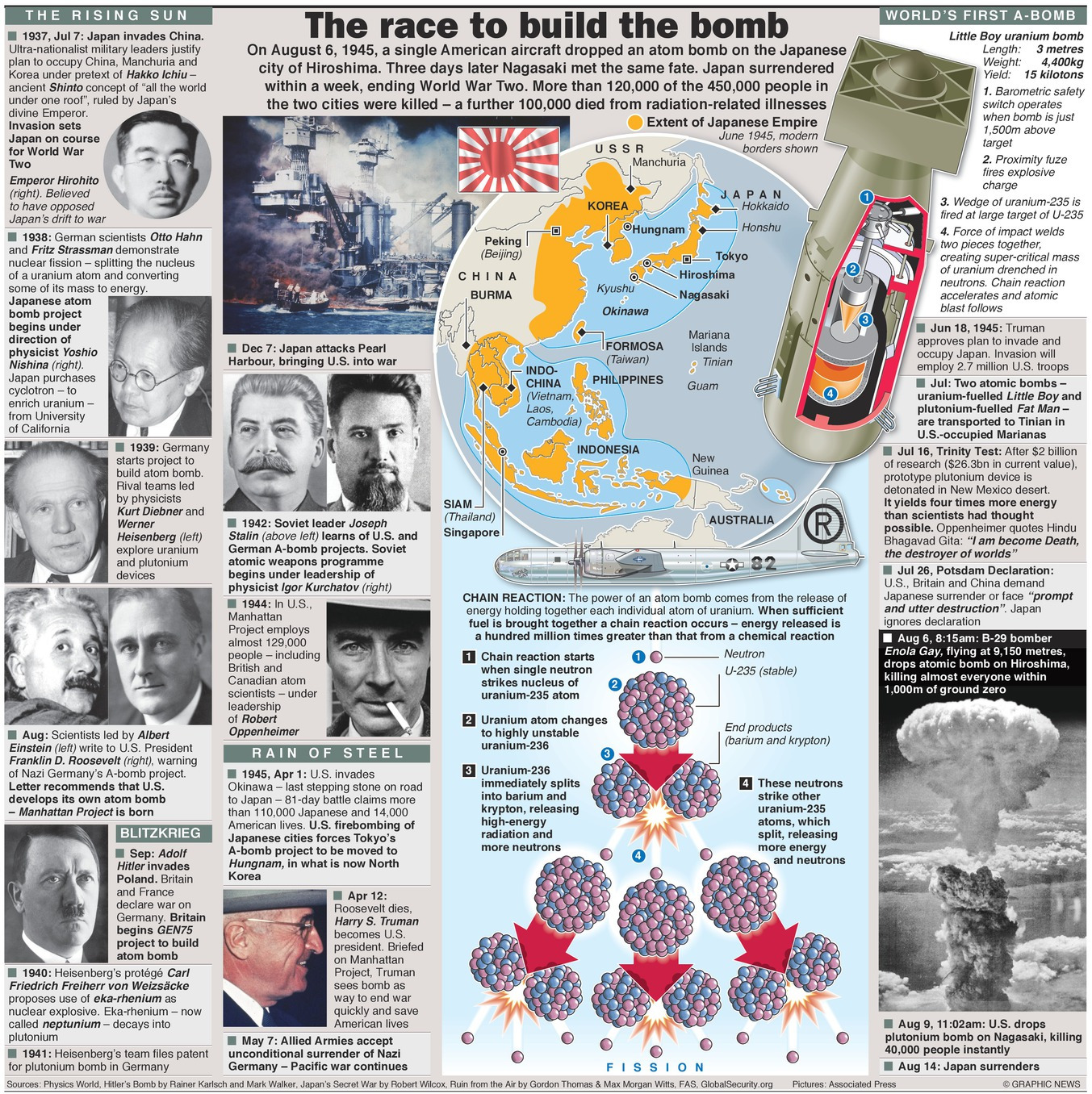
Albert Einstein signed the letter. Years later he would regret it, calling it the one mistake he had made in his life. But in August 1939, Adolf Hitler’s armies already occupied Czechoslovakia and Austria and his fascist thugs were arresting Jews and political opponents throughout the Third Reich. Signing the letter seemed vital. His friends and fellow physicists, Leo Szilard and Eugene Wigner, had drafted the note he would now send to President Franklin D. Roosevelt.
The scientists had seen their excitement over the recent breakthrough discoveries of the deepest secrets of the atom turn to fear as they realized what unleashing atomic energies could mean. Now the danger could not be denied. The Nazis might be working on a super-weapon; they had to be stopped.
In his famous letter, Einstein warned Roosevelt that in the immediate future, based on new work by Szilard and the Italian…
View original post 1,776 more words
The Atomic Bomb – WWII Axis and Soviet
27 May 2020 Leave a comment
Nazi Germany
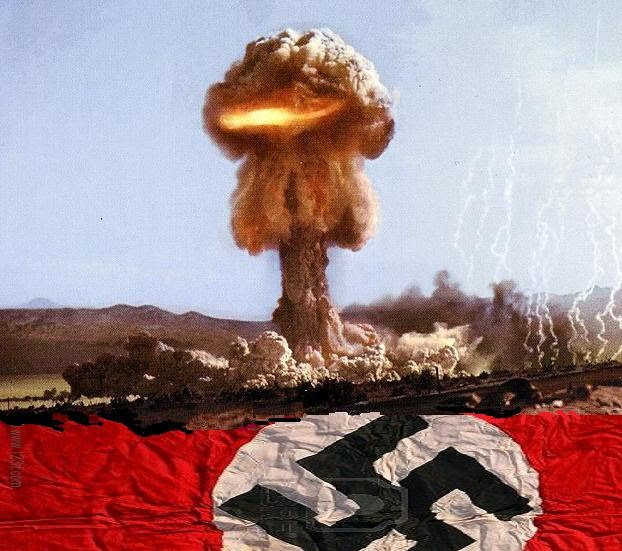
In 1938 Otto Hahn, a German chemist, was the first to succeeded in breaking up (fissioning) a uranium atom into lighter, atomically speaking, elements by bombarding it with neutrons. At the time, the idea seemed preposterous, even to him, and he doubted his own test results, but after overcoming his reservations he published it in a scientific journal. It was soon realized that this process could yield enormous amounts of energy. Leo Szilard, a physicist of Hungarian descent, already considered this possibility while staying in London in 1933. Hahn’s discovery, however, clinched the argument for Szilard, now working in the United States, and he was horrified by the possibility that Nazi Germany could develop such a bomb. He then convinced Albert Einstein to approach President Roosevelt to initiate an American atomic research program.
The American scientists were sure from the start that they were in a race against…
View original post 2,848 more words
Soviet-German Cooperation
27 May 2020 Leave a comment
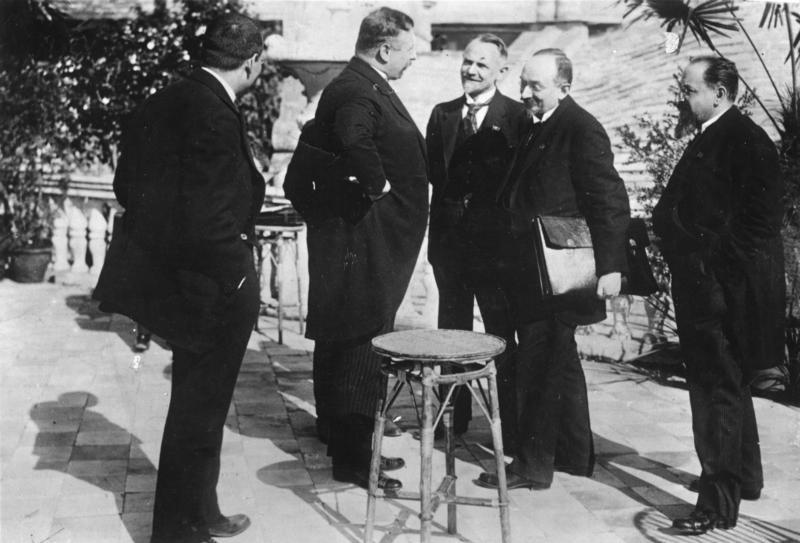
Chancellor of Germany Joseph Wirth (2.from left) with Krassin, Georgi Chicherin and Joffe from the Russian delegation.
The Rapallo Accord
In April 1922, long before Hitler and the Nazis, another treaty was signed between the Soviet Union and the Weimar Republic in which both countries gave up any territorial and financial claims against each other. The treaty also contained several secret clauses that dealt with cooperation in the fields of armor, military aviation, and gas warfare. Both countries were to benefit from this arrangement. Germany had the capability to develop these fields on its own, but it was impossible to do this in Germany itself, under the nose of the observant Versailles Treaty’s overseeing committee. The Soviet Union was remote enough for this purpose, and anyway there were no foreign forces on its land to report what really went on. Among other things, German engineers worked in the Soviet Union…
View original post 2,203 more words
Confusing Urgent with Important
27 May 2020 Leave a comment

 One of the things we learned in organizational science was that managers are prone to focus attention and resources on urgent situations at the expense of more serious threats to viability. Thus the aphorism: “When you are up to your ass in alligators it’s difficult to remember that your initial objective was to drain the swamp”. Many times we consultants saw clients working hard to put out fires (complaints, delays, etc.) while obvious to strategic weaknesses eroding their ability to compete with rivals. One memorable client responded to our product profitabilty analysis showing why they were losing money, “I can’t drop that product, it’s our best seller!”
All this by way of introduction to an article at Real Clear Politics Miscalculating Risk: Confusing Scary With Dangerous In this case the subject is evaluating risks, but the mistake can also be made regarding opportunities. Excerpts in italics with my bolds.
View original post 934 more words
The Great Enrichment
27 May 2020 1 Comment
in economic history Tags: creative destruction, The Great Enrichment


Recent Comments