Free To Choose in Under 2 Minutes Episode 2 – The Tyranny of Control
22 May 2020 Leave a comment
in Adam Smith, applied price theory, applied welfare economics, comparative institutional analysis, constitutional political economy, development economics, economic history, economics of religion, entrepreneurship, growth disasters, growth miracles, income redistribution, industrial organisation, international economics, labour economics, labour supply, law and economics, Milton Friedman, property rights, Public Choice, public economics, rentseeking, survivor principle, television Tags: capitalism and freedom, India, Japan
What English does – but most languages can’t
22 May 2020 Leave a comment
in economics of education, economics of media and culture Tags: economics of languages
Snow Job: Giant Pumped Hydro Scheme Set to Destroy Australia’s Favourite National Park
22 May 2020 Leave a comment


Future generations will wonder why this one destroyed the planet, while claiming to save it, using completely useless industrial wind turbines and solar panels.
Whether it’s dumping hundreds of thousands of toxic solar panels and windmill blades into landfill, or the toxic lakes in China where the rare earths are processed that make them, the so-called ‘green’ energy revolution is anything but.
Touted by ex-PM Malcom Turnbull and his hapless sidekick, Josh Frydenberg as the Nation’s mega-battery, the heavily-hyped Snowy 2.0 pumped hydro scheme (shelved in the 1970s because it was uneconomic then) has been heralded as the saviour for the Australian wind industry.
The line goes something like this: if we use 3 MWh of wind power to pump water through 27 km of tunnels, over an elevation of 900m, later, when power consumers actually need it, Snowy Hydro could return 2 MWh to the grid.
Never mind…
View original post 1,317 more words
#globalwarming already on a low base despite a decade of #climateemergency alarmism @Greens @NZGreens @AOC @greenpeaceusa @BernieSanders @SenWarren @oxfam
21 May 2020 Leave a comment
in energy economics, environmental economics, global warming, health economics, Marxist economics, politics - USA Tags: climate alarmists, economics of pandemics

Justice Thomas on affirmative action
21 May 2020 Leave a comment
in discrimination, economics of education, law and economics, politics - USA, Public Choice

SNOWFALL Will Signal The Death Of The Global Warming Movement
21 May 2020 Leave a comment

 BREAKING : ‘A Very Rare And Exciting Event’ To The Rescue | Climatism
SNOWFALL will become “A very rare and exciting event…
Children just aren’t going to know what snow is.”
Dr David Viner – Senior scientist, climatic research unit (CRU)
“Winters with strong frosts and lots of snow
like we had 20 years ago will no longer exist at our latitudes.”
– Professor Mojib Latif (2000)
“Good bye winter. Never again snow?” – Spiegel (2000)
“Milder winter temperatures will decrease heavy snowstorms” – IPCC (2001)
“End of Snow?” – NYTimes (2014)
***
WE all associate snowstorms with cold weather. But, the effects of snow on our climate and weather last long after the storm has passed. Due to snows reflective properties, its presence or absence influences patterns of heating and cooling over Earth’s surface more than any other single land surface feature.
CLIMATE models from the 1970s have consistently predicted…
View original post 4,114 more words
The rise and fall of global trade: from the Romans to coronavirus
21 May 2020 Leave a comment
in economic history, international economic law, international economics, International law Tags: globalisation
OMV Taranaki wins consents (but with robust conditions) to take vital step for NZ’s energy industry
21 May 2020 Leave a comment

Oil and gas company OMV Taranaki has won consents to undertake the drilling of up to 10 exploration and appraisal wells, as well as the associated discharges, within its petroleum exploration permit in the Maui Field in the Taranaki Basin.
This is seen as a vital step for the energy industry in NZ, because reserves of oil and gas could run out within 11 years at present rates of consumption. And with the economy under the whip, any extension of those reserves would come as a welcome fillip.
OMV will be aiming to build on its success in the last drilling season with its wildcat well Toutouwai-1, 50km off the Taranaki coast, penetrating several layers of hydrocarbons. Because of the Covid-19 pandemic it had to withdraw from further work proving up the Toutouwai discovery.
View original post 403 more words
Free To Choose in Under 2 Minutes Episode 1 – The Power of the Market
21 May 2020 Leave a comment
in applied price theory, applied welfare economics, comparative institutional analysis, constitutional political economy, development economics, economic history, economics of regulation, entrepreneurship, financial economics, growth miracles, history of economic thought, industrial organisation, international economics, labour economics, labour supply, law and economics, Milton Friedman, occupational choice, poverty and inequality, property rights, Public Choice, public economics, survivor principle, television Tags: capitalism and freedom


Situation Critical: Massive Wind Power Collapses Threaten Australia’s Entire Eastern Power Grid
20 May 2020 Leave a comment
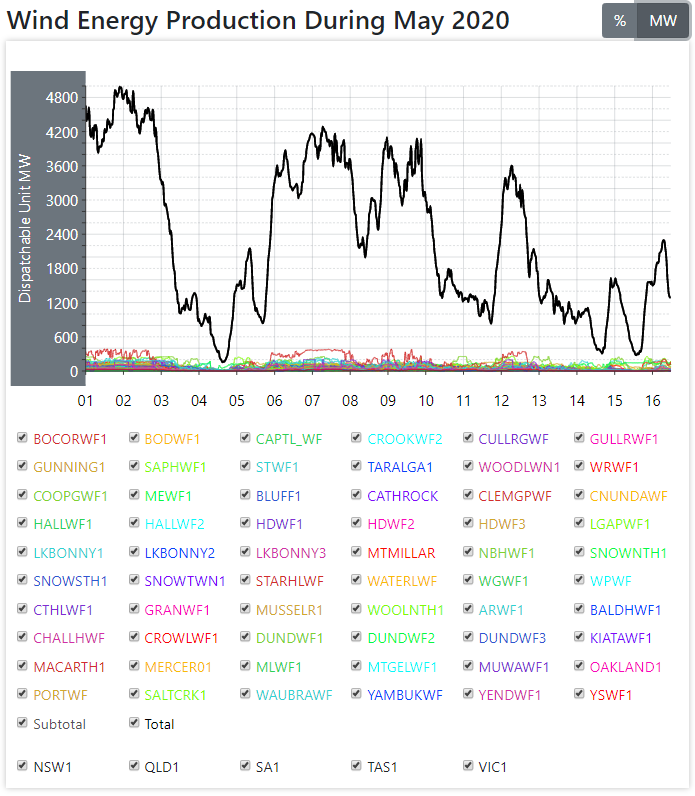
Wind power is the joke where the punchline is a mixture of rocketing power prices and a grid on the brink of collapse. None of which is particularly funny for those suffering from one and threatened by the other. As to the latter, this country’s maniacal obsession with heavily subsidised and chaotically intermittent wind and solar has Australia at ‘situation critical’.
Depicted above – courtesy of Aneroid Energy – is the output delivered by Australian wind power outfits to the Eastern Grid so far this month.
Spread from Far North Queensland, across the ranges of NSW, all over Victoria, Northern Tasmania and across South Australia its entire capacity routinely delivers just a trickle of its combined notional capacity of 7,295MW.
Collapses of over 3,000 MW or more that occur over the space of a couple of hours are routine, as are rapid surges of equal magnitude, which make the grid…
View original post 2,086 more words
Cabinet reshuffles and ministerial by-elections in the 19th century
20 May 2020 Leave a comment
Winston Churchill was famously rejected by the electors of North-West Manchester when he was appointed as President of the Board of Trade in 1908, before being found a suitable berth at Dundee. He was certainly not the first high profile casualty of a ministerial by-election.
Lord John Russell, the new Home Secretary (and future Prime Minister), was defeated at South Devon in May 1835. William Gladstone, appointed as Colonial Secretary, abandoned his candidature for Newark in irritation after a protectionist opponent came forward in January 1846, and although his name was subsequently linked with numerous other constituencies, he remained out of the Commons until the next general election in 1847.

Following last week’s Cabinet reshuffle, several ministers will be getting to grips with the challenges of their new departments. However, unlike the nineteenth century, they are at least spared the extra burden of seeking renewed endorsement from their constituents. Under a law passed in the reign of Queen Anne (1707), anyone accepting ‘an office of profit under the Crown’ – which included not only ministerial posts, but also a wide range of lesser positions – had to vacate his parliamentary seat and seek re-election. Those moving between offices also faced a by-election. In 1859 Thomas Milner Gibson had to stand twice in quick succession for Ashton-under-Lyne: on 27 June, after being appointed as president of the Poor Law Board, and then again on 9 July after being moved to the presidency of the Board of Trade. Ministerial by-elections made up more than a quarter of all by-elections taking place between…
View original post 467 more words
Unequal Pay: For Women Only – Part One.
20 May 2020 Leave a comment

American women who work for wages or a salary, on the average, earn 77 cents when American men earn one (1) dollar, also on the average.
You have to be careful of averages. They are not naturally vicious but they are often used to deceive. That is, people routinely overestimate themselves and don’t slow down enough to understand what they are seeing and hearing when an average is mentioned.
Here is a little practice exercise: Suppose all women who lack education beyond high school quit work completely. (They might go on welfare or they might find hard working husbands, maybe currently illegal immigrants – Not a bad idea actually, if I say so myself!) If this happened, what would become to the 77 cents on the dollar?
(The answer is several paragraphs below.)
Consider also that “on the average” means, of course, that there are many women who earn more…
View original post 1,737 more words


Recent Comments