Polish-Soviet War – First Phase 1919 – May 1920 I THE GREAT WAR 1920
17 May 2020 Leave a comment
in defence economics, war and peace Tags: World War I
Richard Epstein, “A History of Public Utility Regulation in the Supreme Court”
17 May 2020 Leave a comment
in applied price theory, applied welfare economics, Austrian economics, comparative institutional analysis, economic history, economics of information, economics of regulation, history of economic thought, industrial organisation, law and economics, Public Choice, Richard Epstein Tags: competition law, network industries
How The Ancient Greeks Proved Earth Wasn’t Flat 2,200 Years Ago
17 May 2020 Leave a comment
in economics of media and culture

Alfred Marshall (1885) on the socialists of his time
16 May 2020 Leave a comment
in Alfred Marshall, history of economic thought, Marxist economics

Thomas Sowell summarises his Conflict of Visions book
16 May 2020 Leave a comment
in comparative institutional analysis, Thomas Sowell

Diseases are often named after their place of origin
16 May 2020 Leave a comment
in health economics Tags: anti-vaccination movement, vaccines

Marshall’s Laws and The Grapes of Wrath – Chicago Price Theory
16 May 2020 Leave a comment
in Alfred Marshall, applied price theory, health and safety, history of economic thought, labour economics, labour supply, occupational choice Tags: compensating differences
Blasphemy at the Old Bailey (BBC TV, 1977). A brilliant reenactment of the Gay News trial
16 May 2020 Leave a comment
in economics of crime, economics of religion, law and economics, television Tags: free speech
The Great Geomagnetic Storm of May 1921
16 May 2020 Leave a comment

May 12, 2020: 99 years ago this week, people around the world woke up to some unusual headlines.
“Telegraph Service Prostrated, Comet Not to Blame” — declared the Los Angeles Times on May 15, 1921. “Electrical Disturbance is ‘Worst Ever Known'” — reported the Chicago Daily Tribune. “Sunspot credited with Rail Tie-up” — deadpanned the New York Times.

They didn’t know it at the time, but those newspapers were covering the biggest solar storm of the 20th Century. Nothing quite like it has happened since.
It began on May 12, 1921 when giant sunspot AR1842, crossing the sun during the declining phase of Solar Cycle 15, began to flare. One explosion after another hurled coronal mass ejections (CMEs) directly toward Earth. For the next 3 days, CMEs rocked Earth’s magnetic field. Scientists around the world were surprised when their magnetometers suddenly went offscale, pens in strip chart recorders pegged uselessly…
View original post 607 more words
Media Turn Math Dopes into Dupes
16 May 2020 Leave a comment


Those who have investigated global warming/climate change discovered that the numbers don’t add up. But if you don’t do the math you wouldn’t know that, because in the details is found the truth (the devilish contradictions to sweeping claims). Those without numerical literacy (including apparently most journalists) are at the mercy of the loudest advocates. Social policy then becomes a matter of going along with herd popularity. Shout out to AOC!
Now we get the additional revelation regarding pandemic math and the refusal to correct over-the-top predictions. It’s the same dynamic but accelerated by the more immediate failure of models to forecast contagious reality. Sean Trende writes at Real Clear Politics The Costly Failure to Update Sky-Is-Falling Predictions. Excerpts in italics with my bolds.
On March 6, Liz Specht, Ph.D., posted a thread on Twitter that immediately went viral. As of this writing, it has received over 100,000…
View original post 2,131 more words
SIR FRANCIS DRAKE AND THE SPANISH ARMADA – 1588
16 May 2020 Leave a comment


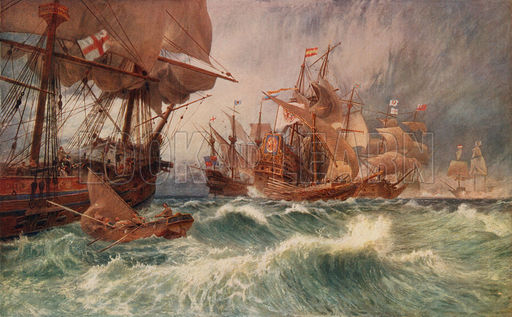
In England his name described a malewaterfowl that might be seen bobbing placidly on the village pond — but in Spanish the drake became a dragon. El Draque was a name with which to frighten naughty children, a fire-breathing monster whose steely, glittering scales ‘remained impregnable’, wrote the sixteenth-century dramatist Lope de Vega, ‘to all the spears and all the darts of Spain’.
By the 1580s, Francis Drake’s reputation provoked panic in the seaports of Spain and in its New World colonies. In a series of daring raids, the rotund Devon-born pirate had pillaged Spanish harbours, looted Catholic churches and hijacked King Philip’s silver bullion as it travelled from the mines of the Andes to the Spanish treasury in Seville. In his most famous exploit, during 1577-80, Drake had sailed round the world claiming California for Queen Elizabeth and arriving home laden with treasure. No wonder she knighted him —…
View original post 980 more words
#OTD #COVID19
16 May 2020 Leave a comment
in health economics, politics - Australia, politics - New Zealand Tags: economics of pandemics


Recent Comments