In our textbook, Modern Principles, Tyler and I write: Imagine how difficult it would be to get a date if every date required marriage? In the same way, it’s more difficult to find a job when every job requires a long-term commitment from the employer. In two new excellent pieces, Brian Albrecht and Pieter Garicano…
The Hidden Cost of Hard-to-Fire Labor Laws: Why European Firms Don’t Take Risks
The Hidden Cost of Hard-to-Fire Labor Laws: Why European Firms Don’t Take Risks
08 Mar 2026 Leave a comment
in applied price theory, economics of bureaucracy, economics of regulation, entrepreneurship, labour economics, law and economics, managerial economics, organisational economics, personnel economics, property rights, Public Choice, theory of the firm, unemployment Tags: creative destruction, employment law, European Union, Germany
Changes in the Gender Wage Gap for Business Professionals
14 Feb 2026 1 Comment
in applied price theory, discrimination, economics of education, gender, human capital, labour economics, labour supply, managerial economics, occupational choice, organisational economics, personnel economics Tags: gender wage gap
In the United States, much of the gap in earnings between men and women is due to the persistent gap for high wage earners. This paper explores changes in the gender wage gap for MBAs graduating from a large public university over 30 years. We document large gender wage gaps on average, which grow in…
Changes in the Gender Wage Gap for Business Professionals
If this is employment law, the law needs to change
22 Nov 2025 Leave a comment
in economics of regulation, industrial organisation, labour economics, labour supply, law and economics, managerial economics, occupational choice, organisational economics, personnel economics, politics - New Zealand, property rights, Public Choice, transport economics, urban economics Tags: employment law
Eric Crampton writes – Yesterday [November 17], the Supreme Court ruled that Uber did not merely facilitate connections between four drivers and their various passengers – as Uber has maintained. And that the four drivers were not contractors for Uber either. Instead, those drivers were Uber employees while logged into the app.
If this is employment law, the law needs to change
What Do Managers Do?
26 Sep 2025 1 Comment
in applied price theory, managerial economics, organisational economics, personnel economics
Economists have been thinking for a long time about the operation of buying and selling in markets. However, they have traditionally spent less time studying what happens inside a firm–a setting in which forces of supply and demand are replaced by managerial decision-making. Anyone who has had both a good boss and bad boss knows…
What Do Managers Do?
The evolution of the economics job market
24 Sep 2025 Leave a comment
in economics of education, human capital, labour economics, labour supply, managerial economics, occupational choice, organisational economics, personnel economics
In the halcyon days of 2015-19, openings on the economics job market hovered at around 1900 per year. In 2020, Covid was a major shock, but the market bounced back quickly in 2021 and 2022. Since then, though, the market has clearly been in a funk. 2023, my job market year, saw a sudden dip […]
The evolution of the economics job market
A labour law reform that works for workers
14 Sep 2025 Leave a comment
in economics of regulation, labour economics, labour supply, law and economics, personnel economics, politics - New Zealand, property rights Tags: employment law
Roger Partridge writes – Every day, New Zealand workers clock longer hours than their peers in most developed nations yet produce far less value per hour worked. This productivity paradox has haunted our economy for decades, condemning workers to lower wages and longer working days. Now, Parliament has a chance to help change this cycle. […]
A labour law reform that works for workers
EPA Suspends over 140 Toxic Employees Who Wrote Letter Denouncing Trump Policies
09 Jul 2025 1 Comment
in economics of bureaucracy, economics of climate change, energy economics, environmental economics, environmentalism, global warming, labour economics, labour supply, occupational choice, personnel economics, politics - USA, Public Choice

The best part of this story is two fold. First, these individuals have done a good job of self-identif[ying] themselves as fifth columnists inside the Trump administration, making it easier to get rid of them.
EPA Suspends over 140 Toxic Employees Who Wrote Letter Denouncing Trump Policies
Same goes for performance management
05 Jul 2025 Leave a comment
in labour economics, labour supply, managerial economics, organisational economics, personnel economics
Massive Rent-Seeking in India’s Government Job Examination System
03 Jul 2025 1 Comment
in applied price theory, development economics, economics of bureaucracy, economics of education, growth disasters, growth miracles, labour economics, occupational choice, personnel economics, Public Choice Tags: India
In India, government jobs pay far more than equivalent jobs in the private sector–so much so that the entire labor market and educational system have become grossly distorted by rent seeking to obtain these jobs. Teachers in the public sector, for example, are paid at least five times more than in the private sector. It’s […]
Massive Rent-Seeking in India’s Government Job Examination System
Bosses Don’t Need a ‘What Did You Do’ Email. They’re Already Tracking You. (and how this might be related to Keynes’ theory of sticky wages)
27 Mar 2025 Leave a comment
in applied price theory, human capital, labour economics, labour supply, law and economics, macroeconomics, managerial economics, monetary economics, organisational economics, personnel economics, property rights, unemployment Tags: efficiency wage, wage rigidity
Elon Musk’s email to federal employees prompted angst, but lots of employers use technology for continuous feedback on worker performanceBy Natasha Khan and Ray A. Smith. Excerpts:”What did you do last week?The question that Elon Musk lobbed to federal workers in an email set off anger and angst from unions and employees. It also prompted…
Bosses Don’t Need a ‘What Did You Do’ Email. They’re Already Tracking You. (and how this might be related to Keynes’ theory of sticky wages)
A negative productivity shock from working from home
08 Feb 2025 Leave a comment
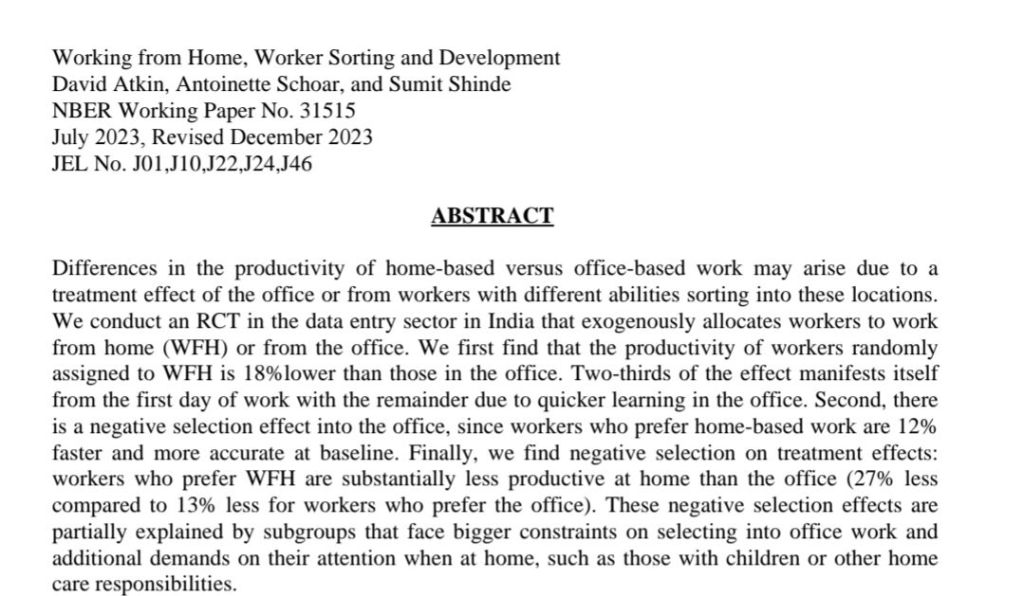
in applied price theory, experimental economics, industrial organisation, labour economics, labour supply, managerial economics, occupational choice, organisational economics, personnel economics Tags: economics of pandemics
More on Business Dynamism
11 Dec 2024 Leave a comment
in applied price theory, economic history, economics of bureaucracy, economics of regulation, entrepreneurship, financial economics, income redistribution, industrial organisation, labour economics, labour supply, managerial economics, organisational economics, personnel economics, Public Choice, rentseeking, survivor principle, theory of the firm Tags: creative destruction, employment law
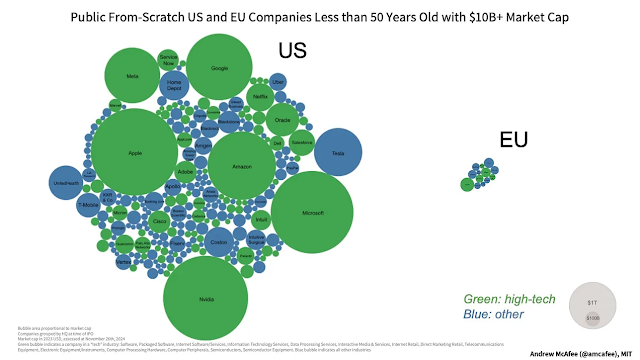
Over at the Geek Way, Andrew McAfee has created a startling visualization related to entrepreneurship in the US and EU. The Draghi Report on EU competitiveness is generating a small buzz among economists. One startling claim is thatthere is no EU company with a market capitalisation over EUR 100 billion that has been set up…
More on Business Dynamism
Creative destruction again
28 Sep 2024 Leave a comment
in applied price theory, industrial organisation, labour economics, labour supply, managerial economics, occupational choice, organisational economics, personnel economics Tags: creative destruction, economics of pandemics
Employers are reluctant to admit workers work because they are paid wages
09 Sep 2024 Leave a comment
in applied price theory, labour economics, labour supply, managerial economics, organisational economics, personnel economics

https://www.facebook.com/groups/774813624767808/permalink/829599789289191/?ref=share&mibextid=NSMWBT
Why Top CEOs Earn Big Paychecks
22 Aug 2024 Leave a comment
in applied price theory, economic history, economics of education, entrepreneurship, human capital, industrial organisation, labour economics, labour supply, liberalism, managerial economics, market efficiency, occupational choice, organisational economics, personnel economics, politics - USA, poverty and inequality, survivor principle Tags: CEO pay, superstar wages

CEO compensation at large firms is high, especially in comparison to average worker wages, sparking debates over income inequality. Critics argue that such pay packages are unfair and disproportionate to actual company performance. Proponents contend that high pay reflects productivity and is necessary to attract scarce top talent to large firms. Let’s go to the […]
Why Top CEOs Earn Big Paychecks
 Utopia, you are standing in it!
Recent Comments