Labour productivity growth in the New Zealand retail services confounds Baumol’s cost disease
17 Dec 2015 Leave a comment
in applied price theory, economic history, industrial organisation, managerial economics, market efficiency, organisational economics, personnel economics, politics - New Zealand, survivor principle Tags: Baumol's disease, labour productivity
The average age of managers as a cause of the 1970s productivity slowdown
16 Dec 2015 Leave a comment
in applied price theory, business cycles, labour economics, labour supply, macroeconomics, occupational choice, personnel economics, theory of the firm
Jim Feyrer put forward a clever hypothesis about the sudden decline in the average quality of managers as a major contributor to the 1970s productivity slowdown. His hypothesis is a good contribution to real business cycle theory because what could be more random a shock than a demographic shock arising from the baby boom.
Feyrer’s hypothesis builds on Robert Lucas’s theory of the entrepreneur and the optimal size of the firm. The better entrepreneurs can manage larger spans of control.
Specifically, these more talented entrepreneurs can spread their skills and vision over a larger workforce thereby raising its productivity and that of the firm. Better quality managers are better trainers, better leaders, better problem solvers and better at recruiting and retaining staff.
If managerial skill and talent accumulates with experience, an influx of young workers into the workforce with the influx of the baby boomers into the workforce will lower the average quality of entrepreneurs. This will show up empirically as a decrease in the average age of managers and with that their experience and skills.
With the average age of the labour force lower during the influx of the baby boomers, more marginal managers have to be promoted into managerial positions to supervise younger employees. Lower managerial quality will lower the productivity of the workforce as a whole.
If managerial talent and skill is to have any meaning, a more talented manager should be able to extract greater productivity from the same quality labour force. Lazear points out that
Supervision and management are fundamental in personnel economics and in the theory of the firm… Boss effects are large and significant. Most important, bosses vary substantially in their quality. A very good boss increases the output of the supervised team over that supervised by a very bad boss by about as much as adding one member to the team.
The influx of less able managers in the 1970s, as shown by a five-year reduction in the median age of US managers in the chart below, accounted for 20% of the observed productivity slowdown and resurgence in the 1970s and 1980s according to Feyrer. To fill vacancies, employers had to drop their hiring standards for managers.
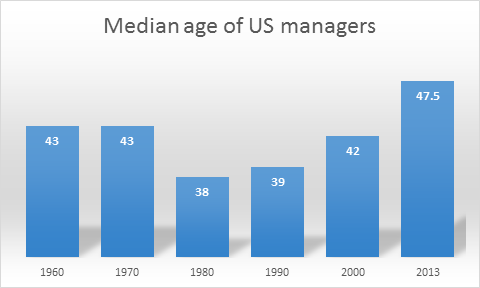
Source: Jim Feyrer The US Productivity Slowdown, the Baby Boom, and Management Quality, Journal of Population Economics (2011) and Bureau of Labor Statistics Employed persons by detailed occupation and age (2013).
When the median age of managers rose in the 1990s, and along with it the average of quality of management, this productivity slowdown was reversed. Both the increase in the decrease in the age of managers are random productivity shocks in the tradition of real business cycle theory.
The average age of the US manager was 38 in 1980 and 39 in 1990. There is no US managerial occupation with an average age of less than 40 in 2013. The fifth managerial occupation with the lowest managing age is food service managers. The highest outside of agriculture is chief executives,

Source: Bureau of Labour Statistics Employed persons by detailed occupation and age (2013).
One of the mocking tones directed at real business cycle theory is it was supposed to require a regular forgetting of technologies so that productivity fell and then the loss technologies were remembered a few years later to have a business cycle.
That forgetting and remembering is what happened with the average age of managers and labour productivity in the 1970s. Management quickly lost five years of experience then slowly regained it with matching productivity swings and roundabouts.
Feyrer is another addition to a long line showing that business cycles can arise from the sum of random shocks, rather than one big shock, as Prescott suggested in 1986:
Another Summers question is, Where are the technology shocks? Apparently, he wants some identifiable shock to account for each of the half dozen postwar recessions. But our finding is not that infrequent large shocks produce fluctuations; it is, rather, that small shocks do, every period.
Are CEOs denied their labour surplus?
11 Dec 2015 Leave a comment
in applied price theory, entrepreneurship, fisheries economics, human capital, industrial organisation, labour economics, labour supply, managerial economics, occupational choice, organisational economics, personnel economics, survivor principle Tags: CEO pay, moral hazard, promotion tournaments, superstar, superstar wages
Bang Dang Nguyen and Kasper Meisner Nielsen looked at how share prices reacted to 149 cases of the chief executive or another prominent manager dying suddenly in American companies between 1991 and 2008.
If the shares rise on an executive’s death, he was overpaid; if they fall, he was not. Only 42% of the bosses studied were overpaid. Those with the bigger pay packages gave the best value for money as measured by the share-price slump when they passed away unexpectedly.
Share prices do speak to the value of the company and the contribution of its CEO. The share price of Apple went up and down by billions on the back of rumours about the health of Steve Jobs.
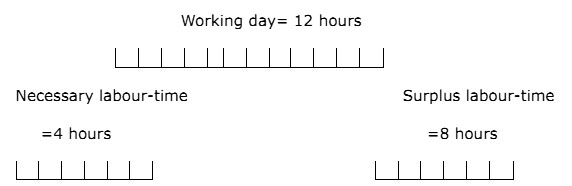
In terms of splitting of what some call the labour surplus increase from a firm hiring an executive, these employees retain on average about 71% and their employer keeps 29%. Others call this rent sharing.

71% going to the CEO might initially sound high, “but it’s not like he’s taking home more than he produced for the company,” says Nguyen.

The exploitation of CEOs gets worse when you consider the extensive use of promotion tournaments by their employers when setting their wages. They are thrust into rat races. Promotion tournaments are an integral and often invisible part of their workplaces.
Executive level employees are often ranked by their employers relative to each other and promoted not for being good at their jobs but for being better than their rivals. These promotion tournaments sent one employee against another – one worker against another – to the profit of the owners of the firm.
The rat race set up by the owners of the firm are so cutthroat that in competitions to determine promotions the capitalists who own the firm may find that their employees discover that the most efficient way of winning a promotion is by sabotaging the efforts of their rivals.
Lazear and Rozen’s tournament theory of executive pay has stood the test of time. The key to this rat race is the larger is your boss’s pay, the bigger the motivation for you as an underling to work for a promotion. As Lazear wrote in his book, Personnel Economics for Managers
The salary of the vice president acts not so much as motivation for the vice president as it does as motivation for the assistant vice presidents.
Are women just too smart to be computer scientists?
08 Dec 2015 Leave a comment
in applied price theory, discrimination, economics of education, gender, human capital, labour economics, managerial economics, occupational choice, organisational economics, personnel economics, politics - Australia, politics - New Zealand, politics - USA Tags: economics of personality traits, gender wage gap, reversing gender gap


Women started drifting away from computer science in the mid-1980s. The interpretation put forward by the professional grievance industry, that is, by National Public Radio in the USA is:
The share of women in computer science started falling at roughly the same moment when personal computers started showing up in U.S. homes in significant numbers.
These early personal computers weren’t much more than toys. You could play pong or simple shooting games, maybe do some word processing.
And these toys were marketed almost entirely to men and boys. This idea that computers are for boys became a narrative. It became the story we told ourselves about the computing revolution. It helped define who geeks were, and it created techie culture.
 Source: NPR
Another interpretation is there are systematic differences between teenage boys and teenage girls in verbal and written skills. Young women moved away from enrolling in computer…
View original post 224 more words
The role of the six-day working week in Japanese sexism and the gender wage gap
02 Dec 2015 Leave a comment
in applied price theory, discrimination, economic history, economics, economics of love and marriage, gender, human capital, labour economics, occupational choice, personnel economics Tags: asymmetric marriage premium, compensating differentials, entrepreneurial alertness, gender wage gap, marital division of labour
When I was studying in Japan, they were at the end of phasing out working on Saturdays. The staff at my university work on Saturday mornings for four hours and then went home.
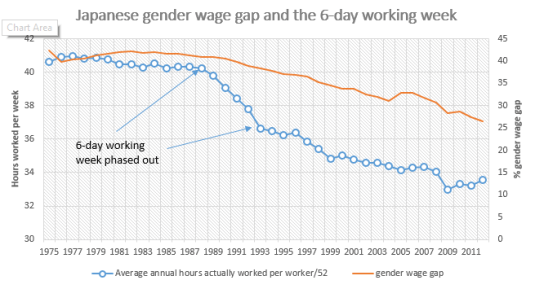
The Japanese working week was reduced by law from 48 to 44 hours per week in 1988 and to 40 hours per week from 1993 (Prescott 1999; Hayashi and Prescott 2002). The Japanese stopped routinely working on Saturdays over the 1990s. The number of national holidays was increased by three and an extra day of annual leave was also prescribed by law.
While feuding with strangers on an unrelated matter about the gender wage gap, it somehow occurred to me that the six-day working week might have something to do with what is on the face of a large amount of sexism in Japan and a large gender wage gap.
That feud with strangers was about unconscious bias as a driver of the gender wage gap in New Zealand. The gender wage gap Japan is attributed to conscious prejudice.
Source: OECD Stat.
In the above chart I have plotted the average weekly hours worked of Japanese workers and the Japanese gender wage gap. Two things can be noticed from the above chart:
- there is a sharp reduction in the number of hours worked per week by Japanese workers when they stopped working on Saturdays; and
- the gender wage gap started declining after the introduction of a five-day working week in Japan.
In a country where it is standard to work six days a week, the price of motherhood would be much higher than in other countries industrialised countries that phased out the 48-hour week decades previous. The asymmetric marriage premium would also be much higher if one partner to the marriage worked a six-day week while the other looked after the children.
Other drivers of the gender wage gap that arise from human capital specialisation and depreciation and from the differences of a few years in the marrying ages of men and women would be intensified if people worked another day per week. The payoff from a marital division of labour and human capital specialisation where one worked long hours and the other focused on investing in human capital that allow them to care for the children and move in and out of the workforce with less human capital depreciation would be much larger.
Much is made of the distinctiveness of Japanese culture and its sexism. In my time in Japan, the thing I notice most distinctively about Japanese culture was its extraordinary pragmatism and willingness to change rapidly. The Japanese economic miracle was founded on rapid industrialisation, innovation and repeated renewal of human capital. That requires an entrepreneurial spirit and open-mindedness.
Cultural and preference based explanations of the gender wage Including that in Japan underrate the rapid social change in the role of women in the 20th century in all countries in all cultures. As Gary Becker explains:
… major economic and technological changes frequently trump culture in the sense that they induce enormous changes not only in behaviour but also in beliefs. A clear illustration of this is the huge effects of technological change and economic development on behaviour and beliefs regarding many aspects of the family.
Attitudes and behaviour regarding family size, marriage and divorce, care of elderly parents, premarital sex, men and women living together and having children without being married, and gays and lesbians have all undergone profound changes during the past 50 years. Invariably, when countries with very different cultures experienced significant economic growth, women’s education increased greatly, and the number of children in a typical family plummeted from three or more to often much less than two.
A good explanation of this rapid social change is in Timur Kuran’s “Sparks and Prairie Fires: A Theory of Unanticipated Political Revolutions” and “Now Out of Never: The Element of Surprise in the East European Revolution of 1989“.
Kuran suggests that political revolutions and large shifts in political opinion will catch us by surprise again and again because of people’s readiness to conceal their true political preferences under perceived social pressure:
People who come to dislike their government are apt to hide their desire for change as long as the opposition seems weak. Because of the preference falsification, a government that appears unshakeable might see its support crumble following a slight surge in the opposition’s apparent size, caused by events insignificant in and of themselves.
Kuran argues that everyone has a different revolutionary threshold where they reveal their true beliefs, but even one individual shift to opposition leads to many others to come forward and defy the existing order. Small concessions embolden the ground-swell of revolution.
Those ready to oppose social intolerance or who are lukewarm in their intolerance keep their views private until a coincidence of factors gives them the courage to bring their views into the open. They find others share their views and there is a revolutionary bandwagon effect.
Plenty of people have had personal experiences of this in the 1980s and the 1990s when there were rapid changes in social and political attitudes about racism, sexism and gay rights. This includes Japan.
In the case of the Japanese gender wage gap, the move from a six-day to a five-day working week radically changed the asymmetric marriage premium and the payoff from investing in both specialised human capital and in human capital that depreciates quickly when away from work.
This large shift in incentives to work and invest in human capital would embolden a change in social attitudes. This is because the previous views were no longer profitable and many would gain from the change. Others who prefer just to go along with crowd would quickly follow them in to stay in tune with whatever is now popular.
Much of Japanese sexism may be the preference falsification that was low-cost when there was a six-day working week. The move to a five-day working week greatly increased the cost of that sexism and the profits from finding new ways of organising the workplace that better matched motherhood and career in Japan.
Undervalued workers are an untapped business opportunity for more alert entrepreneurs to hire these undervalued workers. In the case of Japan, with a five-day working week, hiring women for jobs that involved considerable investment in firm-specific human capital became more profitable. Previously under a six-day working week it was more profitable to invest in men because they undertook few childcare responsibilities. Under a five-day working week, that payoff matrix favours women more than in the past.
Unconscious bias and the gender wage gap
30 Nov 2015 Leave a comment
in applied price theory, discrimination, gender, labour economics, managerial economics, occupational choice, organisational economics, personnel economics Tags: gender wage gap, preference formation, unconscious bias
How @IainLG @suemoroney @NZPSA argued against zero-hours contract regulation when arguing for a ban
12 Nov 2015 Leave a comment
in job search and matching, labour economics, labour supply, personnel economics, politics - New Zealand, unemployment, welfare reform
I stayed on after my Parliamentary testimony this morning to listen to others. A dozen or more made submissions arguing for more regulation – usually asking that zero hours contracts be outlawed.
I was the only submitter so far who argued against any regulation of zero hours contracts. I was thanked for putting a different perspective at the end of my submission. All members of the committee were very polite and listen to what I had to say.
Inadvertently, of course, Iain Lees-Galloway and Sue Moroney of the Labour Party and several members of the Public Service Association unearthed telling points against the case for regulation of zero hours contracts in the course of the morning in both the submissions and through the Q&A.
The first member of the Public Service Association to present information against zero hours contracts was a home support worker who was a union organiser.
This Public Service Association union organiser said, among many points in a kitchen sink submission, that zero hour contracts would deter people from entering her industry. That’s my point about zero hours contracts:
- Zero hours contracts are a risk to employers when recruiting unless they are packaged within an attractive job offer; and
- Offering a zero hours contracts will deter applicants from accepting a job offer unless there is some compensating factor in that offer.
A second member of the Public Service Association talked about her daughter who was on a zero hours contract in her first job. After a seven-month spell of unemployment, her daughter worked as many shifts as possible to show she was a valued member of her team. Good for her. In low skilled jobs, what employers look for is someone who is friendly and reliable.
Part of that story was about the difficulties of her daughter with the correct payment of her unemployment benefit. Every Friday she has to telephone WINZ to forecast how many hours she expected to work in the following week so her unemployment benefit is correctly calculated for the following paid day.
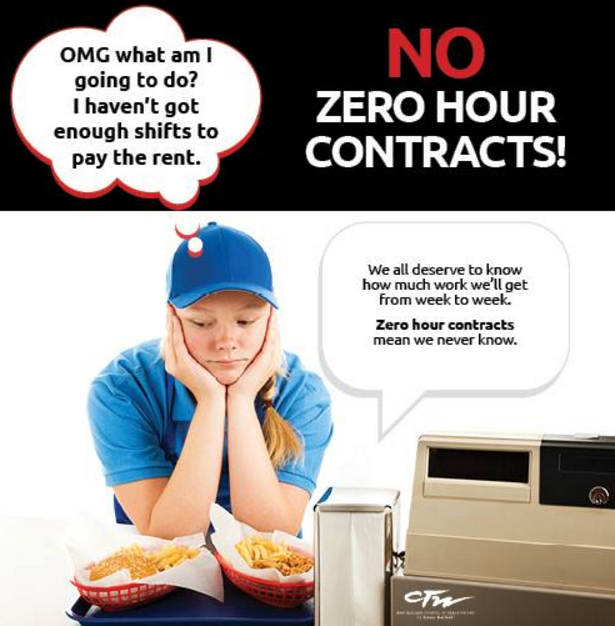
From time to time, the submitter’s daughter was called in at the last minute for a shift on her zero hours contract at the weekend so that estimate of the previous day is incorrect and she is overpaid on her benefit.
This retention of unemployment benefit eligibility is a key point against the arguments raised by Iain Lee-Galloway about how workers and, in particular, the unemployed have no option but to accept zero hours contracts. Galloway was correct in making this the crux of the matter.
He can he kept stressing the inequality of bargaining power and a lack of options of job applicants when questioning me at the hearings this morning.
It was Iain Lees-Galloway who set up this bargaining power inequality as a crucial argument against zero hours contracts, not me. Zero hours contracts are said by the Labour Party and the unions to be a bad deal. It’s an offer job seekers cannot refuse, especially if they’re unemployed.
If beneficiaries do have options and they can refuse an offer of a zero hours contract, as 50% of British unemployment beneficiaries do, most arguments for the regulation or prohibition of zero hours contracts fall of the first hurdle.
The submitter’s daughter was still on an unemployment benefit despite taking a zero hours contract. She had options. She had a basic income, the unemployment benefit, so she was never left in the lurch if there was no shift that week. She never earned less than the unemployment benefit weekend and week out and often earned more.
- No one who already has a job would take a zero hours contracts unless they were confident of matching the hours and income they earn now; and
- An unemployment beneficiary keeps the unemployment benefit as a cushion when they accept a zero hours contract unless they earn more than $200 a week.
The unemployment benefit allows beneficiaries to earn up to $200 a week after which benefit is withdrawn at 50 cents per dollar. As the beneficiary is still on the benefit, they have access to those all-important 2nd tier benefits ranging from accommodation allowances to special grants for unexpected urgent expenses.
Zero hours contracts allow the unemployed to make the benefit pay. Simon Chapple pointed out to me a few years ago that part-time work and benefit receipt can be an attractive long-term option for low skilled workers such as single mothers. The unemployment or single-parent beneficiary who works part-time has the certainty of the unemployment benefit plus a couple hundred dollars extra-week from their part-time job while retaining the second tier benefits that guard against unexpected expenses.
Sue Moroney then finished off the case against regulating zero hours contracts when questioning a submitter from the construction industry. The submitter was discussing the generosity of parental leave as well as zero hours contracts.
Sue Moroney pointed out that because of childcare responsibilities, the ability of that industry to attract women is greatly diminished if they offer zero hours contracts. She was pointing out a major cost of zero hours contracts to employers who offer them.
Sue Moroney highlighted the risk to employers of cutting themselves off from a major part of the job applicant pool – mothers of young children. That is a big cost unless employers offering zero hours contracts either pay a wage premium to keep access to that talent or offer these contracts to teenagers and adults, men and women, who circumstances dispose to working variable hours, sometimes working long hours and sometimes not working at all that week.
Zero hours contracts is an issue about job search and job matching. These contracts will benefit some employers and some employees. Other jobseekers will not sign such contracts. Still others will find that after signing a zero hours contract, that was not the best choice for them in retrospect. That form of on-the-job learning about competing job opportunities is common. Young people spend their first 10 to 15 years in the workforce job shopping. They move through half a dozen or more different jobs, employers and even industries before they find a good fit for them and stay on.
All in all, zero hours contracts empower the unemployed. Zero-hours contracts allow the unemployed to try out jobs while keeping their unemployment or single parent benefit. They don’t have to go completely off the benefit then risk a stand-down period of 6 to 12 weeks if they leave a regular job that is unsatisfactory.
Furthermore, the zero hours contracts give them an opportunity sometimes to earn a lot of money in a short period of time was still retaining their benefit eligibility. As another member of the Public Service Association mentioned when your wages balloon because of long hours one week, your benefit is wound back, but they are still on their benefit. They don’t have to reapply and risk of stand-down period
Zero hours contracts expand the options of jobseekers, especially the unemployed. Taking a zero hours contract gives the unemployed the option to test out a job without having to give up their unemployment benefit. They are empowering, not put upon as the Labour Party and the union members argued today.
Just testified before a parliamentary committee on zero hours contracts
12 Nov 2015 2 Comments
in labour economics, labour supply, managerial economics, occupational choice, organisational economics, personnel economics, politics - New Zealand, unions Tags: compensating differentials, part-time work, zero hour contracts
My submission to the Transport and Industrial Relations Committee today on the Employment Standards Bill is there should be no regulation of zero hours contracts:
- Workers sign these contracts because they are to their net advantage;
-
Always knowing your working hours in advance is known only to about 30% of shift workers; and
-
Workers command a wage premium when they sign zero hours contracts.
The obvious question is why do jobseekers sign a zero hours contract if it is not in their interests? Most of all, why would a worker who already has a job quit to work on a zero hours contract unless it is to their advantage?
If zero hours contracts are oppressive, the only workers hired on them would be the unemployed. Anyone who has a job would refuse such offers. Those unemployed that do sign a zero hours contract would quit as soon as a better offer comes along. 50% of job offers to British welfare beneficiaries to work on a zero hours contract are turned down.
This frequent refusal of zero hours contracts not only suggests there are options for jobseekers including the unemployed but there are costs to employers. The most likely employer response to reduce these costs of rejection is a offer to pay more to sign a zero hours contract. Everyone in this room knows contractors who work in much more than those in regular employment.
Unless labour markets are highly uncompetitive with employers having massive power over employees, employers should have to pay a wage premium if zero-hour contracts are a hassle for workers. It is standard for unusual, irregular or casual work to come with a wage premium. If you want regular hours, fixed hours, that comes at a price – a lower wage per hour.
Zero hours contracts is creative destruction in the labour market. Plenty of new ways of working have emerged in recent years: the proliferation of part-time work, temporary workers, leased workers, working from home, teleworking and contracting. Employment laws rest on the now decaying assumption that workers have long, stable relationships with single employers.
At least a quarter of a million New Zealanders already work shifts often with little notice of changes. Work schedules are always known in advance only to 31% of temporary, seasonal and casual employees. Another quarter of these have about two weeks or more notice of shifts. Hundreds of thousands of New Zealand workers freely sign on for variable hours.
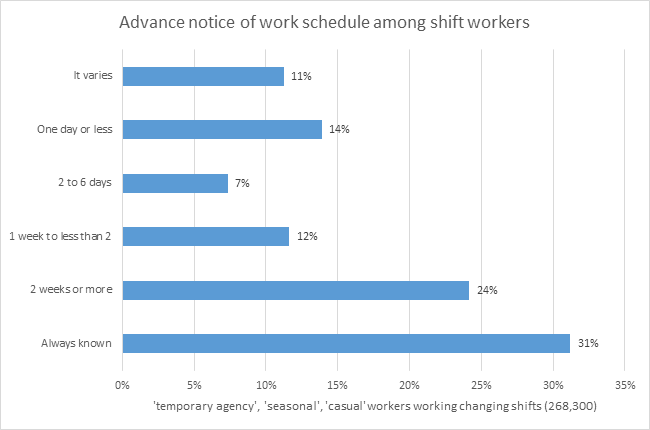
Source: Survey of Working Life December Quarter 2012, Statistics New Zealand, Table 13.
Something new and innovative such a zero hours contract should not be regulated because it is not well understood. Zero hours contracts don’t come cheap for employers because of the risk of job offer rejection. There must be offsetting advantages that allow this practice to survive in competition with other ways of hiring a cost competitive labour force.
The fixed costs of recruitment and training are such that one 40-hour worker is cheaper than hiring and training two 20-hour workers. Zero hour contracts would be most likely in jobs with low recruitment costs, few specialised training needs and highly variable customer flows.
This business variability can be borne by the employer with the worker on regular hours but paid less. The alternative is the employee shares this risk with a wage premium for their troubles.
Workers with low fixed costs of working at different times profit from a move onto zero-hours contracts. Those with higher fixed costs of changing their working hours will stay on lower hourly rates but more certain working times
To summarise my points today:
- workers sign zero hours contracts because they are to their advantage to do so;
-
Advance notice of working hours is not as common as people think for shift workers; and
-
Irregular and unusual working arrangements usually command a wage premium.
Employers must pay a wage premium to induce in workers to sign zero hours contracts. This Bill undermines the right of workers to seek those higher wages. Thanks for your time and attention.
In addition to being patient No. 1 of Bush derangement syndrome, @NYTimeskrugman suffers from wrong headedness as well
03 Nov 2015 Leave a comment
in comparative institutional analysis, personnel economics, politics - USA
The shape of things to come
30 Oct 2015 Leave a comment
in health economics, labour economics, personnel economics
The low skilled won’t be hired for living wage jobs @nmjyoung @EtuUnion @WellingtonMayor @FIRST_Union
30 Oct 2015 3 Comments
in applied price theory, human capital, labour economics, minimum wage, personnel economics, politics - New Zealand, rentseeking Tags: entrepreneurial alertness, expressive voting, living wage
The upshot of the Wellington City Council paying a living wage to employees and including those of sub-contractors is over time the composition of their low skilled labour force will change. The Council will recruit people who can earn in other jobs $19.25. Workers who don’t have the capability of producing at that level of productivity will never be interviewed.
The Council is required by law to recruit on merit and to be a good employer. Workers who would never have previously applied for Wellington City Council jobs covered by the living wage decision because they can earn better pay elsewhere will now do so because of the higher pay of these council jobs.
These higher skilled workers will crowd out the lower skilled workers that currently apply for the low paid jobs covered by the upcoming living wage increase. The workers with the type of skills that currently win those jobs covered by the living wage increase will not be shortlisted because the quality of the recruitment pool will increase because of the living wage. There will be an influx of more skilled workers attracted by the higher wages for council jobs because of the living wage policy. They will go to the head of the queue and displaced workers who currently apply for and win those council jobs.
A living wage is an exclusionary policy where ordinary workers, often with families who are not productive enough to produce $19.25 per hour plus overheads will never be interviewed by the Wellington City Council or council subcontractors for a job covered by the living wage increase.
In a cruel twist of fate, because the council is implementing its living wage on 1 July 2016, higher quality workers will start applying for jobs covered by the living wage increase now. This will further reduce the number of initial beneficiaries of the living wage increase. Council workers recruited between now on 1 July 2016 will be applying in anticipation of that increase.
The living wage adopted by the Wellington City Council is a classic case of rent capitalisation. With the council paying over the odds for a job, workers will have every incentive to compete for the higher wages. The most obvious way of winning that race for these limited number of higher paying jobs is to be a more productive worker than the other job applicants.
The living wage jobs will attract a higher quality pool of job applicants. These higher quality job applicants who would not otherwise applied but for the living wage will outcompete existing low skilled low paid workers who would otherwise benefited from the living wage increase. In some cases, these higher quality, more skilled recruits will be taking a job at the Council or its contractors covered by the living wage increase on much the same pay as they command anywhere else in the labour market. As such, ratepayers are paying about 20% more for no reduction in poverty.
The existing employees of the Wellington City Council and its subcontractors will be locked into golden handcuffs. Workers who lack the labour productivity to command a wage equivalent of the living wage elsewhere in the job market will never quit. Wellington City Council employees covered by the living wage will also have a much reduced incentive to up-skill will seek promotion. There will be no internal reward for undertaking additional training or job responsibilities among low skilled is because the living wage will mean they will not get a wage rise at the Council.
The windfall gains to the current low paid council employees but no future council employees illustrate the folly of a living wage policy at the Wellington City Council. Some of these existing Wellington City Council employees will have children so child poverty rates may improve. That is all that will be gained for a permanent increase of about 20% in the price paid for council services.
Because of the change in the recruitment pool for all future vacancies, the impact on the poverty rates among future council employees will be minimal. These recruits to future council vacancies covered by the living wage increase will be recruited from other jobs where they already earn a similar pay to the living wage paid at the Council. Ratepayers will pay about 20% more for services in return for a small reduction in child poverty among its existing council employees.
As these existing employees move on, and they will one day, ratepayers will continue to pay about 20% more until either the Council sees the errors of its ways or the policy is overturning on judicial review. There will be no reduction in family poverty because new recruits are switching to the Council for the usual wage premium from moving to one job to another and that’s it. As the existing council employees leave, any child poverty reduction from the living wage policy will fade to zero.
As mentioned, potential recruits who are productive enough to earn a competitive market wage equal to the living wage level in their existing jobs will be the most qualified applicants. The best of these higher quality applicants will fill future council vacancies covered by the living wage policy. Workers who are not productive enough to earn the living wage in other jobs simply won’t be shortlisted for council jobs. The Council must by law hire the best qualified applicant for any vacancy.

Source: Peter Kolesar, Garrett van Rysin and Wayne Cutler.
Any extra labour productivity from a living wage at the Wellington City Council is in doubt because low skilled service sectors are notorious for their low potential for productivity gains. They are the bread-and-butter of Baumol’s disease.

Source: Chris Rauchle.
It’s kicking the Wellington City Council when it is down to mention that low paid workers with families will lose a considerable part of the living wage increase because of reductions in their family tax credits – reductions in the Working for Families in-work tax credit. Any living wage increase at the Wellington City Council is the subject of multiple clawbacks by IRD. There is income tax, a 25% abatement rate on Working for Families tax credits on any family income above about $36,000 and 15% GST. All in all, the transfer out of the pockets of ratepayers to IRD would be at least one-third.
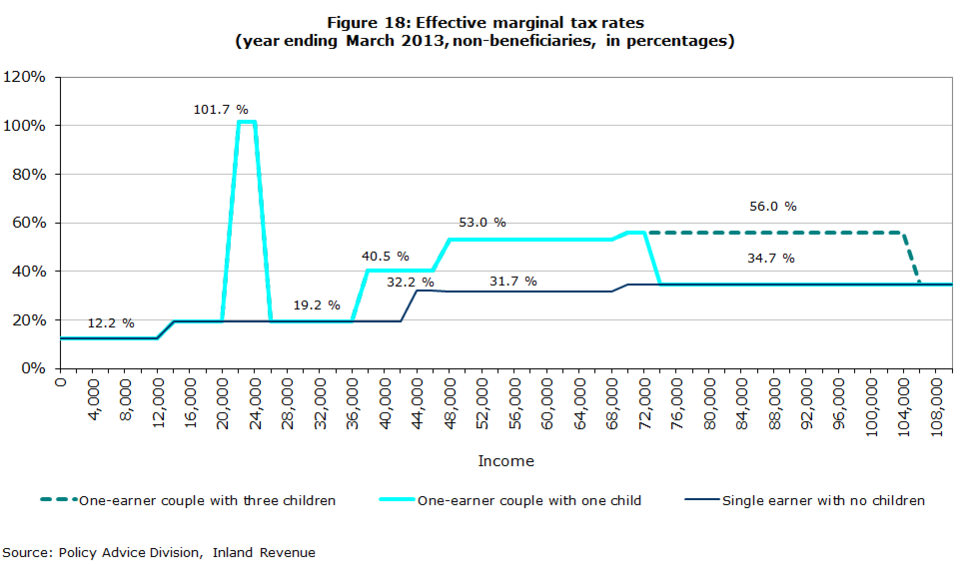
I have not included any accommodation supplement, childcare subsidy or community services card the low paid worker is receiving from WINZ. The winding back of these social benefits to the low paid worker and his or her family is a pointless transfer from Wellington City ratepayers to the national taxpayer.
It will be kicking Wellington City Council even further to remind of the enforcement and compliance costs of living wage ordinances in the USA at the city level.
The Wellington City Council this week acted against legal advice to require contractors under joint services agreements with other councils in the Wellington region to pay employees who work within the boundaries of Wellington city the living wage. The American cities had to define the minimum number of hours in a day that minimum wage workers who are mobile for their jobs had to spend within their city limits before their employer was subject to their living wage ordinance.
It is standard to put forward an efficiency wage argument for a living wage. The higher wage paid as result of the introduction of the living wage will motivate workers to work harder and cheer each other on.
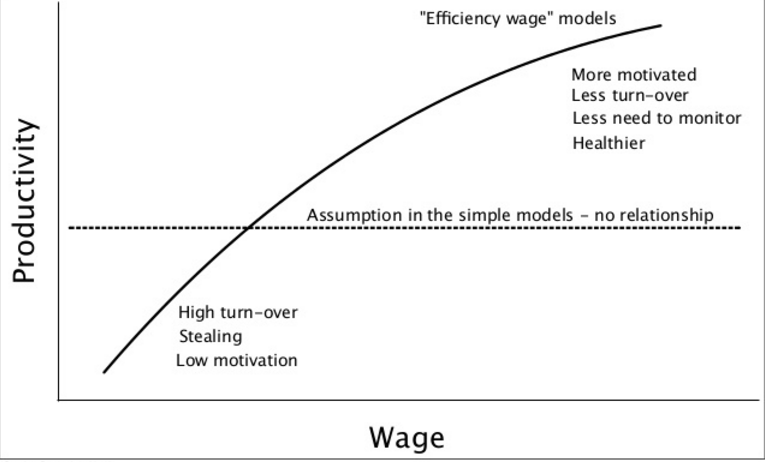
Source: John Horton.
These workers paid the efficiency wage will require less supervision because under an efficiency wage, a rate of pay that is more than the going rate for their skills and experience with other employers and in other industries and occupations, these workers paid the efficiency wage have more to lose if disciplined or dismissed. By the way, the theory of the efficiency wages is an American theory where there is employment at will.
This additional effort and greater motivation from the efficiency wage, from the above market rate of pay, will reduce the costs of supervision to the employer of teams of employees as well as increase output per worker. This is supposed to offset some of the costs of the living wage increase.
At bottom, this efficiency wage hypothesis is entrepreneurs are unaware of the higher quality and greater self-motivation of better paid recruits for vacancies but wise bureaucrats and farsighted politicians notice these gaps in the market. Bureaucrats and politicians notice these gaps in the market before those who gain from superior entrepreneur alertness to hitherto untapped opportunities for profit do so and instead leave that money on the table.
I won’t mention that many of the modern theories of the firm focus, in part or in full on reducing opportunistic behaviour, cheating and fraud in employment relationships. The cost of discovering prices and making and enforcing contracts and getting what you pay for are central to the Coase’s theory of the firm put forward in 1937.
In Barzel’s (1982) theory of the firm, measurement costs drive the emergence and organisation of the firm. The firm arose to minimising the cost of measuring what is to be exchanged by bringing some of those measuring tasks in-house. Much of the organisation of the firm, including the degree of vertical and horizontal integration and many different forms of contracting are driven by ensuring owners and managers get what they pay for and are not overcharged through manipulation or cheating.
Alchian and Demsetz’s (1972) theory of the firm focused on moral hazard in team production. As they explain
Two key demands are placed on an economic organization-metering input productivity and metering rewards.
The main rationale in personnel economics from everything ranging from employer funding of retirement pensions to the structure of promotions and executive pay including stock options is around better rewarding self-motivating employees and reducing the costs of monitoring employee effort.
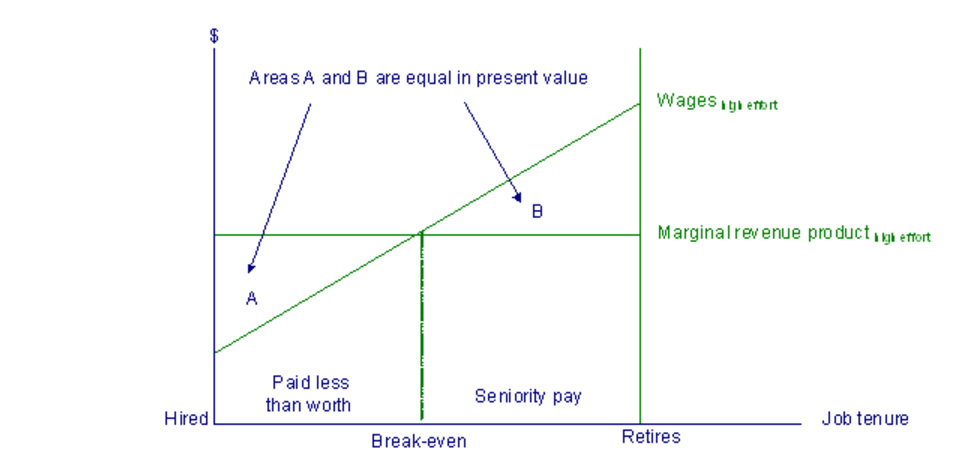
Source: Department of Labour (2009).
The profits of entrepreneurs for running a firm is directly linked from their successful policing of the efforts of employees and sub-contractors to ensure the team and each member perform as promised and individual rewards matched individual contributions (Alchian and Demsetz 1972; Barzel 1987). The entrepreneur is a residual claimant to the revenues of the firm net of paying all other inputs. Entrepreneurs must successfully police the contributions of their employers and contractors if they are to survive in competition. The better they are at this, the more the alert entrepreneur profits.
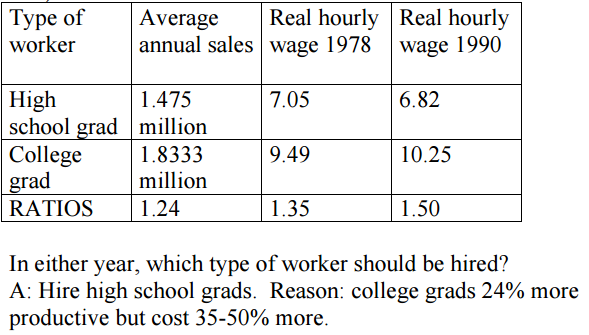
Every profit minded entrepreneur seeks to hire the group of workers with the lowest cost per unit of output produced by them. Those that do not will not survive in competition with more alert rivals. The trade-off between worker quality and wages in setting hiring standards is a routine entrepreneurial decision in every firm when recruiting:
Managers often say that their goal in hiring is to obtain the best quality workers. It sounds like a good idea, but is it? The most productive workers are also likely to be the most expensive. Should the goal instead be to hire the least expensive workers? …The best worker is not the cheapest, nor the most productive, but the one with the highest ratio of productivity to cost. We should hire as long as the marginal productivity of the last worker hired is greater than or equal to the cost of the worker.
Source: Lazear and Gibbs.
The essence of anthropology
24 Oct 2015 Leave a comment
in development economics, economics of media and culture, growth disasters, growth miracles, personnel economics Tags: academic bias, anthropology, Noble Savage, technological diffusion, The Great Escape, The Great Fact
Why isn’t everyone on a zero hours contract?
15 Oct 2015 Leave a comment
in applied price theory, economics of regulation, labour supply, occupational choice, organisational economics, personnel economics
I was chatting with a friend in the pub the other night about the proliferation of contractors in New Zealand in the government sector. It was observed that many of them simply perform the jobs of employees and bring no special skills for them but are very expensive to hire. They are paid a premium because that they are supposedly hired on short notice for short periods of time to fill gaps. They are paid a premium for their availability and willingness to leave on short notice without fuss.
I had no experience of contractors in Australia. If a gap needed to be filled within an agency quickly, you went to a manager higher up the hierarchy. The decision was made then to reallocate through secondments staff from another part of the agency from an area that was less busy than normal at the moment. In the interim, staff are recruited to fill any gap that is anything more than short-term with the secondments filling the gap until the recruits arrive.
Will you ask @WoodhouseMP to end zero-hour contracts for good? They're unfair and wrong. nzlp.nz/0hrspk http://t.co/IB8rm0gu6w—
New Zealand Labour (@nzlabour) April 09, 2015
The conversation then turned to the issues as to why any employees are guaranteed a minimum number of hours or continuity of employment. Why isn’t everyone on a zero hours contract and only come in when they are needed and are paid accordingly.
We've had 900+ submissions on the Employment Standards Legislation Bill so far. Submit here: responses.psa.org.nz/subesl20150916… http://t.co/XzIiiMYgOD—
(@NZPSA) September 24, 2015
The reason for long-term employment agreements with fixed hours and weekly wages irrespective of how busy the business is arises from the fixed costs of employment, and the costs of search and matching in the labour market.
The difference between zero hours contracts and permanent employment may be a overstated. Advance notice of work schedules is always known only to a minority of temporary and permanent employees in New Zealand. There is not much difference between that advance notice between temporary and in permanent employees.
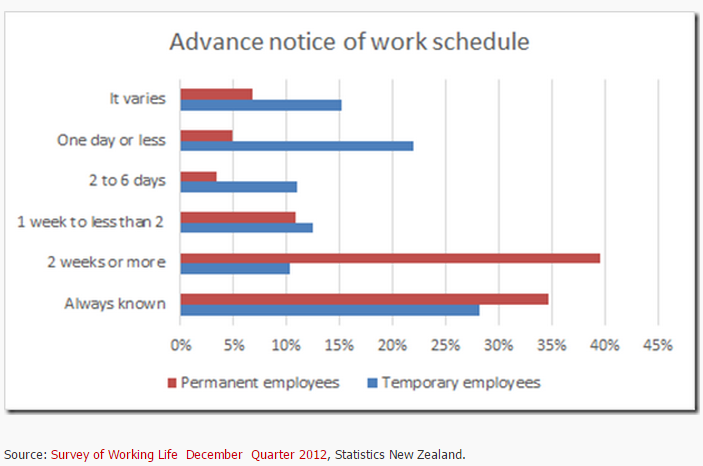
Critics overplay their hand if they suggest that somehow workers a very much disadvantaged and employers are holding all the cards. Job turnover and recruitment problems are a serious cost to a business. Workers will not sign contracts, such as zero hours contracts or casual work contracts if they are not to their advantage.
The question that must always be asked is why do people who are deemed competent to vote and drive cars sign zero hours contract? What is in it for them? David Friedman asked this question about the economics of restraint of trade agreements for employees:
…the employer who insists on an employee signing a non- competition agreement will find that he must pay, in additional wages or other terms of employment, the cost that the agreement imposes upon the employee, as measured by the employee and revealed in his actions. It follows that the employer will insist on such an agreement only if he believes that its value to him is greater than its cost to the employee… The contract is designed, after all, with the objective of getting the other party to sign it. If I am designing the contract and offering it to many other parties, that may put me in a position to commit myself to insisting on terms that give me a large fraction of the benefit that the contract produces. But it is still in my interest to maximize the size of that net benefit-which I do by only insisting on terms that are worth at least as much to me as they cost the other party.
Critics overplay their hand if they suggest that somehow workers are very much disadvantaged and employers are holding all the cards. Job turnover and recruitment problems are a serious cost to a business. Workers will not sign zero hours contracts if they are not to their advantage.
Unless labour markets are highly uncompetitive with employers having massive power over employees, employers should have to pay a wage premium if zero-hour contracts are a hassle for workers.
The fixed costs of employment are such that you shouldn’t expect zero-hour contracts: you’ll typically do better with one 40-hour worker over two 20-hour workers because of these costs. Zero hour contracts would be most likely in jobs with low recruitment costs and where specialised training needs are low. Workers with low fixed costs of working will move into the zero-hour sector while those with higher fixed costs would prefer lower hourly rates but more guaranteed hours. Again, read lower here as meaning relative to what they could elsewhere earn.
This is what 1599 submissions against the Employment Standards Legislation Bill looks like. http://t.co/WrkGpIiOP2—
(@NZPSA) October 06, 2015
Most workers, the majority of workers are on conventional employment agreements. They work five days a week, 40 hours a week for a fixed pay.
Anyone I know who decides to work as a contractor expects to be paid much more than a conventional employee. They command a large premium for not having certainty of hours and ongoing employment. The same goes for any job that is particularly risky, has unsocial hours or involves weekend work or anything else that departs from the standard working week. All these jobs command a wage premium.
Employers incur fixed costs of employment when they recruit and train new employees. These recruits must be expected to stay long enough to work sufficient hours for the firm to expect to recover these investments [Oi (1962, 1983a, 1990), Idson and Oi (1999), Hutchens (2010), Hutchens and Grace-Martin (2006)].
These costs are fixed costs because they do not vary with how many hours the employee works or with how long an employee stays with their employer. On-going supervision, office space and other overheads can increase with the number of employees, not the hours they work per week. These fixed employment costs must be recouped over the expected job tenure of the employee with the firm.
Employers will not hire an additional worker unless they anticipate recovering the costs of doing do including fixed employment costs and other overheads.
Hiring one more worker for 40 hours per week is cheaper than hiring two workers to work 20 hours per week each. These two part-timers would about double the recruitment and training costs to secure the same total additional supply of hours worked per week. Profits are a small share of the revenue earned on selling the output of each worker.
Zero hour contracts would be most likely in jobs with low recruitment costs and where specialised training needs are low. Workers with low fixed costs of working will move into the zero-hour sector while those with higher fixed costs would prefer lower hourly rates but more guaranteed hours. Again, read lower here as meaning relative to what they could elsewhere earn.
The literature on the economics of the fixed costs of work arose out of the economics of retirement and the economics of the labour supply of married women, and in particular of young mothers. This literature was attempting to explain why older workers, or young mothers either worked a minimum number of hours, or not at all.
Fixed costs of working constrain the choices that employees make about how many hours and days that are worthwhile working part-time. For employees, the fixed costs of going to work limit the numbers of days and number of hours per day that a worker is willing to work part-time. The timing costs of working at scheduled times and a fixed number of days per week can make working fewer full-time days, rather than fewer hours per day less disruptive to the leisure and other uses of personal time.
The fixed costs of working induced older workers to retire completely, and young mothers to withdraw from the workforce for extended periods of time, unless these workers worked either full-time or enough hours part-time each day and through the week to justify the costs of commuting and otherwise disrupting their day and week.
There are fixed costs to workers and employers finding each other as a suitable job match. They commit to a long-term relationship rather than risk that good job match dissolving and they are not able to recruit the fixed cost of initially finding such a good match.
Employers choose not to lay off workers during recessions because they want to retain their job specific human capital and recoup the fixed costs of employing them. If the employer lets them go in a downturn that is mild, they risk having to spend considerable money on finding our suitable replacement down the road.
It’s costly for employers to lose good employees. It’s equally costly for them to find good employees and quickly lose them again because they are unhappy or not as well-paid as elsewhere. There is much to be made on both sides of the employment relationship through long-term relationships. That’s why not everyone is on a zero-hours contract.
Zero hours contract doesn’t make it any cheaper for an employer to find a suitable recruit then train that recruit. A wage premium must be paid to induce the would-be recruit to prefer that working arrangement with no fixed hours over the others available to them including staying in their existing job.
Regulation of zero hours contracts will deny workers the option of higher wages by accepting uncertain hours. Hundreds of thousands of New Zealanders already work on employment agreements where there hours are not fixed but a variable on relatively short notice.

@nzlabour @FairnessNZ My first Parliamentary submission – opposing regulation of zero hours contracts
25 Sep 2015 1 Comment
in applied price theory, labour economics, labour supply, occupational choice, personnel economics, politics - New Zealand Tags: employment law, employment protection law, employment regulation, fixed costs of employment, Leftover Left, The fatal conceit, unintended consequences, zero hours contracts
This Labour Party link made it very easy for me to submit to the Select Committee of Parliament to oppose the Bill on regulating zero hours contracts. I oppose the Bill for the exact opposite reasons that the Labour Party opposes the Bill.

I encourage others to make a submission to Parliament as well opposing this draft amendment that will lower the wages of workers. My submission is as follows:
I do not support the proposed changes to the legislation governing zero hour contracts in the Employment Standards Legislation Bill. There should be no regulation of zero hours contracts.
Zero hours contracts is creative destruction at work in the labour market, sweeping away obsolete working time arrangements, mostly in the retail services sector. Plenty of new ways of working have emerged in recent years that include the proliferation of part-time work, temporary workers, leased workers, working from home, teleworking and sub-contracting. Employment laws were built on the now decaying assumption that workers had career-long, stable relationships with single employers.
Advance notice of work schedules is always known only to a minority of temporary and permanent employees in New Zealand, and there’s not much difference between that advance notice between temporary and permanent employees.
Critics overplay their hand if they suggest that somehow workers are very much disadvantaged and employers are holding all the cards. Job turnover and recruitment problems are a serious cost to a business. Workers will not sign zero hours contracts if they are not to their advantage.
Unless labour markets are highly uncompetitive with employers having massive power over employees, employers should have to pay a wage premium if zero-hour contracts are a hassle for workers.
The fixed costs of employment are such that you shouldn’t expect zero-hour contracts: you’ll typically do better with one 40-hour worker over two 20-hour workers because of these costs. Zero hour contracts would be most likely in jobs with low recruitment costs and where specialised training needs are low. Workers with low fixed costs of working will move into the zero-hour sector while those with higher fixed costs would prefer lower hourly rates but more guaranteed hours. Again, read lower here as meaning relative to what they could elsewhere earn.
Unless we have a good idea about why firms are moving to zero hours contracts, which we don’t, and why employees sign these contracts rather than work for other employers who offer more regular hours, meddling in these novel working time arrangements is risky.
Employers must pay a wage premium to induce in workers to sign zero hours contracts. This Bill seeks to deny workers the right to seek higher wages.
Feel free to use the above text as the basis for your own submission to Parliament.
 Utopia, you are standing in it!
Recent Comments