
The Dunning Kruger effect versus non-directional coaching
12 Mar 2015 3 Comments
in economics of education, human capital, managerial economics, organisational economics, personnel economics Tags: coaching, cognitive psychology, Dunning-Kruger effect, John Cleese, psychology of learning, Socratic questions
This seems to be a tension between the Dunning-Kruger effect on the principles of coaching as encompassed by its modern manifestation, non-directional coaching.
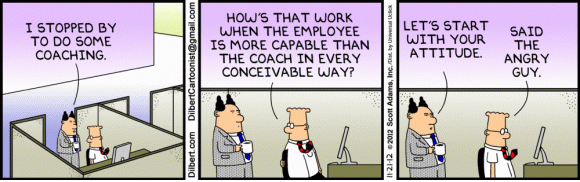
Under the modern fad of non-directional coaching, the coach asks open-ended questions which will elicit from the coached his or her own breakthroughs. Questions like what happened, what did you do then, is there another way will lead the student of the coach to reveal their knowledge within?

Psychologists David Dunning and Justin Kruger published a paper in which they described cognitive trait that quickly became known as the Dunning-Kruger effect. In a recent article, Dunning summarizes the effect as:
…incompetent people do not recognize—scratch that, cannot recognize—just how incompetent they are
He further explains:
What’s curious is that, in many cases, incompetence does not leave people disoriented, perplexed, or cautious.
Instead, the incompetent are often blessed with an inappropriate confidence, buoyed by something that feels to them like knowledge.

People who lack the skill to do something also lack the skill to recognise that they don’t know how to do it and to develop the skill how to do it. Dunning also points out:
An ignorant mind is precisely not a spotless, empty vessel, but one that’s filled with the clutter of irrelevant or misleading life experiences, theories, facts, intuitions, strategies, algorithms, heuristics, metaphors, and hunches that regrettably have the look and feel of useful and accurate knowledge.
I’m bad at spelling, grammar and proofreading my own work. To know how skilled or unskilled I am at using the rules of grammar, I must have a good working knowledge of those rules to start with the self-assessed myself as not been good at grammar. This is impossible for me to find out for myself because I don’t know the rules of grammar to tell me that I don’t know the rules of grammar and to what extent I don’t know the rules of grammar. I have succumbed to the Dunning-Kruger Effect
“The Dunning–Kruger effect is a cognitive bias in which unskilled people make poor decisions and reach erroneous conclusions, but their incompetence denies them the metacognitive ability to recognize their mistakes.
The unskilled therefore suffer from illusory superiority, rating their ability as above average, much higher than it actually is, while the highly skilled underrate their own abilities, suffering from illusory inferiority.
Actual competence may weaken self-confidence, as competent individuals may falsely assume that others have an equivalent understanding.
As Kruger and Dunning conclude, ‘the miscalibration of the incompetent stems from an error about the self, whereas the miscalibration of the highly competent stems from an error about others’. The effect is about paradoxical defects in cognitive ability, both in oneself and as one compares oneself to others.”
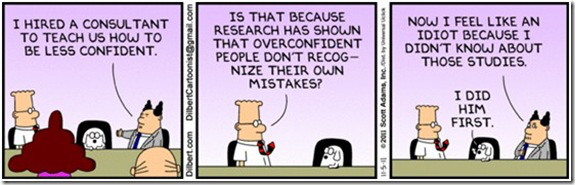
Poor performers fails to see the flaws in their thinking or the answers they lack. As Dunning explains:
A whole battery of studies conducted by myself and others have confirmed that people who don’t know much about a given set of cognitive, technical, or social skills tend to grossly overestimate their prowess and performance, whether it’s grammar, emotional intelligence, logical reasoning, firearm care and safety, debating, or financial knowledge.
College students who hand in exams that will earn them Ds and Fs tend to think their efforts will be worthy of far higher grades; low-performing chess players, bridge players, and medical students, and elderly people applying for a renewed driver’s license, similarly overestimate their competence by a long shot
Dunning and Kruger proposed that, for a given skill, incompetent people will:
- fail to recognize their own lack of skill;
- fail to recognize genuine skill in others;
- fail to recognize the extremity of their inadequacy; and
- recognize and acknowledge their own previous lack of skill, if they are exposed to training for that skill
Going back to my point about the modern trend in coaching of asking non-directive questions and open-ended questions and expecting the student to make their own breakthroughs, this contradicts the Dunning Kruger effect and the requirement that it be fixed through training. Coaching is not training; they are separate activities.
I was taught this non-directive coaching and went round the workplace asking questions of colleagues who are not economists using these open-ended questions of a coach. None of them made breakthroughs as a result of questions such as what happened, what happened then and other Socratic questions such as those below:
Conceptual clarification questions
Get them to think more about what exactly they are asking or thinking about. Prove the concepts behind their argument. Use basic ‘tell me more’ questions that get them to go deeper.
· Why are you saying that?
· What exactly does this mean?
· How does this relate to what we have been talking about?
· What is the nature of …?
· What do we already know about this?
· Can you give me an example?
· Are you saying … or … ?
· Can you rephrase that, please?
Probing their assumptions makes them think about the presuppositions and unquestioned beliefs on which they are founding their argument. This is shaking the bedrock and should get them really going!
· What else could we assume?
· You seem to be assuming … ?
· How did you choose those assumptions?
· Please explain why/how … ?
· How can you verify or disprove that assumption?
· What would happen if … ?
· Do you agree or disagree with … ?
Probing rationale, reasons and evidence
When they give a rationale for their arguments, dig into that reasoning rather than assuming it is a given. People often use un-thought-through or weakly-understood supports for their arguments.
· Why is that happening?
· How do you know this?
· Show me … ?
· Can you give me an example of that?
· What do you think causes … ?
· What is the nature of this?
· Are these reasons good enough?
· Would it stand up in court?
· How might it be refuted?
· How can I be sure of what you are saying?
· Why is … happening?
· Why? (keep asking it — you’ll never get past a few times)
· What evidence is there to support what you are saying?
· On what authority are you basing your argument?
Questioning viewpoints and perspectives
Most arguments are given from a particular position. So attack the position. Show that there are other, equally valid, viewpoints.
· Another way of looking at this is …, does this seem reasonable?
· What alternative ways of looking at this are there?
· Why it is … necessary?
· Who benefits from this?
· What is the difference between… and…?
· Why is it better than …?
· What are the strengths and weaknesses of…?
· How are … and … similar?
· What would … say about it?
· What if you compared … and … ?
· How could you look another way at this?
Probe implications and consequences
The argument that they give may have logical implications that can be forecast. Do these make sense? Are they desirable?
· Then what would happen?
· What are the consequences of that assumption?
· How could … be used to … ?
· What are the implications of … ?
· How does … affect … ?
· How does … fit with what we learned before?
· Why is … important?
· What is the best … ? Why?
And you can also get reflexive about the whole thing, turning the question in on itself. Use their attack against themselves. Bounce the ball back into their court, etc.
· What was the point of asking that question?
· Why do you think I asked this question?
· Am I making sense? Why not?
· What else might I ask?
· What does that mean?
Signs of poor management – Not listening and not making people feel valued
12 Mar 2015 Leave a comment

What do industrial and organisational psychologists help employers do?
03 Mar 2015 Leave a comment
in managerial economics, organisational economics, personnel economics Tags: Dilbert, industrial psychology
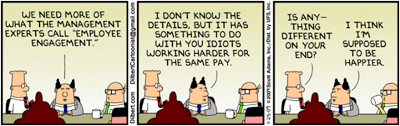
HT: sageassessments

Zero hours contracts prevalence, the class struggle and the gales of creative destruction
26 Feb 2015 1 Comment
in labour economics, labour supply, managerial economics, occupational choice, organisational economics, personnel economics Tags: class struggle, Class war, creative destruction, false consciousness, inherent inequality of bargaining power between workers and employers, job satisfaction, preference formation, work life balance, zero hours contracts
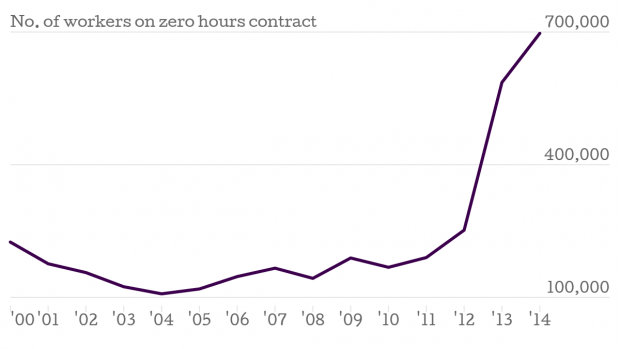
Source: Use of zero hours contracts rises to record levels | City A.M.
The number of workers on zero hours contracts has certainly exploded in the UK, going from about 100,000 to 700,000 in about five years. The UK data also suggests that most of these contracts will be in the accommodation and food services sector.
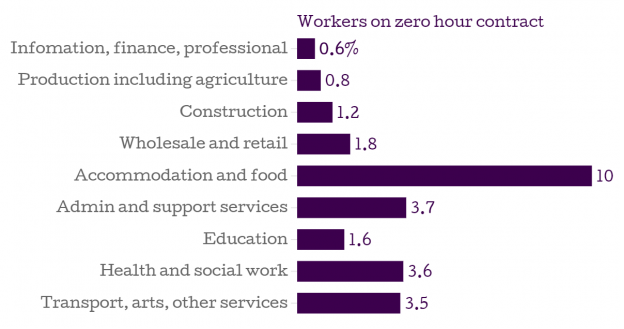
Source: Use of zero hours contracts rises to record levels | City A.M.
Zero hours contracts is creative destruction at work in the labour market, sweeping away obsolete working time arrangements, mostly in the retail services sector.

Zero hours contracts is creative destruction at work in the labour market, sweeping away obsolete working arrangements mostly in the retail services sector.
New Zealand data is hard to come by on zero hours contracts. Data on working hours arrangements is in the Survey of Working Life which is conducted every couple of years. This survey doesn’t give any data directly on the prevalence of zero hours contracts, but it does tell you how many people are temporary employees and among these, who is a casual and seasonal employee and whether they have regular hours.
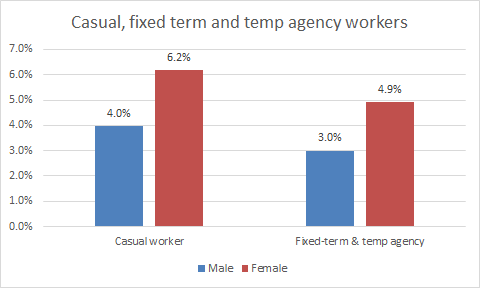
Source: Survey of Working Life December Quarter 2012, Statistics New Zealand.
The first thing can be said about the prevalence of zero hours contracts in New Zealand is two years ago the number of workers both male and female who were casual, fixed term and temp agency workers was relatively small. Less than one in 20 male workers was a casual worker; 3% of male workers was on a fixed term or temp agency worker. For women, 6% were casual workers and 4.9% were either fixed term or temp agency workers.
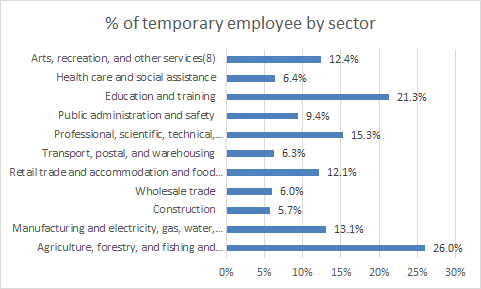
Source: Survey of Working Life December Quarter 2012, Statistics New Zealand.
Temporary employment is most common In the agriculture, forestry and fishery sectors, which is no surprise because of the prevalence seasonal workers in that sector.The retail trade accommodation and food sectors is not the next cab off the rank for temporary employment. Temporary employment is rather common in the education and professional science sectors.
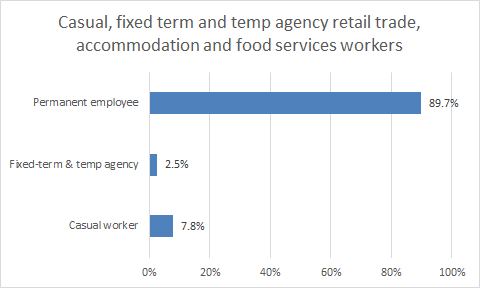
Source: Survey of Working Life December Quarter 2012, Statistics New Zealand.
In the retail trade commendation and food services worker, 90% of all employees are still permanent. There are about 32,000 workers in the retail trade, accommodation and food services sectors.
Source: Survey of Working Life December Quarter 2012, Statistics New Zealand.
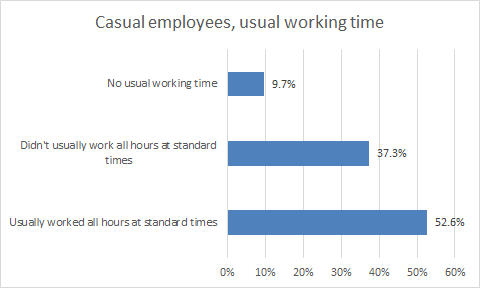
Among all casual employees across all sectors, 50% work standard hours and about 10% have no usual working time. That is, out of the 92,000 casual employees in New Zealand, about 9000 of them have no usual working times, which is the equivalent of a zero hours contract. No data was published by Statistics New Zealand on fixed term and temp agency workers because the sample sizes were too small so the data was suppressed confidentiality reasons.
Source: Survey of Working Life December Quarter 2012, Statistics New Zealand.
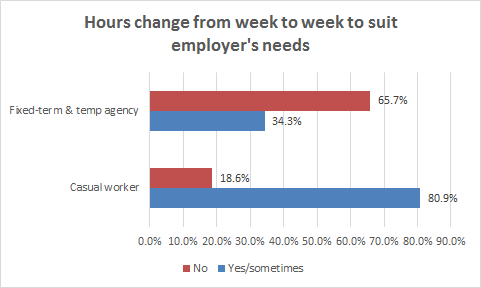
For casual, fixed term and temp agency employees, it is commonplace for them to change their hours from week to week to suit the needs of their employees. The equivalent of zero hours contracts Is commonplace among employees who do not have permanent employment status. It goes with the territory. Those who want fixed hours seek permanent employment.
For zero hours employment to become common, this form of contract in over working time arrangements will have to be come more common among permanent employees. If that is so, such a trend will make the notion of a permanent employee somewhat vague considering these employees, although permanent, are not guaranteed regular hours.
Source: Survey of Working Life December Quarter 2012, Statistics New Zealand.
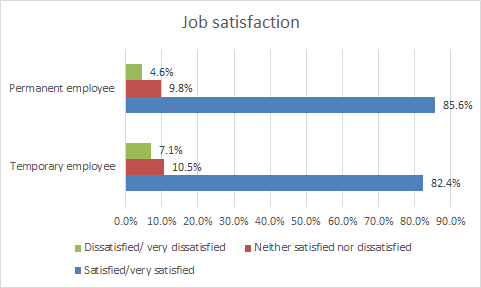
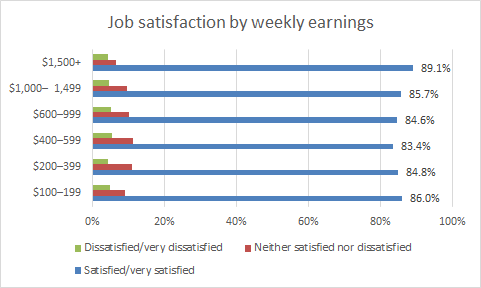
They are a happy lot are temporary employees. Pretty much enjoy their jobs as much as permanent employees do when it comes to their job and, by implication, that perennial left-wing bugbear, the inherent inequality of bargaining power between the bosses and the workers and the violence inherent in the capitalist system. All is not well for the class war.
Source: Survey of Working Life December Quarter 2012, Statistics New Zealand.
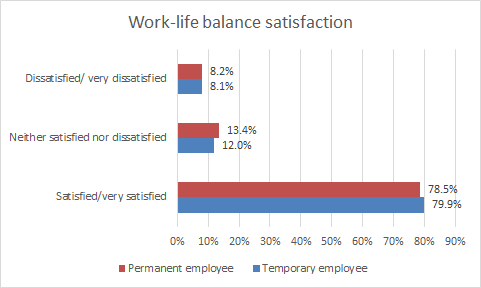
What is worse for the future of the class struggle is that these temporary employees are rather happy lot when it comes to work life balance. Just as happy as permanent employees. Indeed, temporary or permanent employment status has no effect on job satisfaction and work life balance.
Source: Survey of Working Life December Quarter 2012, Statistics New Zealand.
Rise up ye workers, rise up for you have nothing to lose but your zero hours contracts may have to be put on hold as the next battle cry of the class war in New Zealand. Indeed, a lot of consciousness-raising will be in store for our friends on the Left because the working class seem a rather happy lot in their jobs, slightly less grumpy than the middle class, and almost as happy as the ruling class.
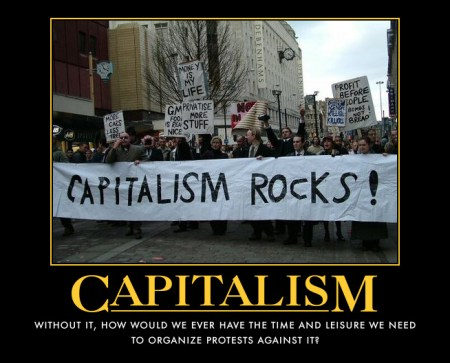
Kicking in the rotted door of capitalism to bring on the permanent revolution has never been easy. Zero hours contracts just does not seem to be the new straw that will break the capitalists’ back any time soon. Workers seem to be rather happy with them or their equivalent that has been around for a long time in the labour market.

Critics overplay their hand if they suggest that somehow workers a very much disadvantaged and employers are holding all the cards. Job turnover and recruitment problems are a serious cost to a business. Workers will not sign contracts, such as zero hours contracts or casual work contracts if they are not to their advantage.
The Effect of Police Body-Worn Cameras on Use of Force and Citizens’ Complaints Against the Police
26 Feb 2015 Leave a comment
in economics of crime, law and economics, managerial economics, organisational economics, personnel economics Tags: camera surveillance, crime and punishment, moral hazard, police
The results are no surprise. There is a 50% drop in the use of force by police when they are required to wear body cameras.
We conducted a randomized controlled trial, where nearly 1,000 officer shifts were randomized over a 12-month period to treatment and control conditions.
During ‘‘treatment shifts’’ officers were required to wear and use body-worn-cameras when interacting with members of the public, while during ‘‘control shifts’’ officers were instructed not to carry or use the devices in any way.
We observed the number of complaints, incidents of use-of-force, and the number of contacts between police officers and the public, in the years and months preceding the trial (in order to establish a baseline) and during the 12 months of the
experiment.
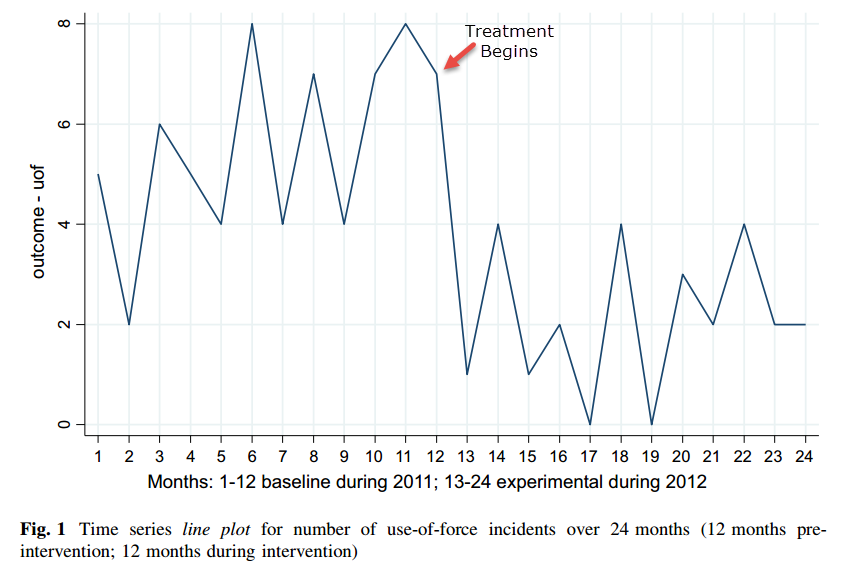
Police use of force reports halved on shifts when police wore cameras. It is not known whether this reduction in the use of force is because members of the public were now aware that any misbehaviour by them to be caught on camera and used as evidence against them or police were aware that any excessive force by them would be caught on camera as well.

Morning People Are Less Ethical at Night – HBR
20 Feb 2015 Leave a comment
in economics of crime, law and economics, managerial economics, organisational economics, personnel economics Tags: economics of personality traits

Managerial Econ: Top 5 problem-solving mistakes by MBA’s
19 Feb 2015 Leave a comment
in entrepreneurship, industrial organisation, managerial economics, organisational economics, personnel economics, survivor principle Tags: entrepreneurial alertness, management, MBA

“Avoid jargon” because most people misuse it. Force yourself to spell out what you mean in simple plain English. It will help your thinking and communication.
“What about the organizational design?” Figure out what is causing the problem, and then think about how to avoid the problem. A lot of papers identified a bad decision, and then suggested reversing it. But they neglected to address the issue of why the bad decision was made, and how to make sure the same mistakes wouldn’t be made in the future.
“Don’t define the problem as the lack of your solution.” For example, if the problem is “the lack of centralized purchasing,” then you are locked into a solution of “centralized purchasing.” Instead, define the problem as “high acquisition cost” and then examine “centralized purchasing” vs. “decentralized purchasing” (or some other alternative) as two solutions to the problem.
“What is the trade-off?” Every solution has costs as well as benefits. If you list only the benefits, it makes your analysis seem like an ex post rationalization of a foregone decision, rather than a careful weighing of the benefits and costs. If you spent some time thinking through the tradeoffs, show it. If not, then you should.
“Which language is this?” I write this when I get gobbledygook written in the passive voice with big words that don’t mean anything. Instead write simple declarative sentences that clarify rather than obfuscate. Form is not a substitute for content.
via Managerial Econ: Top 5 problem-solving mistakes by MBA’s.
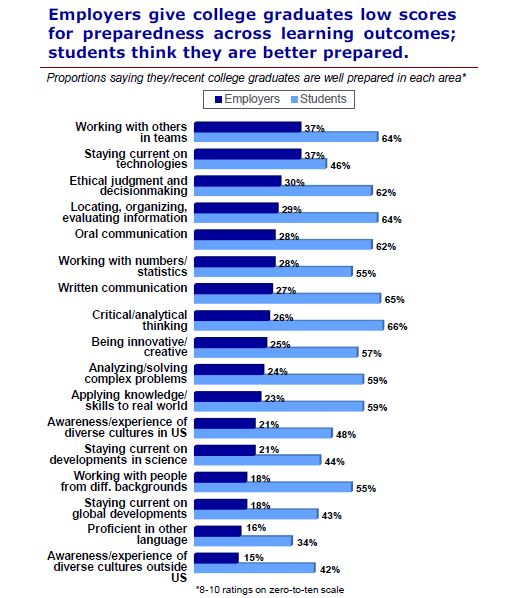
College graduates have a much higher opinion of themselves than do the recruiting employers
18 Feb 2015 Leave a comment
in economics of education, human capital, job search and matching, labour economics, labour supply, personnel economics Tags: job market signaling, recruitment standards

The Law of Crappy Managers
14 Feb 2015 Leave a comment
in economics of bureaucracy, industrial organisation, managerial economics, occupational choice, organisational economics, personnel economics, survivor principle Tags: Peter Principle

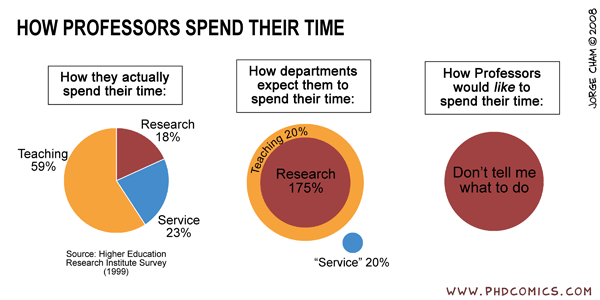
How Professors spend their time
13 Feb 2015 Leave a comment
in economics of education, personnel economics Tags: academics
HT: Sinclair Davidson
 Utopia, you are standing in it!
Recent Comments