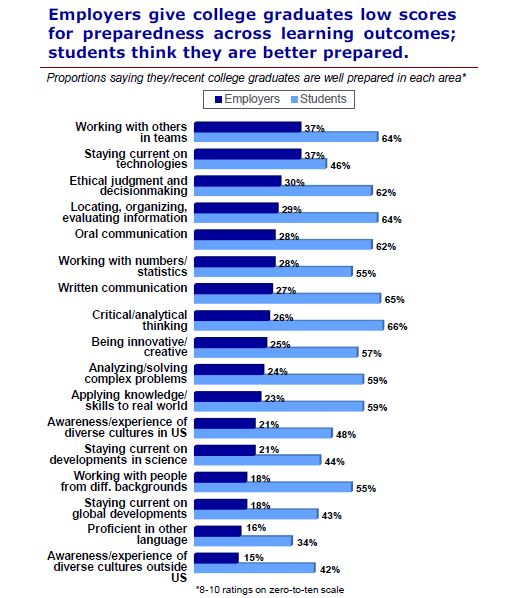
College graduates have a much higher opinion of themselves than do the recruiting employers
18 Feb 2015 Leave a comment
in economics of education, human capital, job search and matching, labour economics, labour supply, personnel economics Tags: job market signaling, recruitment standards

The Law of Crappy Managers
14 Feb 2015 Leave a comment
in economics of bureaucracy, industrial organisation, managerial economics, occupational choice, organisational economics, personnel economics, survivor principle Tags: Peter Principle

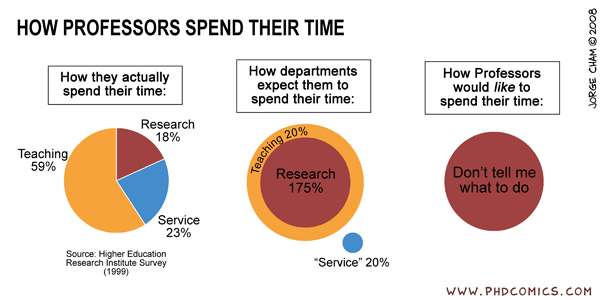
How Professors spend their time
13 Feb 2015 Leave a comment
in economics of education, personnel economics Tags: academics
HT: Sinclair Davidson
The Evolution Of The Employee
09 Feb 2015 Leave a comment
in health and safety, human capital, labour economics, labour supply, managerial economics, market efficiency, occupational choice, organisational economics, personnel economics Tags: modern human resource management


Robert D. Tollison on the main positive contribution of economists to public policy
30 Jan 2015 Leave a comment

History of cultural bias has led to a lack of diversity in green and left-wing groups
29 Jan 2015 Leave a comment
in occupational choice, personnel economics, politics - Australia, politics - New Zealand, politics - USA Tags: activists, Greens, Inner-city Left, Leftover Left


Minorities represent nearly 40 percent of Americans, yet account for fewer than 16 percent of workers at the government agencies, nongovernmental organizations called NGOs and foundations that were studied.
…Taylor wrote that an “unconscious bias” exists within the liberal and progressive culture of the groups, preserving a racially homogenous workplace. “Recruitment for new staff frequently occurs through word-of-mouth and informal networks,” the study said. “This makes it difficult for ethnic minorities, the working class, or anyone outside of traditional environmental networks to find out about job openings and apply for those jobs.”


The spirit of Alfred P. Sloan: 10 Ways to Get People to Disagree
27 Jan 2015 Leave a comment
in entrepreneurship, managerial economics, market efficiency, organisational economics, personnel economics Tags: Alfred P. Sloan, group think

1. Assign someone on your team to the role of “Devil’s Advocate” to ensure a critical eye.
2. Ask part of your group to think like the firm’s competitors (or customers or employees) in order to surface and expose flaws in a set of core assumptions.
3. Establish “ground rules” that will stimulate task-oriented disagreement — but minimize interpersonal conflict.
4. Keep the proceedings “transparent” by making decisions based on what goes on in the meeting and not behind-the-scenes maneuvering.
5. Make sure your team members represent a diversity of thinking styles, skill levels, and backgrounds. And if they don’t, invite people with various points of view to offer their perspectives.
6. Start out with a question and don’t voice an opinion. Once you’ve said, “Here’s what I’m thinking . . .” you have already influenced your team.
7. If you want honest feedback, then be the first person to admit mistakes.
8. Listen (really listen) to everyone’s ideas. Let people know that you value their input and are taking into consideration what they have to say.
9. Pay attention. It’s not enough to listen — you can do that while viewing text messages or pouring a cup of coffee. You also have to be perceived to be paying attention. That means you need to make sure your body language (eye contact, head nods, torso orientation, etc.) sends signals of inclusion.
10. Clearly state the behaviors you want during the discussion (constructive conflict) and as a result of the discussion (shared commitment to the outcome).
via http://www.forbes.com/sites/carolkinseygoman/2012/08/23/10-ways-to-get-people-to-disagree/


Recent Comments