The slow diffusion of modern human resource management

Modern human resource management gained ground in the 1980s, slowly replaced the centralising of people management in personnel departments that was widespread by the 1960s.

Modern human resource management stressed rigorous selection and recruitment, more training at induction and on-the-job, more teamwork and multi-skilling, better management-worker communication, the use of quality circles, and encouraging employee suggestions and innovation.

The aim is a highly committed and capable workforce that pulls toward common goals. This drive for employer-employee unity is in contrast to the old days of detachment and formality with managers directing and controlling workers.

Modern human resource management replaced compliance with rules with genuine employee commitment and a unified corporate culture.

Modern human resource management is a technology and there is a long lag on the widespread adoption of any new technology.

The lag on the intra-industry diffusion of new technologies from 10% to 90% of users is 15 to 30 years long (Hall 2003; Grubler 1991). The literature on technology transfer is full of examples of the slow and costly diffusion of new technologies even with the on-site help of the original innovator and experienced consultants (Boldrin and Levine 2008).

New management practices are often complex and they are often slow and costly to introduce successfully without the assistance of consultants with prior experience with the new practices (Bloom and Van Reenen 2007, 2010).

Managerial innovations such as Taylor’s scientific management, Ford’s mass production, Sloan’s M-form corporations, Deming’s quality movement and Toyota’s lean manufacturing diffused slowly over decades. These technologies required large investments in learning, retraining, reorganisation, trial and error and adaptation and there were many failures (Bloom and Van Reenen 2010).

Bryson, Gomez, Kretschmer and Willman (2007) found that workplace voice and modern, high-commitment human resource management practices diffused unevenly across British workplaces. More employees, larger multi-establishment networks, public or for-profit ownership and network effects all increased the rates of diffusion of the new practices.

Large firms may invest more in skills because they are the early adopters of new management practices. Large firms are organisationally complex and they require more structured, explicit management practices to survive. Higher levels of worker skills have been linked with firms having better management practices (Bloom and Van Reenen 2007, 2010).

Employers who pay higher wages lose more if they mismanage or under-utilise well-paid workers. Large firms pay more, on average, so they lose more if they do not adopt good management practices in a timely fashion.

There are fixed costs to adopting new technologies and management practices, so large firms may be the first to find them profitable (Hall 2003). Later adopters may follow this lead when the new practices are more proven and, through experience and adaptation, cheaper to adopt.

The organisational disruption from switching to any new technology can reduce production and profits for several years and the new way of doing business may fail perhaps at a great cost (Holmes, Levine, and Schmitz 2012; Atkeson and Kehoe 2007; Roberts 2004).

These costs and uncertainties slow technology diffusion and explain why smaller firms use seemly out-of-date management practices. The new ways are not yet profitable for them. The pace of adoption of new technologies is driven by changes in the profitability of using the new technology as compared to the old (Karshenas and Stoneman 1993).

Firms of different sizes will invest in skills development and new management practices to the extent that is profitable to their circumstances.

On some occasions, large firms will find it profitable to invest in more skills development because this is part of the costs of investing in more capital per worker. On other occasions, skills development is necessary to reduce the costs of a growing corporate hierarchy.

No firm cannot invest in more skills development unless this growth is buoyed by market demand. Precipitate investments in skills development are fraught with risks.

Obesity by occupation

Why are we always restructuring the workplace? The economics of organisational fickleness

Ok, whatever is, is efficient, but I always had my doubts when we are always restructuring wherever I worked. This continual organisational upheaval and restructuring was also a phenomena in the private sector.

What was the survival value of this continual disruption of organisational form and organisational capital in competition with rival firms with more stable internal organisational forms?

Internal reorganisations divert management time away from more profitable pursuits such as facilitating production. Managerial resources are scarce, like any other resource, and must be allocated to their highest value uses.

But as a firm grows, waste accumulates through the duplication of employee effort and the assignment of unnecessary tasks within the organisation.

Jack Nickerson and Todd Zenger wrote a great paper in 2002 on the efficiency of being fickle – of repeated reorganisations of the workplace. Their point was simple: times change and they change a lot faster than we think so organisations have to adapt to their rapidly unfolding new market conditions.

They illustrated their point about the need for regular reorganisation inside a short period of time with a case study of the alternating waves of centralisation and decentralisation in Hewlett-Packard.

Throughout the 1970s, Hewlett-Packard was a thoroughly decentralised organisation and was successful in the market. It had a remarkable record of innovation in the 1970s.

In the early 1980s, Hewlett-Packard hard found this decentralisation was starting to work against it in the rapidly evolving computer market. The Independent divisions developed computers, peripherals and components that will both incompatible with each other and competed with each other.

This redundancy between the independent divisions was costly and was confusing to consumers because they had a hodgepodge of products that really won’t related to each other. The computer industry in the early 1980s was involving very rapidly with many incompatible computers and programs, but the few that turned out to be the best became immensely profitable.

In 1984 and 1985, Hewlett-Packard hard centralise product development in headquarters and put all marketing and sales into one unit. Financial performance recovered after this reorganisation.

By 1990, Hewlett-Packard was on again in a steep financial decline. The centralisation of decision-making has slowed product development and there was a significant drop in innovation.

In 1990, computers was separated into competing products and computing systems. Individual product lines were decentralised and treated a separate business units.

In 1994, Hewlett-Packard again decentralised customer support of all computer activities. Three years later, it decentralised the same activities into three organisations. In 1999 it spun off its instruments and medical business.

Over 16 years, Hewlett-Packard, experience five fundamental ships alternating between decentralisation and centralisation. Each one of these reorganisations was greeted with the share price increase.

The reason why this fickleness in organisational form was efficient was the market changes rapidly. Organisational forms and organisational capital become obsolete rather quickly.

The form of organisation that survives in competition with actual and potential market rivals is that specific form of organisation which allows the firm to deliver the products that customers want at the lowest price while covering costs (Alchian 1950; Fama and Jensen 1983a, 1983b).

Each time Hewlett-Packard decentralised was a time in the product life cycle of their industry where there was rapid innovation. Hewlett-Packard tended to centralise in the consolidation phase of product life cycles.

New technologies are unproven and they come with much less information and prior experience to guide the top of a hierarchy in directing their successful adoption from a distance (Acemoglu, Aghion, Lelarge, Van Reenen and Zilibotti 2007). In any hierarchy, the top faces two problems with their subordinates: communicating their desires and seeing that they are carried out (Tullock 2005).

When a large firm directs major changes from the top of a hierarchy, failures of communication in the chain of command are a growing risk. More employees require more supervisors. More supervisors require more supervisors of supervisors at every tier of the hierarchy – the layers of supervision multiply (Posner 2010; Williamson 1975, 1985).

There are delay in executing orders, a loss of information and feedback on the way up, and the truncation of the directions from the top: there is a general weakening of control and coherence (Posner 2010; Williamson 1975, 1985). The daily implementation problems of new technologies cannot go up and down a hierarchy for resolution.

Firms must decentralise (rather than grow in hierarchy) to profit most from a line manager’s superior local knowledge about the implementation of the latest, more complex technologies. Delegating initiative to managers downstream is vital when a large firm introduces frontier technologies about which information flows upstream are slow and considerable learning by doing and rapid adaptation are required (Acemoglu, Aghion, Lelarge, Van Reenen and Zilibotti 2007; Jensen and Meckling 1995).

New technologies usually bug-ridden and require considerable refinement, adaptation and consumer feedback on their use before the mature product emerges (Greenwood 1999; Greenwood and Yorukoglu 1997). This costly process of learning, improvisation and product and process re-design explains the multi-decade long 10-90 lag in technology diffusion across firms in the same industry and the slow rate of consumer acceptance of new products.

Larger firms may struggle with striking the most profitable balance between greater local managerial discretion and effective corporate governance of a large diverse organisation with professional managers and diffuse ownership structures.

A risk of greater local managerial discretion in a large firm is less effective governance (Williamson 1975, 1985; Fama and Jensen 1983a, 1983b). The risks of separating of ownership from control and the distortions to knowledge flows in hierarchies drives the internal organisation of large firms and the division of decision control and decision management rights between the board and management (Fama and Jensen 1983a, 1983b; Williamson 1985).

The separation of decision management rights, vested in hired managers, from decision control rights, vested in the board of directors, is a common governance safeguard against conflicts of interest in business, professional and non-profit organisations, large and small (Fama and Jensen 1983a, 1983b).

Decision management rights cover the initiation and the implementation of decisions. Decision control rights involve the ratification and the monitoring of decisions. Managers and division heads carry out the production decisions, budgets and policies on wages, hours, staffing and job designs developed by head office and which are ratified by the board of directors (Fama and Jensen 1983b, 1985).

Competition between different sizes, shapes and internal organisational forms of firms all vying for sales, cheaper sources of supply and investor support sifts out the keener priced, lower cost, and more innovative enterprises (Alchian 1950; Stigler 1958). These lower-cost firms will be able to under-sell their higher cost rivals.

The winning firm size and internal organisational shape is that configuration which meets any and all problems the firm is actually facing and seizes more of the entrepreneurial opportunities that are within its grasp (Stigler 1958; Alchian 1950).

Large firms invest heavily in mimicking the nimbleness of small firms. Some firms re-create some of the advantages of being small by organising into M-form hierarchies made up of product divisions to improve performance monitoring, identify managerial slack, encourage mutual monitoring, promote competition within the firm for top-level management positions and facilitate comparisons of compliance with the policies of head office (Klein 1999; Fama and Jensen 1983a, 1983b; Williamson 1975, 1985).

Large firms must develop organisational architectures to assign decision rights, reward employees, and evaluate the performance of employees and business units. The aim is to empower subordinates with the requisite local knowledge with the power to act swiftly and the incentive to make good decisions. The organisational architecture of a firm encompasses the assignment of decision rights within the firm, the methods of rewarding individual employees, and the structure of the systems that evaluate the performance of individual employees and business units.

Poor cost control, budgetary excess and any lack of innovation and initiative over products designs and pricing, input mixes and wage and employment policies will reflect in relative divisional performances and overall corporate profits.

Any news of less promising current and future net cash flows will feed into share prices and into the labour market prospects of both career managers and the members of boards of directors (Manne 1965; Jensen and Meckling 1976; Fama and Jensen 1983a, 1983b; Demsetz 1983; Demsetz and Lehn 1985). To survive, managerial firms must balance delegation with more centralised control (Fama and Jensen 1983a; McKenzie and Lee 1998).

One way of balancing delegation with centralised control is simply to reorganise the firm on a regular basis as market circumstances change and entrepreneurial judgements about the future are updated. This regular reorganisation of the firm may seem fickle, but the firm must adapt or die. Firms must be efficiently fickle in their organisational forms.

Not only is whatever is, is efficient, any attempt to change whatever is, is efficient, because otherwise it wouldn’t be attempted. Of course, these reorganisations are entrepreneurial ventures that are never guaranteed success.


The trade-off between hiring higher-skilled and less-skilled workers

Firms differ in the skill compositions of their labour forces because higher-skilled labour is not always the most profitable type of labour to hire.

A profit-minded firm seeks low costs per unit of labour. In truth, nothing is expensive or cheap. This is because buyers will keep buying until the marginal cost equals the marginal benefit. The next unit was not purchased because it wasn’t worth the cost. The last unit was bought because its cost just matched its benefit.

The most cost-effective labour is the labour with the lowest ratio of wages to output. Low cost per unit of output is the goal whether it is comes from low wages or high labour productivity (Lazear 1998).


The wage spread between high quality and lower quality workers is large enough such that no employer hiring lower quality workers can profitably switch to hire higher quality recruits and no firms hiring high-quality workers will switch to hire lower quality recruits (Lazear 1998).

Employers will buy more of an under-priced skill until the returns to labour equalise again across different skill levels and the hiring of any more of the hitherto mispriced skill is no longer profitable because of rising wages.

Firms of all sizes will revisit their skills strategies when market conditions change if they hope to survive in their new circumstances.

Comparing sea ice today to Shackleton’s Ill Fated Voyage – 100 years ago this month

I am a great admirer of Ernest Shackleton – his unlimited determination and boundless courage

What is the main driver of a gender wage gap?

Oops, I hope the boss wasn’t looking

Some economics of the marriage bars (and mandatory retirement ages)

Up until 1966, women had to quit from the Australian Public Service when they married! The bar was repealed in 1966 with a private members bill by Bill Hayden.

Some hid their marriages for years, hiding their rings before they got to work.

One woman remained unmarried and bore four children. She managed this by timing her annual leave to cover the births.

While her personnel area was co-operative, they forced her to resign her middle management position when she decided to make an honest man of her de facto husband by marrying the father of their children.

Claudia Goldin found that marriage bars were policies adopted by firms and local school boards, from about the early 1900’s to 1950. They fired single women when they married and would not not to hire married women.

The marriage bar, which had at its height affected 751 of all local school boards in the USA and more than 50% of all office workers, was virtually abandoned in the 1950’s when the cost of limiting labour supply greatly increased.

When marriage bars disappeared, Goldin found that older female workers in the mid-1950’s were suddenly praised for their “maturity, reliability, neat appearance, and less chatty nature”.

In retail trades, and especially in suburban retail shops, Goldin found that older married women with absolutely no previous training were now the “ideal employee”; the middle-class woman were “naturally courteous” and “well-bred,” and who did not have to work became the preferred recruits of the major department stores. the best female employee was, in the words of a Sears, Roebuck, and Co. officer

a married woman with a mortgage on her house and her children partially raised

These sudden changes in the attitude of employers towards the recruitment of women of different ages and marital status suggests that the previous personnel policies were disciplined by competition.

Marriage bars, in the private sector, were instituted by large firms with centralised hiring promotion and salary schedules that were often fixed and based on tenure with the firm, and other modern employment practices.

This evidence suggested to Claudia Goldin that firms may have wanted to encourage turnover when earnings rose more rapidly with tenure than productivity. These  employers in firms with rigid wage systems, tied to their workers’ seniority, desired a young, inexperienced work force. Goldin hypothesise that the marriage bar was a socially acceptable way of terminating the employment of young women whose wages would eventually rise to exceed their addition revenue to the firm.

Goldin suggested that the marriage bar had some relationship to seniority pay, as discussed by Edward Lazear.

Under seniority pay, and employees paid less than their productivity in their early years of employment but more in their later years of employment up to say a retirement date.

By back loading salary, the employer could economise on the cost of monitoring the employee’s performance and especially so in jobs where it was hard to evaluate performance. Because of the prize at the end of the road: a large salary paid towards the end of a career, an employee had more reasons to be honest and not to underperform and risk dismissal.

Not all workers may be compensated under long-term seniority pay contracts. Routine office workers, support staff, sales agents, and so on appear to be compensated on a spot basis rather than under long-term incentive contracts.

Workers in these more routine occupations have lower monitoring costs. Their productivity can be more easily and cheaply  measure directly.

There is no need for sophisticated incentive contracts as is the case more often with managerial Employees and workers who hold positions of trust. In both cases , the back loading a salary operates as a bond against poor performance and dishonesty.

Most women entered the workforce by the age of 18 in the mid to early 20th century. They married in their early to mid-20s. This meant that the maximum length of their career with the firm would be 5 to 7, maybe 10 years.

Because these women are often assigned to low skilled clerical duties where there are a few promotion prospects, the productivity of these women did not increase much with time in the job.

To make sure that some women didn’t stay on to receive the seniority based salary increases by not marrying, Goldin found that some firms offered a substantial dowry is to women when they married if that already been with the firm for six years.

These dowries were buying women out of jobs where their wages were rising, but their productivity was stable.

Another advantage of buying women out of their jobs when they married was that the male co-workers didn’t have to be paid a wage premium for less job security can as they themselves could be dismissed on similar grounds.

Marriage bars were found by Goldin to be associated with fixed salary scales, internal promotion, and other personnel practices and they are not associated with piece-rate work.

Subsequent work on mandatory retirement ages in the public private sector found a similar link to both seniority pay and organisational architecture and the the limits of individual managerial discretion over firing.

The organisational architecture of a firm encompasses the assignment of decision rights within the firm, the methods of rewarding individual employees, and the structure of the systems that evaluate the performance of individual employees and business units.

Some larger firms may struggle to administer internal corporate governance structures which permit more local managerial discretion over employment relationship matters and still properly control the costs of a more diverse workforce.

A price of growth in the size of a firm is often the standardisation of products, workforce compositions and terms of employment.

When mandatory retirement was lawful, large firms with centralised personnel structures are more often to be found to have mandatory retirement ages.

The nub of the problem is large firms have several layers of management with fairly strict limits on what each individual line manager can do (Williamson 1975, 1985; Fama and Jensen 1983b).

There must be limits on local managerial discretion because the owners and senior managers set the strategic direction of the firm, the products it sells, and how many workers are employed and on what wages.

Larger firms may struggle with striking the most profitable balance between greater local managerial discretion and effective corporate governance of a large diverse organisation with professional managers and diffuse ownership structures. It will be shown that very large firms promulgate rigid personnel policies while smaller firms are much more flexible in their deals with individual employees.

This balance between local managerial discretion and central control must extend to wages and hours because labour costs make up much of the costs of many firms. Changes in policies on wages and conditions are subject to ratification and monitoring by head office and the corporate board in managerial firms.

This increasing rigid separation of decision management rights from decision control rights as a managerial firm grows will restrict flexibility in terms of employment, including phased retirements. Top level managers and board members both have limited amount of time to allocate, limited spans of control, and will have less and less detailed knowledge of their firm as it grows.

Limits on the degree of local managerial discretion over employment relations in large managerial firms can arise from restrictions on managerial delegations, divided decision making rights, hierarchical approval procedures, and the breath and content of wage and personnel policies. This can include not having a personnel policy on the availability of phased retirements. This gap can be through choice, inertia or attention to other concerns currently of a higher priority.

The discretion of supervisors in large firms over the terms and conditions of employment of individual members of their team may be limited to individual performance ratings (Gibbs and Hendricks 2004).

Smaller firms have more more discretion over retirement ages was is less of a separation of ownership and control, and owners are much more able to be on-site and of balance risks and rewards from innovations.

Good evidence to illustrate the proposition that larger firms prefer rigid rules over discretion in personnel policies comes from the days of mandatory retirement. Mandatory retirements can be viewed as the wholesale substitution of local managerial discretion with a single company-wide rule because larger firms find idiosyncratic decisions to be more costly (Parsons 1997).

Back when they were legal, mandatory retirements are near universal in very large workplaces, but in small to medium size firms, there were flexible retirement polices. Few very large firms reported flexible retirement polices. The smaller firms provided for policies that allowed for exceptions to mandatory retirement rules while most of largest firm reported a policy of zero exceptions to mandatory retirement rules (Parsons 1997).

The line managers in small firms were more willing to allow an older worker to work passed the usual retirement age because they had more delegations with regard to terms and conditions of employment. In addition, in smaller firms, the owners are more likely to be among the management team for the CEO and able to closely supervise the success of the discretionary decisions of junior management over conditions of employment and hiring and firing.

Some economics of zero hours contracts – part 4: team production as a constraint on working time flexibility

To continue with my theme in my previous three blogs that zero hours contracts aren’t supposed to exist, a leading explanation for the hesitancy of employers to agree to part-time hours is team production (Hutchens and Grace-Martin 2004, 2006; Hutchens 2010).

Employers may want their employees to work a minimum number of working hours because of rigid production technologies and/or team production. Production technologies vary in the rigidity they impose on the hours worked by employees.

The co-ordination of working times is paramount to effective team production. Once the work time schedule is fixed for team, the worker faces a choice between working at the fixed schedule or working in another team or job.

Two common examples of teams are an assembly line and a football team. Both require a minimum number of workers with rigid starting and finishing times. The absence of a team member could reduce team productivity or safety or even stop production entirely.

When the cost of absence is higher such as for team production, there are more efforts to reduce absences. When a single employee absence is costly to employers, employers take steps to ensure that a minimum number of workers plus a reserve are present. There will be increased spending on monitoring, more cross-training, mutual monitoring by employees and the use of peer pressure. Multiple production lines reduce the risks of absence because spare staff can be hired to fill in across different teams.

Other workers can produce independently of their co-workers. One example is a member of a typing pool. The contribution of each typist depends on their efforts alone. The increment they add to production does not vary with the presence or absence of others, nor is the productivity of others affected by their output. If there is little teamwork, the absence of a worker does not affect other workers.

The Department of Labour (2009) found that about 60 per cent of New Zealand full-time employees did not have flexible hours.

A leading reason for employers hiring part-time workers is to solve scheduling problems that arise when hours of operation and peak periods of daily or weekly production do not easily divide into standard shift lengths.

For example, within the day and within the week variation in customer demand explains the heavy use of part-timers in restaurants, retails stores and many services outlets. Not surprisingly, zero hours contracts arise in industries such as the food services sector where there is already a long history of part-time work.

Different production technologies require their own levels of coordination and supervision. This complicates the use of part-timers. Scheduling problems can arise of workers arrive at different times.

A mix of full and part-time employees could increase supervision costs. There can be repetitions of instructions and different capabilities to perform the same tasks.

Two part-timers could be productive if job is repetitive and does not require much co-ordination. Again, and not surprisingly, zero hours contracts occur in industries where the jobs appear to be relatively simple and the worker can pretty much work out what to do after a little bit of training with little supervision.

A managerial employee is less likely to be allowed to be part-time because they will be absent when employees need direction (Hutchens and Grace-Martin 2004, 2006. Managerial employees have scale effects. Higher level management decisions percolate through the rest of the organisation. The interaction of talent and scale ensures that the impact of any loss of efficiency from having part-time managers compound geometrically into the efforts and productivity of those they lead. Sharing a managerial job has costs because information must be exchanged and a common agenda agreed.

The economics of team production suggests that zero hours contracts will occur in teams with peaks and ebbs in customer demand, where workers are pretty much interchangeable alone can take over with little or no instructional briefing, and the level of task dependency between workers is small.

When extra workers on zero hours contracts are brought on to deal with the spike in demand, they take over the servicing of this demand. There is little need for them to interact with existing workers. For example, in a restaurant situation, they could deal with the extra tables filled by the spike in demand. In a McDonald’s restaurant, for example, they could just take over that the till that was otherwise not in use and serve the extra queues of customers.

To summarise, unless we have a good idea about why firms are moving to zero hours contracts, which we don’t, and why employees sign these contracts rather than work for other employers who offer more regular hours of work, meddling in these still novel arrangements is pretty risky.

Some economics of zero-hours contracts – part 3: the fixed costs of working

The Unite Union, which represents about 7000 workers across New Zealand, has announced a campaign against zero-hours contracts. Zero-hours contracts have no specified hours or times of work so a worker could end up working 40 hours one week and none the next.

Unite national director Mike Treen did not know of the specific numbers of such contracts, but said these contracts were particularly common in the fast food industry, although they also appeared in some other industries.

Unite Union’s national director said that zero hours contracts made workers vulnerable to abuse as they became too nervous to speak out, for fear of having their hours reduced.

There’s no security and it puts enormous power in the hands of managers. People are extremely reluctant to assert their rights for simple things like breaks…

Treen admitted that zero-hours contracts gave employers flexibility, but pretended to know that the amount of flexibility employers actually needed was often exaggerated.


It’s not like they have huge swings or anything. They know how much they are going to sell on any particular day of the week during the year… We don’t expect everybody to have guaranteed hours but 80 per cent of the crew should be able to have it.

Treen said the union was not planning to push for a law change at this stage and would focus on addressing the issue during negotiations with fast food companies early next year.

The new leader of the opposition has promised to outlaw these zero our contracts when he gets into government. I wish him well in drafting a law that outlaws zero-hours contracts without outlawing some part-time and casual jobs as well.

 Zero-hours contracts and the class war

As is to be expected, the Guardian is rather hot and bothered about zero hours contracts. One of its columnists referred to those on zero-hours contracts as the new reserve army of the unemployed:

It is a pity Karl Marx was not around last week to comment on the news that 90% of the workers at Sports Direct are on zero-hours contracts.

The author of the Communist Manifesto would also have had plenty to say about the news that the official estimates of those working in this form of casualised labour had shot up by 25%…

It is safe to say Marx would have cavilled with those who see zero-hour contracts as an expression of Britain’s economic strength, a demonstration of flexible labour markets in action.

He would have thought "reserve army of labour" a better description of conditions in which workers were expected to be permanently on call for an employer.

The Guardian went on to admit that the reserve army of unemployed are not as discontented as they should be:

It’s only fair to say that some employees are content to be on zero-hours contracts.

Some students, for example, want to combine work with study and are willing to turn up when summoned. That’s also true of older workers topping up their pensions with a bit of irregular, part-time work.

Despite this, the class war continues as does the immiseration of the proletariat and the long-term decline in profits that will lead to the crisis in capitalism and, with a bit of luck, the inevitable proletarian revolution:

Marx would have seen zero-hours contracts as the continuation of a long historical trend, stretching back to the mid-1960s when the profitability of western manufacturing firms started to fall.

From that moment, he would say, the search was on for measures to boost profits, and this has manifested itself in a number of ways: by direct attacks on organised labour; by the increased financialisation of the economy; by the search for cheap raw materials whatever the environmental cost; and by asset bubbles.

Accordingly, zero-hours contracts are the response to tougher conditions facing firms as a result of the financial crisis.

Reversing that trend will require more than legislation: it will mean tackling one of the root causes of that crisis: the imbalance of power in the labour market.

A more mellow writer in the Guardian brought up the imagery of the interwar depression:

Of course it is difficult for employers to match the demand to work nine to five and yet also to be served on a 24-hour basis, cheaply and effectively by someone, not them.

But there are other ways to solve this conundrum than indenturing workers or making them wait at the metaphorical factory gate for a tap on the shoulder.

The fixed costs of working

I will start my third blog on the economics of zero-hours by reviewing the economic literature on the fixed costs of working. Helpfully, this literature predicts that zero hours contracts really shouldn’t exist much at all.

The literature on the economics of the fixed costs of work arose out of the economics of retirement and the economics of the labour supply of married women, and in particular of young mothers. This literature was attempting to explain why older workers, or young mothers either worked a minimum number of hours, or not at all.

Fixed costs of working constrain the choices that older employees make about how many hours and days that are worthwhile working part-time. For employees, the fixed costs of going to work limit the numbers of days and number of hours per day that a worker is willing to work part-time. The timing costs of working at scheduled times and a fixed number of days per week can make working fewer full-time days, rather than fewer hours per day less disruptive to the leisure and other uses of personal time.

The fixed costs of working induced older workers to retire completely, and young mothers to withdraw from the workforce for extended periods of time, unless these workers worked either full-time or enough hours part-time each day and through the week to justify the costs of commuting and otherwise disrupting their day and week.

In the case of older workers, there were the fixed costs of commuting and other disruptions to their day. In the case of mothers, there are additional fixed costs of working arising from child care and the commuting and other rather rigid time commitments of picking up and dropping off younger children at school and to day care centres.

The fixed costs of going to work

There is a minimum number of hours of work that will be supplied by different workers that is set by the fixed costs of working. These fixed costs of work arise from commuting time and from dressing and other tasks involved in preparing for the trip to work. These costs are fixed because they do not vary with the number of hours to be worked per day and the amount of effort to be exerted while working (Cogan 1981; Hamermesh and Donald 2007).
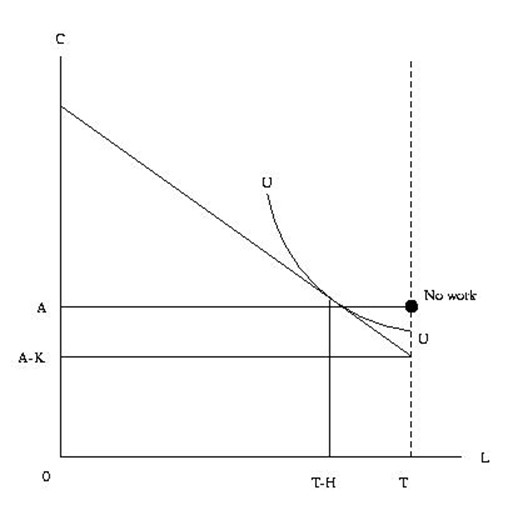


A worker will not accept a job offer or continue in a particular job unless they work sufficient hours so that these fixed costs of going to work are recovered along with receiving sufficient reward for giving up pursuing other job openings open now and in the future and for forgoing leisure and the option of making other uses of their time (Cogan 1981; Hamermesh and Donald 2007).

Cogan (1981) estimated that the average fixed time and money costs of married women entering the workforce was 28 per cent of their earnings, and also estimated that the minimum number of hours a married woman was willing to supply in the labour market was 1,300 hours per year.
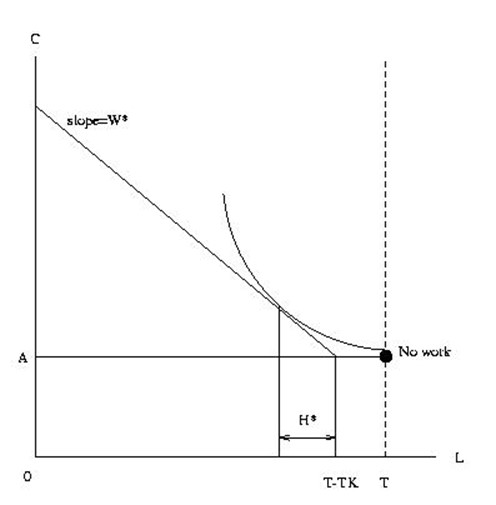

There may be a preference for fewer working days over fewer hours per day to reduce the time and money costs of going to work. Donald and Hamermesh (2009) estimated that fixed costs of going to work are equal to about 8 per cent of income. The fixed costs of working provide an incentive to workers to bunch activities.

The fixed timing costs of labour market entry

A surprisingly large part of the fixed costs of working comes from disruption in the ability to use spare time effectively (Donald and Hamermesh 2009, 2007). Entering or remaining in the workforce for any time at all significantly affects the effective allocation and enjoyment of time outside of working hours. This disruption to the effective use of the time that is left outside of working hours is the fixed timing cost of labour market entry.

One way to reduce this disruption from entering the labour force at all is to seek to reduce the number of days worked per week rather than the number of hours per day.

Leisure and other private uses of time are displaced if the individual takes or stays in even a small part-time job. Workers must use their reduced amount of remaining free time to catch-up on tasks, often at the weekend that they could have done if they were not working.

Leisure time may be the first to go because many personal tasks can be rescheduled but must be done eventually. These range from cooking, eating, and cleaning to personal upkeep, sleep and rest. Tasks must be hurried or done to a lower quality (Donald and Hamermesh 2009).

Routine – having the same schedule from day to day – saves time (Hamermesh 2005). Routine enables people to economise on the set-up costs of consumption, leisure and going to work.

Entering the work-force for any time at all to work even a small number of hours per day or per week calls for new daily and weekly routines and disrupts many existing routines that make better use of leisure, family and other uses of time (Hamermesh 2005).

Entering the workforce constrains the unfettered use of spare time. Working increases the fixed costs of coordinating family and leisure times. Workers must surround working times with buffers to ensure they are not late for work.

One reality of rising incomes is time become more valuable. A rise in wages raises the value of time because time is a finite and irreplaceable resource. Time cannot be stored or bought and sold but people can try and make better use of it.

With only 24 hours still in every day, the cost of time-intensive activities including working will rise as incomes increase. People shift away from time intensive activities and buy more of those products that are time saving or which are less time intensive to consume. Time is money and this maxim applies with greater resonance as incomes and wealth increase.

Another important fixed time costs of labour market entry is its impact on the efficiency of the remaining time devoted to leisure, household production and other activities when even a small amount of market work is undertaken. Spare time is of much less value if part of every day is to be spent at work.

Fixed timing costs arise because of a need to hurry to get to work on time and forego other activities to be rested for work the next morning. The requirement to attend work blocks out certain days from major other uses of that day and reduces the time available in any day of part-day work for leisure, family time and household production.

Household production refers to the goods and services made at home which could be purchased in the market from a third-party. These include food preparation, cooking, carer obligations, and household cleaning. There are also various other household tasks that must perform for one-self which are essentially personal maintenance and leisure.

Working even a few hours can reduce the worker’s efficiency in household production and other non-market activities and may require the worker to buy goods and services that were previously produced at home. This reduces the net financial rewards of working. Fewer full days of work, rather than fewer hours per day is less disruptive to leisure and the other uses of personal time.

The fixed time costs of market work might induce workers to engage in different mixes of other activities. The additional hours of work during the week affect the allocation of time on a non-working weekend day. They reduce leisure time on weekends and increase weekend time devoted to household production by those who do market work on week days. Workers catch up at the weekend on the household production that the rigidities of their market work prevented them from doing during the week.

Stress is an important fixed cost of working. Workers spend non-market time worrying or thinking about work-problems. Even a few hours of market work will place a worker at risk of some stress.

Floors and ceilings on the structure of the working week

The fixed costs of going to work and the fixed time cost of labour market entry both place constraints on the willingness of workers to accept a job offer involving a zero-hours contract. These contracts must offer something extra over competing job options.

The employer must offer something extra to prospective recruits to induce them to sign a zero-hours contract. There must be something substantial to overcome both the fixed costs of work, such as commuting, and the less obvious but still substantial fixed costs of labour market entry.

Any commitment to work, such as working on a zero hours contract, carries with it significant costs in terms of disruption to the rest of the day, the rest of the working week and the amount of the weekend that is spent on leisure versus resting from work and catching up on tasks that otherwise could have been done during the week but for work commitments.

A zero-hours contract must pay enough over the expected life time of the job to make up for the costs of going to work as well as the disruption and loss of leisure time and also the pure disutility of working before the worker breaks even on working.

As the Unite Union official noted, zero hours contracts appear to be most prevalent in the fast food sector. Job turnover rates in the sector can be several hundred per cent per year.

Many of the workers in the fast food sector, as the Unite union official himself noted, are young. Teenagers and young workers changed jobs frequently, particularly those who are studying part-time or full-time work, injuring the summer.

As such, zero-hours contracts in any particular job will have a short expected life over which the teenager or young worker would have to recoup for the fixed cost of working and the fixed cost of any labour market entry. Employers would have to offer some sort of premium or other implicit guarantee of regular work to induce prospective young recruits to sign a zero hours contract.

The type of workers who will profit from signing a zero hours contracts of those workers with few other demands on their time and flexible days. The workers who might find zero hours contract appealing will be those who do have much routine in their day. Workers who have a considerable amount of routine in their day such as because of family commitments will not find the wage offers in zero hours contracts appealing.

There will be job sorting: workers who have low fixed costs of working and low fixed costs of labour market entry will be attracted to zero-hours contracts.

Employers profit from offering zero hours contracts to workers who don’t want to make a regular commitment to come into work every day. Teenagers and students fall into this category, which makes it less surprising that zero hours contracts appear to be most common in the fast food sector.

There are mutual gains in the fast food sector to both employers and workers from zero hours contracts when there are peaks and troughs in product demand, and some teenagers and young workers have a low cost of coming into work at short notice.

Richard Posner on academic moralists

Image

Some economics of zero hours contracts – part 1: concepts, definitions and initial puzzles

Unions say New Zealand employers are following trends overseas and adopting zero hour contracts: workers have to be available for work, but have no hours guaranteed. Unite Union national director Mike Treen said:

McDonald’s, KFC, Pizza Hut, Starbucks, Burger King, Wendy’s – all of the contracts have no minimum hours, and so people can be – and are – rostered anywhere from three to 40 hours a week, or sometimes 60 hours a week, and it depends a lot on how you get on with your manager.

No official figures are available on the number of people on zero hour contracts in New Zealand, but they are are available in the UK in the chart below. About 250,000 workers in the UK work on zero hours contracts.

These workers agree not to work for anyone else, but are not promised regular work at all with their new employer.

The question that must always be asked is why do people who are deemed competent to vote and drive cars sign zero hours contract? What is in it for them? David Friedman asked this question about the economics of restraint of trade agreements for employees:

…the employer who insists on an employee signing a non- competition agreement will find that he must pay, in additional wages or other terms of employment, the cost that the agreement imposes upon the employee, as measured by the employee and revealed in his actions.

It follows that the employer will insist on such an agreement only if he believes that its value to him is greater than its cost to the employee…

The contract is designed, after all, with the objective of getting the other party to sign it.

If I am designing the contract and offering it to many other parties, that may put me in a position to commit myself to insisting on terms that give me a large fraction of the benefit that the contract produces.

But it is still in my interest to maximize the size of that net benefit-which I do by only insisting on terms that are worth at least as much to me as they cost the other party.

The inherent inequality of bargaining power between employers and workers and the reserve army of the unemployed must not be all that they are cracked up to be these days if low paid workers have to sign legally enforceable restraint of trade agreements.

Obviously, the few members of the reserve army of the unemployed lucky enough to have a low pay, insecure job that offers no regular hours today have so many other job options that their employers must get them to agree not to quit and job-hop at will. Jobs must be readily available  to low paid workers for otherwise why do employers insist on this restraint of trade in employment agreements.

Why do workers sign these contracts, which can include a promise of exclusive services – not working for other employers? Several subsequent blog posts will attempt to answer this question

The inherent inequality of bargaining power between employers and workers doesn’t work too well here because  the worker is accepting this job as compared to these other options , which may include employment in an existing job.

Once a worker is on-the-job and has accumulated job specific human capital, issues of post-contractual opportunism come up on both sides.

An important function of the employment contract is to prevent attempts to renegotiate terms and conditions once one side of the other has committed to the relationship and will find it costly to go elsewhere.

Zero hours contracts are negotiated upfront, which makes them unappealing to anyone already has a job, unless the terms and conditions of a zero hour contract, including the wages paid are much more appealing than officious observers make out.

Richard Epstein made this point about the general operation of the labour market, which is of relevance to our search to the answers to the questions posed by this blog post:

Labour markets are not characterized by tricky externalities. They do not pollute streams or require the creation of public goods. They are not characterized by genuine breakdowns in information, as workers are in a position to observe the conditions of their employment on a day-to-day basis.

Left to their own devices, without explicit support from union activities, they will be highly competitive, and thus work hard to allocate scarce human capital to its most productive use.

Workers have the option to quit for higher wages, and employers can always seek out low cost techniques to reduce their labour costs.

Any short-term dislocation for firms or individuals is more than offset by the overall increase in the system productivity, spurred in part by clear signals that should increase investments in human capital.

Zero hours contracts are a new labour market phenomena . That is no reason to automatically default to monopoly explanations for their emergence, including their emergence in a highly competitive industries and highly competitive labour markets where  employees change jobs regularly.

As Coase said in the context of industrial organisation as a whole and novel business practices in particular:

One important result of this preoccupation with the monopoly problem is that if an economist finds something—a business practice of one sort or other—that he does not understand, he looks for a monopoly explanation. And as in this field we are very ignorant, the number of ununderstandable practices tends to be rather large, and the reliance on a monopoly explanation, frequent.

The next blog post arises out of my first exposure to the labour economics of working arrangements. Specifically, how the fixed costs of employment and the fixed cost of going to work  both lead to minimum hours constraints in most employment contracts.

Most of what I know about the  labour, personnel and organisational economics of working arrangements  was about explaining  why employers would expect an employee to work as a minimum number of hours if they were to employ them at all. Always good to start with explanations as to why zero hours should not exist, but they clearly do.

Subsequent blog posts will discuss zero hours contracts in the context of the team production and organisational architecture; and zero hours contracts, equalising differentials and job sorting.

The Effective Decision – Peter Drucker

1. Classifying the problem. Is it generic? Is it exceptional and unique? Or is it the first manifestation of a new genus for which a rule has yet to be developed?

2. Defining the problem. What are we dealing with?

3. Specifying the answer to the problem. What are the “boundary conditions”?

4. Deciding what is “right,” rather than what is acceptable, in order to meet the boundary conditions.. What will fully satisfy the specifications before attention is given to the compromises, adaptations, and concessions needed to make the decision acceptable?

5. Building into the decision the action to carry it out. What does the action commitment have to be? Who has to know about it?

6. Testing the validity and effectiveness of the decision against the actual course of events. How is the decision being carried out? Are the assumptions on which it is based appropriate or obsolete?

via The Effective Decision.

Claudia Goldin on the main cause of the gender wage gap

Image

Academic jargon decoded

image

Image

Previous Older Entries Next Newer Entries

Bassett, Brash & Hide

Celebrating humanity's flourishing through the spread of capitalism and the rule of law

Truth on the Market

Scholarly commentary on law, economics, and more

The Undercover Historian

Beatrice Cherrier's blog

Matua Kahurangi

Celebrating humanity's flourishing through the spread of capitalism and the rule of law

Temple of Sociology

Celebrating humanity's flourishing through the spread of capitalism and the rule of law

Velvet Glove, Iron Fist

Celebrating humanity's flourishing through the spread of capitalism and the rule of law

Why Evolution Is True

Why Evolution is True is a blog written by Jerry Coyne, centered on evolution and biology but also dealing with diverse topics like politics, culture, and cats.

Down to Earth Kiwi

Celebrating humanity's flourishing through the spread of capitalism and the rule of law

NoTricksZone

Celebrating humanity's flourishing through the spread of capitalism and the rule of law

Homepaddock

A rural perspective with a blue tint by Ele Ludemann

Kiwiblog

DPF's Kiwiblog - Fomenting Happy Mischief since 2003

The Dangerous Economist

Celebrating humanity's flourishing through the spread of capitalism and the rule of law

Watts Up With That?

The world's most viewed site on global warming and climate change

The Logical Place

Tim Harding's writings on rationality, informal logic and skepticism

Doc's Books

A window into Doc Freiberger's library

The Risk-Monger

Let's examine hard decisions!

Uneasy Money

Commentary on monetary policy in the spirit of R. G. Hawtrey

Barrie Saunders

Thoughts on public policy and the media

Liberty Scott

Celebrating humanity's flourishing through the spread of capitalism and the rule of law

Point of Order

Politics and the economy

James Bowden's Blog

A blog (primarily) on Canadian and Commonwealth political history and institutions

Science Matters

Reading between the lines, and underneath the hype.

Peter Winsley

Economics, and such stuff as dreams are made on

A Venerable Puzzle

"The British constitution has always been puzzling, and always will be." --Queen Elizabeth II

The Antiplanner

Celebrating humanity's flourishing through the spread of capitalism and the rule of law

Bet On It

Celebrating humanity's flourishing through the spread of capitalism and the rule of law

History of Sorts

WORLD WAR II, MUSIC, HISTORY, HOLOCAUST

Roger Pielke Jr.

Undisciplined scholar, recovering academic

Offsetting Behaviour

Celebrating humanity's flourishing through the spread of capitalism and the rule of law

JONATHAN TURLEY

Res ipsa loquitur - The thing itself speaks

Conversable Economist

Celebrating humanity's flourishing through the spread of capitalism and the rule of law

The Victorian Commons

Researching the House of Commons, 1832-1868

The History of Parliament

Articles and research from the History of Parliament Trust

Books & Boots

Reflections on books and art

Legal History Miscellany

Posts on the History of Law, Crime, and Justice

Sex, Drugs and Economics

Celebrating humanity's flourishing through the spread of capitalism and the rule of law

European Royal History

Exploring the Monarchs of Europe

Tallbloke's Talkshop

Cutting edge science you can dice with

Marginal REVOLUTION

Small Steps Toward A Much Better World

NOT A LOT OF PEOPLE KNOW THAT

“We do not believe any group of men adequate enough or wise enough to operate without scrutiny or without criticism. We know that the only way to avoid error is to detect it, that the only way to detect it is to be free to inquire. We know that in secrecy error undetected will flourish and subvert”. - J Robert Oppenheimer.

STOP THESE THINGS

The truth about the great wind power fraud - we're not here to debate the wind industry, we're here to destroy it.

Lindsay Mitchell

Celebrating humanity's flourishing through the spread of capitalism and the rule of law

Alt-M

Celebrating humanity's flourishing through the spread of capitalism and the rule of law

croaking cassandra

Economics, public policy, monetary policy, financial regulation, with a New Zealand perspective

The Grumpy Economist

Celebrating humanity's flourishing through the spread of capitalism and the rule of law

International Liberty

Restraining Government in America and Around the World