On the decline of socialism in the Americas
21 Jan 2016 Leave a comment
in applied price theory, development economics, economics of bureaucracy, growth disasters, Marxist economics, Public Choice, rentseeking Tags: 2016 presidential election, Argentina, Brazil, Venezuela
Socialism with an iPad @jeremycorbyn @JohnMcDonnellMP
18 Jan 2016 Leave a comment
in economics of bureaucracy, entrepreneurship, Marxist economics
The Civil Service on Helping Foreign Nations
13 Jan 2016 Leave a comment
in economics of bureaucracy, Public Choice, television Tags: Yes Prime Minister
How big is Medsafe’s invisible graveyard? @PeterDunneMP @annetterongotai
17 Dec 2015 1 Comment
in economics of bureaucracy, economics of regulation, health economics, politics - New Zealand Tags: drug lags, Drug safety
Medsafe replicates in part or in whole the drug approval processes of its overseas counterparts. There is expedited processing for drugs already approved overseas.
Every day in which a drug approval application is sitting on the desk of a bureaucratic at Medsafe is a day in which another New Zealander may die but for that drug.
That delay in access to drugs because of the duplication in approval processes is the invisible graveyard of Medsafe. My Official Information Act requests so far have been unable to access a cost benefit analysis at the Ministry of Health that quantifies the size of that invisible graveyard.

If economists have a bitter drinking song it would be “how many people has the FDA killed today”. Many drugs became available years after they were on the market outside the USA because of drug approval lags at the FDA. The dead are many. To quote David Friedman:
In 1981… the FDA published a press release confessing to mass murder. That was not, of course, the way in which the release was worded; it was simply an announcement that the FDA had approved the use of timolol, a ß-blocker, to prevent recurrences of heart attacks. At the time timolol was approved, ß-blockers had been widely used outside the U.S. for over ten years.
It was estimated that the use of timolol would save from seven thousand to ten thousand lives a year in the U.S. So the FDA, by forbidding the use of ß-blockers before 1981, was responsible for something close to a hundred thousand unnecessary deaths.
The only rational basis for duplicating overseas drug safety approval processes is the honest belief that a New Zealand process can pick up errors. These errors must be so large that they justify the delay. If there are no such errors to pick up in a cost justified manner, the drug approval branch of Medsafe just adds to the invisible graveyard.
The Ministry of Health did advise its Minister of the unilateral recognition model in Singapore. If a drug is registered in two trusted jurisdictions, it is fast tracked. If it is registered in one other trusted jurisdiction, it goes through an expedited process. This process appears to only cut the registration process for a drug from 270 days to 240 days.
The truncated approaches when there is approval of the drug in a trusted jurisdiction usually call for access to evaluation reports and other red tape. What can drug trials in New Zealand
find out that is not already known? Medsafe targets processing applications for the approval of new drugs in New Zealand to be done within 200 days. That’s 200 days too many.

My preferred unilateral recognition process consists of authenticating the drug registration certificate from a trusted overseas jurisdiction. It would be a post-box process. The G7 countries plus Australia should be this list of trusted overseas jurisdiction. There should be automatic recognition in New Zealand of any drug registration in those jurisdictions.
There is no reason to believe that Medsafe will pick up errors of trusted jurisdictions overseas. Medsafe denied New Zealanders access to four drugs approved in comparable regulatory jurisdictions in the last three years. Medsafe rejected two other drugs in the last three years but these drugs were not approved in comparable jurisdictions. Medsafe is not involved in the funding of medicines; this is the responsibility of PHARMAC.
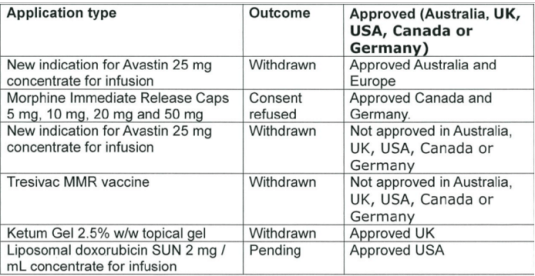
Source: data released 29 October 2015 pursuant to an Official Information Act request to the Ministry of Health.
Medsafe is turning down not even a handful of drugs were approved overseas jurisdictions in the past three years. Was that worth the wait? Was that worth a larger invisible graveyard?
The net benefits of the entire drug approval framework over the past three years in New Zealand is riding out on rejecting for approval half a dozen drugs, four of which are approved as safe in other comparable jurisdictions.
The size of the invisible graveyard has been quantified in the USA. The Prescription Drug User Fee Acts (PDUFA) reduced the drug approval time lag by 10 months:
Converting these economic gains into equivalent health benefits, we find that the more rapid access of drugs on the market enabled by PDUFA saved the equivalent of 140,000 to 310,000 life years.
A few drugs were approved that were later withdrawn. Their unfortunate consequences must always be weighed against the drugs that got to the market faster, saving lives, relieving pain and curing illnesses. That trade-off must be faced up to openly rather than as it is now left in the invisible graveyard.

The Taylor rule and the Fed’s interest rate policies compared
17 Dec 2015 2 Comments
in economics of bureaucracy, macroeconomics, monetary economics, politics - USA
Public and private sector union membership in the USA since 1973
14 Dec 2015 Leave a comment
in economic history, economics of bureaucracy, labour economics, politics - USA, Public Choice, rentseeking, unions Tags: union membership, union power, union wage premium
Public and private sector union membership took completely different paths in the USA over the last 40 years. Public sector union memberships held its own. There is been a steady decline in union membership in the private sector. The exception is construction unions which held their own in membership for the last 10 years.
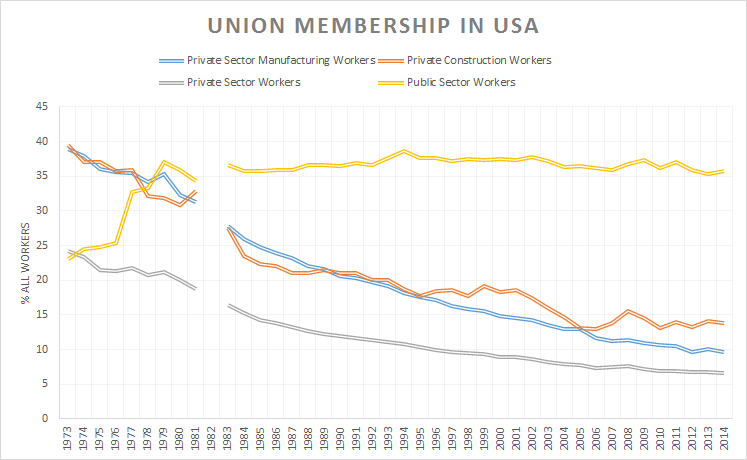
Source: unionstats.com.
@WorldBank is telling porky pies about #EndPoverty and fighting #ClimateChange
13 Dec 2015 Leave a comment
in development economics, economics of bureaucracy, energy economics, environmental economics, global warming, growth disasters, growth miracles Tags: climate aid, climate alarmists, extreme poverty, global poverty, green rent seeking, overseas aid, overseas development assistance, World Bank

HL Mencken on the @realDonaldTrump & @BernieSanders
13 Dec 2015 Leave a comment
in economics of bureaucracy, economics of media and culture, economics of regulation, income redistribution, Marxist economics, politics - USA, Public Choice, rentseeking Tags: 2016 presidential election, expressive voting, left-wing populists, Leftover Left, rational ignorance, rational irrationality, right-wing populists

Milton Friedman explains the public choice error
12 Dec 2015 Leave a comment
in comparative institutional analysis, constitutional political economy, economics of bureaucracy, Milton Friedman, Public Choice Tags: grass is greener fallacy, public choice error, The fatal conceit, The pretense to knowledge, unintended consequences
The obvious reason for the popularity of behavioural economics
10 Dec 2015 Leave a comment
in applied price theory, behavioural economics, comparative institutional analysis, economics of bureaucracy, Public Choice, rentseeking Tags: expressive voting, rational ignorance, rational irrationality, special interests

Corruption vs. Human Development
09 Dec 2015 Leave a comment
in development economics, economic history, economics of bureaucracy, economics of crime, economics of regulation, growth disasters, growth miracles, income redistribution, industrial organisation, law and economics, Public Choice, rentseeking Tags: bribery and corruption, capitalism and freedom, rent seeking, rule of law, The Great Fact
Corruption vs. Human Development (HDI) http://t.co/WNlSMYzdWD—
Max Roser (@MaxCRoser) August 08, 2015
Time spent paying taxes in USA, UK, France, Germany, Italy, Japan, Australia and New Zealand
08 Dec 2015 Leave a comment
in economics of bureaucracy, public economics
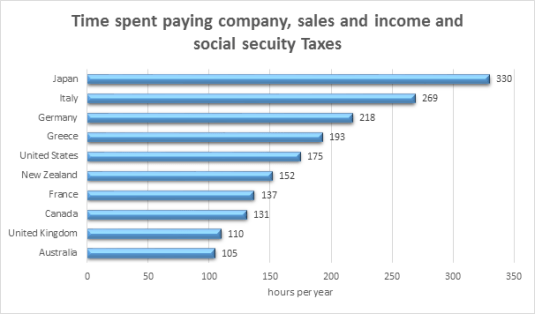
Source: Download: Paying Taxes 2016: PwC.

If poverty could be solved by experts, we’d have solved it in 30s @HelenClarkUNDP
03 Dec 2015 Leave a comment
in constitutional political economy, development economics, economics of bureaucracy, growth disasters, growth miracles
@BillEnglishMP why no SOEs portfolio report for 2 years @TaxpayersUnion @JordNZ
01 Dec 2015 1 Comment
in applied price theory, economics of bureaucracy, industrial organisation, politics - New Zealand
For some months now I’ve been trying to ascertain the latest performance of the state owned enterprises (SOE) portfolio. The last Crown Portfolio Report was issued in December 2013. That was two long years ago. I therefore asked for access to the quarterly report on the Crown commercial portfolio to the Minister of Finance by the Treasury.

My Official Information Act request to the Treasury was declined on commercial in confidence grounds. Not only was my request to the Minister of Finance similarly refused, he told me to do the analysis myself by working my way through the 49 annual reports of the state owned enterprises in New Zealand.

Source: Bill English, Minister of Finance, Response to Official Information Act request, 30 November 2015.
Look it up yourself is not a good approach to public accountability to busy taxpayers who have lives to lead. There is a very well-paid Treasury that can do that analysis and has been doing that analysis every year until two years ago.
There is been no explanation for the non-publication of the Crown Portfolio report for two years. That is unacceptable in terms of tax payer accountability.
What is weird about this blow to taxpayer accountability is I have been refused access to Treasury analysis of public information. I’m not actually asking for the analysis. I am asking for a tabulation of 49 annual reports of state owned enterprises. Somehow a tabulation of public information is commercial in confidence despite the fact I can do it myself. This makes no sense.
It appears that for two years now the Minister of Finance has not been advised on the annual rates of return of the state owned enterprise portfolio as a whole. If he had, the Treasury and the Minister of Finance would have supplied that data to me in the course of my Official Information Act requests because it was obvious that I was after that information and they have a duty to be helpful when processing Official Information Act requests.
The Minister of Finance should be more curious about tens of billions of dollars in taxpayer’s assets that currently struggle to offer a positive return.

Source: The New Zealand Treasury, Crown Portfolio Report 2013, p. 41.
No publicly listed company could fail to publish its annual report. The fact that this has not been picked up as an example of why public ownership is inferior. No one profits from highlighting these governance shortcomings.
If the state owned enterprises were listed on the stock exchange, investors would sell off a company that missed its reporting date. Missing a reporting date is a sure sign of both poor governance and poor performance. Entrepreneurs would see a poorly governed company as a takeover opportunity. There are no similar disciplines for state owned enterprises whose governance and transparency falls short.
By the way, the original objective of my research was to compare state-owned enterprise performance under the current and previous governments. The Treasury was unable to supply data further back than 2007. Everything before then is on paper. The individual company reports have to be looked up by hand.
Nothing is at the fingertips of the Treasury if the Minister of Finance was interested in knowing whether his stewardship of state owned enterprises was superior to that of his predecessors.


Recent Comments