
Celebrating humanity's flourishing through the spread of capitalism and the rule of law
30 Nov 2015 Leave a comment
in economics of bureaucracy, energy economics, environmental economics
17 Nov 2015 Leave a comment
in applied price theory, applied welfare economics, comparative institutional analysis, constitutional political economy, development economics, economic history, economics of bureaucracy, growth disasters, growth miracles, Public Choice Tags: bourgeoisie deal, capitalism and freedom, Deirdre McCloskey, industrial revolution, The Great Enrichment, The Great Escape, The Great Fact, Thomas Piketty

.
15 Nov 2015 Leave a comment
in applied price theory, economics of bureaucracy, Public Choice, rentseeking Tags: bootleggers and baptists, Bruce Shanley, pressure groups
11 Nov 2015 Leave a comment
in development economics, economics of bureaucracy, growth miracles
31 Oct 2015 Leave a comment
in applied price theory, Austrian economics, comparative institutional analysis, economic history, economics of bureaucracy, economics of media and culture, industrial organisation, Public Choice, survivor principle Tags: creative destruction, entrepreneurial alertness, industry policy, Internet, picking losers, picking winners, The fatal conceit, The meaning of competition, The pretense to knowledge
31 Oct 2015 Leave a comment
in applied price theory, Austrian economics, comparative institutional analysis, constitutional political economy, defence economics, economics of bureaucracy, economics of regulation, industrial organisation, labour economics, Ludwig von Mises, Public Choice, survivor principle Tags: Nazi Germany
#TBT Ludwig von Mises' 1942 Letter to the Editor in the @nytimes on Nazi socialism. http://t.co/kv7TFekY8J—
Mises Institute (@mises) October 15, 2015
25 Oct 2015 Leave a comment
in comparative institutional analysis, constitutional political economy, development economics, economic history, economics of bureaucracy, income redistribution, Marxist economics, Milton Friedman, Public Choice, rentseeking, technological progress Tags: expressive voting, interest groups, Leftover Left, logic of collective action, Mancur Olson, Naomi Klein, pressure groups, rational ignorance, rational irrationality, rise and decline of nations, Twitter left

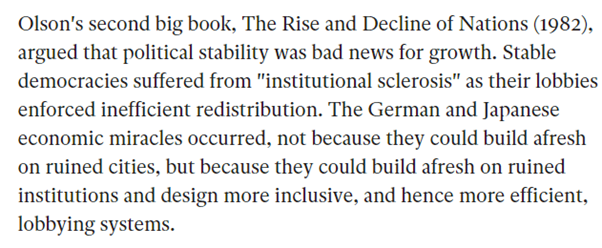
Source: quoted by Naomi Klein in “The Shock Doctrine”.
LA premiere tonight @NaomiAKlein @avilewis @mrdannyglover in person Q&A 7.30pm sundancecinemas.com http://t.co/wRkPFbnUHu—
Changes Everything (@thischanges) October 16, 2015
1. There will be no countries that attain symmetrical organization of all groups with a common interest and thereby attain optimal outcomes through comprehensive bargaining.
2. Stable societies with unchanged boundaries tend to accumulate more collusions and organizations for collective action over time.
3. Members of “small” groups have disproportionate organizational power for collective action, and this disproportion diminishes but does not disappear over time in stable societies.
4. On balance, special-interest organizations and collusions reduce efficiency and aggregate income in the societies in which they operate and make political life more divisive.
5. Encompassing organizations have some incentive to make the society in which they operate more prosperous, and an incentive to redistribute income to their members with as little excess burden as possible, and to cease such redistribution unless the amount redistributed is substantial in relation to the social cost of the redistribution.
6. Distributional coalitions make decisions more slowly than the individuals and firms of which they are comprised, tend to have crowded agendas and bargaining tables, and more often fix prices than quantities.
7. Distributional coalitions slow down a society’s capacity to adopt new technologies and to reallocate resources in response to changing conditions, and thereby to reduce the rate of economic growth.
8. Distributional coalitions, once big enough to succeed, are exclusive, and seek to limit the diversity of incomes and values of their membership.
9. The accumulation of distributional coalitions increases the complexity of regulation, the role of government, and the complexity of understandings, and changes the direction of social evolution.
Source: Obituary: Professor Mancur Olson | Obituaries | News | The Independent
23 Oct 2015 Leave a comment
in applied price theory, economics of bureaucracy, financial economics, industrial organisation, managerial economics, organisational economics, politics - New Zealand
The current controversy over payment of dividends by Housing New Zealand is misplaced because of the subtle connections between payment of dividends and greater value for money.
By paying dividends, the investment priorities of Housing New Zealand are subject to additional ministerial scrutiny. Its capital program is scrutinised in greater detail by the Cabinet because ministers must fund it against competing bids across the entire budget and parliamentary scrutiny process.
Each budget bid is championed by a minister, each of whom must make their case every year against all-comers. This annual competition for a central pool of capital filters out lower value investment bids.
If dividends were not paid but were instead retained as free cash flows in the agency, there would be less ministerial scrutiny of Housing New Zealand because it would have a smaller role in annual budget rounds. Ministers and the Parliament sit up and pay attention when money is to be spent, as they should, and the larger is the sum in the budget, the more attention is paid to value for the money sought. Funding projects with retained dividends may reduce ministerial and parliamentary scrutiny.
Payment of dividends does not reduce the ability of Housing New Zealand to engage in new capital spending. If the dividends were not paid, the amount of new capital spending from budget appropriations would be reduced dollar for dollar.
22 Oct 2015 Leave a comment
in comparative institutional analysis, constitutional political economy, economics of bureaucracy, politics - New Zealand, Public Choice Tags: economics of federalism, Switzerland
Suggestions by the New Zealand Initiative for regions to be able to ask to be exempt from some national policies was against a background that New Zealand is too small to be a federal state. The New Zealand provinces were abolished in 1876. Switzerland seems to still put bread in the shops despite having many tiny Cantons and half-Cantons.
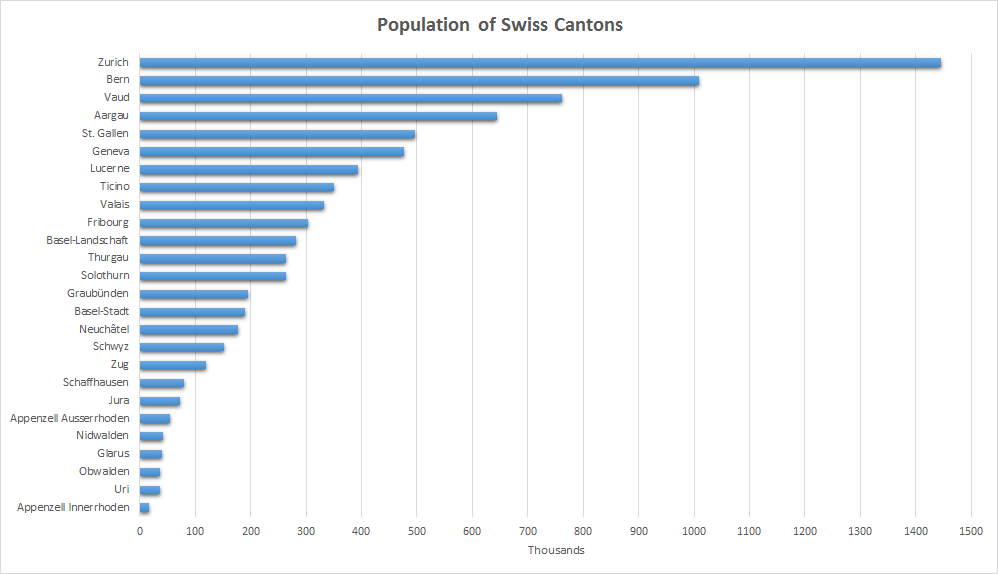
Source: Swiss Statistics – Cantons, communes.
So many American states have smaller populations are New Zealand, half in all, that is difficult to present them on a chart. All managed to be richer the New Zealand despite the horrors of federalism or because of it. These small state populations are before considering how much local government legislative power there is, including taxing and spending powers, city income taxes and city sales taxes, and county and local police forces.

Source: List of U.S. states and territories by population – Wikipedia, the free encyclopedia.
The median national population size of countries is not much more than New Zealand’s current population.
As I argued in my previous post on distance, New Zealand were prosperous from the time of European settlement despite a small population and their great distance from the main markets of the world on each side of the Atlantic.
Half the world's population lives inside this circle. http://t.co/XlTeEsTZkn—
Weird Science (@weird_sci) October 17, 2015
Of the ten richest countries in terms of GDP per capita, only four have populations above one million people (Alesina 2003). These countries are the USA (290 million people), Switzerland (7 million people), Norway (4 million people) and Singapore (3 million people). Of these four nations, two are below the global national population median of six million (Alesina 2003).
18 Oct 2015 Leave a comment
in constitutional political economy, development economics, economics of bureaucracy, environmental economics, environmentalism, global warming, growth disasters, growth miracles, international economics, politics - Australia, politics - New Zealand, politics - USA, Public Choice, rentseeking Tags: bootleggers and baptists, climate alarmism, expressive voting, free-riders, global warming, green tariffs, international public goods, Leftover Left, New Zealand Greens, Twitter left
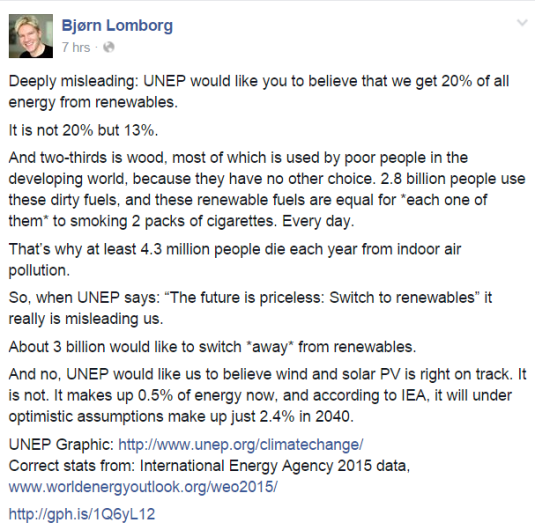
It is time for the environmental movement to face up to the fact that there never will be an international treaty to restrain carbon emissions. The practical way to respond to global warming is healthier is wealthier, richer is safer. Faster economic growth creates more resources for resilience and adaptation to a changing environment.
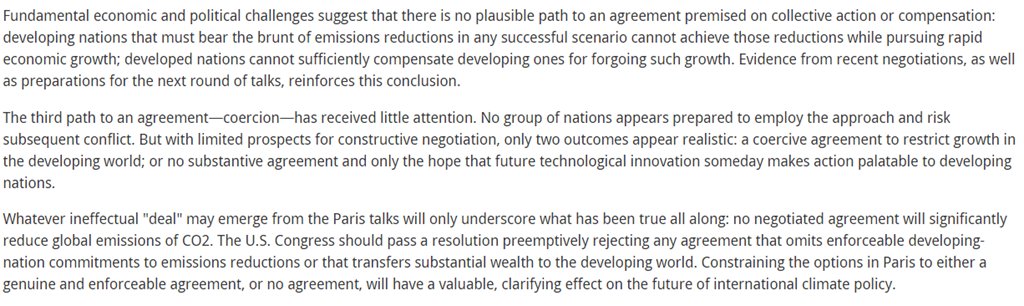
NEW REPORT: The Futility and Farce of Global Climate Negotiations bit.ly/1LvFFv3 http://t.co/TwbFUwaPlm—
Manhattan Institute (@ManhattanInst) October 17, 2015
India's target compared to its recent history http://t.co/pIvwhoSTpL—
Richard Tol (@RichardTol) October 02, 2015
15 Oct 2015 Leave a comment
in economics of bureaucracy, television Tags: Yes Prime Minister
03 Oct 2015 Leave a comment
in economics of bureaucracy, politics - New Zealand, Public Choice Tags: government waste, Taxpayers'Union
For some reason NZ has a Consul General in Hawaii. Their main job appears to be working with Palau, Micronesia and the Marshall Islands, so I wonder why they are not located on one of those island…
Source: MFAT’s Hawaii Mansion | Kiwiblog
Celebrating humanity's flourishing through the spread of capitalism and the rule of law
Celebrating humanity's flourishing through the spread of capitalism and the rule of law
Celebrating humanity's flourishing through the spread of capitalism and the rule of law
Celebrating humanity's flourishing through the spread of capitalism and the rule of law
Celebrating humanity's flourishing through the spread of capitalism and the rule of law
Celebrating humanity's flourishing through the spread of capitalism and the rule of law
Celebrating humanity's flourishing through the spread of capitalism and the rule of law
Celebrating humanity's flourishing through the spread of capitalism and the rule of law
A History of the Alt-Right
Econ Prof at George Mason University, Economic Historian, Québécois
Celebrating humanity's flourishing through the spread of capitalism and the rule of law
Scholarly commentary on law, economics, and more
Beatrice Cherrier's blog
Celebrating humanity's flourishing through the spread of capitalism and the rule of law
Celebrating humanity's flourishing through the spread of capitalism and the rule of law
Celebrating humanity's flourishing through the spread of capitalism and the rule of law
Why Evolution is True is a blog written by Jerry Coyne, centered on evolution and biology but also dealing with diverse topics like politics, culture, and cats.
Celebrating humanity's flourishing through the spread of capitalism and the rule of law
A rural perspective with a blue tint by Ele Ludemann
DPF's Kiwiblog - Fomenting Happy Mischief since 2003
Celebrating humanity's flourishing through the spread of capitalism and the rule of law
The world's most viewed site on global warming and climate change
Tim Harding's writings on rationality, informal logic and skepticism
A window into Doc Freiberger's library
Let's examine hard decisions!
Commentary on monetary policy in the spirit of R. G. Hawtrey
Thoughts on public policy and the media
Celebrating humanity's flourishing through the spread of capitalism and the rule of law
Politics and the economy
A blog (primarily) on Canadian and Commonwealth political history and institutions
Reading between the lines, and underneath the hype.
Economics, and such stuff as dreams are made on
"The British constitution has always been puzzling, and always will be." --Queen Elizabeth II
Celebrating humanity's flourishing through the spread of capitalism and the rule of law
Celebrating humanity's flourishing through the spread of capitalism and the rule of law
WORLD WAR II, MUSIC, HISTORY, HOLOCAUST
Undisciplined scholar, recovering academic
Celebrating humanity's flourishing through the spread of capitalism and the rule of law
Res ipsa loquitur - The thing itself speaks
In Hume’s spirit, I will attempt to serve as an ambassador from my world of economics, and help in “finding topics of conversation fit for the entertainment of rational creatures.”
Researching the House of Commons, 1832-1868
Articles and research from the History of Parliament Trust
Reflections on books and art
Posts on the History of Law, Crime, and Justice
Celebrating humanity's flourishing through the spread of capitalism and the rule of law
Exploring the Monarchs of Europe


Recent Comments