No, today’s column is not about Trump’s inane protectionism, which is definitely an example of economic illiteracy. It’s about another area where Trump is copying Joe Biden, channeling Elizabeth Warren, mind-melding with AOC, and acting like Bernie Sanders. Though it probably is indirectly connected with protectionism. “Affordability” has become a big issue, in part because […]
As explained in my four-part series (here, here, here, and here) and in this clip from a recent interview, Javier Milei’s first two years have been amazingly successful. There are two points in the interview that deserve emphasis. First, Javier Milei’s libertarian policies already have been extremely beneficial for the Argentine economy. Inflation has dramatically […]
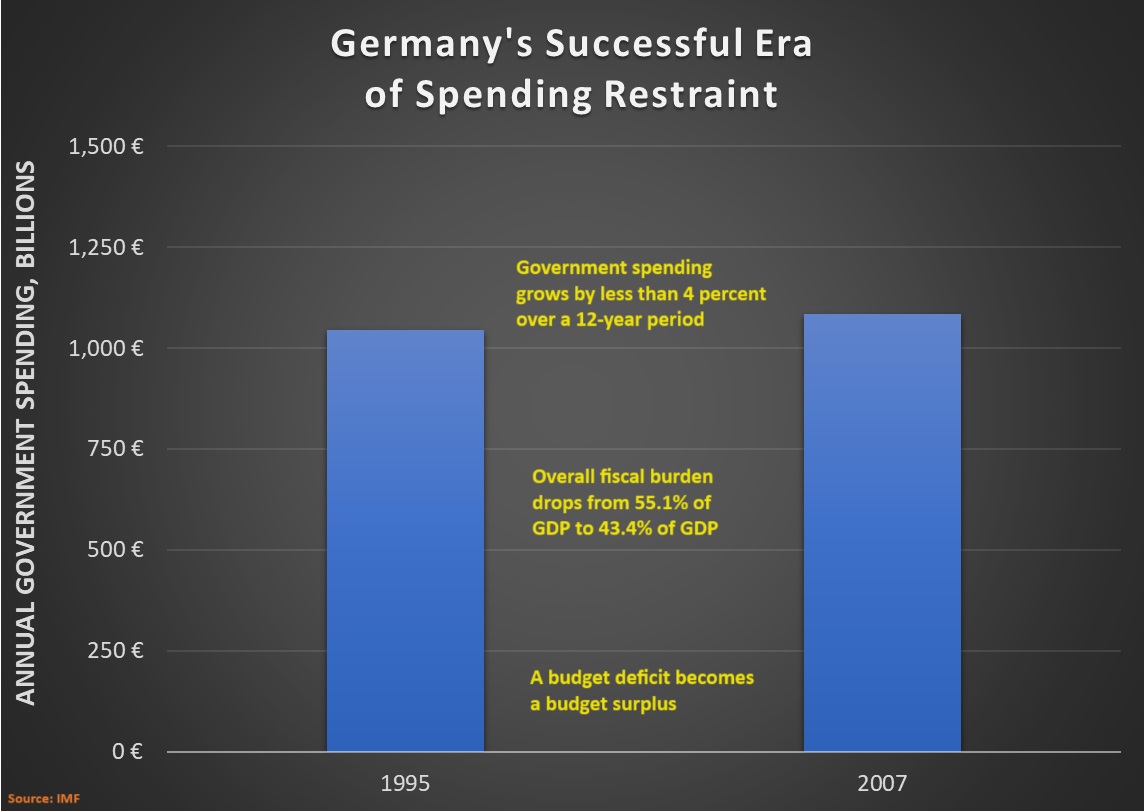
A lot has happened if you look at the past 100 years of German economic policy. Hyperinflation leading to Hitler’s National Socialists taking power. An impressive free-market revival after World War II. A growing welfare state after the imposition of a value-added tax in the 1960s. Some semi-impressive spending restraint starting in the mid-1990s. Very […]
One of Argentine President Milei’s radical reforms was to “take a chainsaw” to rent control laws. Argentina had had some of the most restrictive rent control regimes ever. All of that was abandoned almost over night. Many media outlets noted with glee that rents fell dramatically. Even most economists were surprised by how much supply…
Tweet… is from page 158 of Milton Friedman’s 1953 paper “The Case for Flexible Exchange Rates,” as this paper is reprinted in Friedman’s 1953 collection, Essays in Positive Economics: In brief, it [free trade] is desirable in its own right as one of the basic freedoms we cherish; it promotes the efficient use of resources…
It seems as if a few times every week, I see a headline about President Trump announcing a new tariff or repealing a tariff, sometimes involve many countries and sometime just a few. However, it is not at all clear that any president has a right to alter tariffs. This question was raised before Trump…
Peter Dunne writes – In 1994 the then Labour Opposition resolved to introduce a new top tax rate of 39 cents in the dollar. The reason for the policy was purely political, not fiscal. Labour was shedding votes to Jim Anderton’s left-wing Alliance at the time and wanted to do something symbolic to staunch the flow. […]
This policy has been so popular with economists on a bipartisan basis, yet a recent piece in ReStud raises some doubts, as the wage subsidies induce many to drop out of school: As a complement to the federal earned income tax credit (EITC), some states offer their own EITC, typically calculated as a percentage of […]
The super-rich are super-mobile. So, if a country decides to increase taxes on the super-rich (for example, with a wealth tax), some (but not all) of the super-rich will simply move elsewhere. This should not be a surprise to anyone. And yet, simplistic proposals to tax the super-rich are a favourite policy for some political…
Maybe it’s just because I live in Minnesota, a state where the differences between immigrants from Sweden, Norway, and Finland are still apparent in the names of towns and the surnames of people. But when I run into people who would prefer that the US distribution of income be more equal, they often point to…
I’ve written endlessly about the negative effect of high tax rates on productive behavior, as well as some quirky examples of how taxes lead to some unintended consequences. Today, let’s consider how government regulations distort behavior. We’ll start with a video from Reason about government policies that backfire. In this case, note the second example. […]
Why Evolution is True is a blog written by Jerry Coyne, centered on evolution and biology but also dealing with diverse topics like politics, culture, and cats.
In Hume’s spirit, I will attempt to serve as an ambassador from my world of economics, and help in “finding topics of conversation fit for the entertainment of rational creatures.”




Recent Comments