Two recent joint-papers Did California’s Fast Food Minimum Wage Reduce Employment? by Clemens, Edwards and Meer and The Effects of California’s $20 Fast Food Minimum Wage on Prices by Clemens, Edwards, Meer and Nguyen give what I think is a plausible and consistent account of California’s $20 fast food minimum wage. California’s $20 fast food…
The CA Minimum Wage Increase: Summing Up
The CA Minimum Wage Increase: Summing Up
06 Apr 2026 1 Comment
in applied price theory, econometerics, economics of regulation, income redistribution, labour economics, labour supply, politics - USA, Public Choice, unemployment
Fleecing Rich Taxpayers: Europe vs. the United States
13 Mar 2026 Leave a comment
in applied price theory, entrepreneurship, human capital, income redistribution, labour economics, labour supply, politics - USA, Public Choice, public economics Tags: taxation and entrepreneurship, taxation and investment, taxation and labour supply

I frequently make the point that America’s tax system is more progressive than European tax systems. But not because the United States imposes higher tax rates on upper-income households. Instead, the big difference is that lower-income and middle-class households in the United States face much lower tax burdens than their European counterparts. In those columns, […]
Fleecing Rich Taxpayers: Europe vs. the United States
Eat the Rich: Sanders and Khanna Introduce Federal Billionaires Tax
12 Mar 2026 Leave a comment
in applied price theory, economic growth, entrepreneurship, financial economics, fiscal policy, human capital, income redistribution, labour economics, labour supply, liberalism, macroeconomics, Marxist economics, politics - USA, Public Choice, rentseeking Tags: taxation and entrepreneurship, taxation and investment, taxation and labour supply

Below is my column on Fox.com on the new push by Democrats to impose a wealth tax nationally. While the…
Eat the Rich: Sanders and Khanna Introduce Federal Billionaires Tax
The Nightmare Scenario Leading to a Wealth Tax
07 Mar 2026 Leave a comment
in applied price theory, economic growth, economic history, entrepreneurship, fiscal policy, income redistribution, liberalism, macroeconomics, Marxist economics, politics - USA, Public Choice, public economics Tags: taxation and entrepreneurship, taxation and investment, taxation and labour supply

Is it time to pack our belongings and head to Argentina, where Javier Milei is dramatically improving economic policy and cultural attitudes? I’m joking, but also not joking. The reason I’m not joking is that there’s a very depressing scenario for America’s near-term economic outlook. It involves these six potential developments. Thanks in part to […]
The Nightmare Scenario Leading to a Wealth Tax
Will Denmark and/or the Netherlands Copy Norway’s Failed Wealth Tax?
02 Mar 2026 1 Comment
in fiscal policy, human capital, income redistribution, labour economics, labour supply, macroeconomics, poverty and inequality, Public Choice, public economics Tags: Denmark, taxation and entrepreneurship

Class-warfare tax policy is always a bad idea. Economists generally don’t like class-warfare policies because it is foolish to impose high marginal tax rates on productive behaviors such as investment and entrepreneurship. Politicians should not like class-warfare policies because of the negative impact on jobs and wages for ordinary people as well as the potential negative […]
Will Denmark and/or the Netherlands Copy Norway’s Failed Wealth Tax?
Even auto giants know it: the electric car boom is out of charge
19 Feb 2026 Leave a comment
in economics of bureaucracy, economics of climate change, energy economics, environmental economics, environmentalism, global warming, income redistribution, Public Choice, rentseeking, transport economics Tags: electric cars

By Paul Homewood h/t Ian Magness From the Telegraph: “I think the customer has spoken. That’s the punchline,” said Jim Farley, the chief executive of Ford. The American boss was speaking last week as his company unveiled a $5bn (£3.7bn) annual loss, barely two months after it had booked a shock $19.5bn write-down. The […]
Even auto giants know it: the electric car boom is out of charge
Eat the Rich: California Democrats Trigger a Reverse Gold Rush with a Wealth Tax
16 Feb 2026 Leave a comment
in entrepreneurship, fiscal policy, human capital, income redistribution, labour economics, labour supply, macroeconomics, Marxist economics, politics - USA, Public Choice, public economics Tags: California, regressive left, rule of law, taxation and entrepreneurship, taxation and investment, wealth tax

Below is my column in the California Post and New York Post on the exodus of wealthy taxpayers from the state as Democrats seek to trap them with a retroactive wealth tax. They are engineering a type of reverse Gold Rush as up to a trillion dollars leave the state with a line of U-Hauls […]
Eat the Rich: California Democrats Trigger a Reverse Gold Rush with a Wealth Tax
The Rise and Fall (and Rise) of Sweden, Part III
10 Feb 2026 Leave a comment
in applied price theory, comparative institutional analysis, constitutional political economy, economic growth, economic history, economics of regulation, fiscal policy, income redistribution, industrial organisation, labour economics, labour supply, macroeconomics, Public Choice, public economics Tags: Sweden

Based on a video from the Center for Freedom and Prosperity back in 2010, as well a video from Johan Norberg I shared in 2016, there’s a lot to learn by looking at Swedish economic history. Here’s a more recent video that also looks at that nation’s economic track record. You’ll notice a similar message […]
The Rise and Fall (and Rise) of Sweden, Part III
Debunking Trump’s Error-Filled WSJ Column
04 Feb 2026 Leave a comment
in applied price theory, budget deficits, economic growth, economic history, fisheries economics, history of economic thought, income redistribution, industrial organisation, international economic law, international economics, macroeconomics, politics - USA, Public Choice, rentseeking Tags: free trade, tarrifs
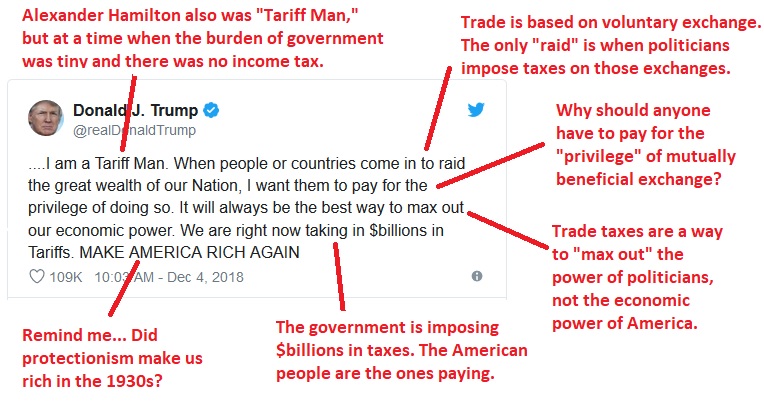
Donald Trump, who describes himself as “Tariff Man,” recently wrote a column in defense of his protectionist trade policy for the Wall Street Journal. After reading the column, my first thought was that Trump was trying to show he is more economically illiterate than Joe Biden (a big challenge, as seen here and here). And […]
Debunking Trump’s Error-Filled WSJ Column
Violent Saviors: The West’s Conquest of the Rest
29 Jan 2026 Leave a comment
in applied price theory, comparative institutional analysis, constitutional political economy, development economics, economic history, economics of bureaucracy, growth disasters, growth miracles, history of economic thought, income redistribution, law and economics, liberalism, libertarianism, Marxist economics, property rights, Public Choice, rentseeking Tags: age of empires, economics of colonialism
Michelle Tandler on NYC rent control
28 Jan 2026 1 Comment
in applied price theory, economics of regulation, income redistribution, law and economics, politics - USA, property rights, Public Choice, regulation, rentseeking, urban economics Tags: rent control
This is what I’m seeing: + 2.4 million rent-controlled apartments in a city with a massive housing shortage and 1.4% vacancy rate. + A huge % of these tenants are wealthy, white boomers using the units as pieds-a-terres while they spend their weekends and summers elsewhere. + Meanwhile, the government is using rent control to…
Michelle Tandler on NYC rent control
Americans Are Getting Richer, Part IV
24 Jan 2026 Leave a comment
in applied price theory, economic growth, economic history, income redistribution, labour economics, macroeconomics, politics - USA, poverty and inequality

In 2016, here’s some of what I wrote about the economic outlook in Illinois. And I shared the same observation when writing about California in 2018. There’s a somewhat famous quote from Adam Smith (“there is a great deal of ruin in a nation“) about the ability of a country to survive and withstand lots of […]
Americans Are Getting Richer, Part IV
Part II: Oxfam Is a Leftist Joke, not a Real Charity
20 Jan 2026 1 Comment
in applied price theory, development economics, economic growth, economic history, growth miracles, income redistribution, labour economics, liberalism, macroeconomics, Marxist economics, poverty and inequality, Public Choice, technological progress Tags: regressive left, The Great Enrichment

As I wrote nine years ago, Oxfam is a pathetic organization. Originally created to help the poor, it has been captured by activists who peddle class warfare. But they play that role in an incredibly sloppy fashion. In all the debates I’ve been part of over the years, no left-leaning academic has been willing to […]
Part II: Oxfam Is a Leftist Joke, not a Real Charity
Quotation of the Day…
14 Jan 2026 Leave a comment
in applied price theory, economics of regulation, income redistribution, law and economics, property rights, Public Choice, rentseeking, Thomas Sowell, urban economics Tags: housing affordability, land supply

Tweet… is from page 152 of Thomas Sowell’s Compassion Versus Guilt, a 1987 collection of some of his popular essays; specifically, it’s from Sowell’s June 14th, 1985, column titled “Chances versus Guarantees”: People who bought homes in a quiet little town often become resentful when other people begin moving in, expanding and changing the community.…
Quotation of the Day…
Profile of George Borjas and his influence
12 Jan 2026 Leave a comment
in applied price theory, income redistribution, labour economics, labour supply, politics - USA, Public Choice Tags: economics of immigration
More recently, his research has found new attention and urgency in President Donald Trump’s second term: Borjas, 75, worked as a top economist on the Council of Economic Advisers, a post he stepped down from last week. Borjas is an immigrant and refugee who escaped Cuba for the United States in 1962 and later obtained…
Profile of George Borjas and his influence


Recent Comments