Thatcher was able to implement her policies because the Labour Party of the 1980s failed to offer a credible alternative government. In the 1983 general election, Labour ran on policy such as
abandoning the United Kingdom‘s nuclear deterrent by cancelling Trident and removing cruise missiles.
After barely upholding the social democratic alliance in 1983, British labour did slightly better after four more years of Maggie Thatcher. Labour won 30% of the vote in 1987, up from 27%. in 1983 The social democratic alliance drop down from 25% to 22%
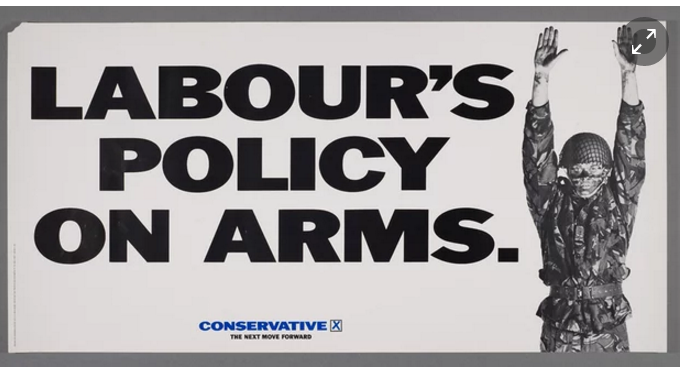
One reason was clever responses are national security in the 1987 election such as this
On 24 May, Kinnock was interviewed by David Frost and claimed that Labour’s alternative defence strategy in the event of a Soviet attack would be “using the resources you’ve got to make any occupation totally untenable”.
In a speech two days later Mrs. Thatcher attacked Labour’s defence policy as a programme for “defeat, surrender, occupation, and finally, prolonged guerrilla fighting… I do not understand how anyone who aspires to Government can treat the defence of our country so lightly.”
In 1992, Labour still lost the election by a landslide despite 13 years of Thatcher good and ended its commitment to unilateral nuclear disarmament, high taxes and old-style nationalisation. Go left, go left so damaged the labour brand that a new generation of leaders was required.
The British electorate had every chance to vote for a hard left Labour in the 1980s. It rejected it resoundingly and almost voted in the social democratic alliance as the main opposition party.
My two cents on the sharp rise of partisanship and congressional polarisation is they are driven by the great restraint in the growth of government spending in the 1980s.
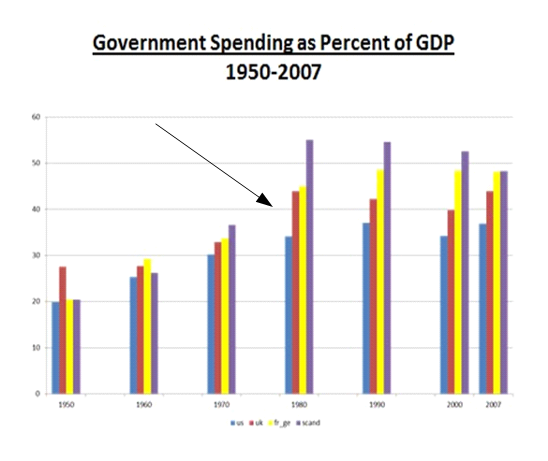
From 1950 to 1980 the size of government doubled but then stopped dead in the 1980s. This great restraint on the growth of government happened everywhere. It was not just Thatcher’s Britain or Reagan’s America. It was everywhere, France and Germany, and even Scandinavia.
Peltzman’s data which I have charted has government spending in the USA, Britain, France and Scandinavia doubling between 1950 and 1980, and then nothing much happened between 1980 and 2007 – the size of government was pretty flat as a share of GDP for 27 years.
Governments everywhere hit a brick wall in terms of their ability to raise further tax revenues. Political parties of the Left and Right recognised this new reality.
Government spending grew in many countries in the m-d-20th century because of demographic shifts, more efficient taxes, more efficient spending, a shift in the political power from those taxed to those subsidised, shifts in political power among taxed groups, and shifts in political power among subsidised groups Importantly for explaining later political polarisation, that growth of government was concentrated in four programs – defence, health, education and income security
The median voter in all countries was alive to the power of incentives and to not killing the goose that laid the golden egg which underwrote the initial growth in the size of government. The rising deadweight losses of taxes, transfers and regulation limit inefficient policies and the sustainability of redistribution.
After 1980, the taxed, regulated and subsidised groups had an increased incentive to converge on new lower cost modes of redistribution to protect what they had. More efficient taxes, more efficient spending, more efficient regulation and a more efficient state sector reduced the burden of taxes on the taxed groups. Reforms ensued after 1980 led by parties on the Left and Right, with some members of existing political groupings benefiting from joining new coalitions.
A lot more is at stake when the main political battleground is dividing a relatively fixed revenue pie post-1980 than a growing pie Between 1950 and 1980. Fiscally conservative voters will elect parties strongly committed to no new taxes. Their opponents will look for equally ideologically committed parties. Peltzman makes the very interesting point that:
There is no new program in the political horizon that seems capable of attaining anything like the size of any of these four. For the time being the future government rest on the extent of existing mega programs.
Health and income security account for 55% of total government spending in the OECD. It is in these two programs where the future of the growth of government lie.
The pressure for that growth in government will come from the elderly. Governments will have to choose between high taxes on the young to fund the current generosity of social insurance, healthcare and old-age pensions or find other options. Peltzman explains this political tension for programs benefiting the elderly in his essay The Socialist Revival:
Deficit financing of future growth in these programs becomes increasingly problematic. So we now have the seeds of political conflict rather than consensus.
These very large programs confer substantial benefits on some. These beneficiaries resist any change in the status quo. But the benefits have to be financed at substantial cost to today’s workers. Many of them will not benefit on balance from these programs over their lifetimes. It is by no means clear whether the number of winners exceeds the number of losers today.
Policies that were once unthinkable now can be discussed and even implemented here and there. These include increased retirement ages, less generous public health care programs, more reliance on private saving for retirement and so forth.
Given that intergenerational and other struggles over who is taxed and who faces benefit cuts, middle-of-the-road politicians lose their appeal to the electorate.
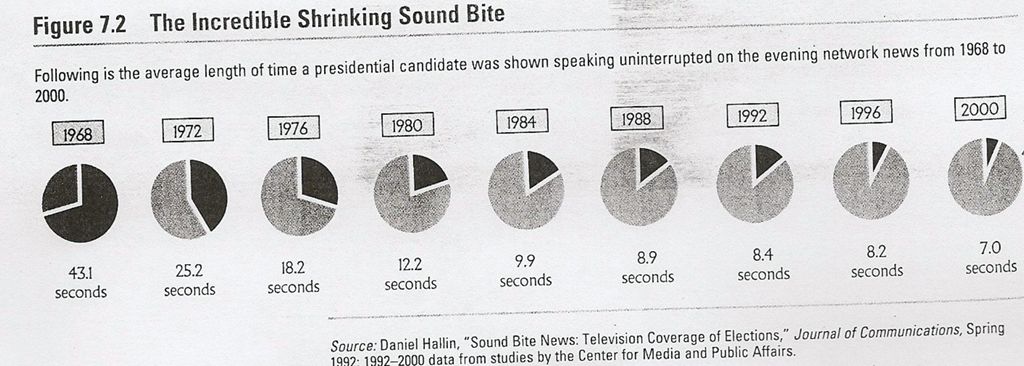
Another reason for greater political polarisation is the rising cost of time. Sound-bites news programs and current affairs are now a couple of seconds long when they used to be 15 seconds long maybe 30 years ago.
People have less time to pay attention to politics so they want to work out quickly from short sound-bites whether the politicians they are contemplating supporting are made of the right stuff. For voters in a hurry, conviction politicians are more appealing be they of the left or of the right. Voters want someone who will hold fast against new taxes or for new taxes as the case may be. Much is at stake as Sam Peltzman explained in his 2012 essay The Socialist Revival:
The steady growth of the old age population share is on the verge of a substantial acceleration… This means that government health care and public pension spending growth will also have to accelerate merely to keep the promises implicit in present programs.
The political economy will have to choose between higher taxes on the young to keep these promises, an accelerated shrinkage of the rest of the budget or less generous public health and pension programs. It is not clear yet which way the decision will go.
What is clear is that for the first time since the invention of the welfare state the magnitude and generosity of its signature programs is at political risk.
In this stand-off between those who might have to pay more in taxes and those who might receive less in old age pensions, welfare benefits and services including healthcare, neither side wants a politician naturally inclined to blink and compromise. They will elect politicians who hang tough for their side of the argument and their share of the budget.
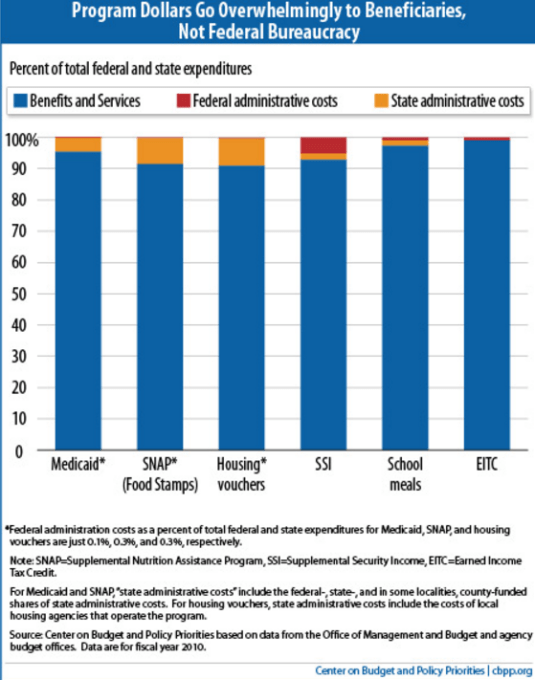
Firing the entire welfare state bureaucracy does not save the day for a universal basic income as Robert Greenstein explains
Suppose UBI provided everyone with $10,000 a year. That would cost more than $3 trillion a year — and $30 trillion to $40 trillion over ten years.
This single-year figure equals more than three-fourths of the entire yearly federal budget — and double the entire budget outside Social Security, Medicare, defense, and interest payments. It’s also equal to close to 100 percent of all tax revenue the federal government collects…
Where would the money to finance such a large expenditure come from? That it would come mainly or entirely from new taxes isn’t plausible.
We’ll already need substantial new revenues in the coming decades to help keep Social Security and Medicare solvent and avoid large benefit cuts in them. We’ll need further tax increases to help repair a crumbling infrastructure that will otherwise impede economic growth. And if we want to create more opportunity and reduce racial and other barriers and inequities, we’ll also need to raise new revenues to invest more in areas like pre-school education, child care, college affordability, and revitalizing segregated inner-city communities.
A UBI that’s financed primarily by tax increases would require the American people to accept a level of taxation that vastly exceeds anything in U.S. history. It’s hard to imagine that such a UBI would advance very far, especially given the tax increases we’ll already need for Social Security, Medicare, infrastructure, and other needs.
Morgan Foundation wants the National party-led government to take on NIMBYs not only with more high-rises and urban intensification but congestion charges too! There is only so much courage you can expect in one term of government. Relaxing the Auckland urban limit, which will hopefully cause housing prices to stop rising in Auckland was not enough.
No softly softly catchy monkey here. No concept of winning the battles you can win.
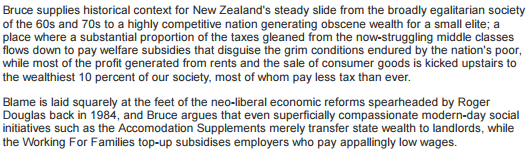
You really are still fighting the 1990 New Zealand general election if Max Rashbrooke makes more sense than you on the good old days before the virus of neoliberalism beset New Zealand from 1984 onwards.
Maybe 65% of the population of those good old days before the virus of neoliberalism. were missing out on that broadly egalitarian society championed by Bryan Bruce.
As is typical for the embittered left, the reactionary left, gender analysis and the sociology of race is not for their memories of their good old days. New Zealand has the smallest gender wage gap of any of the industrialised countries.
The 20 years of wage stagnation that proceeded the passage of the Employment Contracts Act and the wages boom also goes down the reactionary left memory hole.
That wage stagnation in New Zealand in the 1970s and early 80s coincided with a decline in the incomes of the top 10%. When their income share started growing again, so did the wages of everybody after 20 years of stagnation. The top 10% in New Zealand managed to restore their income share of the early 1970s and indeed the 1960s. That it is hardly the rich getting richer.
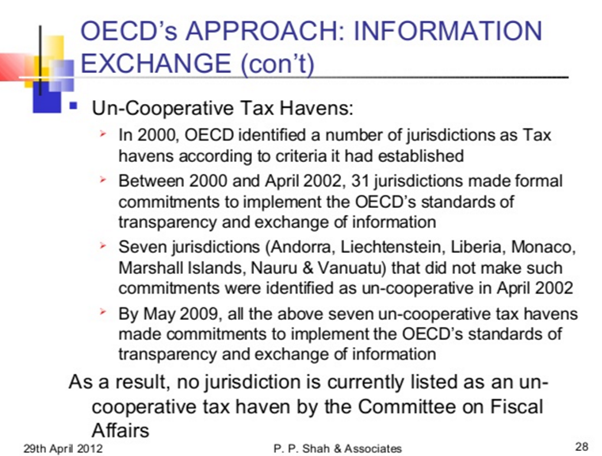
I hope none in this clip protesting against tax havens as short changing everybody else were fresh from protesting how international economic agreements such as the TPPA infringe on the sovereignty of countries.
If you standing up for national sovereignty that includes standing up for the right of other countries doing things that you do not like within their own country.
If countries have the right to set taxes and tariffs as high as they like, they have just the same right to set them as low as they like.
All that plucky rhetoric of TPPA no way and how international economic agreements violate the sovereignty of countries and developing countries in particular is forgotten in a flash by Oxfam.
Oxfam manages the blinding hypocrisy of opposing the Transpacific Partnership on national sovereignty grounds and at the same time call for international treaties to bully small countries about their tax policies, which overrides their economic sovereignty.
The sovereign rights of developing countries to find their own way does not extend to undermining the tax bases of the rich countries struggling to finance their welfare states.
The Pacific Islands, the once were heroes of the recent Paris climate talks, turn into pariahs once they start looking out for themselves and setting up offshore financial centres and tax havens.
Developing countries are free to impoverish themselves by embracing socialism, but if they decide to attract investment and jobs through low tax rates and offshore financial centres, a new form of colonialism is embraced by the reactionary left as embodied by Oxfam.
When my father was born, 7 in 10 people lived in absolute poverty.
Why Evolution is True is a blog written by Jerry Coyne, centered on evolution and biology but also dealing with diverse topics like politics, culture, and cats.
“We do not believe any group of men adequate enough or wise enough to operate without scrutiny or without criticism. We know that the only way to avoid error is to detect it, that the only way to detect it is to be free to inquire. We know that in secrecy error undetected will flourish and subvert”. - J Robert Oppenheimer.

 Utopia, you are standing in it!
Recent Comments