Make Progress, Not Work! Bryan Caplan’s best single video
21 Aug 2015 Leave a comment
in applied price theory, applied welfare economics, development economics, economic history, economics of information, economics of media and culture, growth miracles, liberalism, Public Choice Tags: Bryan Caplan, capitalism and freedom, makework bias, The Great Enrichment, The Great Escape, The Great Fact
Why @NZGreens @nzlabour @GreenpeaceNZ hate applied welfare economics
21 Aug 2015 Leave a comment
in applied welfare economics, economics of regulation, energy economics, environmental economics, health economics, international economics, labour economics, law and economics, politics - New Zealand, Public Choice Tags: antiforeign bias, antimarket bias, expressive voting, Greenpeace, Leftover Left, make-work bias, methodology of economics, New Zealand Greens, New Zealand Labour Party, rational ignorance, rational irrationality
Quotation of the Day from French Economist Frederic Bastiat in the 1850s http://t.co/2ECWtb6m9u—
Mark J. Perry (@Mark_J_Perry) August 14, 2015
More evidence of mass kidnappings of #occupywallstreet activists
20 Aug 2015 Leave a comment
in applied price theory, human capital, income redistribution, labour economics, labour supply, politics - USA, poverty and inequality, Public Choice, rentseeking, sports economics Tags: expressive voting, Left-wing hypocrisy, Leftover Left, mass kidnappings, Occupy Wall Street, rational ignorance, rational irrationality, superstar wages, superstars, top 0.1%, top 1%
Ratio of Median Salary of Top 25 Highest Paid MLB Player to Avg. Worker Pay Increased from 100:1 to 700:1 Since 1988 http://t.co/5zLktBXS3D—
Mark J. Perry (@Mark_J_Perry) August 18, 2015
Henry Hazlett on why economics is so difficult
20 Aug 2015 Leave a comment
in applied price theory, applied welfare economics, comparative institutional analysis, constitutional political economy, economics of bureaucracy, income redistribution, Public Choice, rentseeking Tags: antiforeign bias, antimarket bias, bootleggers and baptists, green rent seeking, Henry Hazlett, makework bias, methodology of economics, philosophy of economics
The depth and breadth of European colonization 1500-1900
19 Aug 2015 Leave a comment
in constitutional political economy, economic history, Public Choice, rentseeking Tags: age of empires, British empire, British imperialism, colonialism, imperialism
A map showing the depth and breadth of European colonization 1500-1900: thesocietypages.org/socimages/2015… http://t.co/37234ZzDfj—
(@SocImages) March 21, 2015
Why Is The NRA So Powerful
19 Aug 2015 Leave a comment
in applied price theory, constitutional political economy, economics of regulation, Public Choice Tags: competition for political influence, gun control, lobby groups, median voter theorem, rational ignorance, special interests, voter demographics
What does U.S. gun ownership really look like? Load up with #PollPosition’s @Johnnydontlike: bit.ly/1y2EMjX http://t.co/fn5EpM75U7—
(@PJTV) March 25, 2015


The current sizes of government
19 Aug 2015 Leave a comment
in fiscal policy, Public Choice Tags: size of government
46% of Tory MPs don’t understand politics #ToriesForCorbyn @jeremycorbyn
19 Aug 2015 Leave a comment
in economics of media and culture, Public Choice Tags: British Labour Party, British politics, expressive voting, Leftover Left, rational irrationality
https://twitter.com/toadmeister/status/631585303631921152
https://twitter.com/TheBigBlueBear6/status/633743084430344192
Over-qualification rates in jobs in the USA, UK and Canada
19 Aug 2015 2 Comments
in economics of bureaucracy, economics of education, human capital, job search and matching, labour economics, labour supply, occupational choice, politics - USA, Public Choice Tags: British economy, Canada, compensating differentials, job shopping, offsetting behaviour, on-the-job training, search and matching, The fatal conceit, The pretense to knowledge
In the UK, foreign-born are much more likely to be over qualified than native born highly educated not in education with less difference between men and women. More men than women are overqualified for their jobs in the UK. Over qualification is less of a problem in the UK than in the USA and Canada.
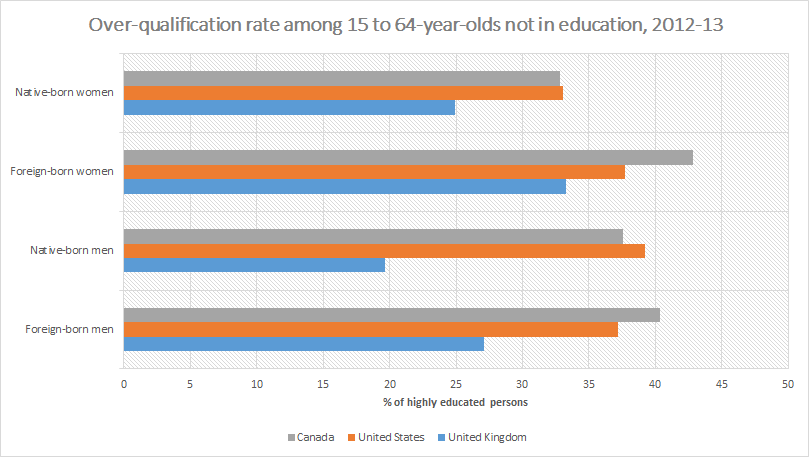
Source: OECD (2015) Indicators of Immigrant Integration 2015: Settling In.
In the USA and Canada, there are few differences between native and foreign born men in over-qualification rates. Foreign-born women tend to be more over-qualified than native born women in the USA and more so in Canada. Many more workers are overqualified for their jobs in the USA and Canada as compared to the UK.
There are large differences in the percentage of people with tertiary degrees and the education premium between these three countries that are outside the scope of this blog post. These trends may explain differences in the degree of educational mismatch.
It goes without saying that the concept of over-qualification and over-education based mismatch in the labour market is ambiguous, if not misleading and a false construct.
To begin with, under human capital theories of labour market and job matching, what appears to be over-schooling substitutes for other components of human capital, such as training, experience and innate ability. Not surprisingly, over-schooling is more prominent among younger workers because they substitute schooling for on-the-job training. A younger worker of greater ability may start in a job below his ability level because he or she expects a higher probability to be promoted because of greater natural abilities. Sicherman and Galor (1990) found that:
overeducated workers are more likely to move to a higher-level occupation than workers with the required level of schooling
Investment in education is a form of signalling. Workers invest so much education that they appear to be overqualified in the eyes of officious bureaucrats. The reason for this apparent overinvestment is signalling superior quality as a candidate. Signalling seems to be an efficient way of sorting and sifting among candidates of different ability. The fact that signalling survives in market competition suggests that alternative measure ways of measuring candidate quality that a more reliable net of costs are yet to be discovered.
A thoroughly disheartening chart if you're a graduate in the UK i100.io/mpDbJAl http://t.co/mv9izA0mbc—
i100 (@thei100) August 20, 2015
Highly educated workers, like any other worker, must search for suitable job matches. Not surprisingly, the first 5 to 10 years in the workforce are spent in half a dozen jobs as people seek out the most suitable match in terms of occupation, industry and employer. Some of these job seekers who are highly educated will take less suitable jobs while they search on-the-job for better matches. Nothing is free or instantly available in life including a good job match.
A more obvious reason for over qualification is some people like attending university and other forms of education for the sheer pleasure of it.
Anyone who encounters the words over-qualified and over-educated should immediately recall concepts such as the pretence to knowledge, the fatal conceit, and bureaucratic busybodies. As Edwin Leuven and Hessel Oosterbeek said recently:
The over-education/mismatch literature has for too long led a separate life of modern labour economics and the economics of education.
We conclude that the conceptional measurement of over-education has not been resolved, omitted variable bias and measurement error are too serious to be ignored, and that substantive economic questions have not been rigorously addressed.
Should We Subsidize Scientific Research?
18 Aug 2015 Leave a comment
in applied price theory, applied welfare economics, entrepreneurship, industrial organisation, Public Choice, rentseeking, survivor principle Tags: competition as a discovery procedure, economics of science, industry policy, losers, picking winners, R&D, The meaning of competition, The pretence the knowledge
The track record on banking on solar energy innovation becoming cost competitive
18 Aug 2015 Leave a comment
in economic history, energy economics, entrepreneurship, environmental economics, global warming, politics - USA, Public Choice, rentseeking Tags: Big Solar, creative destruction, green rent seeking, renewable energy, renewable resources, solar energy
Do immigrants bring their politics with them?
17 Aug 2015 Leave a comment
in politics - USA, Public Choice Tags: economics of immigration, voter demographics
Based on this paper by @CatoInstitute's @AlexNowrasteh, immigrants barely differ politically object.cato.org/sites/cato.org… http://t.co/suwazCEcrU—
David Bier (@myfreesociety) February 24, 2015
Sanders, Trump and the median voter theorem
16 Aug 2015 Leave a comment
in politics - USA, Public Choice Tags: 2016 presidential election, expressive voting, left-wing populists, Leftover Left, median voter theorem, rational ignorance, rational irrationality, right-wing populists
UK has the lowest company tax rate in the G20
16 Aug 2015 Leave a comment
in applied price theory, economic growth, fiscal policy, macroeconomics, politics - Australia, politics - New Zealand, politics - USA, Public Choice, public economics Tags: British economy, company tax rate, company taxation, optimal tax theory, race to the top, tax competition
IFS Friday Figure: UK has the lowest corporate tax rate in the G20 #Budget2015 announced a 2% cut by 2020 #IFSFriFig http://t.co/T4Oq6ZXYd4—
IFS (@TheIFS) July 24, 2015
India and Pakistan became independent today
16 Aug 2015 Leave a comment
in constitutional political economy, development economics, economic history, growth disasters, Public Choice Tags: age of empires, British empire, India, Pakistan
This day in 1947 | India and Pakistan independent after some 200 years of British rule: timesmachine.nytimes.com/timesmachine/1… http://t.co/VfbpKayExM—
NYT Archives (@NYTArchives) August 15, 2015


Recent Comments