Putin is actually the best of a bad lot
16 Apr 2015 Leave a comment
in constitutional political economy, development economics, growth disasters, growth miracles, Public Choice Tags: Putin, Russia
The Tories used to win a lot of votes in Scotland
16 Apr 2015 Leave a comment
in Public Choice Tags: British general election, British politics, Scotland, Tory party
There was a time when Scotland was more Conservative than England. blogs.lse.ac.uk/politicsandpol… http://t.co/JykfZuq4iZ—
(@UberSerf) March 27, 2015
Good to see the hard left are still at it in the British general election
16 Apr 2015 Leave a comment
in Marxist economics, Public Choice Tags: British general election, hard left, Leftover Left
Are you the Judean People's Front? Here are the Socialist/Communist/Workers parties standing in #GE2015: http://t.co/hDhqO2JGP8—
Tom Harris (@tnjharris) April 14, 2015
Lessons for New Zealand from Bob Hawke’s promise that no child need live in poverty by 1990
15 Apr 2015 Leave a comment
in income redistribution, politics - Australia, politics - New Zealand, poverty and inequality
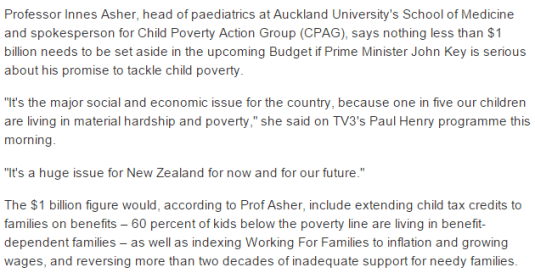
A local doctor thinks we can abolish child poverty in New Zealand with $1 billion in increases to welfare benefits and family allowances.
During the 1987 Australian Federal election campaign, Labour Party Prime Minister Bob Hawke announced a Family Allowance Supplement that would ensure no Australian child need live in poverty by 1990.
Child poverty was to be no more in Australia by 1990. These changes in social welfare benefits and family allowance supplements would ensure that every family would be paid one per week dollar more than the poverty threshold applicable to their family situation. I know child poverty was to be done in this way because I worked in the Prime Minister’s Department at this time.

Bob Hawke was not a man for admitting error, most certainly was not, but he admitted that this promise was his greatest error – his pledge that no child will need live in poverty by 1990:
It was a silly shorthand thing,” Mr Hawke has told News Limited newspapers. “I should have just said what was in the distributed speech.” “We set ourselves this first goal: by 1990 no Australian child will be living in poverty,” Mr Hawke said on June 23, 1987 at an election campaign launch. The comment entered Australian political folklore after it was supposed to improve the ALP’s major social welfare reform. The printed version had it as: “By 1990 no Australian child need live in poverty.” Mr Hawke’s words returned to haunt him as his pledge was impossible to keep.
About 580,000 Australian children lived in poverty in 1987. In 2007, at least 13 per cent of children, or 730,000 people, were poor. This was after social welfare benefits and family allowance supplements were increased to $1 above the child poverty threshold.
There is an infallible test of the practicality of Left over Left dreams such as the abolition of child poverty by writing bigger and bigger cheques to those currently poor.
If you could abolish child poverty simply by increasing welfare benefits and family allowances, the centre-right parties would be all over it like flies to the proverbial as a way of camping over the middle ground and winning the votes of socially conscious swinging voters for decades to come. Many people who would naturally vote for the centre-right parties on all other issues vote over to centre-left parties out of a concern for poverty and a belief that centre-left parties will give a better deal to the poor.
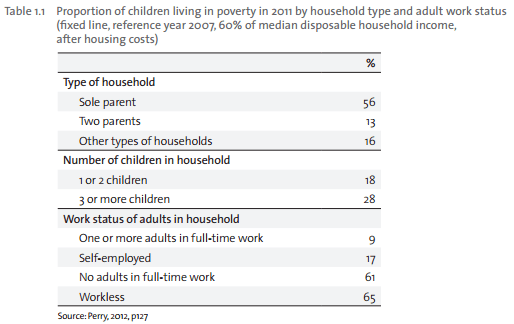
Countries all round the world have attempted to buy their way out of poverty by lifting welfare benefits and family allowance rates with no success. Simon Chapple is also quite clear that social welfare benefits reduce the incentive to work.
The payment of welfare benefits to families who do not work creates a number of potential issues. Firstly, as it guarantees an income to people not in paid employment, including those with children, it creates incentives not to work. While theoretically indisputable, much debate surrounds how large this effect is in practice, and how best to offset it.
There is child poverty in northern European and Scandinavia despite the most generous possible welfare states. Most of this child poverty is among single parent families in all industrialised countries.
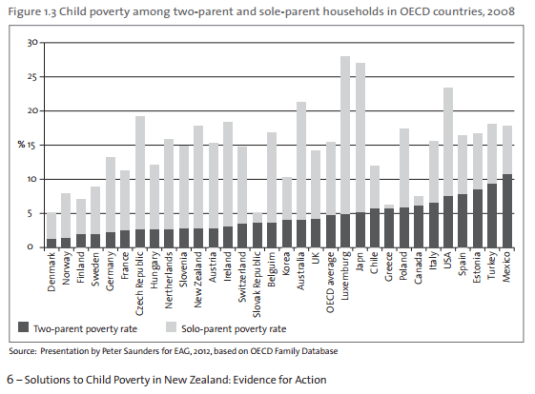
Around 60 percent of New Zealand children in poverty are in social welfare beneficiary households, and most of these are sole-parent households.

Child poverty rates are lower in the Nordic states but the Nordic states expectation that mothers will return to the workforce rapidly – when their child is 1 to 3 years old. Employment is front and centre in the Nordic welfare state strategy to reduce child poverty.

The notion that poverty is simply the result of a lack of money and giving people more money will abolish child poverty has never worked. As the OECD (2009, p. 171) observed:
It would be naïve to promote increasing the family income for children through the tax-transfer system as a cure-all to problems of child well-being.
The only major success in reducing beneficiary numbers anywhere has been time limits in the USA in 1996. Time limits on welfare for single parents reduced caseloads by two thirds, 90% in some states.

After the 1996 US Federal welfare reforms, the subsequent declines in welfare participation rates and gains in employment were largest among the single mothers previously thought to be most disadvantaged: young (ages 18-29), mothers with children aged under seven, high school drop-outs, and black and Hispanic mothers. These low-skilled single mothers were thought to face the greatest barriers to employment. Blank (2002) found that:
…nobody of any political persuasion predicted or would have believed possible the magnitude of change that occurred in the behaviour of low-income single-parent families.
Employment are never married mothers increased by 50% after the US well for a reforms: employment a single mothers with less than a high school education increased by two thirds: employment on-going single mothers string ages of 18 in 24 approximately doubled. With the enactment of welfare reform in 1996, black child poverty fell by more than a quarter to 30% in 2001. Over a six-year period after welfare reform, 1.2 million black children were lifted out of poverty. In 2001, despite a recession, the poverty rate for black children was at the lowest point in national history.
This great success of US welfare reforms was after a quarter of six century of no progress, poverty among single mothers and among black children declined dramatically.
The best solution to child poverty is to move their parents into a job. Simon Chapple is also quite clear in his book last year with Jonathan Boston that a sole parent in full-time work, and a two parent family with one earner with one full-time and one part-time worker, even at low wages, will earn enough to lift their children above most poverty thresholds. Welfare benefits trap children in poverty.
Sustained full-time employment of sole parents and the fulltime and part-time employment of two parents, even at low wages, are sufficient to pull the majority of children above most poverty lines, given the various existing tax credits and family supports.
The best available analysis, the most credible analysis, the most independent analysis in New Zealand or anywhere else in the world that having a job and marrying the father of your child is the secret to the leaving poverty is recently by the Living Wage movement in New Zealand.
According to the calculations of the Living Wage movement, earning only $19.25 per hour with a second earner working only 20 hours affords their two children, including a teenager, Sky TV, pets, international travel, video games and 10 hours childcare. This analysis of the Living Wage movement shows that finishing school so your job pays something reasonable and marrying the father of your child affords a comfortable family life.
Robert Lucas on the irrelevance of income redistribution to the Great Enrichment
15 Apr 2015 Leave a comment

The Scottish National Party manifesto
15 Apr 2015 Leave a comment
in income redistribution, Public Choice, rentseeking Tags: British general election, British politics, Scotland, Scottish National party
SNP manifesto. #PrivateEye http://t.co/oD3iuyajBl—
Wire Spy (@wirespyuk) April 02, 2015
Hollywood’s highest paid star Leonardo DiCaprio earns three times average FTSE 100 boss | City A.M.
15 Apr 2015 Leave a comment
in applied welfare economics, entrepreneurship, Marxist economics, politics - USA, Public Choice, Rawls and Nozick, rentseeking Tags: Occupy Wall Street, top 1%
This top 1% gets a pass from the Occupy activists

Hillary is running as some sort of class war warrior against the big end of town
14 Apr 2015 Leave a comment
in income redistribution, politics - USA, Public Choice, rentseeking Tags: 2016 presidential election, campaign finance report form, expressive voting, Hillary Clinton, median voter theorem, rational ignorance, rational irrationality, special interests
Top 20 Hillary Clinton campaign contributors, 1999-2014, in case you were wondering. http://t.co/c8KTOkJ30X—
Downtown Josh Brown (@ReformedBroker) April 14, 2015
Hillary’s presidential run is Directors’ law personified
13 Apr 2015 Leave a comment
in economics of media and culture, politics - USA, Public Choice
The 2008 US presidential campaign was the best soapie on TV. The 2016 season of that show looks even better.
Back in 2008, Hillary Clinton’s campaign rhetoric intrigued me. It was all about the middle-class and helping the middle class. No working part class warriors today in the main strain of the Democratic Party. The 2016 campaign is the same.
The median voter is a middle-class voter. The median voter is the swinging voter or the independent voter in American terminology. All parties go after this voter if they want to win elections.
Director’s Law of public expenditure is that public expenditure is used primary for the benefit of the middle class, and is financed with taxes which are borne in considera class war rhetoric in a campaign announcement is mainly for the benefit of the left of the party to discourage primary runs by Sen Warren, in particular ble part by the poor and the rich because the median voter comes from the middle-class.
Presidential primary and general election debates in 2016 will be about how things were getting harder for the middle-class and the Republican or Democratic candidate pitching for votes will stand up for the middle-class better than their competition in the presidential primary or general election.
Morning radio in New Zealand, the state owned broadcaster, interviewed one of their political contacts about Hillary’s announcement. His suggestions were her were go left, young Hillary, go left. He wanted her to imitate the policies of the left-wing Democratic Party potential candidate Senator Warren and significantly increase the minimum wage.
At no time did our intrepid reporter on 9 to Noon ask whether this go left political strategy would increase the chances of Hillary winning or have any relevance under a Republican-controlled Senate and House of Representatives or help the Democratic Party win back the House.
Republican-control of Congress will be a strong incentive to Hillary to go to the centre if she wants to have any chance of implementing any of her policies. The class war rhetoric in her campaign announcement is mainly to neutralise the chances of Senator Warren contesting the primaries. Oddly enough, the priorities of Senator Warren also focus on the concerns of the middle-class voters such as about student loans rather than paying the rent and buying groceries.
The NZ Greens want to introduce food stamps, but only for part of the year?!
12 Apr 2015 Leave a comment
in income redistribution, politics - New Zealand, politics - USA, poverty and inequality, Public Choice Tags: expressive voting, food stamps, Left-wing hypocrisy, rational ignorance, rational irrationality, school breakfast programs, soup kitchens, welfare reform, welfare state
The welfare state has a long history of providing some of its support to the needy in kind rather than in cash. This can range from soup kitchens to public housing as well as food stamps.

In the USA, food stamps provide provide food-purchasing assistance for low- and no-income people living. Food stamps can only be exchanged for food.

Instead of requiring the poor and needy to attend a soup kitchen, they can be given vouchers to buy food at supermarkets and take it home and cook at themselves. These days some sort of debit card system can be used where purchases are restricted to food at supermarkets and other participating retailers.
A close parallel with food stamps, properly understood, is free school breakfast programs. The welfare state is providing in-kind support to hungry children. This is done at school, to ensure that the children eat the meals.
Rather than rely on their parents to spend their welfare benefits and income support on food for their children, the food is given directly to the children when they arrive at school in the morning. In New Zealand, these free school breakfast programs are restricted to schools in low income areas.
There is a Feed the Kids Bill in Parliament sponsored by the Green Party. I have frequently criticised this proposal as it doesn’t provide breakfast to needy children at the weekends and school holidays. They are left to go hungry. Abandoned by their so called social justice champions through lack of imagination and self-awareness.
If children are showing up at school without their breakfast on a regular basis, their parents should reported that the child protection authorities for intervention. This can start with budget advice and assistance with applying for any additional and emergency financial support they are eligible for from Work and Income New Zealand.
 Soup kitchens not only provides people with food, it provides various other assistance to help people to get back on their feet.
If you were proposing a food stamps program in New Zealand because children are going hungry, you’ll be laughed at if you suggested it should only apply the part of the year such as during the school term.
That is precisely what the Greens are doing. The only difference is how they are organised the provision of in-kind support to children, this case, food. Instead of their parents collecting a debit card that can only be used to buy food, the food is eaten by their children at school.
What are the Democrat – Republican part as in spreads on the major issues
12 Apr 2015 Leave a comment

A Guaranteed Minimum Income for New Zealand? The Treasury costings
12 Apr 2015 Leave a comment
in income redistribution, politics - New Zealand, politics - USA, welfare reform
The Treasury modelled a Guaranteed Minimum income (GMI) at the request of the Welfare Working Group in 2010. A GMI paying $300 per week – the mean benefit income among those on benefits – would cost $44.5 billion (model 1) or $52.6 billion if we extended it to super annuitants as a replacement for NZ Superannuation or old age pension (model 2). The former could be covered by a flat personal income tax rate of 45.4%; the latter, 48.6%.
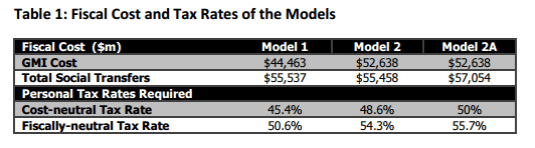
Full fiscal neutrality would require tax rates of 50.6% and 54.4% – the lower tax rates would be just enough to cover the transfers, but income tax revenues are currently also used to fund more than just transfers.
If we recognize that most parents are beneficiaries via Working for Families and compensate them for their loss with a $86 per child per week payment (model 3), we get a $57.1 billion fiscal cost and a personal tax rate of 50% (or 55.7% for fiscal neutrality).
Treasury noted that many beneficiaries (including the disabled, carers and sole parents) currently receive more than $300 per week and would be made financially worse off under a GMI scheme.
Treasury also warned about potential adverse labour supply responses to the necessary higher personal income tax rates. The large gap between company and personal tax rates would increase IRD’s enforcement costs.
In 1987, Finance Minister Roger Douglas announced a Guaranteed Minimum Family Income Scheme to accompany a new 22% flat income tax. The idea did not go ahead.
Richard Nixon also proposed a guaranteed minimum family income plan in 1969 to replace the Aid to Families with Dependent Children (AIDC) scheme at the behest of future Senator Daniel Patrick Moynihan. This was based on the negative income tax proposals of Milton Friedman and George Stigler. Nixon’s plan passed the House but not the Senate after 3 years of infighting.
The final outcome was the earned income tax credit (EITC) in 1975 that was expanded significantly in the 1990s to become the largest single federal income transfer programme. One attraction of the EITC is that because its benefits rise positively with earnings up to the phase-out point, so it can have a positive rather than negative effect on work incentives for workers on a low wage.
The power of ordinary citizens to effect change when there is federalism and upper houses
11 Apr 2015 Leave a comment
in constitutional political economy, election campaigns, politics - Australia, politics - New Zealand, Public Choice
The latest counting in the New South Wales Legislative Council election shows the ease in which ordinary citizens can form a political party and be elected to Parliament when there is federalism and an upper house elected by proportional representation.
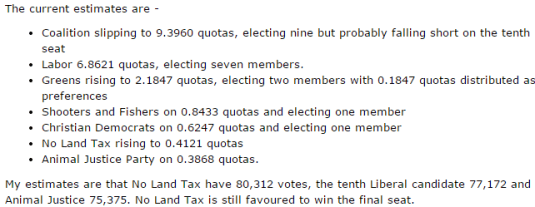
Five of the six Australian states have an upper house. In four of those states, the electoral system is proportional representation, with results in the election of many small parties.
In Tasmania, my home state, the Legislative Council as single member constituencies with two or three vacancies filled every year but is full of independents elected the six-year terms. The political parties having no chance of getting candidates elected in front of them. The Tasmanian voters simply don’t vote for party candidates in the Legislative Council elections. Out of 15 members, there is one Liberal Party member, and two members from the Labour Party
In the current New South Wales Legislative Council election, the favourite to win the last seat, and with it the balance of power in the upper house is a previously unheard of No Land Tax party. The Shooters and Fishers party is electing another member this year in New South Wales. The Christian Democrats also have two members.
In Victoria, the Australian Sex Party finally got a candidate elected to the upper house late last year through the courtesy of proportional representation.
Other small parties in the Victorian Legislative Council are the Shooters and Fishers Party with two members, the Democratic Labour Party with one member and a party of never heard of, Vote 1 Local Jobs, with the last seat. These small parties share the balance of power.
The South Australian Legislative Council includes two members from the No Pokies Party, two members from the Family First Party, and one from the Death with Dignity party. Again, this motley crew shares the balance of power.
Western Australian Legislative Council has a government majority, but there is one member from the Shooters and Fishers Party.
The crossbench in the Australian Senate is made up of eight independents and small parties. Several Australian senators on the crossbenchers are completely mad and ignorant; in one certain case, as thick as two short planks. This doesn’t harm, in the case of Jackie Lambie, her chances of being re-elected to the Senate for Tasmania for another six-year term in 2019. A number of Tasmanian voters, including members of my family, value her honesty, though they do admit she is not very bright and is rather rough around the edges.
The strength of democracy lies in the ability of small groups of concerned and thoughtful citizens to band together and change things by running for office and winning elections. That is how new Australian parties such as the ALP, the country party, DLP, Australian democrats and Greens changed Australia. One Nation even had its 15 minutes of fame. Most of these parties started in someone’s living room, full of concerned citizens aggrieved with the status quo.
In Australian elections in recent years, about a quarter of the electorate do not give their vote in upper house selections to the major parties: the Labour Party, the Liberal Party and the Australian Greens. That is fertile ground for small parties to flourish.
So fertile ground is the Australian Senate that the big parties want to change the election system to make it harder for the small parties to swap preferences to get elected through proportional representation and make it much harder to register a political party in the first place.
As would be expected, the far left parties get nowhere in the upper houses of the Australian State parliaments, despite the benefits of proportional representation and preferential voting. These upper houses are filled with small parties from both the left and the right, populist parties all, but the battle cry of socialism just doesn’t resonate with the Australian electorate.
Same thing happened in New Zealand in its recent parliamentary elections. New Zealand has no upper house, but does have proportional representation for the House of Representatives.
A pre-existing hard left party well-funded by a millionaire with an agenda to avoid extradition to the USA got 1.2% of the party vote, but it lost its electorate seat and so is out of Parliament since late last year’s general election.


Recent Comments