
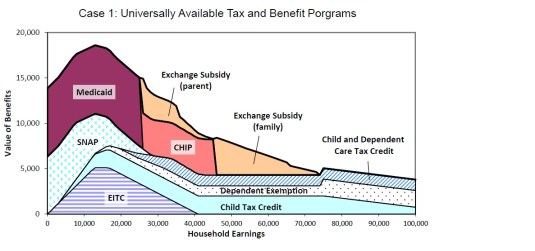
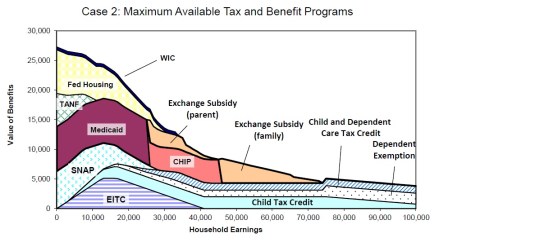
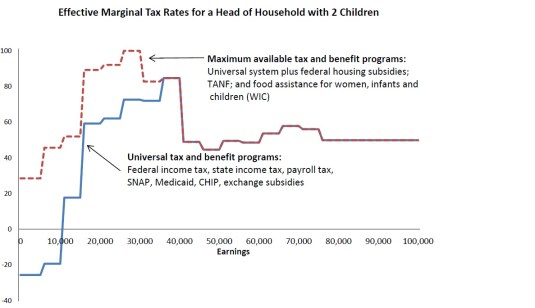
One in five Americans on Medicaid; this image does not include those on Medicare –those over 65 who get their healthcare paid by the government.



Celebrating humanity's flourishing through the spread of capitalism and the rule of law
08 Dec 2014 Leave a comment
in fiscal policy, income redistribution, labour economics, labour supply, politics - USA, public economics, welfare reform Tags: effective marginal tax rates, Obama care, poverty traps, welfare reform
One in five Americans on Medicaid; this image does not include those on Medicare –those over 65 who get their healthcare paid by the government.
08 Dec 2014 Leave a comment

08 Dec 2014 Leave a comment
in development economics, economics of bureaucracy, growth disasters, growth miracles, rentseeking Tags: bribery and corruption
07 Dec 2014 Leave a comment
in Gordon Tullock Tags: Gordon Tullock

Tullock was an irascible, but very charming man to those who knew and worked with him.
His gruff exterior, combined with a quick and biting wit often at others expense, led many to misunderstand him.
He was simply one of the quickest and cleverest social scientists to practice in the second half of the 20th century.
07 Dec 2014 Leave a comment
in constitutional political economy, Public Choice Tags: checks and balances, constitutional political economy, public choice, retrospective voting
Citizens do have sufficient knowledge and sophistication to vote out leaders who are performing poorly or contrary to their wishes. Modern democracy is government subject to electoral checks.
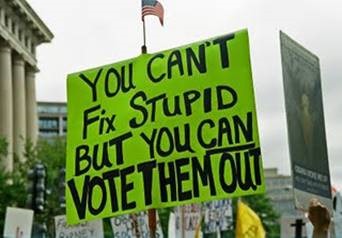
The power of the electorate to turn elected officials out of office at the next election gives elected officials an incentive to adopt policies that do not outrage public opinion and administer the policies with some minimum honesty and competence.
A representative democracy enables the adult population, at very little cost in time, money or distraction from private pursuits commercial or otherwise:
to assure an orderly succession of at least minimally competent officials,
to generate feedback to the officials concerning the consequences of their policies,
to prevent officials from (or punish them for) entirely ignoring the interests of the governed, and
to prevent serious misalignments between government action and public opinion.
Enough of politics and elections, I have a life to lead, don’t you? Too many want to remake democracy with the faculty workshop as their model.

Such deliberation has demanding requirements for popular participation in the democratic process, including a high level of knowledge and analytical sophistication and an absence, or at least severe curtailment, of self-interested motives.
05 Dec 2014 Leave a comment
in energy economics, rentseeking Tags: corporate welfare, green rent seeking, wind welfare
05 Dec 2014 Leave a comment
in economics of bureaucracy, economics of crime, politics
02 Dec 2014 Leave a comment
in comparative institutional analysis, constitutional political economy, liberalism, Public Choice Tags: Casey Mulligan, Gary Becker, growth in government, public choice
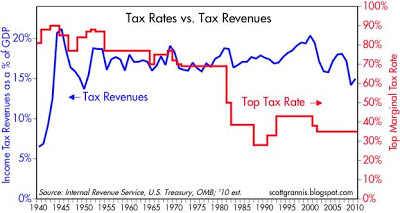
…in Deadweight Costs and the Size of Government (NBER Working Paper Number No. 6789) , [Gary Becker and Casey Mulligan] conclude that flatter and broader taxes also tend to encourage bigger government because taxpayers offer less resistance to increases in flat tax rates than in rates of more onerous and less efficient forms of taxation.
Any decline in the resistance of taxpayers leads to larger government budgets since an endless number of groups agitate for greater government support.
Flat tax rates, such as the VAT and Social Security taxes on earnings, usually start at very low levels but invariably increase over time.
The VAT is now 20 percent and higher in some countries. And payroll taxes began at a modest 2 percent in the 1930s in the United States, but have been increased 21 times to the present 15 percent combined rate on employees and employers.
01 Dec 2014 Leave a comment
in income redistribution, politics - New Zealand, Public Choice, rentseeking Tags: The withering away of the Labour Party, the withering away of the proletariat
Andrew Little is looking to update Labour's definition of the 'working class': stuff.co.nz/national/polit… http://t.co/AQ9mJL7CQf—
NZ Stuff Politics (@NZStuffPolitics) November 30, 2014
The vanguard of the working class has decided the working classes are a bit too small these days to survive politically. The party vote of the New Zealand Labour Party was its lowest since its foundation in 1919 in the New Zealand 2014 general election.
Small-businesses owners, the self-employed and those on contracts are “workers”, Labour’s new leader Andrew Little says. Little has used his first major speech as leader to challenge Labour to update its definition of working people:
People on middle incomes, people who own a small business, people who work on contract who are doing their best to earn a crust and get ahead, they are feeling forgotten – mostly because in policy terms they are
Back in the day, a large number of Labour Party politicians were asked why did they join the Labour Party. Their answer was the Labour Party promised a better deal for the working man.

Unfortunately for the New Zealand Labour Party, the traditional working class is simply are not enough votes to form a government even when you add in the precariat. The party vote of the Labour Party in New Zealand in the last two general elections is been in about 24%. Two thirds of the New Zealand electorate gave their party vote to non-left parties. The party vote of the Labour Party and the green party summed to only 33% of the vote.

What is worse, if you are to believe these Daily Mail graphics, both the traditional working class and precariat area are a bit old, in case of the working class, they are retirement age. The average age of the working class is 66 and the average age of the precariat is 50.

Even the emergent service worker class is a bit of a disappointment for the Labour Part because they don’t seem to be the stock of shop-floor militancy, higher taxes, more regulation and a more generous welfare state. The emergent service workers have semi-skilled and skilled jobs with career structures and the potential for self-employment.
All in all, the left-wing political parties in New Zealand are in a bit of trouble.The green party is tapped out at a party vote of 10% because their hard left policies limit their growth into the middle class vote. The withering away of the proletariat is leading to a withering away the Labour Party.
Both the Labour Party and the Greens are full of university educated, middle-class radicals whose higher tax and bigger government agenda simply doesn’t appeal to the middle-class vote.
Celebrating humanity's flourishing through the spread of capitalism and the rule of law
Celebrating humanity's flourishing through the spread of capitalism and the rule of law
Celebrating humanity's flourishing through the spread of capitalism and the rule of law
Celebrating humanity's flourishing through the spread of capitalism and the rule of law
Celebrating humanity's flourishing through the spread of capitalism and the rule of law
A History of the Alt-Right
Econ Prof at George Mason University, Economic Historian, Québécois
Celebrating humanity's flourishing through the spread of capitalism and the rule of law
Scholarly commentary on law, economics, and more
Beatrice Cherrier's blog
Celebrating humanity's flourishing through the spread of capitalism and the rule of law
Celebrating humanity's flourishing through the spread of capitalism and the rule of law
Celebrating humanity's flourishing through the spread of capitalism and the rule of law
Why Evolution is True is a blog written by Jerry Coyne, centered on evolution and biology but also dealing with diverse topics like politics, culture, and cats.
Celebrating humanity's flourishing through the spread of capitalism and the rule of law
A rural perspective with a blue tint by Ele Ludemann
DPF's Kiwiblog - Fomenting Happy Mischief since 2003
Celebrating humanity's flourishing through the spread of capitalism and the rule of law
The world's most viewed site on global warming and climate change
Tim Harding's writings on rationality, informal logic and skepticism
A window into Doc Freiberger's library
Let's examine hard decisions!
Commentary on monetary policy in the spirit of R. G. Hawtrey
Thoughts on public policy and the media
Celebrating humanity's flourishing through the spread of capitalism and the rule of law
Politics and the economy
A blog (primarily) on Canadian and Commonwealth political history and institutions
Reading between the lines, and underneath the hype.
Economics, and such stuff as dreams are made on
"The British constitution has always been puzzling, and always will be." --Queen Elizabeth II
Celebrating humanity's flourishing through the spread of capitalism and the rule of law
Celebrating humanity's flourishing through the spread of capitalism and the rule of law
WORLD WAR II, MUSIC, HISTORY, HOLOCAUST
Undisciplined scholar, recovering academic
Celebrating humanity's flourishing through the spread of capitalism and the rule of law
Res ipsa loquitur - The thing itself speaks
In Hume’s spirit, I will attempt to serve as an ambassador from my world of economics, and help in “finding topics of conversation fit for the entertainment of rational creatures.”
Researching the House of Commons, 1832-1868
Articles and research from the History of Parliament Trust
Reflections on books and art
Posts on the History of Law, Crime, and Justice
Celebrating humanity's flourishing through the spread of capitalism and the rule of law
Exploring the Monarchs of Europe
Cutting edge science you can dice with
Small Steps Toward A Much Better World
“We do not believe any group of men adequate enough or wise enough to operate without scrutiny or without criticism. We know that the only way to avoid error is to detect it, that the only way to detect it is to be free to inquire. We know that in secrecy error undetected will flourish and subvert”. - J Robert Oppenheimer.


Recent Comments