

Brad de Long on the difference between the Left and Social Democrats
22 Dec 2014 Leave a comment
in applied price theory, comparative institutional analysis, constitutional political economy, economics of bureaucracy, Marxist economics, Public Choice Tags: Brad De Long, Leftover Left, Social Democrats


Groucho Marx on evidence-based policy
21 Dec 2014 Leave a comment
in politics, Public Choice Tags: evidence-based policy, Groucho Marx, public choice

Some people don’t understand why organic farming isn’t more popular than it is
20 Dec 2014 Leave a comment
in applied price theory, entrepreneurship, health economics, rentseeking Tags: organic farming, Quacks


Jim Hacker explains the London newspaper readership
19 Dec 2014 1 Comment
in economics of media and culture, Public Choice Tags: Yes Minister, Yes Prime Minister

What do the top income earners in Australia earn on average?
16 Dec 2014 Leave a comment
in income redistribution, politics - Australia Tags: top 1%

Source: topincomes-parisschoolofeconomics
As with New Zealand, plenty of people in the top income brackets in Australia would regard themselves as middle class – entrepreneurs and professionals who made their way up from the bottom.
As with New Zealand, there is a major spike in top earnings around the time of the 1985 tax reform when the top tax rate was cut from 66% to 49% in Australia.
Source: topincomes-parisschoolofeconomics
As for trans-Tasman comparisons, the top 10% and top 5% in Australia do earn more than their compatriots in New Zealand.
The top 1% in Australia are much better performers than the top 1% in New Zealand, but then again wages and incomes are about a third higher in Australia as compared to New Zealand.
The Australian 0.5% are clearly superior to their New Zealand rivals, earning at least 50% more than them on average.
The New Zealand chart is in New Zealand dollars in 2011; the Australian chart is in Australian dollars in 2010.
A reason for the higher earnings of the Australian top 1% is the larger economy offers a greater superstar effect.

Globalisation and technological changes would allow the Australian best performers, including the top managers and top chief executives, in a given field to serve a bigger market and thus reap a greater share of its revenue. But this would also reduce the spoils available to the less gifted in the business. Australia, as the seven times larger economy, allows their best performers to serve bigger domestic markets.
How much do the top income earners actually earn in NZ?
16 Dec 2014 Leave a comment
in economic history, income redistribution, labour economics, politics - New Zealand, Rawls and Nozick Tags: top 1%

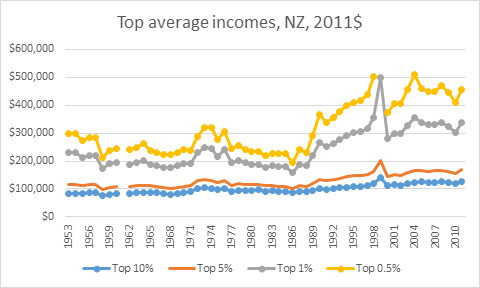
Source: topincomes-parisschoolofeconomics
Note: top income share data for adults for New Zealand adults go back only as far as 1953.
To begin with, a large number of people who see themselves as middle class will have to reclassify themselves in terms of class membership.
More importantly, they will have to pick up on their class consciousness because they are either in the top 10% as any successful professional is because the average income of the top 10% in New Zealand is $128,000. With a bit of luck, these members of the ruling class will be able to afford a house in Auckland without having to borrow from mum and dad.
Pretty much every successful professional is in the top 5% in New Zealand, with an average income of $170,000.
These rich have a lot of people look down upon and order about as junior or senior members of the ruling class, even if they did know they were a member of the ruling class until they looked at the diagram above. Welcome to the ruling class. Goodbye to the middle-class. Get over it.
As for the top 1% in New Zealand, they have an average income in 2011 of $336,000. Once again, successful professionals, successful entrepreneurs and what’s left of the rentier class will have to accept that supreme power as the ruling class of the capitalist system is open to just about anybody who does well at university and enters the professions. Are there no standards?
As for the top 0.5%, data on the top 0.1% stopped in 1989, they earned an average of $457,000 a year in 2011. That is starting to look like good money, though you do have to brush shoulders with celebrities, athletes and more than a few successful small entrepreneurs, but at least you are starting to earn a lot more than your average suburban doctor who is a member of the top 10%.
The ruling class is not what it used to be – the rentier class, old money. That the rich of today – the ruling class of the capitalist system – is open to many ordinary people who are new rich or just plain urban professionals, athletes, musicians and celebrities is a common finding all round the world. As Piketty and Saez explained for the USA:
This rise in top income shares is not due to the revival of top capital incomes, but rather to the very large increases in top wages (especially top executive compensation).
As a consequence, top executives (the “working rich”) have replaced top capital owners at the top of the income hierarchy over the course of the twentieth century.
Many of the rich both in New Zealand and overseas are working rich who made their money themselves and came from middle class or upper middle-class backgrounds.
Many of these rich are well educated smart people rather than the inheritors of wealth. The working rich and most of the rich of the 21st century must be well educated because so many of them are professionals in occupations where you must succeed at university to get in the ground floor, or they are athletes, musicians and other celebrities who must work their way up from the bottom.
A large number of New Zealanders who regarded themselves as middle class action are part of the rich – the top 10%, top 5% and banging on the doors of the top 1% or better – so they better start carrying themselves about with the airs and graces of the ruling class. Better practice by putting a plum in your mouth.
p.s. There was a big spike in top incomes in 1999. It seems like a lot of people in New Zealand brought forward income in 1998 and 1999 in anticipation of the election of a Labour Party government in the 1999 New Zealand general election, and an immediate increase in the top tax rate from 33% to 39% for incomes over $60,000.
The top 10% are a bunch of bludgers in New Zealand too
16 Dec 2014 Leave a comment
in economics of education, income redistribution, politics - Australia, politics - New Zealand, politics - USA Tags: education premium, top 1%
Source: topincomes-parisschoolofeconomics
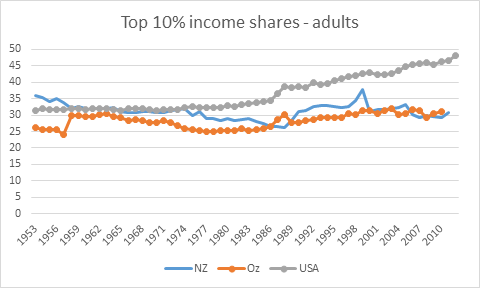
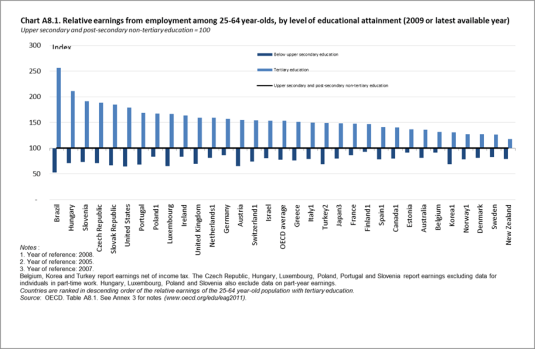
One reason why the top 10% in New Zealand have been a pretty ordinary lot compared to the USA is New Zealand’s university graduate premium – the college premium as it is known in the USA – is at the very bottom of the OECD ladder at about 18% – rock bottom 32nd out of 32 – the wooden spoon.
The College premium in the USA is about 64%, as shown in the OECD data below from OECD Education at Glance. Naturally, this high College premium in the USA should show up in well educated, highly skilled people earning a lot more than those that don’t go to college and don’t go to graduate school.
Stats link: http://dx.doi.org/10.1787/888932460515
Little wonder that the USA top 10% are breaking away from the pack. This slow increase in the income share of the top 10% since the early 1970s coincided with large numbers, including many more women in long duration professional degrees, going to university.
Prior to the mid-1970s, the College premium in the USA had been falling for about a decade because of large numbers of people going on to College and many of these two graduate school to get a draft deferment.
People married younger then so by the time people were at the end of College or graduate school, they were usually married with children and got of further draft deferment and aged out of the draft system.
The top 1% in New Zealand have been bone lazy for at least 60 years now
16 Dec 2014 2 Comments
in income redistribution, politics - Australia, politics - New Zealand Tags: top 1%

Source: topincomes-parisschoolofeconomics
Note: top 1% income share data for adults for New Zealand adults go back only as far as 1953.
The top 1% in New Zealand have had a good 60 years to immiserate the proletariat and what are they done? Nothing!
The top 1% share of national income is much the same as it was in 1953! The Australian top 1% haven’t done much better. Bludgers, the lot of them.
What do the Occupy movement have to protest about in New Zealand if the rich haven’t been getting richer?


Recent Comments