Secret Tapes of the final Copenhagen Summit negotiations, starring Obama, Brown, Sarko & Merkel

In Copenhagen’s final private negotiations, Obama, Brown, Sarko and Merkel sat down with He Yafei, the Chinese vice-minister of foreign affairs. There is a tape of this meeting at Der Spiegel

He Yafei was the smartest guy in the room. Wen Jiabao refused to attend most of the negotiating sessions.

Given the choice of walking out or sitting down with a vice-minister, they chose humiliation. One response of Obama was:

It would be nice to negotiate with somebody who can make political decisions.

There were still two important placeholders, X and Y, in the draft agreement. They marked the spots where the percentage targets for reductions in greenhouse gas emissions, for the industrialized nations and emerging countries respectively, were to be entered.

China and India were unwilling to make that commitment. They had reached their own agreement with Brazil and South Africa.

"We have all along been saying ‘Don’t prejudge options!,’" said a representative of the Indian delegation*, prompting Merkel to burst out: "Then you don’t want legally binding!"

The entire discussion at Der Spiegel in multiple parts should be read while listening to the tape.

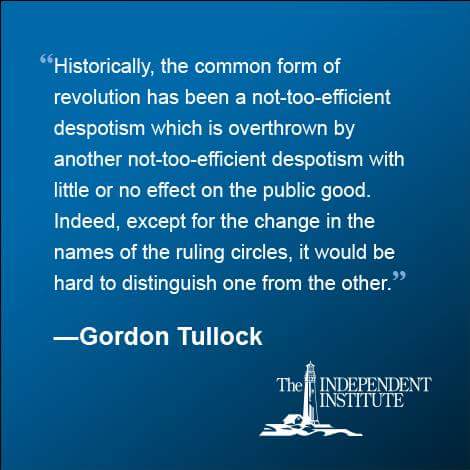
Buchanan and Tullock on the calculus of politics

Image

Tax Burdens: Some Facts (For a Change) | Pundit 2011

via Tax Burdens: Some Facts (For a Change) | Pundit.

The Economics of Elysium

The cost to the taxpayer of investment in desalination in Victoria

Embedded image permalink

Image

The six-way 2015 British general election is warming up

The Conservatives have pulled into a three-point lead, their biggest margin over Labour since 2010

The election is six way because the Scottish Nationalists are expected to sweep the Labour seats in Scotland, which will give them 40 seats or more at the expense of Labour. The Tories have one seat in Scotland.

The Greens are now polling enough to split enough votes away from Labour to allow the Tories or Liberal Democrats to win Labour seats. Many Liberal Democratic seats appear to be going back to the Tories now.

UK is pressing at the heels of the Conservative party in England. How that will work to the advantage of Labour coming through the middle in England is unknown.

Ed Miliband has managed to be more unpopular than Michael Foot.

George Stigler vindicated: Learning the Wealth of Nations

Tyler Cowen has drawn attention to a 2011 paper on policy learning in the 1970s and 80s by Francisco J. Buera, Alexander Monge-Narajo, and Giorgio E. Primiceri was published in Econometrica in 2011. Their paper found that:

1. Policymakers have priors about how good the market economy is, and they revise those views — and thus revise policy — as they observe their own growth results and those of their neighbors.

2. A simple learning model predicts about 97% of the policy choices observed in the data.  The model accounts for more than 77% of the observed policy switches over a three-year time window.

3. Evolving beliefs — and not just the fixed demographic characteristics of countries — are critical for understanding policy decisions.

4. It was probably the growth collapse of the late 1970s for interventionist countries which led to a greater reliance on markets.

5. Adjustment toward better-performing policies is often quite slow.  In part this is because policymakers attribute the superior performance of other countries to heterogeneity rather than policy per se.

This record of politicians learning from failure and success at home and abroad is a vindication of George Stigler’s views of the relative unimportance of economists in influencing public policy.

There was no neoliberal conspiracy that captured the hearts and minds of politicians through mass hypnosis in the 1970s and 1980s as both the Left over Left and the Twitter Left like to suggest

The policies of Friedman had to wait, as George Stigler predicted, for a market to develop among interest groups and the voting public. Once that market developed, Milton Friedman, FA Hayek and others looked like leaders of an opinion.

A few years earlier, Friedman and Hayek were just angry men in the wilderness.

The reason for this sudden change in their public profile and purported influence on the shape the course of public policy in th 1970s and 1980s onwards was political parties were yet to conclude that the existing policy regime had failed irretrievably, and that the successes of neighbours on economic reform might be worth imitating locally.

Once politicians, the voting public and interest groups concluded that new solutions are needed, just as Stigler predicted, the ideas for reform been around for a long time came to the front.

via http://marginalrevolution.com/marginalrevolution/2014/11/learning-the-wealth-of-nations.html

Pharmaceutical Regulation: A Matter of Life and Death | Sam Peltzman

The Jonathan Gruber revelations, Obamacare and the honesty of politics

Is Growth of Government Inevitable? | Sam Peltzman video

Modern topology software does make for rather frightening gerrymanders

George Stigler’s five rules of how governments work

Image

Now out of never: The Element of Surprise in the East European Revolution of 1989 (Article Summary)

A. Main Hypotheses

Dynamics of Transition

Current scholarship on political revolutions fails to explain how rapidly and unexpectedly the 1989 revolutions in Central and Eastern Europe developed.

Individual decisions to support the opposition eventually create a snowball effect. The people that join the movement as it grows will later portray themselves as long-time members of the opposition and encourage even more people to switch over. Thus, preference falsification is both the source of a regime’s stability and its downfall. This phenomenon makes it difficult to track anti-government sentiment in repressive regimes, which is why revolutions come as a surprise but seem to have been inevitable.

B. Summary

United In Amazement

The revolutions in Central and Eastern Europe challenged the view that communist totalitarianism is more stable than ordinary authoritarianism.

In retrospect, it all appears like an inevitable consequence of multiple factors (bad leaders, bad economy, and no freedom.) But at the time, academics, statesmen, diplomats, journalists, futurists, and other experts all did not see it coming, and were astounded when it did.

Received Theories of Revolution and their Predictive Weaknesses

Kuran offers a critique of the current literature related to the hypothesis.

-          Structuralist theory: A revolution occurs when: 1) a state’s evolving relations with other states and local classes weaken its ability to maintain law and order, and 2) the elites harmed by this situation are powerless to restore the status quo ante yet strong enough to paralyze the government. This theory doesn’t rely on subjective factors like religion, etc.

-          Standard theory (Rational-choice): An individual opposed to incumbent regime is unlikely to participate in efforts to remove it, since personal risks outweigh benefits of the movement’s success. He or she will let others make sacrifices to kill the regime, and will still benefit since revolution is a “collective good.”

The standard theory explains why revolution is so rare but not why the 1989 ones occurred, and fails to explain why some people do make the irrational choice to challenge the regime and risk their lives. The structuralist theory explains why conditions were ripe for revolution in Soviet Union, but does not explain why old order collapsed so suddenly at once and why 1989 revolutions were so unexpected.

Preference Falsification and Revolutionary Bandwagons

According to Kuran, “a mass uprising results from multitudes of individual choices to participate in a movement for change; there is no actor named ‘the crowd’ or ‘the opposition.’” (p. 16)

The distinction between an individual’s private and publicly expressed preference is preference falsification.

-          Thus, the individual’s choice to join the opposition is based on a trade-off between internal and external payoffs – the internal psychological cost of preference falsification vs. the benefits and harms of siding with the opposition.

-          As the opposition grows, the external cost of joining becomes lower than the internal cost of not joining. Everyone has a different revolutionary threshold (i.e. “intellectuals” are less susceptible to social pressure) but even one individual shift to opposition leads to many others, creating a revolutionary bandwagon.

-          Since private preferences and thresholds are unknowable, this snowball effect means that society can quickly and quietly reach the brink of revolution.

-          Unanticipated revolutions seem predictable in hindsight because once individuals switch to the opposition after the snowball effect, they will claim they were always opposed to the old regime even if they were not. This perpetuates preference falsification and biases post-revolutionary opinions and analysis.

Gradual and abrupt changes in preference are part of a single unified process:

-          When public opinion changes enough that people start to think a revolution could be possible, the speed at which people join the bandwagon will accelerate.

-          Pressure groups and unorganized groups complement each other in efforts to overthrow the regime. “Where a small pressure group fails to push a bandwagon into motion a slightly better organized or a slightly larger one might.” (pg. 25)

East European Communism and the Wellspring of its Stability

Although oppression under Communism prompted a tiny number of citizens to express dissent through Western and independent publications, uprisings were rare and the few that did occur in Hungary, Czechoslovakia, and East Berlin were quickly crushed. Most people living in Eastern Europe were tolerant of and submissive to the regime. According to Kuran, this was due to 1) official punishment of regime opponents, 2) the need to publicly support the regime, and 3) ignorance of how many people internally shared their antipathy. State propaganda reinforced individuals’ perceptions that they were alone in their dissent. However, once people stopped trying to prove their loyalty and started challenging communism, the regimes began to unravel. Thus, preference falsification is “the wellspring of stability” for Eastern European regimes, which would likely have fallen before 1989 were it not for this phenomenon.

The Revolution

The regimes of Eastern Europe were more vulnerable than publicly expressed opinion made them seem. Even genuine support for the regime was very thin; they could easily be swayed by an alternative to socialism if they thought enough people would support it.

Soviet policies of perestroika and glasnost pointed to growing dissatisfaction with communist leadership, which opened up the possibility of a coup by more hard-line Party leaders. Life under communism had reinforced peoples’ fear of change.

While in retrospect it seems like Gorbachev had engineered the liberalization and ultimate revolution in the Soviet Union, in reality these events occurred in spite of him. Kuran argues they were ignited by several other factors:

-          The massive rise in expressed discontent during glasnost lowered everyone’s revolutionary threshold.

-          Individual decisions to keep anti-Communist movements nonviolent were crucial to their cohesion and ultimate success.

-          Success of anti-government demonstrations in one country inspired them elsewhere, and emboldened those who were on the fence about joining. Each successive revolution took less time to complete.

-          Small government concessions, such as in Czechoslovakia, encouraged protesters to make greater demands for freedom.

-          Communist officials acquiesced to the opposition. The pressure to not support the status quo is an example of preference falsification in the opposite direction, contributing to the regime’s demise.

The Predictability of Unpredictability

Revolutions that come as a surprise are the product of a long period of gestation. The rapid growth of mass movements is due to interdependent public preferences – it is the result of many rational individual decisions undertaken based on changing incentives. Even though the confluence of so many variables is unpredictable, we can still gain insight into the general processes by which revolutions form. However, it is difficult to gauge peoples’ revolutionary thresholds, especially when state censorship and regulation of public opinion polls makes this information unavailable.

C. Comments

Kuran’s argument about the “element of surprise” in revolution supplements PDT’s framework for understanding the causes of regime change, although he does not tackle the question of differentiating successful revolutionary outcomes from failures once the initial government turnover occurs. Additionally, his analysis of revolution in Eastern Europe shows that seemingly stable authoritarian regimes can actually be on the brink of revolt and thus vulnerable to internal and external pressure. This supports PDT’s idea that boosting a state’s civil society will influence more people to publicly express their internal dissent, giving the opposition movement the strength needed to successfully challenge the regime.

Summarized by Shelli Gimelstein. July, 2013.

Source: Timur Kuran, “Now out of never: The Element of Surprise in the East European Revolution of 1989,” World Politics, Vol. 44, No. 1, October 1991, pp. 7-48

James Tobin on limiting the domain of inequality


How to argue against the minimum wage when genuinely trying to argue for it – OECD edition

The 2014 OECD employment outlook argued for modest minimum wage increases while at the same time setting out all the steps necessary to manage the unintended consequences of minimum wage regulation:

Mandatory minimum wages, which now exist – or are being implemented – in 26 OECD countries and a number of emerging economies, can help underpin the wages of low-paid workers.

Evidence suggests that, when set at an appropriate level, minimum wages tend to have only a small adverse effect on employment.

Sensible minimum-wage design includes: taking account of differences by region according to the average income level, as well as by age in experience and productivity; ensuring that the level and adjustments of the minimum wage involve independent commissions; and reducing social security contributions to lower non-wage labour costs at the minimum wage (Emphasis mine).

George Stigler made very similar criticisms of the impracticality of a single minimum wage in 1946:

If an employer has a significant degree of control over the wage rate he pays for a given quality of labour, a skilfully-set minimum wage may increase his employment and wage rate and, because the wage is brought closer to the value of the marginal product, at the same time increase aggregate output…

This arithmetic is quite valid but it is not very relevant to the question of a national minimum wage. The minimum wage which achieves these desirable ends has several requisites:

1. It must be chosen correctly… the optimum minimum wage can be set only if the demand and supply schedules are known over a considerable range…

2. The optimum wage varies with occupation (and, within an occupation, with the quality of worker).

3. The optimum wage varies among firms (and plants).

4. The optimum wage varies, often rapidly, through time.

A uniform national minimum wage, infrequently changed, is wholly unsuited to these diversities of conditions

Modest minimum wage increases must varying in their modesty by individual worker quality,  occupation, region, firm and plant and the extent to which this modesty can be excessively immodest can change rapidly through time. Little wonder that the OECD refers to minimum wage regulation as a careful balancing act.

In sum, to avoid throwing a good number of low paid, low skilled workers onto the scrapheap of society for the sake of their more employable co-workers, the minimum wage pretty much be set separately for each individual worker. The labour market does that now.

Previous Older Entries Next Newer Entries

Bassett, Brash & Hide

Celebrating humanity's flourishing through the spread of capitalism and the rule of law

Truth on the Market

Scholarly commentary on law, economics, and more

The Undercover Historian

Beatrice Cherrier's blog

Matua Kahurangi

Celebrating humanity's flourishing through the spread of capitalism and the rule of law

Temple of Sociology

Celebrating humanity's flourishing through the spread of capitalism and the rule of law

Velvet Glove, Iron Fist

Celebrating humanity's flourishing through the spread of capitalism and the rule of law

Why Evolution Is True

Why Evolution is True is a blog written by Jerry Coyne, centered on evolution and biology but also dealing with diverse topics like politics, culture, and cats.

Down to Earth Kiwi

Celebrating humanity's flourishing through the spread of capitalism and the rule of law

NoTricksZone

Celebrating humanity's flourishing through the spread of capitalism and the rule of law

Homepaddock

A rural perspective with a blue tint by Ele Ludemann

Kiwiblog

DPF's Kiwiblog - Fomenting Happy Mischief since 2003

The Dangerous Economist

Celebrating humanity's flourishing through the spread of capitalism and the rule of law

Watts Up With That?

The world's most viewed site on global warming and climate change

The Logical Place

Tim Harding's writings on rationality, informal logic and skepticism

Doc's Books

A window into Doc Freiberger's library

The Risk-Monger

Let's examine hard decisions!

Uneasy Money

Commentary on monetary policy in the spirit of R. G. Hawtrey

Barrie Saunders

Thoughts on public policy and the media

Liberty Scott

Celebrating humanity's flourishing through the spread of capitalism and the rule of law

Point of Order

Politics and the economy

James Bowden's Blog

A blog (primarily) on Canadian and Commonwealth political history and institutions

Science Matters

Reading between the lines, and underneath the hype.

Peter Winsley

Economics, and such stuff as dreams are made on

A Venerable Puzzle

"The British constitution has always been puzzling, and always will be." --Queen Elizabeth II

The Antiplanner

Celebrating humanity's flourishing through the spread of capitalism and the rule of law

Bet On It

Celebrating humanity's flourishing through the spread of capitalism and the rule of law

History of Sorts

WORLD WAR II, MUSIC, HISTORY, HOLOCAUST

Roger Pielke Jr.

Undisciplined scholar, recovering academic

Offsetting Behaviour

Celebrating humanity's flourishing through the spread of capitalism and the rule of law

JONATHAN TURLEY

Res ipsa loquitur - The thing itself speaks

Conversable Economist

In Hume’s spirit, I will attempt to serve as an ambassador from my world of economics, and help in “finding topics of conversation fit for the entertainment of rational creatures.”

The Victorian Commons

Researching the House of Commons, 1832-1868

The History of Parliament

Articles and research from the History of Parliament Trust

Books & Boots

Reflections on books and art

Legal History Miscellany

Posts on the History of Law, Crime, and Justice

Sex, Drugs and Economics

Celebrating humanity's flourishing through the spread of capitalism and the rule of law

European Royal History

Exploring the Monarchs of Europe

Tallbloke's Talkshop

Cutting edge science you can dice with

Marginal REVOLUTION

Small Steps Toward A Much Better World

NOT A LOT OF PEOPLE KNOW THAT

“We do not believe any group of men adequate enough or wise enough to operate without scrutiny or without criticism. We know that the only way to avoid error is to detect it, that the only way to detect it is to be free to inquire. We know that in secrecy error undetected will flourish and subvert”. - J Robert Oppenheimer.

STOP THESE THINGS

The truth about the great wind power fraud - we're not here to debate the wind industry, we're here to destroy it.

Lindsay Mitchell

Celebrating humanity's flourishing through the spread of capitalism and the rule of law

Alt-M

Celebrating humanity's flourishing through the spread of capitalism and the rule of law

croaking cassandra

Economics, public policy, monetary policy, financial regulation, with a New Zealand perspective

The Grumpy Economist

Celebrating humanity's flourishing through the spread of capitalism and the rule of law

International Liberty

Restraining Government in America and Around the World