Bruce Yandle discusses the concept of Bootleggers and Baptists
15 Nov 2015 Leave a comment
in applied price theory, economics of bureaucracy, Public Choice, rentseeking Tags: bootleggers and baptists, Bruce Shanley, pressure groups
When did buying your own home become an investment in New Zealand?
09 Nov 2015 Leave a comment
in economics of regulation, politics - New Zealand, Public Choice, rentseeking, urban economics
Buying a house became an investment in New Zealand coincidently with the passing of the Resource Management Act and all the restrictions on land supply it empowered. Prior to then buy a house was a good idea except if you want to make money because real housing prices in 1993 were the same as in the mid-70s.

Source and notes: Dallas Fed International Housing Database July 2015 – The author acknowledge use of the dataset described in Mack and Martínez-García (2011); real housing prices are nominal housing prices deflated by a personal consumption deflator.
Housing prices rose by 50% in the first few years after the passage of the Resource Management Act. Housing prices doubled again in the last five years of the last Labour Government in New Zealand. With the economic recovery, housing prices increased again by 30% in the last four years or so.
The housing prices charted in deflated above are nationwide figures originally from nationwide nominal data published by the Reserve Bank of New Zealand and Quotable Value. They do not show the even faster growth in housing prices in, example, Auckland, Wellington and Christchurch and stagnant housing prices in declining regions, cities and towns of New Zealand.
The demise of the Green Book and the decline of racism in America
04 Nov 2015 1 Comment
in applied price theory, constitutional political economy, discrimination, entrepreneurship, industrial organisation, liberalism, politics - USA, Public Choice, rentseeking
The Green Book was an indispensable survival guide to black Americans traveling in America in the Jim Crow Era if they wish to “sidestep humiliation (or worse) on the journeys”. As Richard Epstein noted when reflecting on the 50th anniversary of the 1964 Civil Rights Bill:
Title II was passed when memories were still fresh of the many indignities that had been inflicted on African American citizens on a routine basis. It took little imagination to understand that something was deeply wrong with a nation in which it was difficult, if not impossible, for African American citizens to secure food, transportation, and lodging when traveling from place to place in large sections of the country. In some instances, no such facilities were available, and in other cases they were only available on limited and unequal terms.
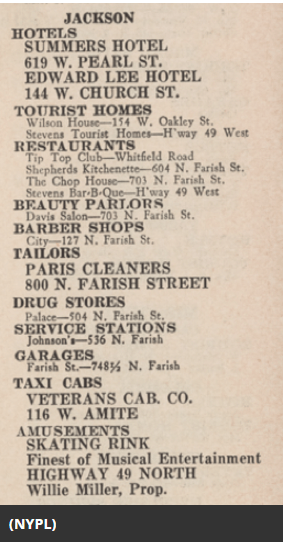
The Green Guide lists the types of businesses by name and address in the southern states that were known to welcome black patrons.
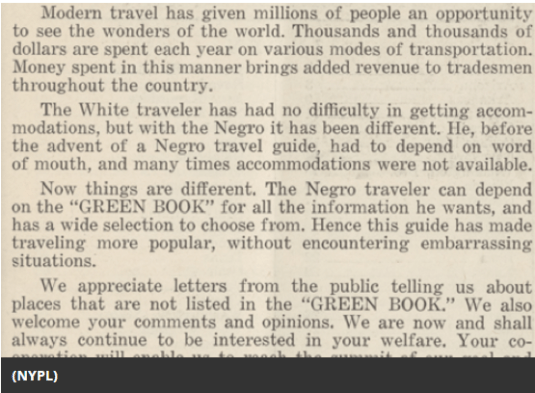
The Green Book spoke in code about how to avoid “embarrassing situations”. This was code for “the violence and discrimination inflicted by bigots”. The diffusion of the car into the black middle class was a godsend to escape racism.
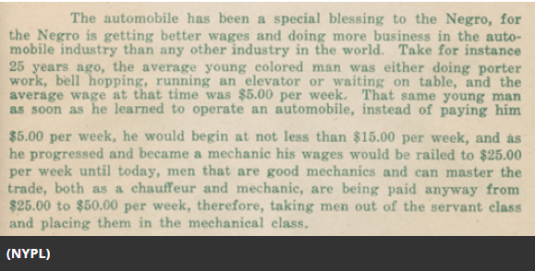
The founding publisher was a US postal worker who with typical entrepreneurial flair initially published the Green Book from his apartment in Virginia starting in the late 1930s. To find businesses that welcomed black patrons, Victor Green tapped into his network of fellow mailmen. His book covered the entire 50 states, parts of Canada and even extended to Europe in later editions.
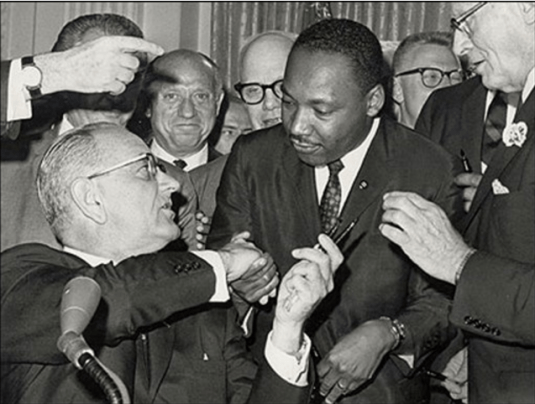
The Green Book stopped publishing a mere two years after the passage of a major civil rights bill in 1964 and the voting rights bill of 1965. These two bills strengthened voter rights and outlawed discrimination by businesses and employers.

By 1966, just two years after the passage of the civil rights bill, the market collapsed for information on businesses that welcomed black patrons in America. This was because so many businesses now welcome black patronage in every part of the southern states and elsewhere in America that a special booklet no longer had buyers. At the height of its popularity, the Green Book sold 15,000 copies per year.
Yes, there were law reforms but the closing of the Green Book is a sign of surprisingly rapid social change given the dogged resistance of the Democratic Party led southern states to all previous attempts at racial integration.
As an example of this tenacious resistance to civil rights legislation, Texas divided itself into 252 counties and delegated considerable responsibility to them. Local sheriffs in southern states would campaign on slogans such as “the man who can take care of situations that may arise”.
Control of the police and local courts was central to the enforcement of racial segregation in the southern states of America. This was backed up by the monopoly that the Democratic Party had over local and state offices.
To register to vote in Texas, for example, a black voter had to register with the local voter registration board in one of the 252 counties. Assuming you could find a member – they came in late, took long lunches and went home early – they would fail the applicant on the literacy test or some other criteria.
Can you pass a literacy test given to Black voters in the 1960's http://t.co/mtOIr7XE50—
History In Pictures (@historyepics) August 28, 2015
The aggrieved black would be voter would then have to take is local voter registration board all the way to the Supreme Court to overturn that decision. The members of the local voter registration board would refuse to follow the orders of the US District Court orders. The criminal contempt citation would be appealed all the way to the Supreme Court.
Once the criminal contempt citation is upheld by the Supreme Court, the voter registration board resigned so the litigation would have to start all over again against the new board members. This was because the state of Texas could not be named as a co-defendant under the 1957 civil rights law – the first past 100 years by Congress.
Such was the hostile legal environment, the lawlessness, the FBI had an eight part go to strategy in case a local sheriff arrested FBI agents in southern states when they are enforcing civil rights law. Black civil rights leaders in the USA were keen gun owners and owned a lot of them for home defence and they used them.
Plenty of school busing orders by courts were appealed for years and years and were resisted at every turn in both northern and southern states. One or two states closed their entire school systems and threatened to transfer the assets to private hands to prevent racial integration.
James Heckman was one of the first economist to note the rapid social change in the southern states of America over the course of the 60s. Heckman spent two years as a teenager in the late 1950s in racist Southern States of America and returned in 1963 and in 1970. His parents were received a delegation of neighbours upon their arrival to explain Southern ways.
Civil disobedience at its best, 1950s http://t.co/WzszCj1zBf—
Historical Pics (@VeryOldPics) September 20, 2015
There was organised segregation in 1963 when Heckman visited again as a college student. His 1963 visit with a college roommate from Nigeria was monitored by the local sheriff. In Birmingham, they stayed at the black YMCA. The people at the YMCA were frightened to death because Heckman and his Nigerian friend were breaking the local Jim Crow laws. Shops closed in New Orleans to avoid serving them.
In 1970, Heckman re-visited New Orleans as an academic, going back to the same places as in 1963. They were completely integrated, totally changed. This rapid social change fascinated him.
The Civil Rights Act of 1964 broke the control of segregationists over their political and legal institutions. The racial segregation collapsed because it could no longer rely on Jim Crow laws and the private violence and boycotts through the White Citizens Councils which police turned a blind eye too when they were not actively involved.
Unlike the Ku Klux Klan, the White Citizens’ Councils met openly and was seen as “pursuing the agenda of the Klan with the demeanour of the Rotary Club” by “unleashing a wave of economic reprisals against anyone, Black or white, seen as a threat to the status quo”. In Mississippi, the State Sovereignty Commission funded the Citizens’ Councils.
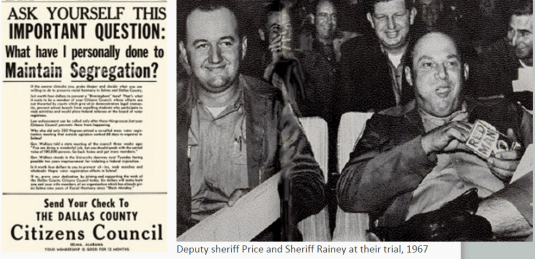
The 1957 and, particular, the 1964 civil rights laws overthrew racial segregation because more Black Americans could vote in the Southern States in state and local elections. Politicians soon courted those votes and there was a political realignment and a social revolution. The lawlessness that back-up most of segregation quickly came to an end because its victims could now vote. Richard Epstein explains:
With Jim Crow in the South this set of insidious practices was not accomplished by explicit laws mandating racial segregation. Rather, those inflexible social and economic patterns were supported by four interlocking strategies. First, illicit control of the electoral franchise, which in turn translated into control of the police and the courts. Second, corrupt use over the infrastructure translated into an ability to deny water and electrical hook-ups to firms that did not toe the segregationist line. Third, private violence to which southern police forces turned a blind eye when they did not actively support it. Fourth, social ostracism to those who spoke up against the system. Sensible people either left, stayed away or remained silent.
LBJ was behind the first civil rights bill of the 20th century. This was the 1957 civil rights bill. LBJ’s astute understanding of public choice processes was central to how he crafted the 1957 bill.
Then Senator Johnson could see that his fellow Southern Democrats would not live with racial integration at the social level. But he knew from his dealings with the Southern Democrats that in their heart of hearts that they could not ultimately deny that people have a right to vote. LBJ knew that if Black Americans in the Southern States could secure the right to vote, all the other rights they sought would soon follow and would be protected by law. He was right.
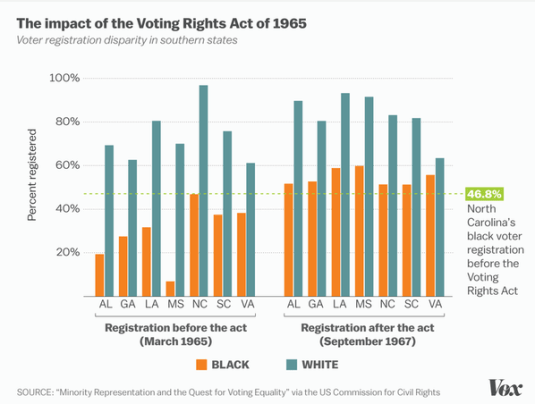
The Voting Right Act had a huge impact on many southern states. For example, black voter registration rates in Mississippi increased from a mere 6.7 percent in 1965 to 59.8 percent in 1967, according to the US Commission for Civil Rights. For a state that’s historically around 40 percent black, this represented a massive shift in politics — a change that much of the predominantly white leadership at the time feared but would have to accept due to the Voting Rights Act.
Timur Kuran in “Sparks and Prairie Fires: A Theory of Unanticipated Political Revolutions,” suggested that political revolutions and large shifts in political and social opinion will catch us by surprise again and again because of people’s readiness to conceal their true political preferences proclivities under perceived social pressure.
Kuran begins with a simple, even mundane point: social pressures can make people say that they want and believe something that they really don’t want or believe… The result of social pressures is to produce what Kuran calls “preference falsification,” a phenomenon that occurs when you make an inaccurate public statement about your actual preferences (or beliefs). Falsified preferences might be described more simply, of course, as lies; but they are a distinctive, and distinctly interesting, kind of lies, with particular social implications… People joined organizations they abhorred, followed orders they considered nonsensical, cheered speakers they despised and ostracized dissidents they greatly admired.
Those ready to oppose racism or who were lukewarm about it, kept their opposition private until a coincidence of factors gave them the courage to bring their views into the open. In switching sides, they encouraged other hidden opponents to switch. Fear changes sides. Genuine supporters of the old older falsify their publically professed preferences, pretending that they support the new order. These are late-switchers. Do not trust them. These opportunists will just as easily switch back.
Plenty of people have had personal experiences of this in the 1980s and the 1990s when there was rapid change in social and political attitudes about racism, sexism and gay rights. A few people had to stand up for what was right and a surprisingly large number quickly joined their side.
Once Blacks in the southern states started voting for the local sheriff and judges and for state-wide officials, the local legal infrastructure helped the market work rather than frustrated it. As Richard Epstein noted when writing a freedom of association but his remarks equally apply to the market process:
The practice of freedom of association cannot survive in a society that has corrupt electoral institutions, corrupt provision of public services, corrupt use of public force, and unrestrained use of private violence. The hard question in these settings is to ask exactly what legal changes should be made. In one sense, the thought that some non-discrimination principle could gain hold through legislation seems laughable. Indeed, it was only because federal legislation could work, with much huffing and puffing, to override state legislation that the local monopoly was broken… The competitive market works well when supported by well-ordered public institutions.
The rapid demise of the Green Book is a testament to the shallowness of racism in America apart from a hard-core full of hatred of whatever comes along. Certainly, the collapse in the market for a specialised information on businesses willing to accept black patch and suggests that many southern businesses opened their doors to black customers once it was physically safe to do so. The Civil Rights Bill of 1964 bought an end to lawlessness in the South principally because black people could now vote. Epstein again:
At its best, and in its original form, the Civil Rights Act of 1964 sought to break the control of the local segregationist forces over their political institutions. First on the list was Title I, which attacked exclusion from voting.
Swedish and Danish top incomes & union decline @FlipChartRick @EconomicPolicy @PoliticalSift
04 Nov 2015 Leave a comment
in applied price theory, applied welfare economics, econometerics, entrepreneurship, labour economics, Public Choice, rentseeking, unions Tags: Denmark, labour surplus, Sweden, top 1%, union power, union wage premium
The Danish top 1% and top 10% is even lazier than their transnational co-conspirators. No success at all at either grinding the Danish unions down or extracting more labour surplus from the long-suffering Danish proletariat.

Source: OECD StatExtract and Top Incomes Database.

Source: OECD StatExtract and Top Incomes Database.
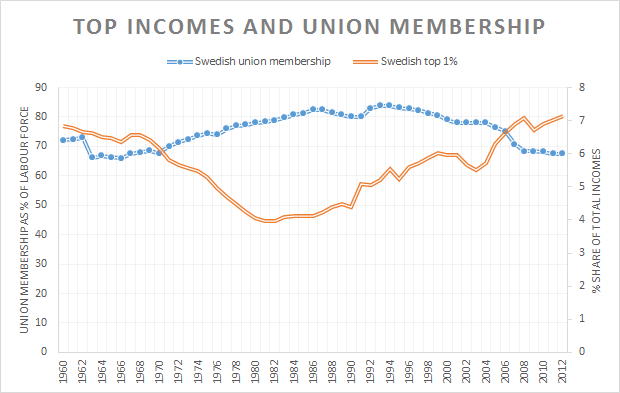
The Swedish top 10% and top 1% have done a bit better since the economic liberalisation in that country from the early 1990s. But none of that additional labour surplus has anything to do with grinding the unions down because Swedish union membership has not declined.

Source: OECD StatExtract and Top Incomes Database.
Source: OECD StatExtract and Top Incomes Database.
Why are so many Silicon Valley start-up founders libertarian Democrats?
03 Nov 2015 Leave a comment
in economics of media and culture, entrepreneurship, income redistribution, industrial organisation, politics - USA, Public Choice, rentseeking, survivor principle Tags: creative destruction, entrepreneurial alertness, expressive voting, rational ignorance, Silicon Valley, start-ups, voter demographics
Top incomes and the decline of unions in Canada, France and Italy
03 Nov 2015 Leave a comment
in applied price theory, applied welfare economics, economic history, entrepreneurship, industrial organisation, labour economics, labour supply, Milton Friedman, poverty and inequality, Public Choice, rentseeking, unions Tags: Canada, entrepreneurial alertness, France, Italy, top 1%, union power, union wage premium
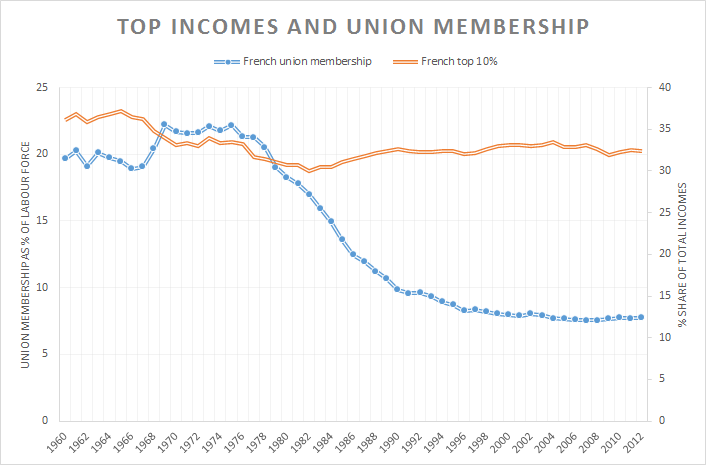
The French ruling class is as lazy as their transnational co-conspirators down under. French union membership is in serious decline albeit from a low base. An opportunity lost for the French ruling class. It has not lifted a finger to extract additional labour surplus from the downtrodden French proletariat now stripped of their only line of collective defence against capitalist exploitation.
Source: OECD Stat and Top Incomes Database.
The top 10% and top 1% in France are no better off than two generations ago despite the decline of French unions. The French Left must be most disappointed. No kicking in the rotten door of the permanent revolution anytime soon after the immiserised French proletariat rises up because it has nothing to lose but its chains. The 21st century version of the Marxist call to the barricades would be a proletariat stirred to revolution with nothing to lose but their suburban home, motorcar, IPad and air points

Source: OECD Stat and Top Incomes Database.
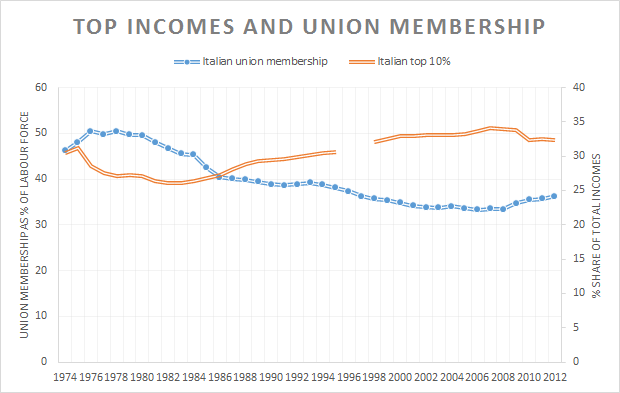
The Italian ruling class has had little success in bringing Italian unions down. The top 10% in Italy is earning no more now than back when the Red Brigades were gunning for them.
Source: OECD Stat and Top Incomes Database.
The top 1% in Italy is doing a little bit better than when the Red Brigade was gunning for them, but not much more. Unions don’t figure in explaining that small rise in Italian top 1% incomes over the last 40 years. Italian unions are pretty much a strong as they were 40 years ago in membership. Italian employment protection laws are pretty much as strong as they used to be too.

Source: OECD Stat and Top Incomes Database.
The Canadian ruling classes even more incompetent than their transnational co-conspirators over in Italy. There appears to have been next to no decline in union membership in Canada. The Canadian top 10% is not earning any more than back in the 60s.

Source: OECD Stat and Top Incomes Database.
The Canadian top 1% is doing a little bit better than 25 years ago also but not off the back of unions which are almost as strong as in the past. The Canadian Left will have to look for a different hypothesis than the ravages of the top 1%.

Source: OECD Stat and Top Incomes Database.
All in all, the Economic Policy Institute simply got lucky with a spurious correlation between top incomes and union membership in the USA.
Did the New Zealand film industry just eat our lunch? By Jason Potts
01 Nov 2015 Leave a comment
in applied price theory, economics of media and culture, fiscal policy, industrial organisation, job search and matching, labour economics, labour supply, macroeconomics, politics - Australia, politics - New Zealand, Public Choice, rentseeking, survivor principle Tags: film subsidies, Hollywood economics, industry policy, offsetting behaviour, The fatal conceit, The pretense to knowledge, unintended consequences

James Cameron is going to film the next three instalments of the Avatar franchise in New Zealand. He promises to spend at least NZ$500 million, employ thousands of Kiwis, host at least one red-carpet event, include a NZ promotional featurette in the Avatar DVDs, and will personally serve on a bunch of Film NZ committees, and probably even bring scones, all in return for a 25% rebate on any spending he and his team do in the country (up from a 20% baseline to international film-makers) that is being offered by the New Zealand Government.
The implication that many media reports are running with is that this is a loss to the Australian film industry, that we should be fighting angry, and that we should hit back at this brilliantly cunning move by the Kiwi’s by increasing our film industry rebates, which currently are about 16.5% (these include the producer and location offsets, and the post, digital and visual effects offset) to at very least 30%. These rebates cost tax-payers A$204 million in 2012, which hardly even buys you a car industry these days.
So what are the economics of this sort of industry assistance? Is this something we should be doing a whole lot more of? Was the NZ move to up the rebate especially brilliant? First, note that James Cameron has substantial property interests in New Zealand already, so this probably wasn’t as up for grabs as we might think. But if that’s how the New Zealand taxpayers want to spend their money, that’s up to them. The issue is should we follow suit?
The basic economics of this sort of give-away is the concept of a multiplier “”), which is the theory that an initial amount of exogenous spending becomes someone else’s income, which then gets spent again, creating more income, and so on, creating jobs and exports and all sorts of “economic benefits” along the way.
People who believe in the efficacy of Keynesian fiscal stimulus also believe in the existence of (>1) multipliers. Consultancy-based “economic impact” reports do their magic by assuming greater-than-one multipliers (or equivalently, a high marginal propensity to consume coupled with lots of dense sectoral linkages). With a multiplier greater than one, all government spending is magically transformed into “investment in Australian jobs”.
So the real question is: are multipliers actually greater-than-one? That’s an empirical question, and the answer is mostly no. (And if you don’t believe my neoliberal bluster, the progressive stylings of Ben Eltham over at Crikey more or less make the same point.)
But to get this you have to do the economics properly, and not just count the positive multipliers, but also account for the loss of investment in other sectors that didn’t take place because it was artificially re-directed into the film sector, which no commissioned impact study ever does.
This is why economists have a very low opinion of economic impact studies, which are to economics what astrology is to physics.
What does make for a good domestic film industry then? Look again at New Zealand, and look beyond the great Weta Studios in Wellington, for Australia and Canada both have world-class production studios and post-production facilities. Look beyond New Zealand’s natural scenery, for Vancouver is an easy match for New Zealand and Australia pretty much defines spectacular.
No, the simple comparison is that New Zealand is about 20% cheaper than Australia and 30% cheaper than Canada. New Zealand has lower taxes, easy employment conditions and relatively light regulations (particularly around insurance and health and safety). It’s just easier to get things done there.
If Australia really wants to boost its film industry, it might look more closely at labour market restrictions (including minimum wages) and regulatory burden and worry less about picking taxpayer pockets and bribing foreigners.
This article was originally published on The Conversation in December 2013. Read the original article. Republished under the a Creative Commons Attribution No Derivatives licence.
The low skilled won’t be hired for living wage jobs @nmjyoung @EtuUnion @WellingtonMayor @FIRST_Union
30 Oct 2015 3 Comments
in applied price theory, human capital, labour economics, minimum wage, personnel economics, politics - New Zealand, rentseeking Tags: entrepreneurial alertness, expressive voting, living wage
The upshot of the Wellington City Council paying a living wage to employees and including those of sub-contractors is over time the composition of their low skilled labour force will change. The Council will recruit people who can earn in other jobs $19.25. Workers who don’t have the capability of producing at that level of productivity will never be interviewed.
The Council is required by law to recruit on merit and to be a good employer. Workers who would never have previously applied for Wellington City Council jobs covered by the living wage decision because they can earn better pay elsewhere will now do so because of the higher pay of these council jobs.
These higher skilled workers will crowd out the lower skilled workers that currently apply for the low paid jobs covered by the upcoming living wage increase. The workers with the type of skills that currently win those jobs covered by the living wage increase will not be shortlisted because the quality of the recruitment pool will increase because of the living wage. There will be an influx of more skilled workers attracted by the higher wages for council jobs because of the living wage policy. They will go to the head of the queue and displaced workers who currently apply for and win those council jobs.
A living wage is an exclusionary policy where ordinary workers, often with families who are not productive enough to produce $19.25 per hour plus overheads will never be interviewed by the Wellington City Council or council subcontractors for a job covered by the living wage increase.
In a cruel twist of fate, because the council is implementing its living wage on 1 July 2016, higher quality workers will start applying for jobs covered by the living wage increase now. This will further reduce the number of initial beneficiaries of the living wage increase. Council workers recruited between now on 1 July 2016 will be applying in anticipation of that increase.
The living wage adopted by the Wellington City Council is a classic case of rent capitalisation. With the council paying over the odds for a job, workers will have every incentive to compete for the higher wages. The most obvious way of winning that race for these limited number of higher paying jobs is to be a more productive worker than the other job applicants.
The living wage jobs will attract a higher quality pool of job applicants. These higher quality job applicants who would not otherwise applied but for the living wage will outcompete existing low skilled low paid workers who would otherwise benefited from the living wage increase. In some cases, these higher quality, more skilled recruits will be taking a job at the Council or its contractors covered by the living wage increase on much the same pay as they command anywhere else in the labour market. As such, ratepayers are paying about 20% more for no reduction in poverty.
The existing employees of the Wellington City Council and its subcontractors will be locked into golden handcuffs. Workers who lack the labour productivity to command a wage equivalent of the living wage elsewhere in the job market will never quit. Wellington City Council employees covered by the living wage will also have a much reduced incentive to up-skill will seek promotion. There will be no internal reward for undertaking additional training or job responsibilities among low skilled is because the living wage will mean they will not get a wage rise at the Council.
The windfall gains to the current low paid council employees but no future council employees illustrate the folly of a living wage policy at the Wellington City Council. Some of these existing Wellington City Council employees will have children so child poverty rates may improve. That is all that will be gained for a permanent increase of about 20% in the price paid for council services.
Because of the change in the recruitment pool for all future vacancies, the impact on the poverty rates among future council employees will be minimal. These recruits to future council vacancies covered by the living wage increase will be recruited from other jobs where they already earn a similar pay to the living wage paid at the Council. Ratepayers will pay about 20% more for services in return for a small reduction in child poverty among its existing council employees.
As these existing employees move on, and they will one day, ratepayers will continue to pay about 20% more until either the Council sees the errors of its ways or the policy is overturning on judicial review. There will be no reduction in family poverty because new recruits are switching to the Council for the usual wage premium from moving to one job to another and that’s it. As the existing council employees leave, any child poverty reduction from the living wage policy will fade to zero.
As mentioned, potential recruits who are productive enough to earn a competitive market wage equal to the living wage level in their existing jobs will be the most qualified applicants. The best of these higher quality applicants will fill future council vacancies covered by the living wage policy. Workers who are not productive enough to earn the living wage in other jobs simply won’t be shortlisted for council jobs. The Council must by law hire the best qualified applicant for any vacancy.
Source: Peter Kolesar, Garrett van Rysin and Wayne Cutler.
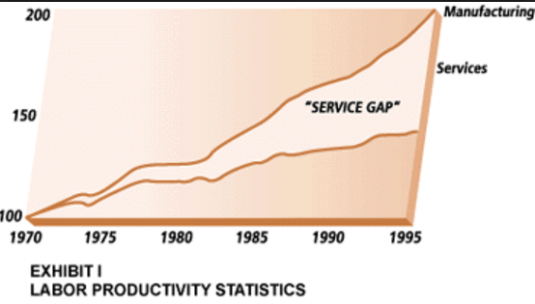
Any extra labour productivity from a living wage at the Wellington City Council is in doubt because low skilled service sectors are notorious for their low potential for productivity gains. They are the bread-and-butter of Baumol’s disease.

Source: Chris Rauchle.
It’s kicking the Wellington City Council when it is down to mention that low paid workers with families will lose a considerable part of the living wage increase because of reductions in their family tax credits – reductions in the Working for Families in-work tax credit. Any living wage increase at the Wellington City Council is the subject of multiple clawbacks by IRD. There is income tax, a 25% abatement rate on Working for Families tax credits on any family income above about $36,000 and 15% GST. All in all, the transfer out of the pockets of ratepayers to IRD would be at least one-third.
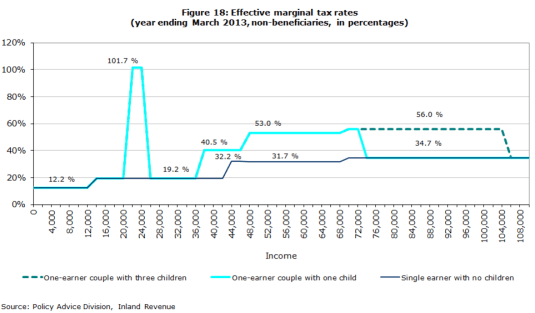
I have not included any accommodation supplement, childcare subsidy or community services card the low paid worker is receiving from WINZ. The winding back of these social benefits to the low paid worker and his or her family is a pointless transfer from Wellington City ratepayers to the national taxpayer.
It will be kicking Wellington City Council even further to remind of the enforcement and compliance costs of living wage ordinances in the USA at the city level.
The Wellington City Council this week acted against legal advice to require contractors under joint services agreements with other councils in the Wellington region to pay employees who work within the boundaries of Wellington city the living wage. The American cities had to define the minimum number of hours in a day that minimum wage workers who are mobile for their jobs had to spend within their city limits before their employer was subject to their living wage ordinance.
It is standard to put forward an efficiency wage argument for a living wage. The higher wage paid as result of the introduction of the living wage will motivate workers to work harder and cheer each other on.

Source: John Horton.
These workers paid the efficiency wage will require less supervision because under an efficiency wage, a rate of pay that is more than the going rate for their skills and experience with other employers and in other industries and occupations, these workers paid the efficiency wage have more to lose if disciplined or dismissed. By the way, the theory of the efficiency wages is an American theory where there is employment at will.
This additional effort and greater motivation from the efficiency wage, from the above market rate of pay, will reduce the costs of supervision to the employer of teams of employees as well as increase output per worker. This is supposed to offset some of the costs of the living wage increase.
At bottom, this efficiency wage hypothesis is entrepreneurs are unaware of the higher quality and greater self-motivation of better paid recruits for vacancies but wise bureaucrats and farsighted politicians notice these gaps in the market. Bureaucrats and politicians notice these gaps in the market before those who gain from superior entrepreneur alertness to hitherto untapped opportunities for profit do so and instead leave that money on the table.
I won’t mention that many of the modern theories of the firm focus, in part or in full on reducing opportunistic behaviour, cheating and fraud in employment relationships. The cost of discovering prices and making and enforcing contracts and getting what you pay for are central to the Coase’s theory of the firm put forward in 1937.
In Barzel’s (1982) theory of the firm, measurement costs drive the emergence and organisation of the firm. The firm arose to minimising the cost of measuring what is to be exchanged by bringing some of those measuring tasks in-house. Much of the organisation of the firm, including the degree of vertical and horizontal integration and many different forms of contracting are driven by ensuring owners and managers get what they pay for and are not overcharged through manipulation or cheating.
Alchian and Demsetz’s (1972) theory of the firm focused on moral hazard in team production. As they explain
Two key demands are placed on an economic organization-metering input productivity and metering rewards.
The main rationale in personnel economics from everything ranging from employer funding of retirement pensions to the structure of promotions and executive pay including stock options is around better rewarding self-motivating employees and reducing the costs of monitoring employee effort.

Source: Department of Labour (2009).
The profits of entrepreneurs for running a firm is directly linked from their successful policing of the efforts of employees and sub-contractors to ensure the team and each member perform as promised and individual rewards matched individual contributions (Alchian and Demsetz 1972; Barzel 1987). The entrepreneur is a residual claimant to the revenues of the firm net of paying all other inputs. Entrepreneurs must successfully police the contributions of their employers and contractors if they are to survive in competition. The better they are at this, the more the alert entrepreneur profits.
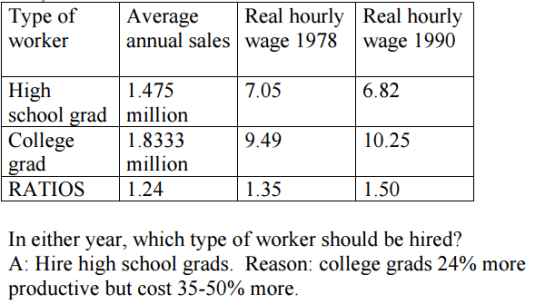
Every profit minded entrepreneur seeks to hire the group of workers with the lowest cost per unit of output produced by them. Those that do not will not survive in competition with more alert rivals. The trade-off between worker quality and wages in setting hiring standards is a routine entrepreneurial decision in every firm when recruiting:
Managers often say that their goal in hiring is to obtain the best quality workers. It sounds like a good idea, but is it? The most productive workers are also likely to be the most expensive. Should the goal instead be to hire the least expensive workers? …The best worker is not the cheapest, nor the most productive, but the one with the highest ratio of productivity to cost. We should hire as long as the marginal productivity of the last worker hired is greater than or equal to the cost of the worker.
Source: Lazear and Gibbs.
The Great Escape and #vegetarianism
25 Oct 2015 Leave a comment
in development economics, economic history, environmental economics, growth miracles, health economics, Public Choice, rentseeking Tags: expressive politics, The Great Enrichment, The Great Escape, The Great Fact, vegetarianism
@NaomiAKlein agrees with #MiltonFriedman on Mancur Olson’s theory of how nations escape institutional sclerosis
25 Oct 2015 Leave a comment
in comparative institutional analysis, constitutional political economy, development economics, economic history, economics of bureaucracy, income redistribution, Marxist economics, Milton Friedman, Public Choice, rentseeking, technological progress Tags: expressive voting, interest groups, Leftover Left, logic of collective action, Mancur Olson, Naomi Klein, pressure groups, rational ignorance, rational irrationality, rise and decline of nations, Twitter left

Source: quoted by Naomi Klein in “The Shock Doctrine”.
LA premiere tonight @NaomiAKlein @avilewis @mrdannyglover in person Q&A 7.30pm sundancecinemas.com http://t.co/wRkPFbnUHu—
Changes Everything (@thischanges) October 16, 2015
1. There will be no countries that attain symmetrical organization of all groups with a common interest and thereby attain optimal outcomes through comprehensive bargaining.
2. Stable societies with unchanged boundaries tend to accumulate more collusions and organizations for collective action over time.
3. Members of “small” groups have disproportionate organizational power for collective action, and this disproportion diminishes but does not disappear over time in stable societies.
4. On balance, special-interest organizations and collusions reduce efficiency and aggregate income in the societies in which they operate and make political life more divisive.
5. Encompassing organizations have some incentive to make the society in which they operate more prosperous, and an incentive to redistribute income to their members with as little excess burden as possible, and to cease such redistribution unless the amount redistributed is substantial in relation to the social cost of the redistribution.
6. Distributional coalitions make decisions more slowly than the individuals and firms of which they are comprised, tend to have crowded agendas and bargaining tables, and more often fix prices than quantities.
7. Distributional coalitions slow down a society’s capacity to adopt new technologies and to reallocate resources in response to changing conditions, and thereby to reduce the rate of economic growth.
8. Distributional coalitions, once big enough to succeed, are exclusive, and seek to limit the diversity of incomes and values of their membership.
9. The accumulation of distributional coalitions increases the complexity of regulation, the role of government, and the complexity of understandings, and changes the direction of social evolution.
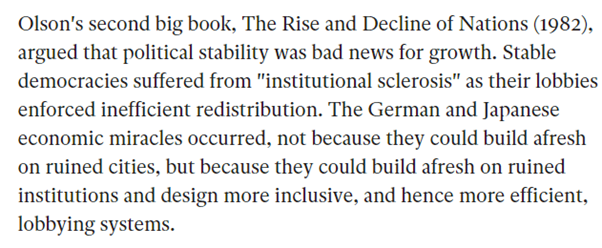
Source: Obituary: Professor Mancur Olson | Obituaries | News | The Independent
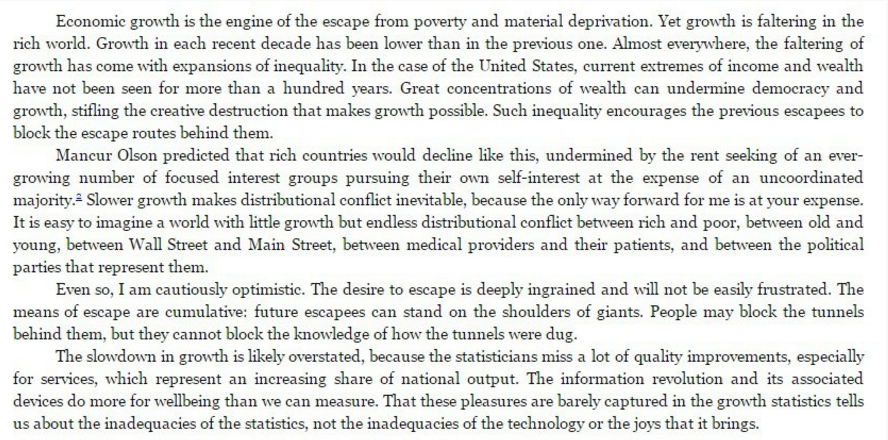
Angus Deaton on slow growth as a force for distributional conflict
25 Oct 2015 Leave a comment
in applied welfare economics, comparative institutional analysis, constitutional political economy, development economics, growth disasters, growth miracles, income redistribution, liberalism, Public Choice, rentseeking Tags: Angus Deaton, The Great Enrichment, The Great Escape, The Great Fact
@CarlyFiorina says it all on action to fight global warming @jamespeshaw @AndrewLittleMP @garethmorgannz
24 Oct 2015 Leave a comment
in applied price theory, comparative institutional analysis, energy economics, environmental economics, global warming, Public Choice, rentseeking Tags: 2016 presidential election, climate alarmists, expressive voting, free riding, game theory, global warming, international public goods, rational ignorance, rational irrationality
@RusselNorman tried to outthink, outsmart @JohnKey unlike @nzlabour who just tried to smear him
22 Oct 2015 Leave a comment
in environmental economics, Marxist economics, politics - New Zealand, Public Choice, rentseeking Tags: Leftover Left, New Zealand Greens, New Zealand Labour Party, rational ignorance, rational rationality, Russel Norman, Twitter left
German, French and Italian real housing prices since 1975
19 Oct 2015 Leave a comment
in applied price theory, applied welfare economics, economic history, economics of regulation, rentseeking, urban economics Tags: France, Germany, housing affordability, housing prices, Italy, land supply, land use planning, zoning
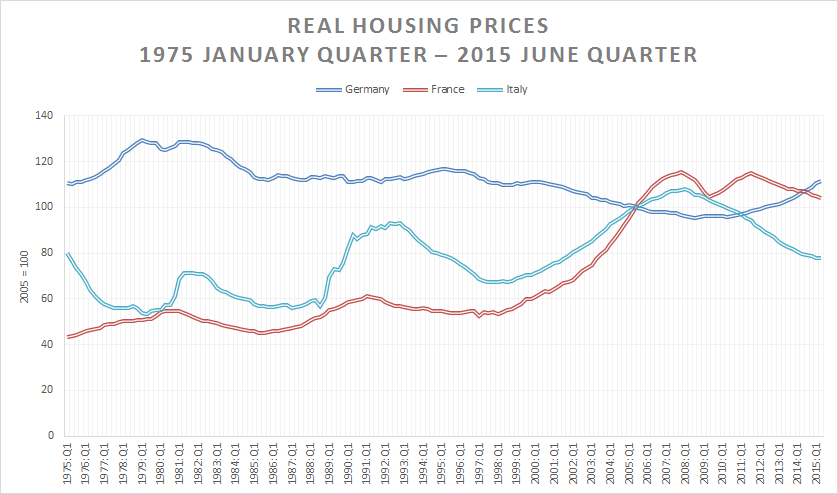
Source and notes: International House Price Database – Dallas Fed June 2015; nominal housing prices for each country is deflated by the personal consumption deflator for that country.
@GreenpeaceNZ @jamespeshaw The Futility and Farce of Global Climate Negotiations @RichardTol
18 Oct 2015 Leave a comment
in constitutional political economy, development economics, economics of bureaucracy, environmental economics, environmentalism, global warming, growth disasters, growth miracles, international economics, politics - Australia, politics - New Zealand, politics - USA, Public Choice, rentseeking Tags: bootleggers and baptists, climate alarmism, expressive voting, free-riders, global warming, green tariffs, international public goods, Leftover Left, New Zealand Greens, Twitter left
It is time for the environmental movement to face up to the fact that there never will be an international treaty to restrain carbon emissions. The practical way to respond to global warming is healthier is wealthier, richer is safer. Faster economic growth creates more resources for resilience and adaptation to a changing environment.

NEW REPORT: The Futility and Farce of Global Climate Negotiations bit.ly/1LvFFv3 http://t.co/TwbFUwaPlm—
Manhattan Institute (@ManhattanInst) October 17, 2015
India's target compared to its recent history http://t.co/pIvwhoSTpL—
Richard Tol (@RichardTol) October 02, 2015
 Utopia, you are standing in it!
Recent Comments