
Directors’ Law vindicated again – the American middle class think there are undervalued
06 Mar 2016 Leave a comment
Why did communism fall in the USSR?
05 Mar 2016 Leave a comment
in constitutional political economy, economic history, economics of bureaucracy, Public Choice, rentseeking
I find many explanations of the fall of the USSR disappointing because many want to believe in people power and popular rebellions.
The rise and fall of mercantilism view of the USSR put forward by Pete Boettke will be the foundation of better explanations. By analysing communism as a rent-seeking society, the process of social and political evolution can be embedded into the history of the rise and fall of mercantilism.
More freedom in Russia and China came as an unintended by-product of a constitutional struggle over who would control the rules under which the economy prospered (or failed to prosper) and the sharing within the elite.
After the death of Stalin, the Soviet Nomenklatura used both co-option and political repression to encourage loyalty to the communist regime. As Grossman noted:
Under Stalin’s leadership the nomenklatura, after initially emphasizing a strategy of co-option, then experimented with political repression as a substitute for co-option, and finally, in response to the threats posed by German militarism and the onset of the Cold War, employed a combination of intense political repression and co-option. As a result, membership in the CPSU increased rapidly, then decreased sharply, before increasing rapidly again. After Stalin was gone the nomenklatura, having learned the cost of Stalin’s repressive excesses, adopted a policy that combined more co-option with less intense political repression. As a result, membership in the CPSU increased steadily, then levelled off, until the rapprochement between the United States and China, the emergence of Islamic fundamentalism, and the escalation of the cold war arms race resulted in yet more co-option and in the final episode of growth in party membership.
More and more of the general public in Russia and China were co-opted into the winning circle through peacefully adaptations when threats of revolution were minimal.
The cost of co-opting people into the Communist Party was a decrease in the standard of living of members of the Nomenklatura, whereas the cost of political repression was the danger that members of the Nomenklatura would themselves be victimized.
These successive minor reforms were mutual beneficial constitutional exchanges as suggested by Roger Congleton’s brilliant recent book on his king-and-council template and in Herschel Grossman’s earlier paper on co-option in the communist party from 1953 to 1989.
The USSR broke apart as the result of an internal power struggle within a new generation of leaders who grew up in a climate of corruption and high living.
Perestroika and glasnost should be viewed as nothing much more than the usual system reforms and rotations of patronage that were launched after the appointment of all previous Soviet leaders. As Anderson and Boettke explain
…upon closer examination, the succession of Gorbachev in general and the perestroika/glasnost “reform” program in particular bear a close resemblance to other, earlier Soviet government policy adjustments which followed shifts in the top leadership. Gorbachev’s behaviour as a “reformer” over the period 1985 to 1989 can be explained by reference to the incentives facing the dictator of a socialist state based on the distribution of economic privilege and political patronage… Gorbachev’s period of “reform” was not an extraordinary example of the role of ideology or vision in human affairs, but a more routine episode of rent-seeking in action.
Political and economic power was devolved to the 15 republics in the old USSR because this is the only way to operate a mercantilist state.
These local leaders formed their own alliances and declared succession from the USSR when the centre was too weak to fight. Local military units defected with them to a new rent-seeking coalition.
The fall of soviet communism led to a drawn out struggle for access to patronage and state monopolies and a new and better paid manifestation of the old mercantilism but ex-KGB owned and run under Putin.
A fragile state lists from DFID
29 Feb 2016 Leave a comment
in constitutional political economy, development economics, growth disasters, Public Choice, rentseeking Tags: failed states
New Zealand MP travel expenses 1 October – 31 December 2015 @DBSeymour
28 Feb 2016 1 Comment
in economics of bureaucracy, environmental economics, global warming, politics - New Zealand, Public Choice, rentseeking, transport economics Tags: carbon footprint, New Zealand Greens, rational irrationality
10 of the 14 green MPs have above-average air travel expenses – have an above average carbon footprint for a member of the New Zealand Parliament. It is not easy to be Green.
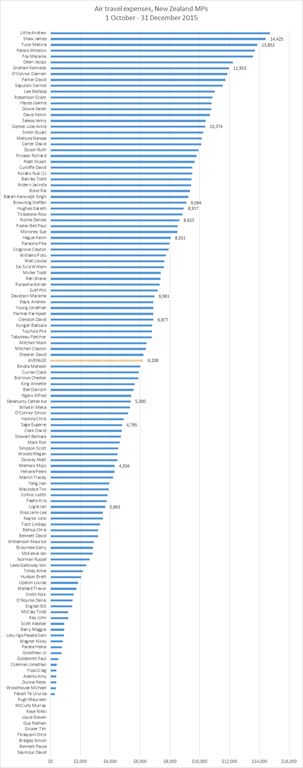
Source: New Zealand Parliament – Members’ expense disclosure from 1 October to 31 December 2015.
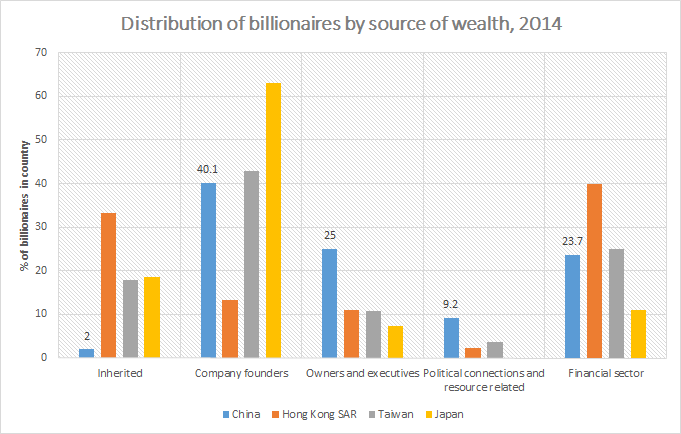
Chinese, Hong Kong, Taiwanese and Japanese billionaires by source of wealth
24 Feb 2016 Leave a comment
in development economics, economic history, entrepreneurship, financial economics, growth miracles, industrial organisation, rentseeking, survivor principle Tags: billionaires, China, entrepreneurial alertness, Hong Kong, Japan, superstar wages, superstars, Taiwan
Surprisingly few billionaires in any of the 4 countries obtained their wealth through political connections. Founding a company seems to be still the path of great wealth even in Japan these days. Hong Kong is a financial centre so the large number of billionaires in its financial sector is no surprise.
Are we there yet on solar power? @GarethMP @GreenpeaceNZ @NZGreens
24 Feb 2016 Leave a comment
in economic history, energy economics, environmental economics, Public Choice, rentseeking Tags: Big Solar, green rent seeking, rational irrationality, solar energy, solar power

Source: History of Solar Power – IER.
The distributional impact of alternative energy incentives
23 Feb 2016 Leave a comment
in energy economics, environmental economics, fiscal policy, politics - USA, public economics, rentseeking
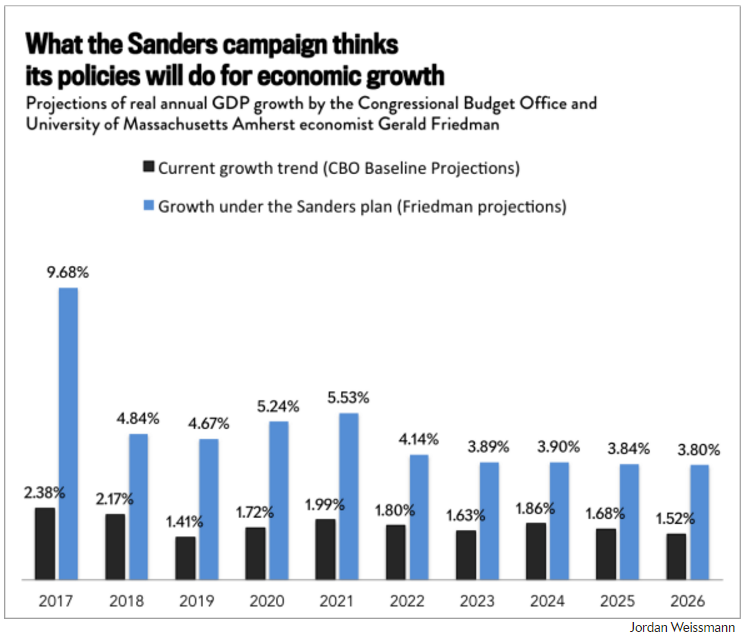
And people vote for @BernieSanders because he is honest
21 Feb 2016 Leave a comment
in fiscal policy, income redistribution, macroeconomics, politics - USA, Public Choice, public economics, rentseeking Tags: 2016 presidential election, cranks, quackery, rational ignorance, rational irrationality
@ChrisHipkins @jacindaardern New Zealand graduate premium @dbseymour
17 Feb 2016 3 Comments
in applied price theory, economics of education, human capital, income redistribution, politics - New Zealand, poverty and inequality, rentseeking
How conceited students are to complain about a $20,000 student loan when they got $1/2 million coming down the pipe. 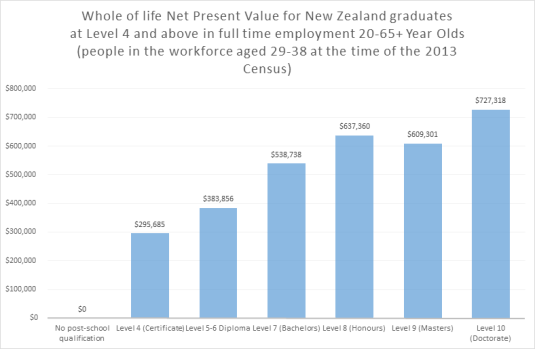
Source: A Degree is a smart investment | Universities New Zealand – Te Pōkai Tara.
Self-appointed social justice warriors in the New Zealand Labour Party and New Zealand Greens pander to this middle class greed. They should be ashamed of themselves.
26% of eligible students do not take out a student loan so they would really get a leg up from the abolition of tuition fees.
The median repayment time for those who left study in 2011 and remained in New Zealand was 5.8 years.
% billionaires who made their money through political connections or resource industries
13 Feb 2016 Leave a comment
in economics of bureaucracy, economics of regulation, energy economics, entrepreneurship, industrial organisation, poverty and inequality, privatisation, rentseeking, resource economics
The 1826 Billionaires in the Forbes 2015 list are classified as rich through political connections if they made their money through past political positions, close relatives or friends in government, or questionable licenses, privatisations or resource extraction industries.
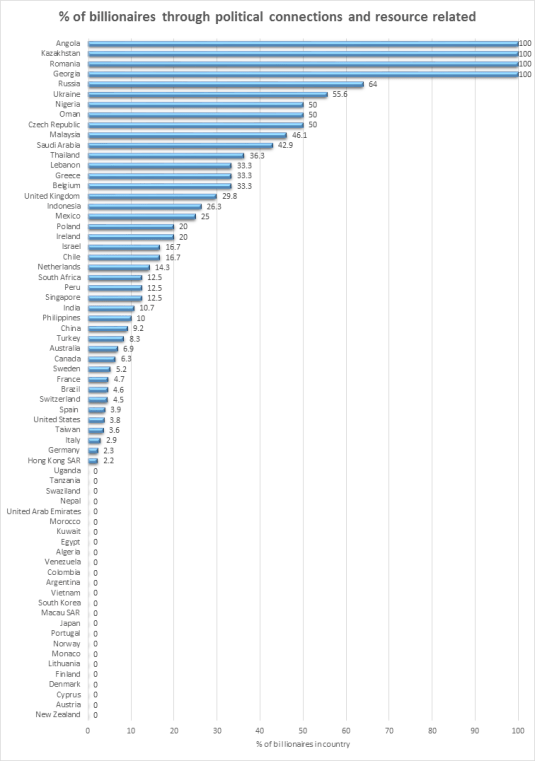
All privatizations were included in the politically-connected/resource-related category despite my data source acknowledging the possibility that the new owners may have transformed the company. Resource billionaires were all deemed to be lucky or cronies by my data source rather than diligent as some most certainly were. This is something of a slur by my data source given the industriousness of some resource billionaires some of whom were even geologists.
Political cronyism is a path to billionaire wealth mainly in the developing countries. Less than 10% of Chinese billionaires made their money through political connections, which is surprising.
Regulating Monopolies: A History of Electricity Regulation
09 Feb 2016 Leave a comment
in applied price theory, economic history, economics of bureaucracy, economics of religion, industrial organisation, law and economics, Public Choice, rentseeking, survivor principle Tags: competition law, electricity industry, natural monopolies, network industries
Here’s where Republicans and Democrats differ on the role of government
08 Feb 2016 Leave a comment
in defence economics, economics of bureaucracy, economics of education, economics of information, economics of media and culture, economics of regulation, energy economics, entrepreneurship, environmental economics, income redistribution, politics - USA, Public Choice, rentseeking Tags: 2016 presidential election Republican Party, Democratic Party, votor demographics
A bizarre Finnish amateur racing car practice for redistributing winning
06 Feb 2016 Leave a comment
in economics of media and culture, fiscal policy, income redistribution, labour economics, labour supply, law and economics, poverty and inequality, property rights, public economics, rentseeking Tags: basic income, car racing, Finland, guaranteed minimum income, negative income tax


Recent Comments