
The obvious reason for the popularity of behavioural economics
10 Dec 2015 Leave a comment
in applied price theory, behavioural economics, comparative institutional analysis, economics of bureaucracy, Public Choice, rentseeking Tags: expressive voting, rational ignorance, rational irrationality, special interests
Corruption vs. Human Development
09 Dec 2015 Leave a comment
in development economics, economic history, economics of bureaucracy, economics of crime, economics of regulation, growth disasters, growth miracles, income redistribution, industrial organisation, law and economics, Public Choice, rentseeking Tags: bribery and corruption, capitalism and freedom, rent seeking, rule of law, The Great Fact
Corruption vs. Human Development (HDI) http://t.co/WNlSMYzdWD—
Max Roser (@MaxCRoser) August 08, 2015
Who profits from the science of global warming? @GreenpeaceUSA #COP21
08 Dec 2015 Leave a comment
in energy economics, environmental economics, environmentalism, global warming, rentseeking

Solar and wind will still be bit players in 2040 @GarethMP @GreenpeaceUSA
06 Dec 2015 Leave a comment
in energy economics, environmental economics, rentseeking
Wind & solar received many times the subsidies of fossil fuels @Greenpeace @NZGreens
06 Dec 2015 Leave a comment


@stevenljoyce has his bridge too far on corporate welfare
25 Nov 2015 Leave a comment
in applied welfare economics, politics - New Zealand, rentseeking, transport economics
Why propaganda?
21 Nov 2015 Leave a comment
in constitutional political economy, economics of media and culture, income redistribution, Marxist economics, Public Choice, rentseeking Tags: economics of advertising, expressive voting, rational ignorance, rational irrationality
Bruce Yandle discusses the concept of Bootleggers and Baptists
15 Nov 2015 Leave a comment
in applied price theory, economics of bureaucracy, Public Choice, rentseeking Tags: bootleggers and baptists, Bruce Shanley, pressure groups
When did buying your own home become an investment in New Zealand?
09 Nov 2015 Leave a comment
in economics of regulation, politics - New Zealand, Public Choice, rentseeking, urban economics
Buying a house became an investment in New Zealand coincidently with the passing of the Resource Management Act and all the restrictions on land supply it empowered. Prior to then buy a house was a good idea except if you want to make money because real housing prices in 1993 were the same as in the mid-70s.
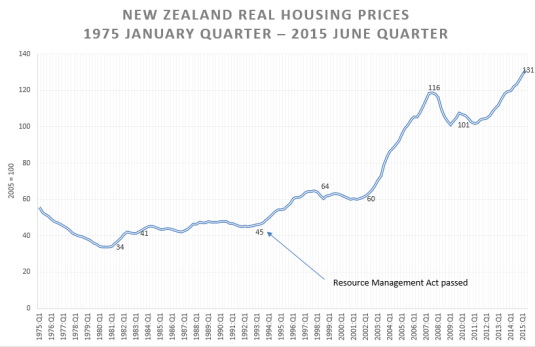
Source and notes: Dallas Fed International Housing Database July 2015 – The author acknowledge use of the dataset described in Mack and Martínez-García (2011); real housing prices are nominal housing prices deflated by a personal consumption deflator.
Housing prices rose by 50% in the first few years after the passage of the Resource Management Act. Housing prices doubled again in the last five years of the last Labour Government in New Zealand. With the economic recovery, housing prices increased again by 30% in the last four years or so.
The housing prices charted in deflated above are nationwide figures originally from nationwide nominal data published by the Reserve Bank of New Zealand and Quotable Value. They do not show the even faster growth in housing prices in, example, Auckland, Wellington and Christchurch and stagnant housing prices in declining regions, cities and towns of New Zealand.
The demise of the Green Book and the decline of racism in America
04 Nov 2015 1 Comment
in applied price theory, constitutional political economy, discrimination, entrepreneurship, industrial organisation, liberalism, politics - USA, Public Choice, rentseeking
The Green Book was an indispensable survival guide to black Americans traveling in America in the Jim Crow Era if they wish to “sidestep humiliation (or worse) on the journeys”. As Richard Epstein noted when reflecting on the 50th anniversary of the 1964 Civil Rights Bill:
Title II was passed when memories were still fresh of the many indignities that had been inflicted on African American citizens on a routine basis. It took little imagination to understand that something was deeply wrong with a nation in which it was difficult, if not impossible, for African American citizens to secure food, transportation, and lodging when traveling from place to place in large sections of the country. In some instances, no such facilities were available, and in other cases they were only available on limited and unequal terms.
The Green Guide lists the types of businesses by name and address in the southern states that were known to welcome black patrons.
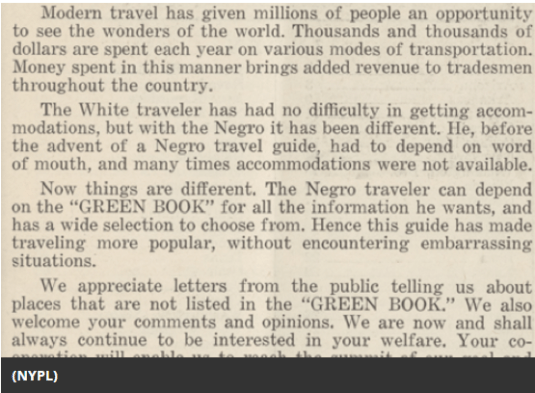
The Green Book spoke in code about how to avoid “embarrassing situations”. This was code for “the violence and discrimination inflicted by bigots”. The diffusion of the car into the black middle class was a godsend to escape racism.
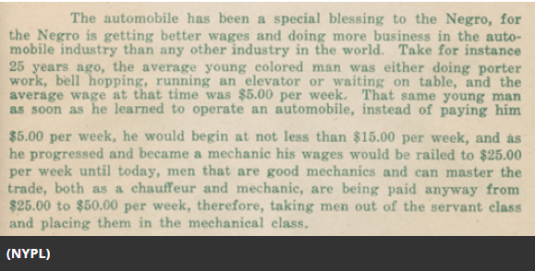
The founding publisher was a US postal worker who with typical entrepreneurial flair initially published the Green Book from his apartment in Virginia starting in the late 1930s. To find businesses that welcomed black patrons, Victor Green tapped into his network of fellow mailmen. His book covered the entire 50 states, parts of Canada and even extended to Europe in later editions.
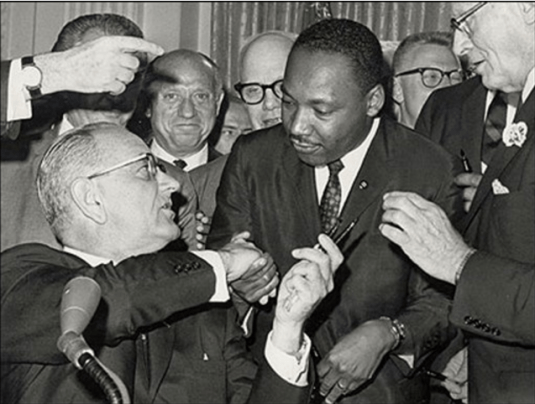
The Green Book stopped publishing a mere two years after the passage of a major civil rights bill in 1964 and the voting rights bill of 1965. These two bills strengthened voter rights and outlawed discrimination by businesses and employers.
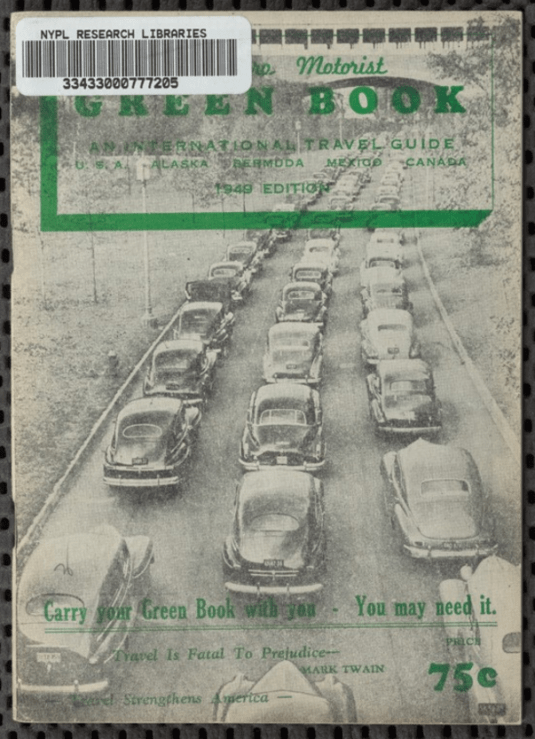
By 1966, just two years after the passage of the civil rights bill, the market collapsed for information on businesses that welcomed black patrons in America. This was because so many businesses now welcome black patronage in every part of the southern states and elsewhere in America that a special booklet no longer had buyers. At the height of its popularity, the Green Book sold 15,000 copies per year.
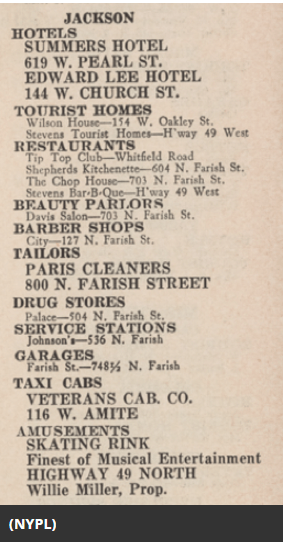
Yes, there were law reforms but the closing of the Green Book is a sign of surprisingly rapid social change given the dogged resistance of the Democratic Party led southern states to all previous attempts at racial integration.
As an example of this tenacious resistance to civil rights legislation, Texas divided itself into 252 counties and delegated considerable responsibility to them. Local sheriffs in southern states would campaign on slogans such as “the man who can take care of situations that may arise”.
Control of the police and local courts was central to the enforcement of racial segregation in the southern states of America. This was backed up by the monopoly that the Democratic Party had over local and state offices.
To register to vote in Texas, for example, a black voter had to register with the local voter registration board in one of the 252 counties. Assuming you could find a member – they came in late, took long lunches and went home early – they would fail the applicant on the literacy test or some other criteria.
Can you pass a literacy test given to Black voters in the 1960's http://t.co/mtOIr7XE50—
History In Pictures (@historyepics) August 28, 2015
The aggrieved black would be voter would then have to take is local voter registration board all the way to the Supreme Court to overturn that decision. The members of the local voter registration board would refuse to follow the orders of the US District Court orders. The criminal contempt citation would be appealed all the way to the Supreme Court.
Once the criminal contempt citation is upheld by the Supreme Court, the voter registration board resigned so the litigation would have to start all over again against the new board members. This was because the state of Texas could not be named as a co-defendant under the 1957 civil rights law – the first past 100 years by Congress.
Such was the hostile legal environment, the lawlessness, the FBI had an eight part go to strategy in case a local sheriff arrested FBI agents in southern states when they are enforcing civil rights law. Black civil rights leaders in the USA were keen gun owners and owned a lot of them for home defence and they used them.
Plenty of school busing orders by courts were appealed for years and years and were resisted at every turn in both northern and southern states. One or two states closed their entire school systems and threatened to transfer the assets to private hands to prevent racial integration.
James Heckman was one of the first economist to note the rapid social change in the southern states of America over the course of the 60s. Heckman spent two years as a teenager in the late 1950s in racist Southern States of America and returned in 1963 and in 1970. His parents were received a delegation of neighbours upon their arrival to explain Southern ways.
Civil disobedience at its best, 1950s http://t.co/WzszCj1zBf—
Historical Pics (@VeryOldPics) September 20, 2015
There was organised segregation in 1963 when Heckman visited again as a college student. His 1963 visit with a college roommate from Nigeria was monitored by the local sheriff. In Birmingham, they stayed at the black YMCA. The people at the YMCA were frightened to death because Heckman and his Nigerian friend were breaking the local Jim Crow laws. Shops closed in New Orleans to avoid serving them.
In 1970, Heckman re-visited New Orleans as an academic, going back to the same places as in 1963. They were completely integrated, totally changed. This rapid social change fascinated him.
The Civil Rights Act of 1964 broke the control of segregationists over their political and legal institutions. The racial segregation collapsed because it could no longer rely on Jim Crow laws and the private violence and boycotts through the White Citizens Councils which police turned a blind eye too when they were not actively involved.
Unlike the Ku Klux Klan, the White Citizens’ Councils met openly and was seen as “pursuing the agenda of the Klan with the demeanour of the Rotary Club” by “unleashing a wave of economic reprisals against anyone, Black or white, seen as a threat to the status quo”. In Mississippi, the State Sovereignty Commission funded the Citizens’ Councils.
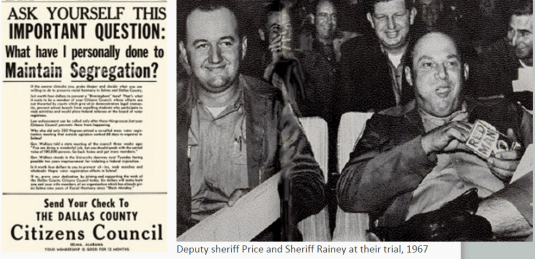
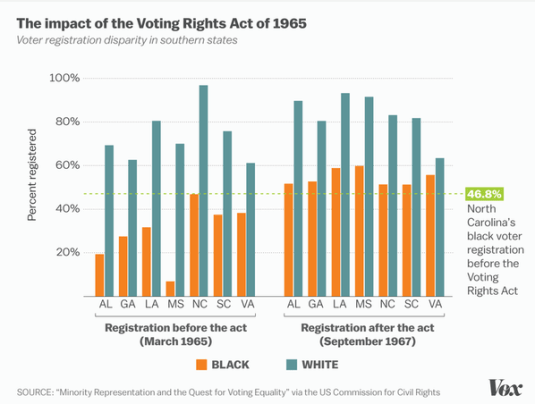
The 1957 and, particular, the 1964 civil rights laws overthrew racial segregation because more Black Americans could vote in the Southern States in state and local elections. Politicians soon courted those votes and there was a political realignment and a social revolution. The lawlessness that back-up most of segregation quickly came to an end because its victims could now vote. Richard Epstein explains:
With Jim Crow in the South this set of insidious practices was not accomplished by explicit laws mandating racial segregation. Rather, those inflexible social and economic patterns were supported by four interlocking strategies. First, illicit control of the electoral franchise, which in turn translated into control of the police and the courts. Second, corrupt use over the infrastructure translated into an ability to deny water and electrical hook-ups to firms that did not toe the segregationist line. Third, private violence to which southern police forces turned a blind eye when they did not actively support it. Fourth, social ostracism to those who spoke up against the system. Sensible people either left, stayed away or remained silent.
LBJ was behind the first civil rights bill of the 20th century. This was the 1957 civil rights bill. LBJ’s astute understanding of public choice processes was central to how he crafted the 1957 bill.
Then Senator Johnson could see that his fellow Southern Democrats would not live with racial integration at the social level. But he knew from his dealings with the Southern Democrats that in their heart of hearts that they could not ultimately deny that people have a right to vote. LBJ knew that if Black Americans in the Southern States could secure the right to vote, all the other rights they sought would soon follow and would be protected by law. He was right.
The Voting Right Act had a huge impact on many southern states. For example, black voter registration rates in Mississippi increased from a mere 6.7 percent in 1965 to 59.8 percent in 1967, according to the US Commission for Civil Rights. For a state that’s historically around 40 percent black, this represented a massive shift in politics — a change that much of the predominantly white leadership at the time feared but would have to accept due to the Voting Rights Act.
Timur Kuran in “Sparks and Prairie Fires: A Theory of Unanticipated Political Revolutions,” suggested that political revolutions and large shifts in political and social opinion will catch us by surprise again and again because of people’s readiness to conceal their true political preferences proclivities under perceived social pressure.
Kuran begins with a simple, even mundane point: social pressures can make people say that they want and believe something that they really don’t want or believe… The result of social pressures is to produce what Kuran calls “preference falsification,” a phenomenon that occurs when you make an inaccurate public statement about your actual preferences (or beliefs). Falsified preferences might be described more simply, of course, as lies; but they are a distinctive, and distinctly interesting, kind of lies, with particular social implications… People joined organizations they abhorred, followed orders they considered nonsensical, cheered speakers they despised and ostracized dissidents they greatly admired.
Those ready to oppose racism or who were lukewarm about it, kept their opposition private until a coincidence of factors gave them the courage to bring their views into the open. In switching sides, they encouraged other hidden opponents to switch. Fear changes sides. Genuine supporters of the old older falsify their publically professed preferences, pretending that they support the new order. These are late-switchers. Do not trust them. These opportunists will just as easily switch back.
Plenty of people have had personal experiences of this in the 1980s and the 1990s when there was rapid change in social and political attitudes about racism, sexism and gay rights. A few people had to stand up for what was right and a surprisingly large number quickly joined their side.
Once Blacks in the southern states started voting for the local sheriff and judges and for state-wide officials, the local legal infrastructure helped the market work rather than frustrated it. As Richard Epstein noted when writing a freedom of association but his remarks equally apply to the market process:
The practice of freedom of association cannot survive in a society that has corrupt electoral institutions, corrupt provision of public services, corrupt use of public force, and unrestrained use of private violence. The hard question in these settings is to ask exactly what legal changes should be made. In one sense, the thought that some non-discrimination principle could gain hold through legislation seems laughable. Indeed, it was only because federal legislation could work, with much huffing and puffing, to override state legislation that the local monopoly was broken… The competitive market works well when supported by well-ordered public institutions.
The rapid demise of the Green Book is a testament to the shallowness of racism in America apart from a hard-core full of hatred of whatever comes along. Certainly, the collapse in the market for a specialised information on businesses willing to accept black patch and suggests that many southern businesses opened their doors to black customers once it was physically safe to do so. The Civil Rights Bill of 1964 bought an end to lawlessness in the South principally because black people could now vote. Epstein again:
At its best, and in its original form, the Civil Rights Act of 1964 sought to break the control of the local segregationist forces over their political institutions. First on the list was Title I, which attacked exclusion from voting.
Swedish and Danish top incomes & union decline @FlipChartRick @EconomicPolicy @PoliticalSift
04 Nov 2015 Leave a comment
in applied price theory, applied welfare economics, econometerics, entrepreneurship, labour economics, Public Choice, rentseeking, unions Tags: Denmark, labour surplus, Sweden, top 1%, union power, union wage premium
The Danish top 1% and top 10% is even lazier than their transnational co-conspirators. No success at all at either grinding the Danish unions down or extracting more labour surplus from the long-suffering Danish proletariat.

Source: OECD StatExtract and Top Incomes Database.

Source: OECD StatExtract and Top Incomes Database.
The Swedish top 10% and top 1% have done a bit better since the economic liberalisation in that country from the early 1990s. But none of that additional labour surplus has anything to do with grinding the unions down because Swedish union membership has not declined.

Source: OECD StatExtract and Top Incomes Database.
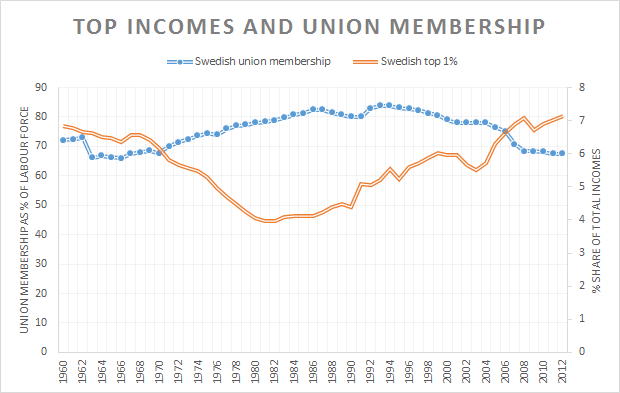
Source: OECD StatExtract and Top Incomes Database.
Why are so many Silicon Valley start-up founders libertarian Democrats?
03 Nov 2015 Leave a comment
in economics of media and culture, entrepreneurship, income redistribution, industrial organisation, politics - USA, Public Choice, rentseeking, survivor principle Tags: creative destruction, entrepreneurial alertness, expressive voting, rational ignorance, Silicon Valley, start-ups, voter demographics


Recent Comments