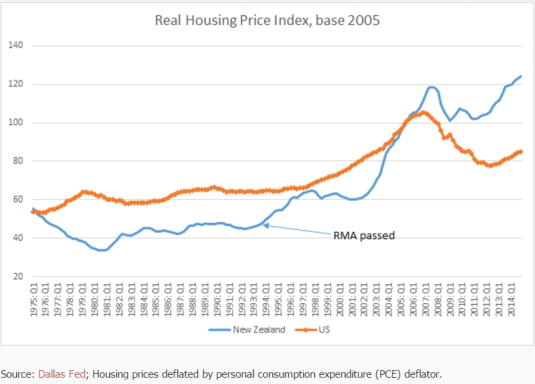
New Zealand housing prices were pretty stable until the passage of the Resource Management Act in 1993. After that, prices took off New Zealand and didn’t slow that much for the recession subsequent to the Global Financial Crisis.
American prices just had a bubble because of loose monetary policy by the Fed and loose lending criteria by banks at the behest of regulators. Real housing prices in the USA started to rise again last year after a dramatic fall.
Australian prices were rising steadily until about 2000 but then took off with a strong economy and the usual restrictions on land supply by local governments at the behest of the existing homeowners.
The Labour Party and the Greens both plan to build 100,000 affordable houses as a way of offsetting soaring housing prices in Auckland and other New Zealand cities. These plans were announced in the 2014 Election in New Zealand.
A trite but insurmountable objection to the proposal to build 100,000 affordable houses is there are no plans to increase the supply of land. That would require RMA reform which both Labour and the Greens oppose. They oppose RMA reform partly for ideological reasons and partly to cultivate middle-class home owner votes.
Unless there is an increase in the supply of land in Auckland and the other New Zealand cities, the government under the plans of the Labour Party and the Greens are building houses the private sector would have built anyway but for the government bought from the same new supply of land released every year by local councils.
The proposals of Labour and the Green to build affordable houses simply changes the identity of who builds the same number of new houses in New Zealand. There is no net increase in this supply of houses so there will not be any improvement in housing affordability.
If the supply of land were to be increased through RMA reforms, there be no need to for the government to build the houses. This is because the market will take care of building the houses on the additional land released by local councils if there is a demand for them and they’re obviously is.
Attempts by a Labour and Green Government to build affordable houses is no more than displace the efforts of private developers to supply houses but in configurations more closely aligned with market demand in terms of the quality and size of the house.
Another insurmountable but still minor objection to supplying 100,000 affordable houses is Friedman’s second law of economics: you can’t give anything away for free because people will queue up for access.
If the government is selling cheap houses to ordinary families, people change that circumstances to make themselves more eligible for the house, which presumably will be targeted by income. Easiest way to do that is to fund a low income family member such as a student to buy the house and sell it to you. Alternatively, you could make an advanced of them against their inheritances as a way of them buying a house.
The classic New Zealand example of the inability to give anything away for free was the introduction of school zoning. People now pay hundreds of thousands of dollars more for a house if it is in a favourable school zone.
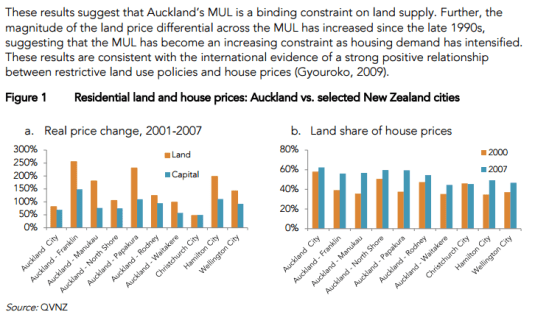
A more serious objection that can never be overcome is as soon as the lucky ordinary family buys the affordable house, they will renovate it to the proper standing reflecting the underlying value of the land. Affordable houses under the plans of the New Zealand Labour Party and the Greens is to build a cheap house on expensive land in Auckland. Land in Auckland is 60% of the price of a house. Land use to be 40% of the value of the house in Auckland.
Plenty of people are in the game of home renovation; some do it as a full-time occupation. They buy an old rundown house on good land and a good location and renovate the house to match the value of the underlying land and location.
The possibility of subsequent renovation to the cheap house on the good land is the death knell of any attempt to sell affordable housing in Auckland or the other New Zealand cities where house prices are spiralling upwards because of restrictions on the supply of land.
Building 100,000 affordable houses were simply present 100,000 renovation opportunities to entrepreneurs. The families who are lucky enough to be first to buy the affordable house will get a marvellous windfall. There will be no long-term impact on the price of land in Auckland because you can’t give anything away for free. Any undervalued good as quickly resold at a profit by budding entrepreneurs after renovating the house to bring it up to market standard given the value of the underlying land.
If the Labour Party and the Greens want more affordable housing, they must support RMA reforms that will increase the supply of land. They won’t do out of sheer political expediency. Labour and the Greens want to win the votes of disgruntled National party voters who already own homes.
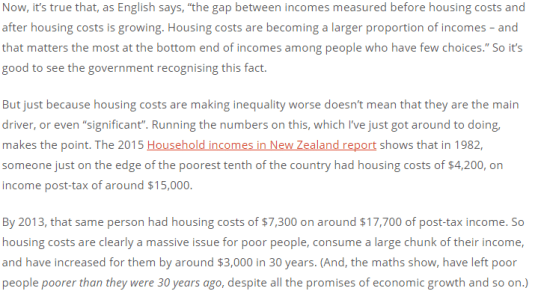
Rashbrooke then goes on to discuss how housing costs were not a main driver of the growing gap between the top 10% and the bottom 10% of the income distribution in New Zealand. My point is he is more concerned with the politics of envy than with building political support for action against poverty.
Rashbrooke showed that the main driver of poverty in New Zealand is rising housing costs. That is easy to redress but for the opposition of the left-wing parties to reforms to the Resource Management Act that will increase the supply of land and thereby drive down housing costs and rents.
Housing costs gobbled up much of the rising incomes of the poor for many years now in New Zealand as Rashbrooke showed today. The New Zealand Labor Party and New Zealand Greens are doing nothing about it. The regulatory constraints on the supply of land could be gone by lunchtime if the self-proclaimed champions of the poor and social justice supported the reform of the RMA.
The proposals of the New Zealand Labour Party and Greens for the government to build more houses is pointless unless there is more land is supplied. If there is no increase in land supply, all the building of more houses by government does is build the same houses of private developers would have built on the same fixed supply of land. There must be an increase in the supply of land to drive housing costs down for the poor.
The reality is that this is an agreement to manage its members’ trade and investment relations – and to do so on behalf of each country’s most powerful business lobbies.
Make no mistake: It is evident from the main outstanding issues, over which negotiators are still haggling, that the TPP is not about “free” trade.
New Zealand has threatened to walk away from the agreement over the way Canada and the US manage trade in dairy products. Australia is not happy with how the US and Mexico manage trade in sugar.
And the US is not happy with how Japan manages trade in rice. These industries are backed by significant voting blocs in their respective countries. And they represent just the tip of the iceberg in terms of how the TPP would advance an agenda that actually runs counter to free trade.
The case for intellectual property rights over drugs is complicated but no one seems to be suggesting that patents should be lengthened.
Far more can be gained in terms of drug availability through regulatory reforms that streamline the drug safety approval process which is currently costing many people their lives.
Sam Peltzman showed in a famous paper in 1973 that the 1962 amendments to US Federal drug approval laws reduced the introduction of effective new drugs in the USA from an average of forty-three annually in the decade before the 1962 amendments to sixteen annually in the ten years afterwards. No increase in drug safety was identified.
The most bizarre part of drug approval processes is they go beyond the checking whether the new drug is safe. What is even more bizarre in New Zealand is the New Zealand drug safety agency duplicates safety processes already performed overseas. This is instead of automatically approving any drug or medical device approved in the USA, UK, Canada or Australia.
Drug safety regulators in the USA also check to see if the drug works – that the drug has its predicted effects. Drug safety is a health policy concern but whether the investors developed a useful drug is something between them and those interested in buying it. Drugs became available years after they were on the market outside the USA because of drug lags at the FDA. To quote David Friedman:
In 1981… the FDA published a press release confessing to mass murder. That was not, of course, the way in which the release was worded; it was simply an announcement that the FDA had approved the use of timolol, a ß-blocker, to prevent recurrences of heart attacks.
At the time timolol was approved, ß-blockers had been widely used outside the U.S. for over ten years. It was estimated that the use of timolol would save from seven thousand to ten thousand lives a year in the U.S.
So the FDA, by forbidding the use of ß-blockers before 1981, was responsible for something close to a hundred thousand unnecessary deaths.
It is a pity that the far left movement ranted against the TPP focused on conspiratorial theories about investor state dispute settlement rather than the risks of this trade deal to the cost of drugs to the health sector. Only late in the game did the far left start talking about drug availability and the costs of drugs to the health budget of the government if patent lives were extended under the TPPA.
A campaign against the TPPA on the basis of its impact on drug availability because of longer patent terms running up against the limited budgets of pharmaceutical purchasing agencies would have appealed across the entire political spectrum. As Joe Stiglitz explains:
The TPP would manage trade in pharmaceuticals through a variety of seemingly arcane rule changes on issues such as “patent linkage,” “data exclusivity,” and “biologics.”
The upshot is that pharmaceutical companies would effectively be allowed to extend – sometimes almost indefinitely – their monopolies on patented medicines, keep cheaper generics off the market, and block “biosimilar” competitors from introducing new medicines for years. That is how the TPP will manage trade for the pharmaceutical industry if the US gets its way.
The health sector can only so much to buy drugs. If drug patents last longer, there is less money to go around because the generics become available later than otherwise.
Again, the decline in white working class support for Democrats is vastly overstated. I bid you a good night. http://t.co/bUNpME5o3B— The Monkey Cage (@monkeycageblog) September 13, 2015
Why Evolution is True is a blog written by Jerry Coyne, centered on evolution and biology but also dealing with diverse topics like politics, culture, and cats.
“We do not believe any group of men adequate enough or wise enough to operate without scrutiny or without criticism. We know that the only way to avoid error is to detect it, that the only way to detect it is to be free to inquire. We know that in secrecy error undetected will flourish and subvert”. - J Robert Oppenheimer.





 Utopia, you are standing in it!


Recent Comments