Candidate Lessig’s Bad Example
11 Oct 2015 Leave a comment
in comparative institutional analysis, constitutional political economy, economic history, politics - USA, Public Choice, rentseeking Tags: campaign finance reform, campaign finance regulation
#TPA more popular among democrats
09 Oct 2015 Leave a comment
in income redistribution, international economics, politics - New Zealand, politics - USA, Public Choice, public economics, rentseeking Tags: TPA, voter demographics

Denis Healey (1959) on the moral righteousness of @jeremycorbyn
05 Oct 2015 Leave a comment
in comparative institutional analysis, constitutional political economy, Public Choice, rentseeking Tags: British politics, Denis Healey, Leftover Left, Twitter left
Denis Healey's speech to Labour conference after 1959 defeat. http://t.co/BTdbfJj147—
Stephen Bush (@stephenkb) October 03, 2015
Denis Healey, writing in 1989. http://t.co/wTSehilpoB—
Stephen Bush (@stephenkb) October 03, 2015
@JosephEStiglitz talks sense on flaws of the #TPPA @ItsOurFutureNZ @greencatherine @RusselNorman
04 Oct 2015 1 Comment
in economics of regulation, international economic law, politics - New Zealand, politics - USA, rentseeking Tags: drug lags, free trade agreements, Leftover Left, preferential trading agreements, TPPA, Trade Blocs
Joe Stiglitz occasionally gets it right such as this week when he spoke about the downside of the Trans-Pacific Partnership Agreement. As he said:
The reality is that this is an agreement to manage its members’ trade and investment relations – and to do so on behalf of each country’s most powerful business lobbies.
Make no mistake: It is evident from the main outstanding issues, over which negotiators are still haggling, that the TPP is not about “free” trade.
Because of all the haggling over the trade-offs where you do something stupid in return for the other side doing something sensible in terms of liberalisation or something equally stupid in additional regulation, the gains in the agreement can be quite small. Again as Joe Stiglitz explains:
New Zealand has threatened to walk away from the agreement over the way Canada and the US manage trade in dairy products. Australia is not happy with how the US and Mexico manage trade in sugar.
And the US is not happy with how Japan manages trade in rice. These industries are backed by significant voting blocs in their respective countries. And they represent just the tip of the iceberg in terms of how the TPP would advance an agenda that actually runs counter to free trade.
The case for intellectual property rights over drugs is complicated but no one seems to be suggesting that patents should be lengthened.
Far more can be gained in terms of drug availability through regulatory reforms that streamline the drug safety approval process which is currently costing many people their lives.
Barriers to entry – costs ($s) of bringing new drugs to the market have risen manyfold #econ3 http://t.co/MFHTFhTLrj—
Geoff Riley (@tutor2u_econ) November 30, 2014
Sam Peltzman showed in a famous paper in 1973 that the 1962 amendments to US Federal drug approval laws reduced the introduction of effective new drugs in the USA from an average of forty-three annually in the decade before the 1962 amendments to sixteen annually in the ten years afterwards. No increase in drug safety was identified.
The most bizarre part of drug approval processes is they go beyond the checking whether the new drug is safe. What is even more bizarre in New Zealand is the New Zealand drug safety agency duplicates safety processes already performed overseas. This is instead of automatically approving any drug or medical device approved in the USA, UK, Canada or Australia.
Drug safety regulators in the USA also check to see if the drug works – that the drug has its predicted effects. Drug safety is a health policy concern but whether the investors developed a useful drug is something between them and those interested in buying it. Drugs became available years after they were on the market outside the USA because of drug lags at the FDA. To quote David Friedman:
In 1981… the FDA published a press release confessing to mass murder. That was not, of course, the way in which the release was worded; it was simply an announcement that the FDA had approved the use of timolol, a ß-blocker, to prevent recurrences of heart attacks.
At the time timolol was approved, ß-blockers had been widely used outside the U.S. for over ten years. It was estimated that the use of timolol would save from seven thousand to ten thousand lives a year in the U.S.
So the FDA, by forbidding the use of ß-blockers before 1981, was responsible for something close to a hundred thousand unnecessary deaths.
It is a pity that the far left movement ranted against the TPP focused on conspiratorial theories about investor state dispute settlement rather than the risks of this trade deal to the cost of drugs to the health sector. Only late in the game did the far left start talking about drug availability and the costs of drugs to the health budget of the government if patent lives were extended under the TPPA.
@amplifyonly @TaurangaTPPA @actionstation @ActivistsNZ @Keyweekat @endarken #ExposeTPP @gregfullmoon http://t.co/JyG5wQ2MX7—
ItsOurFuture (@ItsOurFutureNZ) July 22, 2015
A campaign against the TPPA on the basis of its impact on drug availability because of longer patent terms running up against the limited budgets of pharmaceutical purchasing agencies would have appealed across the entire political spectrum. As Joe Stiglitz explains:
The TPP would manage trade in pharmaceuticals through a variety of seemingly arcane rule changes on issues such as “patent linkage,” “data exclusivity,” and “biologics.”
The upshot is that pharmaceutical companies would effectively be allowed to extend – sometimes almost indefinitely – their monopolies on patented medicines, keep cheaper generics off the market, and block “biosimilar” competitors from introducing new medicines for years. That is how the TPP will manage trade for the pharmaceutical industry if the US gets its way.
The health sector can only so much to buy drugs. If drug patents last longer, there is less money to go around because the generics become available later than otherwise.
@World_Wildlife on the cost of moving to a low carbon economy @jamespeshaw @GreenpeaceNZ @NZGreens
01 Oct 2015 Leave a comment
in applied price theory, environmental economics, global warming, Public Choice, rentseeking Tags: climate alarmism, evidence-based policy, expressive voting, global warming, green rent seeking, low carbon economy, rational ignorance, rational rationality

How to lie about statistics on inequality and global poverty @oxfamnz @Oxfam
29 Sep 2015 Leave a comment
in applied price theory, applied welfare economics, development economics, econometerics, economic history, growth disasters, growth miracles, human capital, labour economics, Marxist economics, poverty and inequality, rentseeking Tags: activists, do gooders, expressive voting, Leftover Left, Oxfam, rational ignorance, rational irrationality, Twitter left
Has the Democratic Party lost the white working class
29 Sep 2015 Leave a comment
in economic history, income redistribution, politics - USA, Public Choice, rentseeking Tags: American politics, Democratic Party, rational ignorance, rational rationality, suppressive voting, Withering away of the proletariat
Again, the decline in white working class support for Democrats is vastly overstated. I bid you a good night. http://t.co/bUNpME5o3B—
The Monkey Cage (@monkeycageblog) September 13, 2015

@nzlabour @NZGreens New Zealand state-owned enterprises dividends paid and capital injections since 2007
25 Sep 2015 Leave a comment
in financial economics, industrial organisation, politics - New Zealand, public economics, rentseeking, survivor principle, transport economics Tags: government ownership, KiwiRail, privatisation, rational ignorance, rational rationality, state owned enterprises, suppressive voting
The New Zealand Labour Party and New Zealand Greens both make much of the fact that when you privatise a state-owned enterprise the taxpayer is no longer entitled to dividends from the privatised business. The fact that the sale price is the net present value of those future dividends is a rating fallacy that is not the subject of this post.
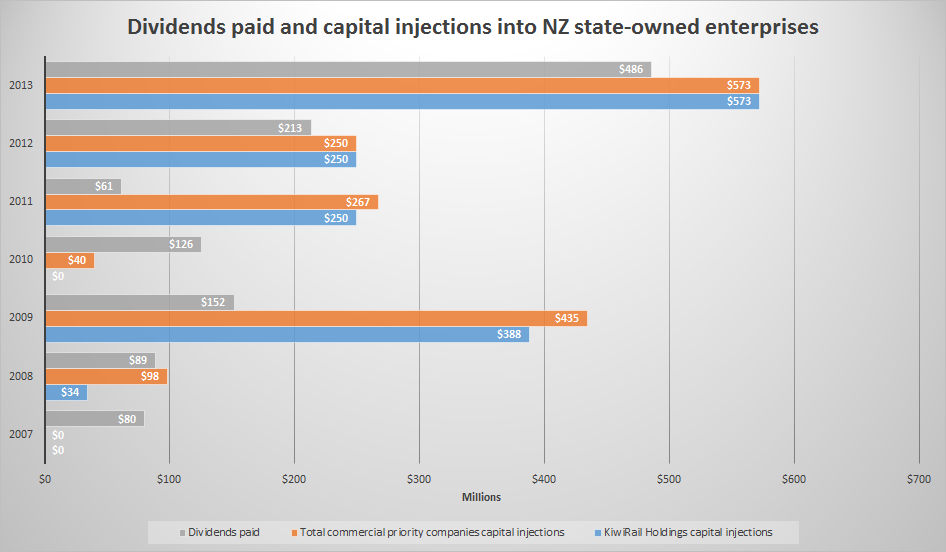
Source: New Zealand Treasury – data released under the Official Information Act.
What is the subject of this post is whether there are indeed any dividends paid to taxpayers after capital injections. 2007 was the last year in which dividends to the taxpayer exceeded capital injections. The reason was that dog called KiwiRail.
How many colonies did each European country have?
20 Sep 2015 Leave a comment
in defence economics, economic history, Public Choice, rentseeking Tags: age of empires, British empire, British imperialism, colonialism
A map of Europe based on how many colonies each country had i100.io/SpgD1re http://t.co/Atj5Td1dHN—
i100 (@thei100) July 04, 2015
The rise of democracy in the 20th century
20 Sep 2015 Leave a comment
in constitutional political economy, income redistribution, liberalism, Marxist economics, Public Choice, rentseeking, war and peace Tags: Age of the Enlightenment, capitalism and freedom, rule of law


Recent Comments