Winston’s big port up North won’t have any business

In the first shot in the pork-barrelling for a by-election, veteran New Zealand populist Winston Peters wants to stop the expansion of the Port of Auckland and move the extra shipping traffic up north to the Port of Whangarei:

And we will upgrade the Auckland to Northland railway line and build the rail link to your port

The Port of Whangarei is about two hours north by car from Auckland. Auckland is a global city of approaching 2 million. Whangarei is the only city up North, with a population of 50,000.

45% of the import traffic to the Port of Auckland is cars. Around 90% of light vehicle imports in New Zealand come through the Port of Auckland. The rest may go through Littleton.

Jellicoe and Freyberg wharves are located between the two container terminals.

Bledisloe multipurpose Wharf

Striving to move some of this light vehicle imports from the Port of Auckland up north to the Port of Whangarei where they be unloaded from a ship onto trains for a short train ride to Auckland, unloaded again onto trucks all seems unnecessary expense.

Photo: Port of Whangarei.

Auckland appears to have spare container capacity up until at least 2035, so this port up North will simply not have much to do in terms of extra container traffic because it will have to compete on the basis of cost and proximity to markets.
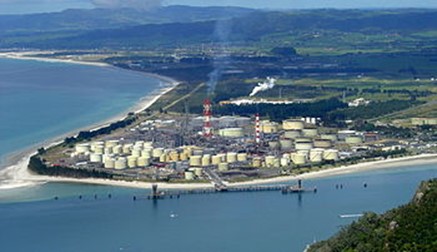
Photo: The Marsden Point Oil Refinery on the opposite shore of Whangarei Harbour.

The traffic that is coming under pressure regarding capacity of the Port of Auckland is multi-cargo traffic such as building materials, vegetables, wheat, vehicles and other goods. The situation is further aggravated by the rapid increase in the number and increased size of cruise ships.

As a good part of the market for the multi cargo traffic is in Auckland, landing them away from their main market just makes no sense and will not happen unless the port of Auckland is prohibited by law from expanding and ships are not allowed to divert to ports such as Wellington and Christchurch.

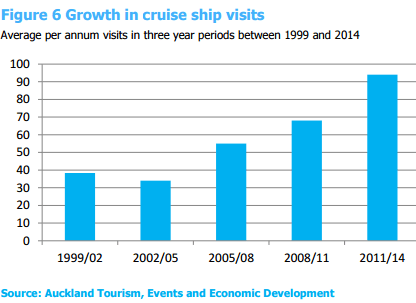
The number of cruise ships visiting Auckland in the last 10 years to about 90 and is expected to reach one 20 by 2020 and 150 by 2030. That traffic cannot be diverted up north to the Port of Whangarei.
Any export traffic that would be viable to send through the Port of Whangarei up north will already be going through it. Export competitiveness is highly sensitive to costs as exporters must simply take the going price in the international market.

This question should be asked more often about the regulation of purported natural monopolies

Image

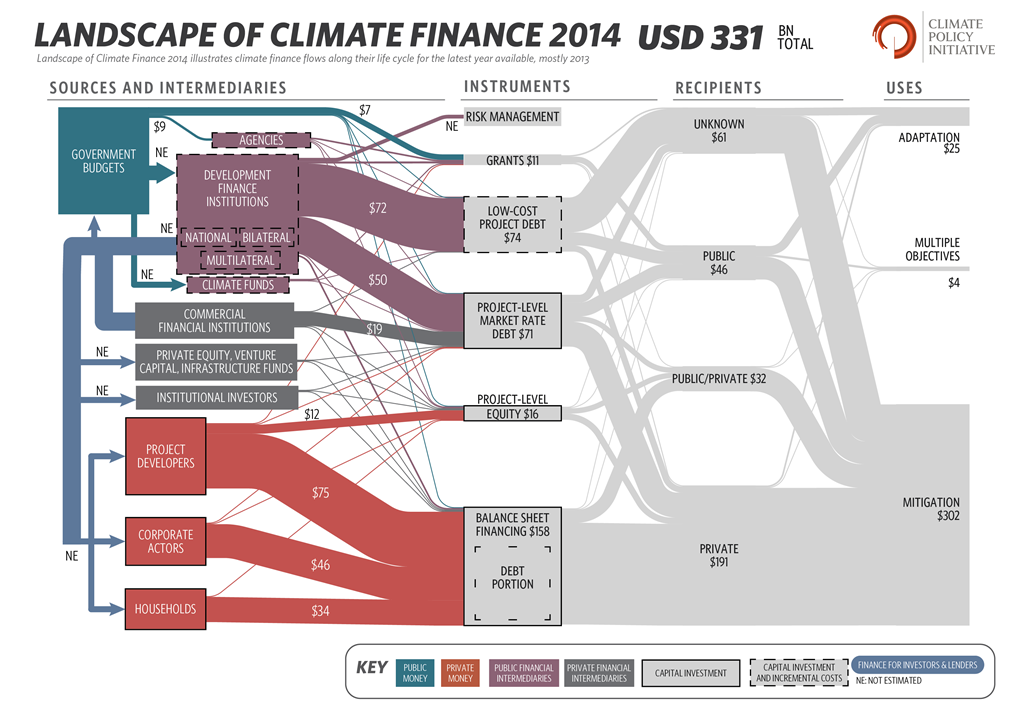
Follow the money – The Global Landscape of Climate Finance 2014 CPI Report Climate Policy Initiative

In 2013, annual global climate finance flows totalled approximately USD 331 billion, falling USD 28 billion below 2012 levels.

Public actors and intermediaries contributed USD 137 billion (USD 134-140 billion) largely unchanged from last year. Private investment totalled USD 193 billion, falling by USD 31 billion or 14% from 2012, see Figure ES1. The actual decrease in total flows may be even larger as, for the first time, Landscape 2014 captures public finance flowing to large hydro and research and development (USD 4 billion and USD 3 billion respectively).

Climate finance flows were split almost equally between developed (OECD) and developing (non-OECD) countries, USD 164 billion and USD 165 billion respectively. The amount we tracked flowing from developed to developing countries fell by USD 8 billion from 2012, to USD 34 billion, with multilateral DFI contributions falling by USD 5 billion and private investment contracting by USD 2 billion.

Almost three-quarters of total flows were invested in their country of origin. Private actors had an especially strong domestic investment focus with USD 174 billion or 90% of their investments remaining in the country of origin. This demonstrates that investment environments that are more familiar and perceived to be less risky are key to investment decisions, highlighting the importance of domestic policy frameworks in unlocking scaled up climate finance flows.

landscape of climate finance global

first recipients of climate finance

who gets what in climate finance

via Global Landscape of Climate Finance 2014 – CPI.

Americans are making a big mistake about health care funding – Vox

Almost everyone who has health insurance in the United States gets help from the government to afford it.

For the elderly, that’s Medicare. For the disabled and the poor, that’s Medicaid. For full-time workers it’s the tax subsidy for employer-provided health insurance.

via Americans are making a big mistake about health care – Vox.

The role of regulation in raising rivals’ costs

An entire industry depends on denying this chart

Image

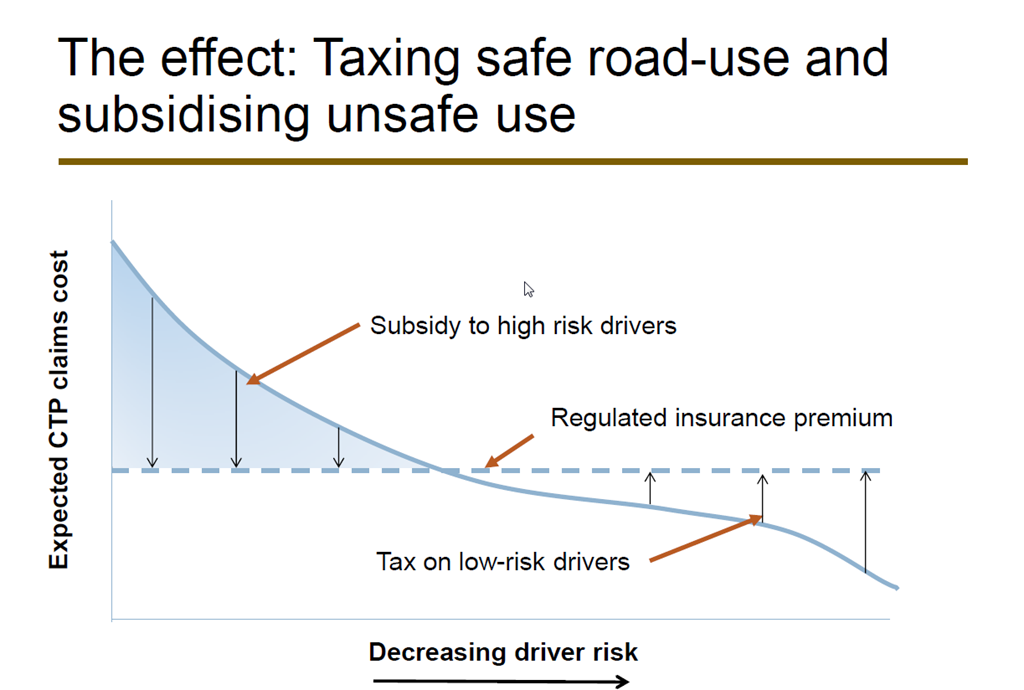
Should young women pay the same car insurance premiums as young men?

car insurance premium cross subsidies

Thrill-seeking young men are prone to drive too fast, late at night, and cause horrific fatalities. Young males are 10 times more likely to be killed or injured than a driver aged over 35.

fatal crashes by sex

Young women’s car insurance premiums increased by 50% after insurers adjust their prices to comply with new European "gender neutral" rules on premiums.


 .

Democrats are under more pressure from interest groups to pass policy

democrat interest groups

Image

Why does the Left in New Zealand support old age pensions for millionaires?

Pensioners

Michael Littlewood from the Retirement Policy and Research Centre has a commentary on redesigning NZ Superannuation. He says (and I agree) that we should not just look at one issue in isolation or just the cost.

He highlights eight key design features that should be agreed on. They are:

  • Universal or means-tested (I favour means-tested if the administrative costs of doing so are not prohibitive)
  • Age of entitlement (I favour increasing it and tying it to life expectancy)
  • Residency test – how long should someone live here to quality. The current threshold is ten years and I think it should be higher. It used to be 25 years.
  • The level. Currently is 43% of the net average wage for a single person. Set at 66% of  the after-tax national average wage for a couple.
  • How to revalue? Is indexed to both CPI and the average wage.
  • How to pay for it? Pay as you go and partially pre-funded. Should it be both? What should the mix be?
  • Payments to single people? Why does a married couple get less than two singles living together?
  • Overseas pensions? The rules for deducting overseas pensions are inconsistent

via Redesigning NZ Super | Kiwiblog.

I was walking back to the office with a mate who I will call the ecological socialist after a meeting with the government department responsible for income support to old age people in New Zealand.

We were both shaky our heads in utter disbelief. We couldn’t understand their idea of defending an old age pension that is free of any means test been paid to millionaires on the grounds of egalitarianism.

foodstampsphone.jpg

By coincidence, we are both Australians where the old age pension is means tested. We couldn’t understand in any way, shape or form the notion of paying old age pensions to rich people when that money could be used to increase the old age pension for those who we lived in ordinary circumstances all their lives and couldn’t save for their retirement.

I prefer to link MPs pay rises to reductions in the trans-Tasman per capita income gap

https://www.facebook.com/nzgreenparty/photos/a.489359751371.266952.10779081371/10152611659431372/?type=1&theater

Real GDP per capita: Australia, New Zealand and OECD, 1950-2007

Source: econfix.wordpress.com

Yet another way to beat the share market

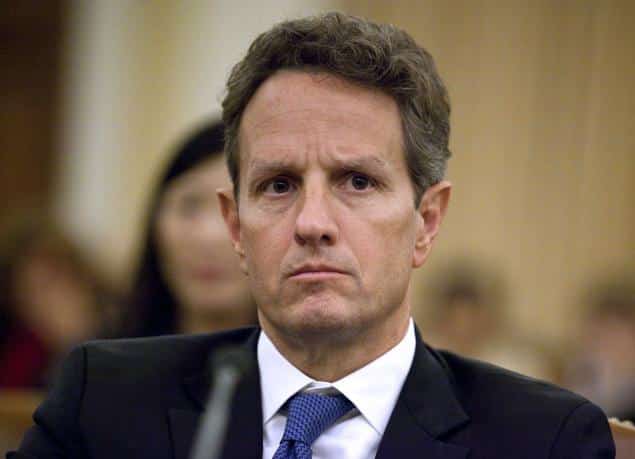
Over the ten trading days following the announcement of Timothy Geithner as Treasury Secretary, financial firms with a connection to Geithner experienced a cumulative abnormal return of about 12% relative to other financial sector firms. This reversed when his nomination ran into trouble due to unexpected tax issues.

That is what Daron Acemoglu, Simon Johnson, Amir Kermani, James Kwak, and Todd Mitton found recently.

Geithner had important social connections from his time as president of the Federal Reserve Bank of New York. He knew some people in finance very well – including those at large and small firms – but some others he did not know at all. This spike in share prices for connections to Tim Geithner was somewhat special as the authors explain:

when Henry (Hank) Paulson became Treasury Secretary in May 2006 – there is no evidence of a positive impact on the stock price of connected firms.

The argument put forward explaining the value of these connections had nothing to do with any suggestions of impropriety whatsoever. What happened was the value of connections spiked in a crisis such as the global financial crisis in 2008:

it was entirely reasonable for market participants to suppose that immediate action with limited oversight would have to be taken, and that officials would rely on a small network of established confidantes for advice and assistance. In fact, this is exactly what happened while Mr Geithner was at Treasury.

When the going gets tough, the tough only have time to ring friends and associates for advice and new staff.

Déjà vu all over again: Sovereign Funds, a History of Bad Timing Version

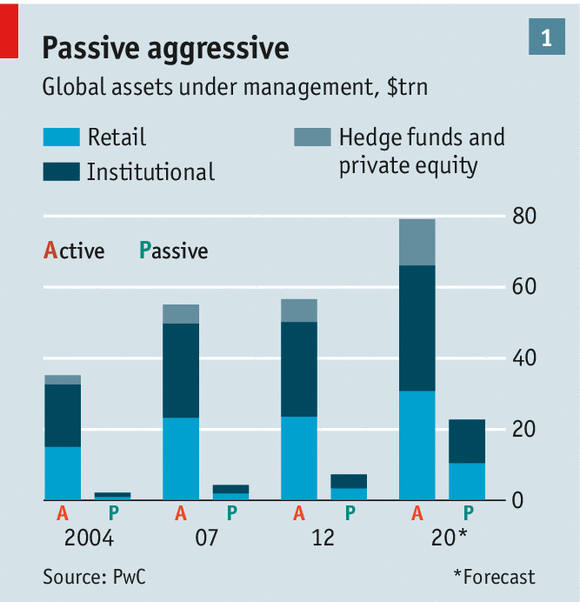
Shara funds under active and passive management

Josh Lerner analysed about 2,600 sovereign fund investments over the last 25 years, to find that:

these funds are “trend chasers” rather than good market timers — they are likely to invest at home when domestic equity prices are higher, and invest abroad when foreign prices are higher. This tendency to shun assets when their prices are low has taken its toll on the returns at these funds…

sovereign fund investments made in a fund’s home country tend to do worse than foreign investments, at least in the short term. Industry price-to-earnings ratios of domestic investments tend to drop in the first year, while international investments have a positive change in the first year. Moreover, when politicians are involved in sovereign funds’ decision-making, more money is funnelled to poorly performing domestic deals

Creative destruction versus the Guardian: A £2-a-month levy on broadband could save our newspapers

ipad and newspapers

A small levy on UK broadband providers – no more than £2 a month on each subscriber’s bill – could be distributed to news providers in proportion to their UK online readership. This would solve the financial problems of quality newspapers, whose readers are not disappearing, but simply migrating online.

via A £2-a-month levy on broadband could save our newspapers | Media | The Guardian.

Did The Guardian just come out in support of a poll tax? Most people have broadband, so it’s the same practical effect?

The smart, green economy, not – electric cars version

The Putin Effect

Image

Previous Older Entries Next Newer Entries

Bassett, Brash & Hide

Celebrating humanity's flourishing through the spread of capitalism and the rule of law

Truth on the Market

Scholarly commentary on law, economics, and more

The Undercover Historian

Beatrice Cherrier's blog

Matua Kahurangi

Celebrating humanity's flourishing through the spread of capitalism and the rule of law

Temple of Sociology

Celebrating humanity's flourishing through the spread of capitalism and the rule of law

Velvet Glove, Iron Fist

Celebrating humanity's flourishing through the spread of capitalism and the rule of law

Why Evolution Is True

Why Evolution is True is a blog written by Jerry Coyne, centered on evolution and biology but also dealing with diverse topics like politics, culture, and cats.

Down to Earth Kiwi

Celebrating humanity's flourishing through the spread of capitalism and the rule of law

NoTricksZone

Celebrating humanity's flourishing through the spread of capitalism and the rule of law

Homepaddock

A rural perspective with a blue tint by Ele Ludemann

Kiwiblog

DPF's Kiwiblog - Fomenting Happy Mischief since 2003

The Dangerous Economist

Celebrating humanity's flourishing through the spread of capitalism and the rule of law

Watts Up With That?

The world's most viewed site on global warming and climate change

The Logical Place

Tim Harding's writings on rationality, informal logic and skepticism

Doc's Books

A window into Doc Freiberger's library

The Risk-Monger

Let's examine hard decisions!

Uneasy Money

Commentary on monetary policy in the spirit of R. G. Hawtrey

Barrie Saunders

Thoughts on public policy and the media

Liberty Scott

Celebrating humanity's flourishing through the spread of capitalism and the rule of law

Point of Order

Politics and the economy

James Bowden's Blog

A blog (primarily) on Canadian and Commonwealth political history and institutions

Science Matters

Reading between the lines, and underneath the hype.

Peter Winsley

Economics, and such stuff as dreams are made on

A Venerable Puzzle

"The British constitution has always been puzzling, and always will be." --Queen Elizabeth II

The Antiplanner

Celebrating humanity's flourishing through the spread of capitalism and the rule of law

Bet On It

Celebrating humanity's flourishing through the spread of capitalism and the rule of law

History of Sorts

WORLD WAR II, MUSIC, HISTORY, HOLOCAUST

Roger Pielke Jr.

Undisciplined scholar, recovering academic

Offsetting Behaviour

Celebrating humanity's flourishing through the spread of capitalism and the rule of law

JONATHAN TURLEY

Res ipsa loquitur - The thing itself speaks

Conversable Economist

In Hume’s spirit, I will attempt to serve as an ambassador from my world of economics, and help in “finding topics of conversation fit for the entertainment of rational creatures.”

The Victorian Commons

Researching the House of Commons, 1832-1868

The History of Parliament

Articles and research from the History of Parliament Trust

Books & Boots

Reflections on books and art

Legal History Miscellany

Posts on the History of Law, Crime, and Justice

Sex, Drugs and Economics

Celebrating humanity's flourishing through the spread of capitalism and the rule of law

European Royal History

Exploring the Monarchs of Europe

Tallbloke's Talkshop

Cutting edge science you can dice with

Marginal REVOLUTION

Small Steps Toward A Much Better World

NOT A LOT OF PEOPLE KNOW THAT

“We do not believe any group of men adequate enough or wise enough to operate without scrutiny or without criticism. We know that the only way to avoid error is to detect it, that the only way to detect it is to be free to inquire. We know that in secrecy error undetected will flourish and subvert”. - J Robert Oppenheimer.

STOP THESE THINGS

The truth about the great wind power fraud - we're not here to debate the wind industry, we're here to destroy it.

Lindsay Mitchell

Celebrating humanity's flourishing through the spread of capitalism and the rule of law

Alt-M

Celebrating humanity's flourishing through the spread of capitalism and the rule of law

croaking cassandra

Economics, public policy, monetary policy, financial regulation, with a New Zealand perspective

The Grumpy Economist

Celebrating humanity's flourishing through the spread of capitalism and the rule of law

International Liberty

Restraining Government in America and Around the World