Scientists dream about what could be.
Economists remind you of price tags and unintended consequences
Celebrating humanity's flourishing through the spread of capitalism and the rule of law
27 Mar 2015 Leave a comment
in applied price theory, applied welfare economics, Austrian economics, comparative institutional analysis, constitutional political economy, F.A. Hayek, liberalism, Public Choice, rentseeking Tags: evidence-based policy, offsetting behaviour, science and public policy, The fatal conceit, The pretence to knowledge, unintended consequences
Scientists dream about what could be.
Economists remind you of price tags and unintended consequences
24 Mar 2015 Leave a comment
in environmental economics, global warming, rentseeking Tags: Big Wind, climate alarmism, global warning, green rent seeking, renewable resources, wind power
20 Mar 2015 Leave a comment
in environmental economics, environmentalism, global warming, liberalism, rentseeking Tags: climate alarmism, conjecture and refutation, green rent seeking, philosophy of science, precautionary principle
20 Mar 2015 Leave a comment
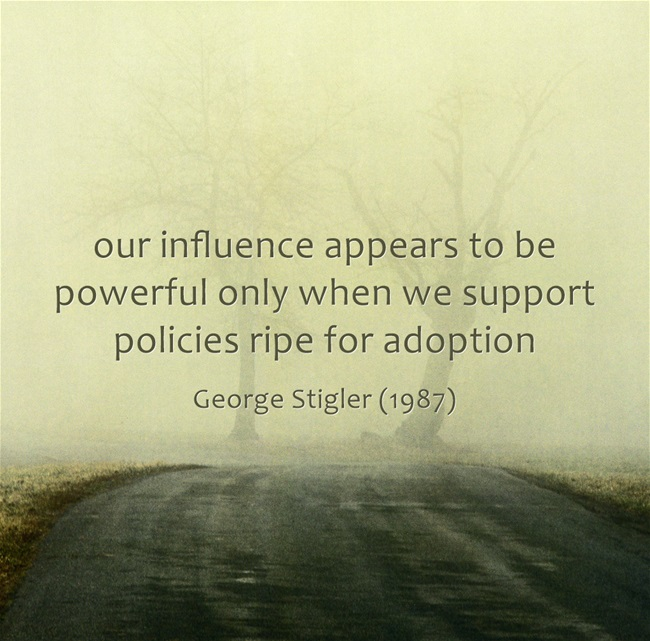
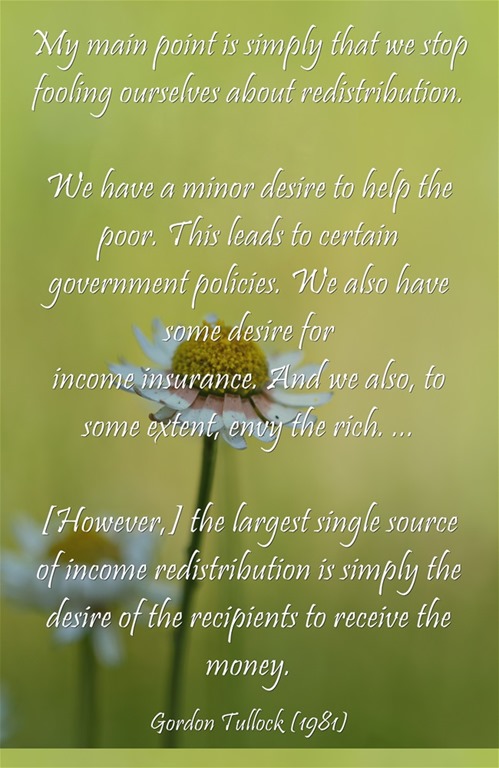
in George Stigler, history of economic thought, Public Choice, rentseeking Tags: evidence-based policy, expressive politics, expressive voting, intellectuals, politics of reform, rational ignorance, rational irrationality
.
14 Mar 2015 Leave a comment
in income redistribution, politics - USA, Public Choice, rentseeking Tags: China
13 Mar 2015 Leave a comment
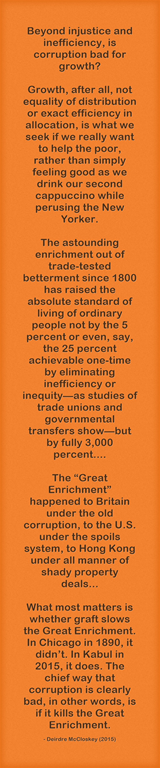
in applied price theory, applied welfare economics, comparative institutional analysis, development economics, economic history, economics of crime, growth disasters, growth miracles, law and economics, Public Choice, rentseeking Tags: corruption, Deirdre McCloskey, The Industrial Revolution
12 Mar 2015 1 Comment
in economic history, economics of bureaucracy, environmental economics, global warming, Public Choice, rentseeking Tags: Anti-Science left, climate alarmism, green rent seeking, Richard Lindzen
10 Mar 2015 Leave a comment
in economics of media and culture, economics of regulation, politics - Australia, politics - New Zealand, rentseeking Tags: barriers to entry, closer economic relations, creative destruction, export pricing, free trade, Hollywood economics, price discrimination, protectionism, rent seeking
Back in the day, New Zealand television programming was sold cheaply into the Australian market. Many cultural and other products are exported into foreign markets and sold for whatever they can get above the price of shipping or digital transmission. What else explains all that rubbish on cable TV?
Under the Closer Economic Relations agreement that creates a single market between Australia and New Zealand, New Zealand made television programming content must be treated the same way as Australian content so it was included in their 50% local content rules for commercial television back from whenever I remember this story from. There was a Federal Court of Australia case that ruled that New Zealand television programming was Australian content programming for the purposes of the relevant media regulations because of Closer Economic Relations.

From the late 1990s, with revival of the New Zealand film and television industry, New Zealand content was starting to flood the Australian market, especially in the off-season in the summer when stations were looking for cheap content to fill a low ratings period.

Naturally, this Kiwi invasion did not please the rent seeking Australian television programme production industry and many a mendicant actor, writer and producer
Where there is a will, where there is a way: minimum quality standards are introduced into the Australian content rules defined by price – a price that happen to be above what the television stations used to pay for New Zealand made programming.
10 Mar 2015 Leave a comment
in applied welfare economics, industrial organisation, politics - New Zealand, rentseeking, transport economics
In the first shot in the pork-barrelling for a by-election, veteran New Zealand populist Winston Peters wants to stop the expansion of the Port of Auckland and move the extra shipping traffic up north to the Port of Whangarei:
And we will upgrade the Auckland to Northland railway line and build the rail link to your port
The Port of Whangarei is about two hours north by car from Auckland. Auckland is a global city of approaching 2 million. Whangarei is the only city up North, with a population of 50,000.

45% of the import traffic to the Port of Auckland is cars. Around 90% of light vehicle imports in New Zealand come through the Port of Auckland. The rest may go through Littleton.

|
|
|
Jellicoe and Freyberg wharves are located between the two container terminals. |
Bledisloe multipurpose Wharf |
Striving to move some of this light vehicle imports from the Port of Auckland up north to the Port of Whangarei where they be unloaded from a ship onto trains for a short train ride to Auckland, unloaded again onto trucks all seems unnecessary expense.

Photo: Port of Whangarei.
Auckland appears to have spare container capacity up until at least 2035, so this port up North will simply not have much to do in terms of extra container traffic because it will have to compete on the basis of cost and proximity to markets.
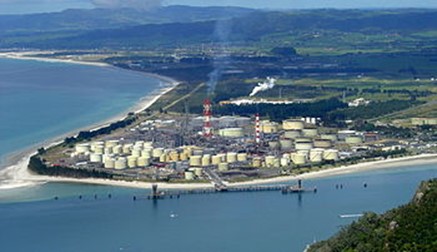
Photo: The Marsden Point Oil Refinery on the opposite shore of Whangarei Harbour.
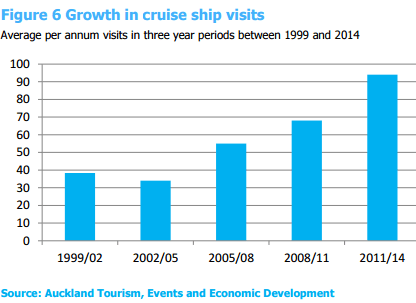
The traffic that is coming under pressure regarding capacity of the Port of Auckland is multi-cargo traffic such as building materials, vegetables, wheat, vehicles and other goods. The situation is further aggravated by the rapid increase in the number and increased size of cruise ships.
As a good part of the market for the multi cargo traffic is in Auckland, landing them away from their main market just makes no sense and will not happen unless the port of Auckland is prohibited by law from expanding and ships are not allowed to divert to ports such as Wellington and Christchurch.
The number of cruise ships visiting Auckland in the last 10 years to about 90 and is expected to reach one 20 by 2020 and 150 by 2030. That traffic cannot be diverted up north to the Port of Whangarei.
Any export traffic that would be viable to send through the Port of Whangarei up north will already be going through it. Export competitiveness is highly sensitive to costs as exporters must simply take the going price in the international market.
09 Mar 2015 Leave a comment
09 Mar 2015 Leave a comment
in environmental economics, global warming, Public Choice, rentseeking Tags: bootleggers and baptists, climate alarmism, global warming, green rent seeking
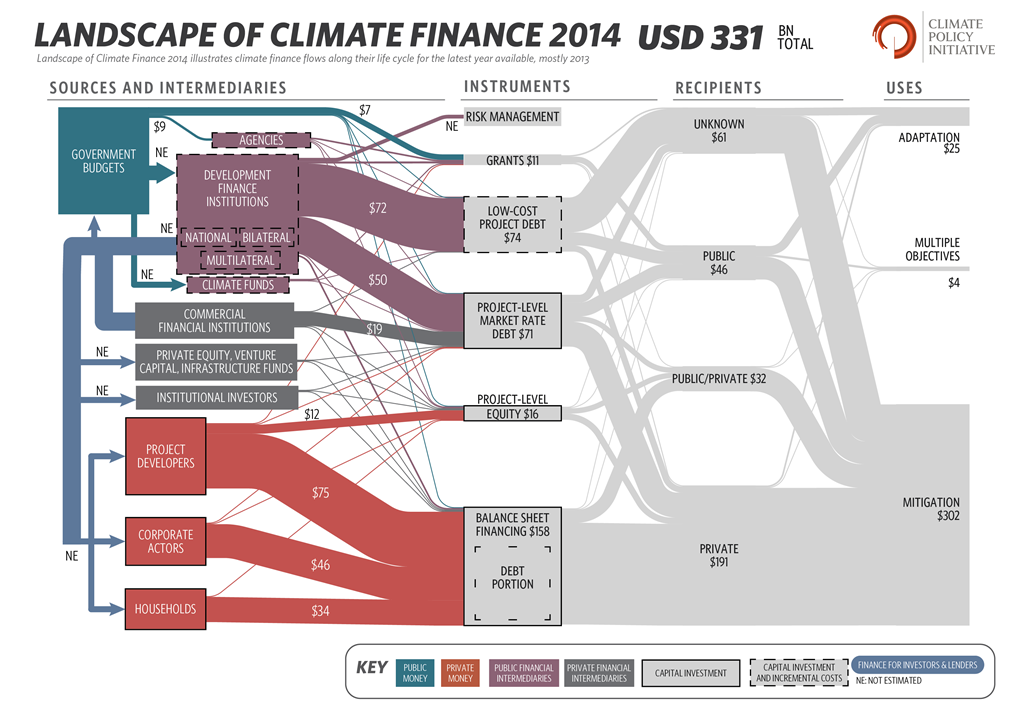
In 2013, annual global climate finance flows totalled approximately USD 331 billion, falling USD 28 billion below 2012 levels.
Public actors and intermediaries contributed USD 137 billion (USD 134-140 billion) largely unchanged from last year. Private investment totalled USD 193 billion, falling by USD 31 billion or 14% from 2012, see Figure ES1. The actual decrease in total flows may be even larger as, for the first time, Landscape 2014 captures public finance flowing to large hydro and research and development (USD 4 billion and USD 3 billion respectively).
Climate finance flows were split almost equally between developed (OECD) and developing (non-OECD) countries, USD 164 billion and USD 165 billion respectively. The amount we tracked flowing from developed to developing countries fell by USD 8 billion from 2012, to USD 34 billion, with multilateral DFI contributions falling by USD 5 billion and private investment contracting by USD 2 billion.
Almost three-quarters of total flows were invested in their country of origin. Private actors had an especially strong domestic investment focus with USD 174 billion or 90% of their investments remaining in the country of origin. This demonstrates that investment environments that are more familiar and perceived to be less risky are key to investment decisions, highlighting the importance of domestic policy frameworks in unlocking scaled up climate finance flows.


02 Mar 2015 Leave a comment
in applied welfare economics, income redistribution, politics - USA, rentseeking Tags: Obamacare, rational ignorance
/cdn0.vox-cdn.com/uploads/chorus_asset/file/3455906/subsidy_poll_1024.0.png)
Almost everyone who has health insurance in the United States gets help from the government to afford it.
For the elderly, that’s Medicare. For the disabled and the poor, that’s Medicaid. For full-time workers it’s the tax subsidy for employer-provided health insurance.
via Americans are making a big mistake about health care – Vox.
Celebrating humanity's flourishing through the spread of capitalism and the rule of law
Celebrating humanity's flourishing through the spread of capitalism and the rule of law
Celebrating humanity's flourishing through the spread of capitalism and the rule of law
Celebrating humanity's flourishing through the spread of capitalism and the rule of law
Celebrating humanity's flourishing through the spread of capitalism and the rule of law
Celebrating humanity's flourishing through the spread of capitalism and the rule of law
Celebrating humanity's flourishing through the spread of capitalism and the rule of law
Celebrating humanity's flourishing through the spread of capitalism and the rule of law
A History of the Alt-Right
Econ Prof at George Mason University, Economic Historian, Québécois
Celebrating humanity's flourishing through the spread of capitalism and the rule of law
Scholarly commentary on law, economics, and more
Beatrice Cherrier's blog
Celebrating humanity's flourishing through the spread of capitalism and the rule of law
Celebrating humanity's flourishing through the spread of capitalism and the rule of law
Celebrating humanity's flourishing through the spread of capitalism and the rule of law
Why Evolution is True is a blog written by Jerry Coyne, centered on evolution and biology but also dealing with diverse topics like politics, culture, and cats.
Celebrating humanity's flourishing through the spread of capitalism and the rule of law
A rural perspective with a blue tint by Ele Ludemann
DPF's Kiwiblog - Fomenting Happy Mischief since 2003
Celebrating humanity's flourishing through the spread of capitalism and the rule of law
The world's most viewed site on global warming and climate change
Tim Harding's writings on rationality, informal logic and skepticism
A window into Doc Freiberger's library
Let's examine hard decisions!
Commentary on monetary policy in the spirit of R. G. Hawtrey
Thoughts on public policy and the media
Celebrating humanity's flourishing through the spread of capitalism and the rule of law
Politics and the economy
A blog (primarily) on Canadian and Commonwealth political history and institutions
Reading between the lines, and underneath the hype.
Economics, and such stuff as dreams are made on
"The British constitution has always been puzzling, and always will be." --Queen Elizabeth II
Celebrating humanity's flourishing through the spread of capitalism and the rule of law
Celebrating humanity's flourishing through the spread of capitalism and the rule of law
WORLD WAR II, MUSIC, HISTORY, HOLOCAUST
Undisciplined scholar, recovering academic
Celebrating humanity's flourishing through the spread of capitalism and the rule of law
Res ipsa loquitur - The thing itself speaks
In Hume’s spirit, I will attempt to serve as an ambassador from my world of economics, and help in “finding topics of conversation fit for the entertainment of rational creatures.”
Researching the House of Commons, 1832-1868
Articles and research from the History of Parliament Trust
Reflections on books and art
Posts on the History of Law, Crime, and Justice
Celebrating humanity's flourishing through the spread of capitalism and the rule of law
Exploring the Monarchs of Europe


Recent Comments