
The Economics of Europe’s Insane History of Putting Animals on Trial and Executing Them
02 Oct 2014 Leave a comment
in applied price theory, economics of religion, law and economics, Public Choice, public economics, rentseeking, taxation Tags: economics of religion, follow the money, Peter Leeson, rent seeking

The fantastically creative and insightful Peter Leeson published an article in the Journal of Law and Economics in 2013 on the practice of putting animals on trial in the Medieval ages.
Abstract
For 250 years insects and rodents accused of committing property crimes were tried as legal persons in French, Italian, and Swiss ecclesiastic courts under the same laws and according to the same procedures used to try actual persons.I argue that the Catholic Church used vermin trials to increase tithe revenues where tithe evasion threatened to erode them.
Vermin trials achieved this by bolstering citizens’ belief in the validity of Church punishments for tithe evasion: estrangement from God through sin, excommunication, and anathema.
Vermin trials permitted ecclesiastics to evidence their supernatural sanctions’ legitimacy by producing outcomes that supported those sanctions’ validity. These outcomes strengthened citizens’ belief that the Church’s imprecations were real, which allowed ecclesiastics to reclaim jeopardized tithe revenue
Leeson’s paper is also closely connected to Ekelund, Herbert, and Tollison’s (1989, 2002, 2006) and Ekelund et al.’s (1996) work. They study the medieval Catholic Church as a firm. They discuss how ecclesiastics used supernatural sanctions to protect the Church’s monopoly on spiritual services against heretical competition.
HT: Wired – fantastically-wrong-europes-insane-history-putting-animals-trial-executing/
The Tyranny of the Taxi Medallions
01 Oct 2014 Leave a comment
in economics of religion, Public Choice, public economics, rentseeking Tags: taxi regulation

Keep your eye on what happens to consumers alert: Murray Rothbard on dumping
01 Oct 2014 Leave a comment

The Key to victory: Run against Piketty-nomics, Scott Sumner | EconLog | Library of Economics and Liberty
23 Sep 2014 Leave a comment
in income redistribution, politics - New Zealand, Public Choice, rentseeking Tags: 2014 New Zealand election, Piketty
This is good news:
New Zealand’s NZX 50 Index increased 1.1 percent, driven higher by power-company stocks, after John Key won a third term as prime minister. Key, a former head of foreign exchange at Merrill Lynch & Co., led his National party to a 48 percent victory in New Zealand’s weekend election, securing the first single-party majority in the South Pacific nation’s parliament since at least 1996. The main opposition Labour Party, which wanted to introduce a tax on capital gains and raise the minimum wage, suffered its worst defeat since 1922.
Perhaps Labour got their ideas from Paul Krugman.
When right-of-center parties are elected, they generally disappoint. Although right-of-center economists favor free markets, most conservative politicians do not. Abe (Japan) and Modi (India) are two recent examples of conservatives who promised reforms and failed to come through (thus far). Fortunately New Zealand is different.
Via http://econlog.econlib.org/archives/2014/09/the_key_to_vict.html

The Putin Effect on transitional economies in the former Soviet union
14 Sep 2014 Leave a comment
in development economics, growth disasters, growth miracles, income redistribution, Marxist economics, Public Choice, rentseeking Tags: development, development miracles, disasters, former Soviet Union, Poland, The Great Enrichment, transitional economies, Ukraine

Poland was in the same position as Ukraine after the collapse of the Soviet empire, but it followed better policy and is now several times richer.
Gerrymandering explained
12 Sep 2014 Leave a comment
in Public Choice, rentseeking Tags: democratic elections, gerrymandering, malapportionment, political accountability, political corruption


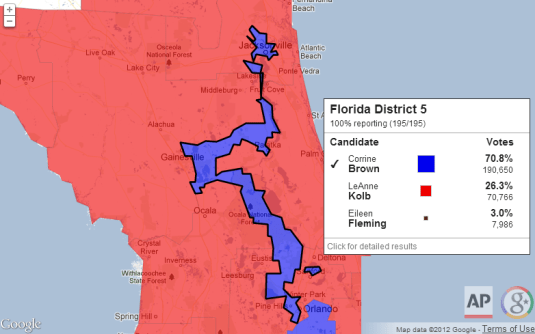
Politicians redraw the electoral boundaries to maximize their support in the newly created district. The obvious outcome is that you can get more seats for less votes.
The gerrymander is named after 19th-century Massachusetts Governor Elbridge Gerry. After Gerry took office in 1810, his Democratic-Republican party redrew the map of the state’s Senate districts in a particularly dramatic and unusual manner to weaken the opposing Federalist Party.

Gerry is less famous for signing the Declaration of Independence and refusing to sign the Constitution because it initially didn’t include a Bill of Rights.
Managerial Econ: Make the rules or your rivals will: use anti-growth activists to erect entry barriers
08 Sep 2014 Leave a comment
in comparative institutional analysis, constitutional political economy, economics of regulation, environmental economics, Public Choice, rentseeking Tags: bootleggers and baptists, rent seeking
The courts have sanctioned the right to organize community opposition that urges government officials and agencies to deny land use permits to applicants, even when the underlying motive of the opposition is protecting market share and eliminating competition.
What’s more, the courts are protecting third-party funding sources, in many cases anonymous funding sources, which support the opposition efforts in order to block potential competition.

Pro-free enterprise does not mean pro-business
28 Aug 2014 Leave a comment
in applied price theory, comparative institutional analysis, constitutional political economy, economics of religion, liberalism, Milton Friedman, Public Choice, rentseeking Tags: Milton Friedman

Infrastructure investment and economic development strategies in Shanghai and Rio de Janeiro
28 Aug 2014 Leave a comment

What is the precariat?
24 Aug 2014 Leave a comment
in applied price theory, applied welfare economics, comparative institutional analysis, constitutional political economy, development economics, entrepreneurship, growth disasters, growth miracles, income redistribution, rentseeking, technological progress, Uncategorized Tags: Leftover Left, precariat, The Great Act, The Great Enrichment, The withering away the proletariat
With the withering away of the proletariat because of the great enrichment, the Left over Left coined the word precariat.

The precariat is a social class formed by people suffering from precarity: a condition of existence without predictability or security, affecting material or psychological welfare as well as being a member of a proletariat class of industrial workers who lack their own means of production and hence sell their labour to live. Specifically, it is applied to the condition of lack of job security, in other words intermittent employment or underemployment and the resultant precarious existence. The term is a portmanteau obtained by merging precarious with proletariat.
Very similar to the Karl Marx’s Lumpenproletariat: the layer of the working class that is unlikely ever to achieve class consciousness and is therefore lost to socially useful production, of no use to the revolutionary struggle, and perhaps even an impediment to the realization of a classless society.
One of the drawbacks of the precariat is they are inconveniently happier than Left over Left are willing to give them credit. For example, a lot of women in part-time jobs are happier than those in full-time jobs because of the greater worklife balance. Casual and seasonal jobs pay more too.
0
 Utopia, you are standing in it!
Recent Comments