


My New Report on Corporate Welfare in New Zealand
10 Oct 2014 Leave a comment
in politics - New Zealand, rentseeking Tags: corporate welfare, New Zealand, rent seeking, Taxpayers Union
The Taxpayers’ Union today launched my report, Monopoly Money, which examines the cost and case for New Zealand’s extensive corporate welfare programmes.
Figure 1: Corporate welfare, Budgets 2008/09 to 2014/15

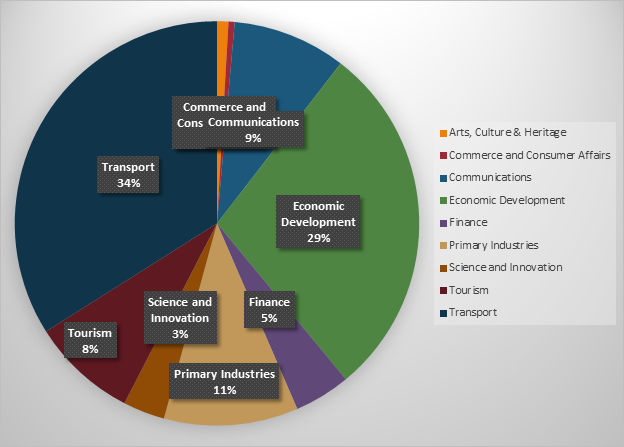
My report, which examines the cost of corporate welfare examines government spending since the 2007/2008 budget, shows:
- Since National took office, corporate welfare has cost taxpayers $1-1.4 billion ($600 – $800 per household) per year
- If corporate welfare was abolished, enough money would be saved to reduce the corporate tax rate from 28% to 22.5%
- If applied to personal income tax rates, the saving would allow the 30% and 33% income tax rates to be lowered to 29%
Figure 2: Corporate welfare, Budgets 2008/09 to 2014/15 by Vote
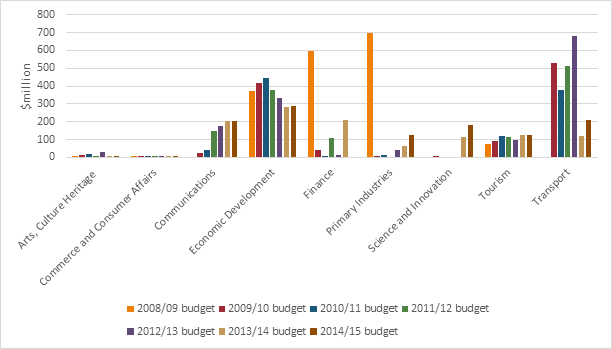
Figure 3: Distribution of total corporate welfare across votes, 2008/09 to 2014/15

Development economics in a nutshell: Gordon Tullock developed his rent seeking insight when he was a diplomat in China
06 Oct 2014 Leave a comment

IOC diva-like demands on Norway for its now scuttled Winter Olympics bid
05 Oct 2014 Leave a comment
in economics of media and culture, politics, Public Choice, rentseeking Tags: Olympic Games, rent seeking
- They demand to meet the king prior to the opening ceremony. Afterwards, there shall be a cocktail reception. Drinks shall be paid for by the Royal Palace or the local organizing committee
- Separate lanes should be created on all roads where IOC members will travel, which are not to be used by regular people or public transportation.
- A welcome greeting from the local Olympic boss and the hotel manager should be presented in IOC members’ rooms, along with fruit and cakes of the season. (Seasonal fruit in Oslo in February is a challenge…)
- The hotel bar at their hotel should extend its hours “extra late” and the minibars must stock Coke products.
- The IOC president shall be welcomed ceremoniously on the runway when he arrives.
- The IOC members should have separate entrances and exits to and from the airport.
- During the opening and closing ceremonies a fully stocked bar shall be available. During competition days, wine and beer will do at the stadium lounge.
- IOC members shall be greeted with a smile when arriving at their hotel.
- Meeting rooms shall be kept at exactly 20 degrees Celsius at all times.
- The hot food offered in the lounges at venues should be replaced at regular intervals, as IOC members might “risk” having to eat several meals at the same lounge during the Olympics.

The Economics of Europe’s Insane History of Putting Animals on Trial and Executing Them
02 Oct 2014 Leave a comment
in applied price theory, economics of religion, law and economics, Public Choice, public economics, rentseeking, taxation Tags: economics of religion, follow the money, Peter Leeson, rent seeking

The fantastically creative and insightful Peter Leeson published an article in the Journal of Law and Economics in 2013 on the practice of putting animals on trial in the Medieval ages.
Abstract
For 250 years insects and rodents accused of committing property crimes were tried as legal persons in French, Italian, and Swiss ecclesiastic courts under the same laws and according to the same procedures used to try actual persons.I argue that the Catholic Church used vermin trials to increase tithe revenues where tithe evasion threatened to erode them.
Vermin trials achieved this by bolstering citizens’ belief in the validity of Church punishments for tithe evasion: estrangement from God through sin, excommunication, and anathema.
Vermin trials permitted ecclesiastics to evidence their supernatural sanctions’ legitimacy by producing outcomes that supported those sanctions’ validity. These outcomes strengthened citizens’ belief that the Church’s imprecations were real, which allowed ecclesiastics to reclaim jeopardized tithe revenue
Leeson’s paper is also closely connected to Ekelund, Herbert, and Tollison’s (1989, 2002, 2006) and Ekelund et al.’s (1996) work. They study the medieval Catholic Church as a firm. They discuss how ecclesiastics used supernatural sanctions to protect the Church’s monopoly on spiritual services against heretical competition.
HT: Wired – fantastically-wrong-europes-insane-history-putting-animals-trial-executing/
The Tyranny of the Taxi Medallions
01 Oct 2014 Leave a comment
in economics of religion, Public Choice, public economics, rentseeking Tags: taxi regulation

Keep your eye on what happens to consumers alert: Murray Rothbard on dumping
01 Oct 2014 Leave a comment

The Key to victory: Run against Piketty-nomics, Scott Sumner | EconLog | Library of Economics and Liberty
23 Sep 2014 Leave a comment
in income redistribution, politics - New Zealand, Public Choice, rentseeking Tags: 2014 New Zealand election, Piketty
This is good news:
New Zealand’s NZX 50 Index increased 1.1 percent, driven higher by power-company stocks, after John Key won a third term as prime minister. Key, a former head of foreign exchange at Merrill Lynch & Co., led his National party to a 48 percent victory in New Zealand’s weekend election, securing the first single-party majority in the South Pacific nation’s parliament since at least 1996. The main opposition Labour Party, which wanted to introduce a tax on capital gains and raise the minimum wage, suffered its worst defeat since 1922.
Perhaps Labour got their ideas from Paul Krugman.
When right-of-center parties are elected, they generally disappoint. Although right-of-center economists favor free markets, most conservative politicians do not. Abe (Japan) and Modi (India) are two recent examples of conservatives who promised reforms and failed to come through (thus far). Fortunately New Zealand is different.
Via http://econlog.econlib.org/archives/2014/09/the_key_to_vict.html


Recent Comments