
The Putin Effect on transitional economies in the former Soviet union
14 Sep 2014 Leave a comment
in development economics, growth disasters, growth miracles, income redistribution, Marxist economics, Public Choice, rentseeking Tags: development, development miracles, disasters, former Soviet Union, Poland, The Great Enrichment, transitional economies, Ukraine

Poland was in the same position as Ukraine after the collapse of the Soviet empire, but it followed better policy and is now several times richer.
Gerrymandering explained
12 Sep 2014 Leave a comment
in Public Choice, rentseeking Tags: democratic elections, gerrymandering, malapportionment, political accountability, political corruption


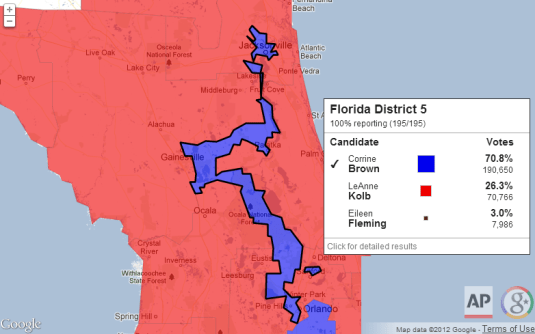
Politicians redraw the electoral boundaries to maximize their support in the newly created district. The obvious outcome is that you can get more seats for less votes.
The gerrymander is named after 19th-century Massachusetts Governor Elbridge Gerry. After Gerry took office in 1810, his Democratic-Republican party redrew the map of the state’s Senate districts in a particularly dramatic and unusual manner to weaken the opposing Federalist Party.

Gerry is less famous for signing the Declaration of Independence and refusing to sign the Constitution because it initially didn’t include a Bill of Rights.
Managerial Econ: Make the rules or your rivals will: use anti-growth activists to erect entry barriers
08 Sep 2014 Leave a comment
in comparative institutional analysis, constitutional political economy, economics of regulation, environmental economics, Public Choice, rentseeking Tags: bootleggers and baptists, rent seeking
The courts have sanctioned the right to organize community opposition that urges government officials and agencies to deny land use permits to applicants, even when the underlying motive of the opposition is protecting market share and eliminating competition.
What’s more, the courts are protecting third-party funding sources, in many cases anonymous funding sources, which support the opposition efforts in order to block potential competition.

Pro-free enterprise does not mean pro-business
28 Aug 2014 Leave a comment
in applied price theory, comparative institutional analysis, constitutional political economy, economics of religion, liberalism, Milton Friedman, Public Choice, rentseeking Tags: Milton Friedman

Infrastructure investment and economic development strategies in Shanghai and Rio de Janeiro
28 Aug 2014 Leave a comment

What is the precariat?
24 Aug 2014 Leave a comment
in applied price theory, applied welfare economics, comparative institutional analysis, constitutional political economy, development economics, entrepreneurship, growth disasters, growth miracles, income redistribution, rentseeking, technological progress, Uncategorized Tags: Leftover Left, precariat, The Great Act, The Great Enrichment, The withering away the proletariat
With the withering away of the proletariat because of the great enrichment, the Left over Left coined the word precariat.

The precariat is a social class formed by people suffering from precarity: a condition of existence without predictability or security, affecting material or psychological welfare as well as being a member of a proletariat class of industrial workers who lack their own means of production and hence sell their labour to live. Specifically, it is applied to the condition of lack of job security, in other words intermittent employment or underemployment and the resultant precarious existence. The term is a portmanteau obtained by merging precarious with proletariat.
Very similar to the Karl Marx’s Lumpenproletariat: the layer of the working class that is unlikely ever to achieve class consciousness and is therefore lost to socially useful production, of no use to the revolutionary struggle, and perhaps even an impediment to the realization of a classless society.
One of the drawbacks of the precariat is they are inconveniently happier than Left over Left are willing to give them credit. For example, a lot of women in part-time jobs are happier than those in full-time jobs because of the greater worklife balance. Casual and seasonal jobs pay more too.
0
Henry Hazlitt on wise bureaucrats and farsighted politicians
21 Aug 2014 Leave a comment
in applied price theory, comparative institutional analysis, entrepreneurship, liberalism, Public Choice, rentseeking, survivor principle Tags: fatal conceit, Henry Hazlitt, pretence to knowledge


The people designing your cities don’t care what you want. They’re planning for hipsters. – The Washington Post
19 Aug 2014 Leave a comment
in applied price theory, economics of regulation, income redistribution, rentseeking, urban economics Tags: do gooders, elitism, land supply, new class, rent seeking, the vision of the annointed, zoning

HT: Michael Warby via The people designing your cities don’t care what you want. They’re planning for hipsters. – The Washington Post .


Recent Comments