
How to beat the share market
15 Aug 2014 Leave a comment
in economics of crime, financial economics, Public Choice, rentseeking Tags: insider trading, official corruption
Become a United States senator. Their share portfolios out-perform the best of the best hedge fund managers, and the best hedge fund manager was paid 3 1/2 billion dollars last year; to get on the list for the top hedge fund manager, you make at least $300 million a year. Good things that politicians know how to outperform them on their modest salaries and busy schedules of public engagements and parliamentary sittings.
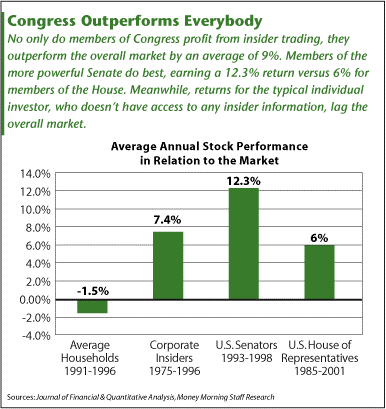
Using the financial disclosures of politicians, "Abnormal Returns From the Common Stock Investments of Members of the U.S. House of Representatives," built model portfolios and charted their performance. They found that House members outperform the market by 6 percentage points. Senators do even better, the authors say, citing their own earlier research from 2004.
Senate portfolios "show some of the highest excess returns ever recorded over a long period of time, significantly outperforming even hedge fund managers," with gains that are "both economically large and statistically significant."

These results suggest that congressmen and senators have access to non-public information on particular businesses, industries or the economy as a whole and invest on the basis that information. The good returns of Senators and Congressmen last far too long to be no more than luck.


The politics of ethnicity-based research in New Zealand
30 Jul 2014 Leave a comment
in applied price theory, discrimination, human capital, income redistribution, labour economics, labour supply, politics - New Zealand, population economics, Public Choice, rentseeking Tags: employment discrimination, inequality, Maori economic development, poverty, Simon Chapple, The Great Enrichment, The Great Fact
When Simon Chapple in 2000 wrote “Māori Socio-Economic Disparity”, which showed that disadvantage in New Zealand is more closely tied to age, marital status, education, skills, and geographic location than it is to ethnicity, broadly conceived, such as Māori ethnicity:
- He was summoned before the Māori Affairs Committee of parliament to defend his paper! His chief executive at the Ministry of Social Policy went along with him to defend what he wrote while employed as a senior analyst at the Department of Labour. Staff at his new ministry launched a petition to have Simon fired.
- The head of the Māori Affairs Ministry accused Simon of breaching the public service code of conduct.
Chapple also found that there are important differences in socio economic development by Māori self-identity. Those who identified only as Māori did worse than those that are identified as Māori and another ethnicity. Identifying only as Māori also correlated with living in rural New Zealand.
In terms of employment discrimination, employers would not know whether a Māori job applicant identified as only as Māori or also with another ethnicity, so discrimination is not a good explanation of Māori disadvantage because of this counterfactual. A major driver of Māori disadvantage, which is identifying on the Census form solely as Maori, is simply unknown to discriminating employers as a basis for discrimination in hiring and promotion.
There were editorials in the Dominion Post, which I cannot find online, and in the New Zealand Herald. The latter said:
The Government is being prodded to recognise that Maori deprivation has more to do with socio-economic factors than ethnicity.
This was the conclusion of a report by the Labour Department’s senior research analyst, Simon Chapple. Helen Clark might well have had that finding partly in mind when she referred to a lot of water having gone under the bridge since the Government first formulated legislation.
Mr Chapple said, in essence, that place of residence, age, education and skills had more to do with poverty than race. In areas such as South Auckland, Northland and the central North Island, there were poor Maori, but there were also poor Pākehā and poor Pasifika.
The Minister attacked him and the paper as well for contradicting the Minister’s claim during the election campaign that everything got worse for Maori in the 1990s.

Real equivalised median household income rose 47% from 1994 to 2010; for Māori, this rise was 68%; for Pasifika, 77% (Perry July 2014)
See Karen Baehler’s Ethnicity-based research and politics: snapshots from the United States and New Zealand for more information and a comparison with the similar response to Daniel Patrick Moynihan’s The Negro Family: A Case for National Action in 1965.
About a quarter of Negro families are headed by women. The divorce rate is about 2 1/2 times what it is [compared with whites],” Moynihan said. “The number of fatherless children keeps growing. And all these things keep getting worse, not better, over recent years.”
Moynihan, now retired from the United States Senate, was a senior official in LBJ’s Labor Department in 1965. He wrote his report on a typewriter over a few weeks and had the publications office in the basement of the Labor Department print 100 of them, marked “For Official Use Only.”
- He warned about the breakdown of the African-American family where deprivation and disorganisation had formed their own vicious circle.
- Many civil rights leaders had labelled Moynihan’s report a subtle form of racism because of its unflattering portrayal of the black family (Wilson 1987).
- These accusations of racism helped make the breakdown of the family a taboo subject in social policy in the USA
see The Moynihan Report Revisited: Lessons and Reflections after Four Decades for a review by the best and the brightest in American economics and sociology on Daniel Patrick Moynihan’s prophetic warnings. Holzer says, for example:
Moynihan was extremely insightful and even prescient in arguing that the employment situation of young black men was a “crisis . . . that would only grow worse.”
He understood that these trends involve both limits on labour market opportunities that these young men face as well as skill deficits of and behavioural responses by the young men themselves.
More children are growing-up without a working father living in the home and glean the awareness that work is a central expectation of adult life (Wilson 1987, 1996).
Single-parent households increased from 13 per cent of all Māori households in 1981 to 24.4 per cent in the 2006 Census. In the 2006 Census, 70 per cent of Māori single parent households were on a low income compared to 15 per cent of other Māori one family households (Kiro, Randow and Sporle 2010).
Most of the skill gaps that are present at the age of 18 – skill gaps which substantially explain gaps in adult earnings and employment in all groups – are also present at the age of five (Cunha and Heckman 2007). There is much evidence to show that disadvantaged children have lower levels of soft skills (non-cognitive skills): motivation, persistence, self-discipline, the ability to work with others, the ability to defer gratification and plan ahead, etc. (Heckman 2008). Most of the skills that are acquired at school build on these soft skills that are moulded and reinforced within whānau.
When I started working on labour economics in 2007 I found that the labour economics of Māori was very narrowly written and stayed well clear of the minefield that Simon braved about how ethnicity does not matter that much to Māori social disadvantage.
The business community as an enemy of capitalism
26 Jul 2014 Leave a comment
in applied price theory, Milton Friedman, rentseeking Tags: competition and monopoly, corporate capitalism, Milton Friedman, rent seeking

The best discussions on green interest group coalitions
26 Jul 2014 Leave a comment
in economics of regulation, environmental economics, global warming, Public Choice, rentseeking Tags: bootleggers and baptists, Bruce Yandle, environmental interest groups, global warming, green rent seeking, Todd Zywicki
Bootleggers, Baptists, and the Global Warming Battle By Bruce Yandle and Stuart Buck:
The theory’s name is meant to evoke 19th century laws banning alcohol sales.
- Baptists supported Sunday closing laws for moral and religious reasons, while bootleggers were eager to stifle their legal competition.
- Politicians were able to pose as acting in the interests of public morality, even while taking contributions from bootleggers.
Yandle and Buck argue that during the battle over the Kyoto Protocol, he “Baptist” environmental groups provided moral support while “bootlegger” corporations and nations worked in the background to seek economic advantages over their rivals.

BAPTISTS? THE POLITICAL ECONOMY OF POLITICAL ENVIRONMENTAL INTEREST GROUPS By Todd J. Zywicki who specifies three testable implications of a public interest model of the activities of environmental interest groups:
(1) a desire to base policy on the best-available science;
(2) a willingness to engage in deliberation and compromise to balance environmental protection against other compelling social and economic interests; and,
(3) a willingness to consider alternative regulatory strategies that can deliver environmental protection at lower-cost than traditional command-and-control regulation.
Zywicki concludes that It has been argued that environmental regulation can be best understood as the product of an unlikely alliance of “Baptists and Bootleggers” – public-interested environmental activist groups and private-interested firms and industries seeking to use regulation for competitive advantage.
The Far Left view of the welfare state
25 Jul 2014 Leave a comment
in income redistribution, rentseeking Tags: bottom 99%, socialism, top 1%, welfare state

HT: Dan Mitchell


Piketty and Pension Fund Socialism
01 Jul 2014 1 Comment
in financial economics, human capital, income redistribution, rentseeking Tags: pension fund socialism, Peter Drucker, Piketty

Any attack on capitalism these days is a direct attack of the retirement savings of ordinary workers. We live in the age of what Peter Drucker called pension fund socialism in 1976. As Drucker added in 1991:
The rise of pension funds as dominant owners and lenders represents one of the most startling power shifts in economic history.
The first modern pension fund was established in 1950 by General Motors.
Four decades later, pension funds control total assets of $2.5 trillion, divided about equally between common stocks and fixed-income securities. Demographics guarantee that these assets will grow aggressively for at least another ten years.
The majority of equity capital is owned by pension funds and other collective investment vehicles corralling the savings of ordinary people. Much of the rest of physical capital is owned by workers through home ownership.
In the age of human capital, 70-90% of all capital in the economy is human capital. The notion of unskilled workers labouring away with the capital supplied by the bosses is 19th century throwback.
The rentier rich has been long replaced by the working rich. They make their fortunes in their own life times – sometimes as business entrepreneurs, sometimes through rent-seeking.
It is also the age of specific human capital, with a proliferation of technologies and products. The rising specialisation of firms and their production inputs has forced firms to try harder to find those inputs that suit their needs best. Management has the task of finding the right inputs. The role and reward to managers has therefore risen.
When the rise in returns on investments in human capital is beneficial and desirable, and policies designed to deal with inequality must take account of its cause. Growth in education levels has been a significant source of rising wages, productivity, and living standards over the past century.
The initial impact of higher returns to human capital is wider inequality in earnings, but that impact becomes more muted and may be reversed over time as young people invest more in their human capital.
The rentier class has been replaced by the working rich. The evidence on the top 1% is most consistent with theories of superstars, skill biased technological change, greater scale and their interaction of these factors.
Individuals who are really good at making money can now apply their skills to larger amounts of capital and reach far larger audiences and markets for their products and services. That favours CEOs, athletes, celebrities, corporate lawyers, successful entrepreneurs and other working rich Who have a skill or talent that can be supplied at little cost on a much larger scale. Some have a special dark place in their hearts for people who earned their money through honest hard work.


Recent Comments