Peter Dunne writes – In 1994 the then Labour Opposition resolved to introduce a new top tax rate of 39 cents in the dollar. The reason for the policy was purely political, not fiscal. Labour was shedding votes to Jim Anderton’s left-wing Alliance at the time and wanted to do something symbolic to staunch the flow. […]
Capital gains tax: how Hipkins has abandoned policy soundness for a symbolic gesture
Capital gains tax: how Hipkins has abandoned policy soundness for a symbolic gesture
01 Nov 2025 Leave a comment
in fiscal policy, income redistribution, macroeconomics, politics - New Zealand, Public Choice, public economics Tags: taxation and investment
Part IV: Yes, Taxes Change Behavior
22 Oct 2025 Leave a comment
in applied price theory, fiscal policy, human capital, labour economics, labour supply, macroeconomics, Public Choice, public economics Tags: taxation and entrepreneurship, taxation and investment, taxation and labour supply

There can be honest and constructive debates about the size of government, such as when I cross swords with someone on the left who understands Arthur Okun’s efficiency-equity tradeoff. Another legitimate debate is about the impact of tax policy, specifically whether higher or lower tax rates have big effects or small effects. But to have […]
Part IV: Yes, Taxes Change Behavior
State very expensive landlord
17 Oct 2025 Leave a comment
in applied price theory, economics of bureaucracy, industrial organisation, law and economics, politics - New Zealand, property rights, Public Choice, public economics, urban economics
A report by the New Zealand Initiative shows that the state is a very expensive landlord: Why does the government need to continue owning or managing more than 77,000 housing units, given its poor track record in this area, especially when state assistance can be provided without extensive government ownership? And why does it not […]
State very expensive landlord
Taxes and Growth, Part II
15 Oct 2025 Leave a comment
in applied price theory, economic growth, fiscal policy, macroeconomics, Public Choice, public economics Tags: taxation and entrepreneurship, taxation and investment, taxation and labour supply

I wrote a column about taxes and growth in 2020. Let’s augment that analysis by digging into some details. I decided to address the issue today after seeing a tweet with this helpful summary of how different taxes cause different levels of economic damage (the Tax Foundation also has a table that ranks different taxes, […]
Taxes and Growth, Part II
Is the earned income tax overrated?
09 Oct 2025 Leave a comment
in applied price theory, economics of education, human capital, income redistribution, labour economics, labour supply, occupational choice, Public Choice, public economics, welfare reform Tags: taxation and labour supply
This policy has been so popular with economists on a bipartisan basis, yet a recent piece in ReStud raises some doubts, as the wage subsidies induce many to drop out of school: As a complement to the federal earned income tax credit (EITC), some states offer their own EITC, typically calculated as a percentage of […]
Is the earned income tax overrated?
Part II: Yes, Taxes Change Behavior
08 Oct 2025 Leave a comment
in applied price theory, labour economics, labour supply, public economics Tags: taxation and entrepreneurship, taxation and investment, taxation and labour supply

There are several visual ways of helping people understand how fiscal policy (and especially marginal tax rates) can change behavior. The philoso-raptor meme. The questioning worker. Supply-and-demand curves. The Wizard-of-Id parody. To augment these examples, I’ve started a series that is based on real-world examples. Part I of the series highlighted how the capital gains […]
Part II: Yes, Taxes Change Behavior
Getting rid of subidies creates wealth
06 Oct 2025 Leave a comment
in applied price theory, comparative institutional analysis, energy economics, industrial organisation, Public Choice, public economics Tags: electric cars, Internet, subsidies
REASON: Starting Today, Electric Vehicle Buyers No Longer Get a Federal Tax Credit. It’s bad news for upper-income motorists wanting a deal, but good news for taxpayers. In 2022, then-President Joe Biden signed the Inflation Reduction Act (IRA) into law…,[awarding] up to $7,500 for purchasing an electric vehicle. …Donald Trump [terminated the subsidy] on September…
Getting rid of subidies creates wealth
Part I: Yes, Taxes Change Behavior
26 Sep 2025 Leave a comment
in applied price theory, economic growth, entrepreneurship, fiscal policy, human capital, labour economics, labour supply, macroeconomics, Public Choice, public economics Tags: taxation and entrepreneurship, taxation and investment, taxation and labour supply
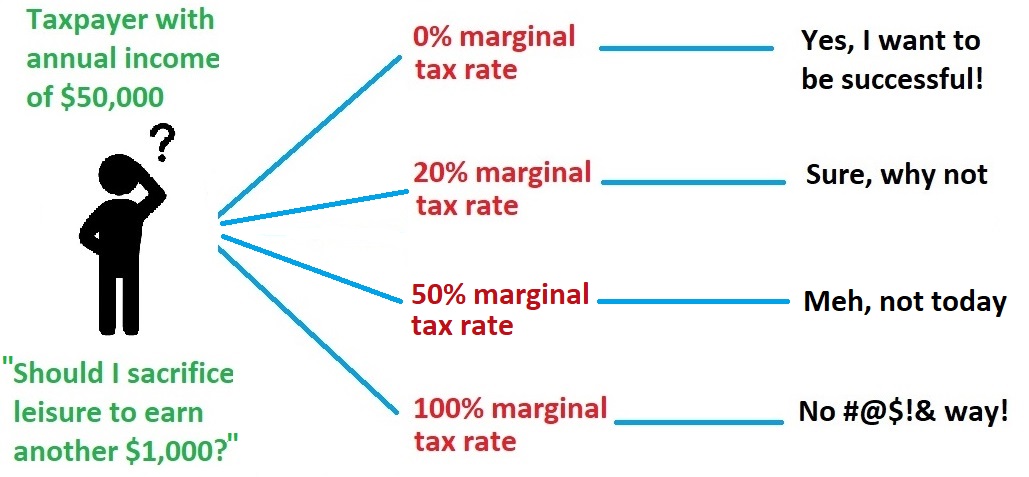
From a big-picture economic perspective, I worry most about the damage of high tax burdens on innovation, entrepreneurship, and investment. Those are things that generate enormous benefits for society, yet also things that are very sensitive to bad tax policy (specifically high marginal tax rates and the tax code’s bias against saving and investment). Sadly, […]
Part I: Yes, Taxes Change Behavior
Newsflash! The super-rich are mobile, and higher taxes incentivise them to move away
25 Sep 2025 1 Comment
in applied price theory, human capital, income redistribution, labour economics, labour supply, occupational choice, Public Choice, public economics Tags: taxation and entrepreneurship, taxation and investment
The super-rich are super-mobile. So, if a country decides to increase taxes on the super-rich (for example, with a wealth tax), some (but not all) of the super-rich will simply move elsewhere. This should not be a surprise to anyone. And yet, simplistic proposals to tax the super-rich are a favourite policy for some political…
Newsflash! The super-rich are mobile, and higher taxes incentivise them to move away
Predistribution, Not Redistribution, in the Nordic Countries
15 Sep 2025 Leave a comment
in applied price theory, economic growth, economics of education, fiscal policy, income redistribution, labour economics, labour supply, macroeconomics, poverty and inequality, Public Choice, public economics, rentseeking Tags: Denmark, Finland, Norway, Sweden
Maybe it’s just because I live in Minnesota, a state where the differences between immigrants from Sweden, Norway, and Finland are still apparent in the names of towns and the surnames of people. But when I run into people who would prefer that the US distribution of income be more equal, they often point to…
Predistribution, Not Redistribution, in the Nordic Countries
Greens say taxing supermarkets more will lower food prices!
10 Sep 2025 Leave a comment
in applied price theory, economics of regulation, industrial organisation, Marxist economics, politics - New Zealand, Public Choice, public economics Tags: competition law
Radio NZ reports: But the Greens’ commerce and consumer affairs spokesperson Ricardo Menéndez March told RNZ that was only “one part of the puzzle” and the government needed to explore all its options – including breaking up the supermarket duopoly. “While we support having new players in the market, Nicola Willis is banking on big […]
Greens say taxing supermarkets more will lower food prices!
How well did Katrina reconstruction go?
05 Sep 2025 Leave a comment
in applied price theory, economic history, economics of bureaucracy, economics of natural disasters, income redistribution, politics - USA, Public Choice, public economics, rentseeking
…the federal government did something extraordinary: It committed more than $140 billion toward the region’s recovery. Adjusted for inflation, that’s more than was spent on the post-World War II Marshall Plan to rebuild Europe or for the rebuilding of Lower Manhattan after the Sept. 11 attacks. It remains the largest post-disaster domestic recovery effort in […]
How well did Katrina reconstruction go?
David Splinter on how much tax billionaires pay
30 Aug 2025 Leave a comment
in applied price theory, econometerics, entrepreneurship, human capital, income redistribution, labour economics, labour supply, politics - USA, poverty and inequality, Public Choice, public economics Tags: taxation and entrepreneurship, taxation and investment
Here is his comment on the paper presented here: Summary: The U.S. tax system is highly progressive. Effective tax rates increase from 2% for the bottom quintile of income to 45% for the top hundredth of one percent. But rates may be lower among those with the highest wealth. This comment starts with the “top 400” […]
David Splinter on how much tax billionaires pay
The Greens’ weekend gift to the government
19 Aug 2025 Leave a comment
in economic growth, entrepreneurship, fiscal policy, income redistribution, labour economics, labour supply, macroeconomics, Marxist economics, politics - New Zealand, poverty and inequality, Public Choice, public economics Tags: taxation and entrepreneurship, wealth tax
Roger Partridge writes – The Greens’ coronation of Chlöe Swarbrick at last weekend’s AGM delivered a manifesto for economic transformation that would make Soviet economists nostalgic for their glory days.
The Greens’ weekend gift to the government
Milei’s Achievements…and Challenges
17 Aug 2025 1 Comment
in development economics, economic growth, economics of bureaucracy, economics of regulation, fiscal policy, growth disasters, income redistribution, industrial organisation, labour economics, law and economics, liberalism, libertarianism, macroeconomics, Marxist economics, monetary economics, property rights, Public Choice, public economics, rentseeking, unemployment Tags: Argentina

I’m back in Argentina, the South American country with the world’s best leader. What Javier Milei has accomplished is amazing. And the economic effects have been wonderful. One of my meetings earlier this week was with Marcelo Elizondo, the head of the International Chamber of Commerce for Argentina. He shared a presentation with me that […]
Milei’s Achievements…and Challenges


Recent Comments