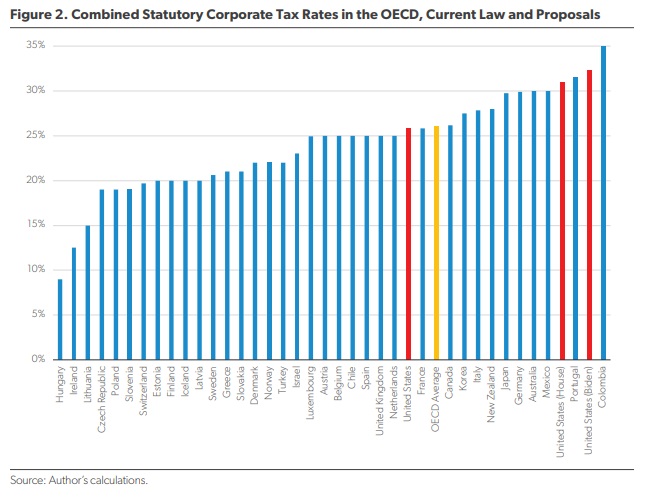
As part of her tax-and-spend agenda, Kamala Harris says she wants to increase the federal corporate tax rate from 21 percent to 28 percent. While it doesn’t seem possible, there is a tiny sliver of good news in her proposal. I’m happy that she isn’t proposing to push the rate to 35 percent, which is […]
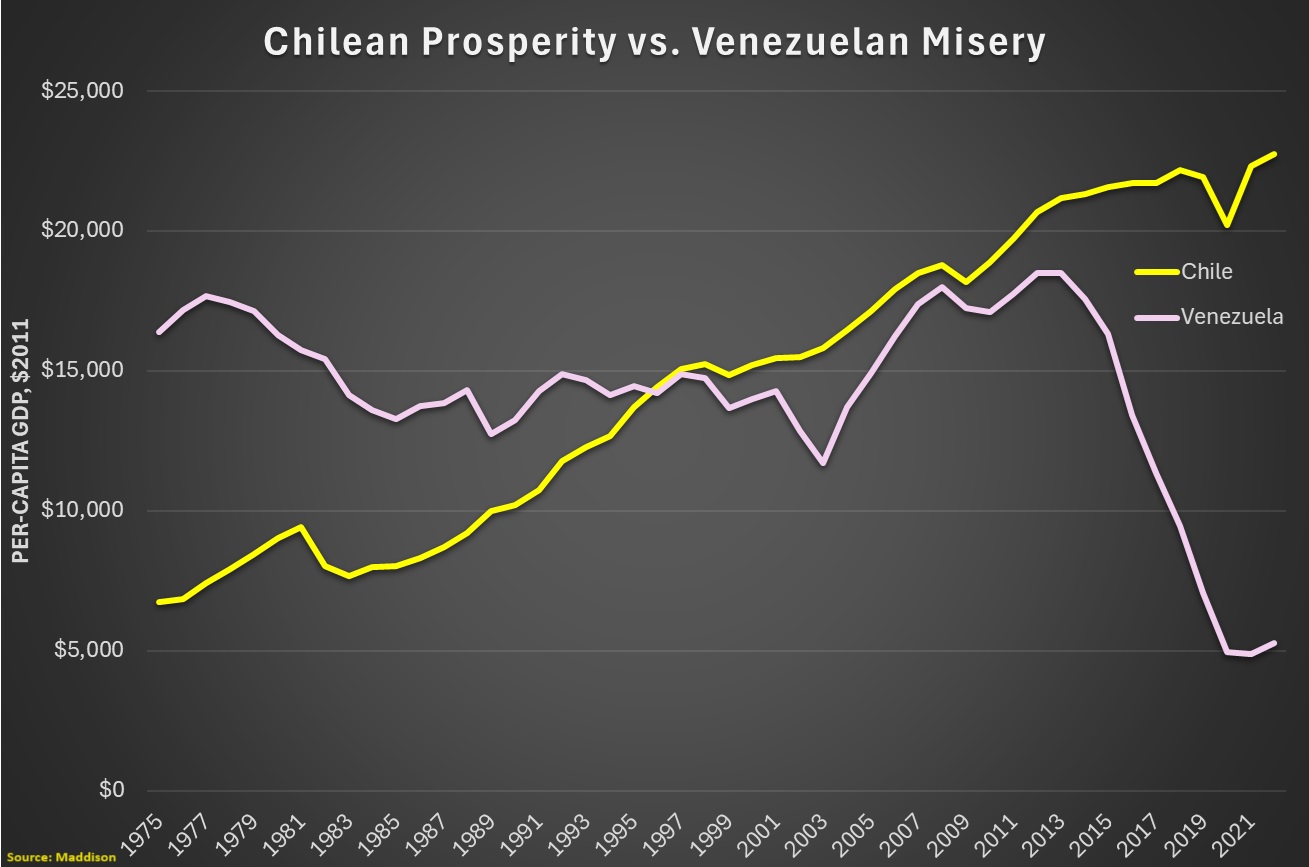
I’ve repeatedly praised Chile’s pro-market reforms (see here, here, and here) and I’ve repeatedly condemned Venezuela’s shift to socialism (see here, here, and here). But if you don’t have time to read all those columns, this chart from the Maddison database tells you everything you need to know. Simply stated, Chile’s reforms have delivered huge […]
Writing about Mitt Romney’s selection of Paul Ryan in 2012, I opined that, “…it probably means nothing. I don’t think there’s been an election in my lifetime that was impacted by the second person on a presidential ticket.” I feel the same way about Tim Walz, who is Kamala Harris’ pick for Vice President. But […]
Garry Moller writes: If I had it my way, I would scrap many of Wellington’s cycleways, and do it better. Allow me to elaborate. … For Wellington to thrive, ample on-street parking is essential. Despite the influx of more public service employees and contractors in recent years, central Wellington is struggling. Many long-term Wellington residents, […]
The idea behind Uber first arose, the story goes, on a snowy evening in Paris back around 2008, when Travis Kalanick and Garrett Camp found themselves stuck in Paris on a snowy evening, unable to find a taxi. They wondered “What if you could request a ride simply by tapping your phone?” They co-founded Uber based…
New Zealand citizen, Peter Thiel, who is one of the world’s richest men, and business associate of Elon Musk, has had his house application in Wanaka rejected on appeal by the Environment Court. Theil was the first investor in Shane Legg’s company, Deep Mind, which started the Artificial Intelligence revolution. Legg is a former student…
Oliver Hartwich writes – New Zealand’s government sacked the entire board of Health New Zealand (Te Whatu Ora) last week, replacing it with a sole commissioner. The move marked more than just another shake-up in the country’s beleaguered health system. It signalled the spectacular failure of a grand experiment that has turned New Zealand into […]
She’s been one of the rising stars of the British Conservative Party for some time now, and I’ve covered stories about her before (Would be nice if a US Democrat said this about Critical Race Theory and A Tory warning for the National Party of 2032), but I’ve finally decided to add Kemi Badenoch as a tag […]
When a city bids to host the Olympic Games, part of the bid is a commitment that the city or the national government will cover any cost overruns–and experience suggests the cost overruns will be large. Alexander Budzier and Bent Flyvbjerg discuss the patterns in “The Oxford Olympics Study 2024: Are Cost and Cost Overrun…
The Miami Herald reports: A stunning 10% of Cuba’s population — more than a million people — left the island between 2022 and 2023, the head of the country’s national statistics office said during a National Assembly session Friday, the largest migration wave in Cuban history. Isn’t it such a weird coincidence that the queue […]
Here’s a lively AIER podcast on Build, Baby, Build with the one and only Veronique de Rugy. Best French libertarian since Bastiat? Décider vous-même!P.S. Capla-Con 2024 starts two weeks from tomorrow in Fairfax, Virginia. You’re all invited! Feel free to coordinate ride-sharing in the comments.
That is the topic of my latest Bloomberg column, here is one excerpt: A recent study finds that, of all domestic subsidies, the most effective involve replacing the dirty production of electricity with the cleaner production of electricity. In practice, that means subsidies or tax credits for solar and wind power. Those are more than twice as effective as […]
That is the topic of my latest Bloomberg column. Here is one summary excerpt: One result: Total tangible corporate investment went up by about 11%. That has been a welcome shot in the arm for an economy that was by some measures suffering from an investment drought. The strong state of the Biden economy may, in…
Government departments are now all required by law to write and publish a Long-term Insights Briefing at least every three years. and they have to consult the public on both choice of topic and the draft report The Public Service Commission gives its take on these provisions here Count me more than a little sceptical. […]
Some folks on the left have a deep-seated resentment of successful investors, entrepreneurs, business owners, and other high-income people. They want to hit them with confiscatory tax rates, even if the tax is so punitive that the government doesn’t wind up with more revenue. Heck, some of them are so consumed by hate and envy […]
Why Evolution is True is a blog written by Jerry Coyne, centered on evolution and biology but also dealing with diverse topics like politics, culture, and cats.
“We do not believe any group of men adequate enough or wise enough to operate without scrutiny or without criticism. We know that the only way to avoid error is to detect it, that the only way to detect it is to be free to inquire. We know that in secrecy error undetected will flourish and subvert”. - J Robert Oppenheimer.



 Utopia, you are standing in it!
Recent Comments