Julian Simon on Resources, Growth and Human Progress
05 Jan 2017 Leave a comment
in economic history, energy economics, entrepreneurship, resource economics Tags: Julian Simon
Matt Ridley and 2012 Julian Simon award
05 Nov 2016 Leave a comment
in development economics, economic history, economics of natural disasters, energy economics, environmental economics, global warming, health economics, resource economics Tags: Julian Simon
26th anniversary of Julian Simon @PaulREhrlich bet @GreenpeaceNZ @GreenpeaceUSA
11 Oct 2016 Leave a comment
in applied price theory, economic history, energy economics, entrepreneurship, industrial organisation, resource economics, survivor principle Tags: commodity prices, doomsday prophecies, endogenous growth theory, entrepreneurial alertness, Julian Simon, Paul Ehrlich
A 2011 blog post of mine on "the bet" rogerpielkejr.blogspot.com/2011/10/cornuc…
Attached a bigger bin of commodities & bet dates in red http://t.co/SC6HeuRwys—
Roger Pielke Jr. (@RogerPielkeJr) April 29, 2015
On going back to live the natural way
25 Aug 2016 Leave a comment
in energy economics, environmental economics, health economics, resource economics
How much of global low carbon energy is wind and solar?
21 Apr 2016 Leave a comment
in economic history, energy economics, environmental economics, resource economics Tags: geothermal power, hydroelectric power, nuclear power, renewable energy, solar power, wind power
Save Our Parks! How to Keep National Parks Open
25 Feb 2016 Leave a comment
in applied price theory, comparative institutional analysis, environmental economics, law and economics, property rights, resource economics Tags: contracting-out, free market environmentalism, national parks, privatisation
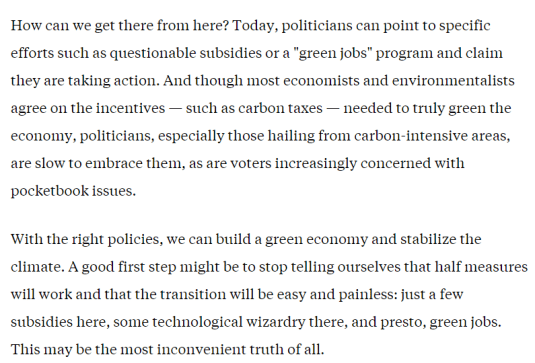
Think Again: The Green Economy @janlogie @GarethMP
23 Feb 2016 Leave a comment
in applied welfare economics, energy economics, environmental economics, politics - New Zealand, politics - USA, Public Choice, resource economics Tags: climate alarmism, green economy, green rent seeking

Source: Matthew Kahn (2009) Think Again: The Green Economy | Foreign Policy
% billionaires who made their money through political connections or resource industries
13 Feb 2016 Leave a comment
in economics of bureaucracy, economics of regulation, energy economics, entrepreneurship, industrial organisation, poverty and inequality, privatisation, rentseeking, resource economics
The 1826 Billionaires in the Forbes 2015 list are classified as rich through political connections if they made their money through past political positions, close relatives or friends in government, or questionable licenses, privatisations or resource extraction industries.
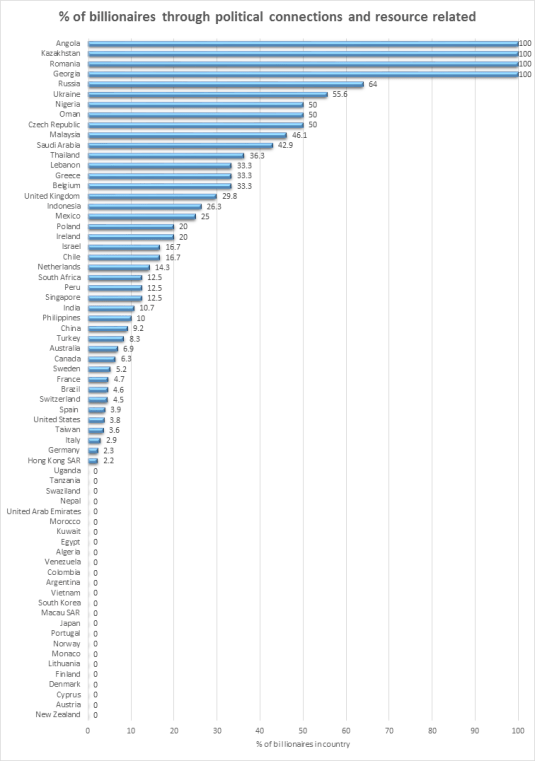
All privatizations were included in the politically-connected/resource-related category despite my data source acknowledging the possibility that the new owners may have transformed the company. Resource billionaires were all deemed to be lucky or cronies by my data source rather than diligent as some most certainly were. This is something of a slur by my data source given the industriousness of some resource billionaires some of whom were even geologists.
Political cronyism is a path to billionaire wealth mainly in the developing countries. Less than 10% of Chinese billionaires made their money through political connections, which is surprising.
How insightful was The Population Bomb
14 Dec 2015 Leave a comment
in development economics, economic history, energy economics, environmental economics, environmentalism, growth miracles, population economics, resource economics, technological progress Tags: cranks, doomsday prophets
Niagara Falls in 1969 with no water
24 Nov 2015 Leave a comment
in environmental economics, resource economics Tags: Niagara Falls
Niagara Falls in 1969 with no water. The water was diverted so that engineers could strengthen areas & slow erosion. http://t.co/5cOZ3CLWRl—
The World (@World) September 28, 2015
#China uses as much coal, steel, and concrete as the rest of the world combined
08 Oct 2015 Leave a comment
in development economics, energy economics, growth miracles, resource economics Tags: China
China uses as much coal, steel, and concrete as the rest of the world combined: bit.ly/1US1Lyc http://t.co/4NqNFNLAYz—
Vox (@voxdotcom) September 15, 2015
@GreenpeaceNZ The 25th anniversary of the famous bet between Julian Simon and Paul Ehrlich
03 Oct 2015 Leave a comment
in economics, energy economics, entrepreneurship, environmental economics, resource economics

A 2011 blog post of mine on "the bet" rogerpielkejr.blogspot.com/2011/10/cornuc…
Attached a bigger bin of commodities & bet dates in red http://t.co/SC6HeuRwys—
Roger Pielke Jr. (@RogerPielkeJr) April 29, 2015
The financial performance of Landcorp since 2007
29 Sep 2015 Leave a comment
in economic history, environmental economics, industrial organisation, politics - New Zealand, resource economics, survivor principle Tags: agricultural economics, Landcorp, privatisation, state owned enterprises
Landcorp is a state-owned enterprise of the New Zealand government. Its core business is pastoral farming including dairy, sheep, beef and deer. In January 2012, Landcorp managed 137 properties carrying 1.5 million stock units on 376,156 hectares of land. Its total return to shareholders, the taxpayers, has been quite up-and-down in recent years.
Source: The New Zealand Treasury – data released under the Official Information Act.
.
Recent Comments