

Joseph Schumpeter, economic growth, and creative destruction
15 Nov 2014 Leave a comment
in applied price theory, comparative institutional analysis, entrepreneurship, liberalism, theory of the firm Tags: creative destruction, Joseph Schumpeter
Alchian and Allen on the role of mathematics in the education of an economic student
18 Oct 2014 Leave a comment


The incentives of a firm and its customers aren’t always properly aligned
22 Sep 2014 Leave a comment

The personnel economics of putting up election billboards
04 Sep 2014 Leave a comment
in applied price theory, labour economics, managerial economics, organisational economics, personnel economics, politics - New Zealand, theory of the firm Tags: 2014 New Zealand election, agent principal problems, labour economics, moral hazard, New Zealand politics, paid versus unpaid labour, personnel economics
I’ve been out of late, helping put up election billboards. Maybe I should get a life, but I noticed that the quality of effort by volunteers was much better than that by the contractors hired by the Internet – Mana party. Everybody in that party appears to be paid including the leader for $140K year. She is not yet in Parliament.

The Internet-Mana party election billboards are very heavy, solid wooden signs and obviously pre-manufactured and must be driven around in a truck. They are certainly too heavy to be put on the back of a trailer behind a private car.
Our signs are constructed on site from a dozen pieces of wood of various sizes. The only pre-prepared part is the billboard itself with fits on the back of a trailer.
What first took my interest is the contractors hired by the Internet – Mana party signs seem to pay not all that much regard to the traffic flow. Some of their signs are parallel with the traffic so hardly anybody can see them. They are all one sided signs.
When we are putting up a election billboard, we squabble like a bunch of old women over the exact angle each sign should face the traffic to capture the most number of passing cars and buses. Everybody has an opinion including those doing it for the first time.

We then squabble about whether the sign should be one-sided or two sided depending upon how well it can be viewed from the other side by traffic coming the other way.
We also squabble about its positioning and height to maximise the number of views by the passing traffic relative to the positioning all the other signs.
There is also a lot of vandalism of these signs by rather naive people who don’t understand that the passing motorist looks at the vandalised signs first.

It takes a whole lot of hatred to vandalised a sign in this way. Photos of the above sign immediately went viral. For some reason, the National party has repaired that sign. I don’t know why.


“Trapped” in Rental Contracts | Organizations and Markets
17 Aug 2014 Leave a comment
in applied price theory, Armen Alchian, comparative institutional analysis, entrepreneurship, industrial organisation, Ronald Coase, survivor principle, theory of the firm Tags: long-term contracts, mutual dependency, relationship dependent assets, transaction costs, vertical integration
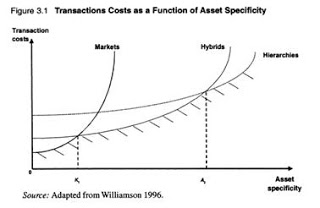
- Mercedes and BMW drivers trapped in lease contracts, rather than buying their cars with cash or credit
- Individuals trapped in wage and salary contracts, rather than raising the capital, arranging the inputs, and bearing the uncertainties to be sole proprietors
- Companies trapped in outsourcing agreements, rather than owning all upstream and downstream production processes directly, as vertically integrated firms
- Vacationers trapped in resort hotels, rather than owning their own vacation condos or timeshares
- Readers trapped by downloading and reading books on their Kindles, essentially “renting” them from Amazon, rather than buying physical books
- Movie fans trapped in DVD rental agreements with Netflix, rather than owning massive DVD libraries
via “Trapped” in Rental Contracts | Organizations and Markets.
George Stigler on do business owners maximise profits?
29 Jul 2014 Leave a comment
in applied price theory, Armen Alchian, entrepreneurship, George Stigler, survivor principle, theory of the firm Tags: george stigler, market selection, profit-maximisation

Entrepreneurs often do not know why they survived in competition. George Stigler in his autobiography told this wonderful story about how you could not get businessmen to admit in a survey that they maximise profits.
You go to their office and asked them: Do they maximise profits?
Their answer would be, of course, not. I am here to provide employment to my workers and put a small amount aside for the education of my children.
The surveyor would then ask them: if you do were to raise your prices, do you expect to increase your profits?
The businessman answers no.
The surveyor how would then ask them: if you were to cut your prices, do you expect to increase your profits?
The businessman answers no.
The survey would then ask: can you point to a time in the last 12-months where you substituted profit for some other objective?
At this point of time, you would be thrown out of their office as some sort of lunatic.

The separation of ownership from control
24 Jul 2014 3 Comments
in Armen Alchian, industrial organisation, Ronald Coase, survivor principle, theory of the firm Tags: Armlen Alchian, Eugene Fara, Harold Demsetz, Ronald Coase, separation of ownership and control, theory of the firm

Eugene Fama divides firms into two types: the managerial firm, and the entrepreneurial firm.
The owners of a managerial firm advance, withdraw, and redeploy capital, carry the residual investment risks of ownership and have the ultimate decision making rights over the fate of the firm (Klein 1999; Foss and Lien 2010; Fama 1980; Fama and Jensen 1983a, 1983b; Jensen and Meckling 1976).
Owners of a managerial firm, by definition, will delegate control to expert managerial employees appointed by boards of directors elected by the shareholders (Fama and Jensen 1983a, 1983b). The owners of a managerial firm will incur costs in observing with considerable imprecision the actual efforts, due diligence, true motives and entrepreneurial shrewdness of the managers and directors they hired (Jensen and Meckling 1976; Fama and Jensen 1983b).
Owners need to uncover whether a substandard performance is due to mismanagement, high costs, paying the employees too much or paying too little, excessive staff turnover, inferior products, or random factors beyond the control of their managers (Jensen and Meckling 1976; Fama and Jensen 1983b, 1985). Any paucity in knowledge slows the reactions of owners in correcting managerial errors including slip-ups in the recruitment and the retention of experienced older employees.
The entrepreneurial firms are owned and managed by the same people (Fama and Jensen 1983b). Mediocre personnel policies and sub-standard staff retention practices within entrepreneurial firms are disciplined by these errors in judgement by owner-managers feeding straight back into the returns on the capital that these owner-managers themselves invested. Owner-managers can learn quickly and can act faster in response the discovery of errors in judgement. The drawback of entrepreneurial firms is not every investor wants to be hands-on even if they had the skills and nor do they want to risk being undiversified.
Many of the shareholders in managerial firms have too small a stake to gain from monitoring managerial effort, employee performance, capital budgets, the control of costs and the stinginess or generosity of wage and employment policies (Manne 1965; Fama 1980; Fama and Jensen 1983a, 1983b; Williamson 1985; Jensen and Meckling 1976). This lack of interest by small and diversified investors does not undo the status of the firm as a competitive investment.

Large firms are run by managers hired by diversified owners because this outcome is the most profitable form of organisation to raise capital and then find the managerial talent to put this pool of capital to its most profitable uses (Fama and Jensen 1983a, 1983b, 1985; Demsetz and Lehn 1985; Alchian and Woodward 1987, 1988).
More active investors will hesitate to invest in large managerial firms whose governance structures tolerate excessive corporate waste and do not address managerial slack and error. Financial entrepreneurs will win risk-free profits from being alert and being first to buy or sell shares in the better or worse governed firms that come to their notice.
The risks to dividends and capital because of manifestations of corporate waste, reduced employee effort, and managerial slack and aggrandisement in large managerial firms are risks that are well known to investors (Jensen and Meckling 1976; Fama and Jenson 1983b). Corporate waste and managerial slack also increase the chances of a decline in sales and even business failure because of product market competition (Fama 1980; Fama and Jensen 1983b). Investors will expect an offsetting risk premium before they buy shares in more ill-governed managerial firms. This is because without this top-up on dividends, they can invest in plenty of other options that foretell a higher risk-adjusted rate of return.
The discovery of monitoring or incentive systems that induce managers to act in the best interest of shareholders are entrepreneurial opportunities for pure profit (Fama and Jensen 1983b, 1985; Alchian and Woodward 1987, 1988; Demsetz 1983, 1986; Demsetz and Lehn 1985; Demsetz and Villalonga 2001). Investors will not entrust their funds to who are virtual strangers unless they expect to profit from a specialisation and a division of labour between asset management and managerial talent and in capital supply and residual risk bearing (Fama 1980; Fama and Jensen 1983a, 1983b; Demsetz and Lehn 1985). There are other investment formats that offer more predictable, more certain rate of returns.

Competition from other firms will force the evolution of devices within the firms that survive for the efficient monitoring the performance of the entire team of employees and of individual members of those teams as well as managers (Fama 1980, Fama and Jensen 1983a, 1983b; Demsetz and Lehn 1985). These management controls must proxy as cost-effectively as they can having an owner-manager on the spot to balance the risks and rewards of innovating.
The reward for forming a well-disciplined managerial firm despite the drawbacks of diffuse ownership is the ability to raise large amounts in equity capital from investors seeking diversification and limited liability (Demsetz 1967; Jensen and Meckling 1976; Fama 1980; Fama and Jensen 1983b; Demsetz and Lehn 1985).Portfolio investors may know little about each other and only so much about the firm because diversification and limited liability makes this knowledge less important (Demsetz 1967; Jensen and Meckling 1976; Alchian and Woodward 1987, 1988).
It is still unwise to still suppose that portfolio investors will keep relinquishing control over part of their capital to virtual strangers who do not manage the resources entrusted to them in the best interests of the shareholders (Demsetz 1967; Williamson 1985; Fama 1980, 1983b; Alchian and Woodward 1987, 1988).
Managerial firms who are not alert enough to develop cost effective solutions to incentive conflicts and misalignments will not grow to displace rival forms of corporate organisation and methods of raising equity capital and loans, allocating legal liability, diversifying risk, organising production, replacing less able management teams, and monitoring and rewarding employees (Fama and Jensen 1983a, 1983b; Fama 1980; Alchian 1950).
Entrepreneurs win profits from creating corporate governance structures that can credibly assure current and future investors that their interests are protected and their shares are likely to prosper (Fama 1980; Fama and Jensen 1983a, 1983b, 1985; Demsetz 1986; Demsetz and Lehn 1985). Corporate governance is the set of control devices that are developed in response to conflicts of interest in a firm (Fama and Jensen 1983b).
Spans of control and the cost of entrepreneurial time
20 Jul 2014 Leave a comment
in applied price theory, Armen Alchian, industrial organisation, Ronald Coase, theory of the firm Tags: markets and hierarchies, Oliver Williamson, Robert Lucas, Ronald Coase, span of control, theory of the firm, Walter Oi

One constraint on the growth of any firm is entrepreneurs have a limited span of control (Coase 1937; Williamson 1967, Lucas 1978; Oi 1983a, 1983b). A span of control is the number of subordinates that an individual supervisor has to control and lead either directly or through a hierarchical managerial chain (Fox 2009).
There are only so many tasks that even the most able entrepreneurs can carry out in one day. Over-stretched spans of control motivate entrepreneurs to hire professional managers and delegate to them a wide range of decision-making rights over the firms they own (Williamson 1975; Foss, Foss and Klein 2008).
Entrepreneurs and the professional managers they hired to assist them must divide their respective time between monitoring employees, identifying new business opportunities, forecasting buyer demand and running the other aspects of their business (Lucas, 1978; Oi 1983, 1983b, 1988; Foss, Foss, and Klein 2008). The larger is the firm, the more employees there are for the entrepreneur to direct, monitor and reward. These costs of directing and monitoring employees will increase with the size of the firm and larger firms will encounter information problems not present in smaller firms (Alchian and Demsetz 1972; Stigler 1962).

The cost of entrepreneurial time spent monitoring employees will increase with the size of the firm (Lucas 1978; Oi 1983b). The time of the more talented entrepreneurs is more valuable because they had the superior managerial skills and entrepreneurial alertness to make their firms large in the first place and remain deft enough to survive in competition. Time spent on the supervision of employees is time that is spent away from other uses of the talents that got these more able entrepreneurs to the top and keeps them there (Williamson 1967; Lucas 1978; Oi 1983b, 1988, 1990; Idson and Oi 1999; Black et al 1999).
Firms in the same industry tend to exhibit systematic differences in their organization of production and the structure of their workforces because entrepreneurial ability is the specific and scarce production input that limits the size of a firm (Lucas, 1978; Oi 1983b). The less able entrepreneurs tend to run the smaller firms while the more able entrepreneurs tend to lead both the currently large firms and the smaller firms that are growing at the expense of market rivals (Lucas 1978, Oi 1983b; Stigler 1958; Alchian 1950).


Recent Comments