The list of no-go zones for U.S. airlines keeps growinghttps://t.co/5qQ04v7nXH pic.twitter.com/WMIJH8hHPQ
— Post Graphics (@PostGraphics) November 3, 2015
The list of no-go zones for U.S. airlines keeps growing
05 Nov 2015 Leave a comment
in economics of crime, transport economics Tags: air crashes, aviation, war on terror
The Economics of Red State vs. Blue State Carbon Politics
25 Oct 2015 Leave a comment
in applied price theory, climate change, constitutional political economy, economics of climate change, economics of media and culture, economics of regulation, energy economics, environmental economics, environmentalism, politics - Australia, politics - New Zealand, politics - USA, Public Choice, transport economics, urban economics
1. My JPAM 2000 paper documents that suburbanites drive more and consume more electricity than urban residents.
2. My 2011 JUE paper documents that center city liberal resident NIMBY zoning regulation has deflected more development to the suburbs where people live a high carbon life (see paper #1 above) and then oppose carbon pricing.
3. My co-authored 2013 JPUBE paper documents that energy intensive manufacturing industries seek out cheap electricity price areas. Whether U.S carbon pricing and the resulting higher electricity prices would nudge them to move oversees remains an open question.
4. My co-authored 2012 EER paper documents that more educated people are more likely to have installed solar panels and to go off the grid and thus not pay higher electricity prices.
5. My 2013 EI paper documents that Congress Representatives oppose carbon mitigation regulation when they are conservative, their district is poorer and their district is high carbon. Nancy Pelosi and Tom Steyer are in liberal, rich, low carbon San Francisco. There, it is easy to comply with carbon regulation. They will pay few new costs for such low carbon regulation.
6. My co-authored 2015 JAERE paper documents that even in California and within counties that suburbanites vote against low carbon regulation relative to center city residents. Since we control for the fact that liberals live in center cities, this 3rd variable does not explain the urban form/voting correlation.
7. In my co-authored 2015 JUE paper we document that U.S protectionism through the Buy America Act has hindered the improvement of our bus fleet as a green technology.
Source: Environmental and Urban Economics: The Economics of Red State vs. Blue State Carbon Politics
Bear populations in Europe
21 Oct 2015 Leave a comment
in transport economics Tags: economics of wildlife
Bear populations in Europe http://t.co/U6PsI8QoS5—
Amazing Maps (@amazinmaps) September 16, 2015
Range anxiety is the least of Tesla’s problems – check out the price!
19 Oct 2015 Leave a comment
in politics - USA, transport economics Tags: electric cars, green rent seeking, Tesla
Tesla destroys the competition when it comes to how far its cars go on one charge buff.ly/1LphuLg http://t.co/UhIAECZIFp—
Business Insider (@businessinsider) October 17, 2015
Why are visiting dignitaries still greeted on the tarmac with red carpets?
16 Oct 2015 Leave a comment
in Public Choice, transport economics

Bridges were invented by Frank Der Yuen in 1962 and have been installed at every modern airport. Why the old-fashioned pomp and ceremony that only works when it doesn’t rain. I remember landing at Soul airport at Christmas dressed for the Australian summer but had to walk downstairs to a bus with the wind fresh from Siberia. It was very cold.

Tesla’s autopilot
16 Oct 2015 Leave a comment
in law and economics, transport economics Tags: creative destruction, driverless cars, tort law
The hidden inequality of who dies in car crashes
08 Oct 2015 Leave a comment
in transport economics Tags: road safety
The hidden inequality of who dies in car crashes: wapo.st/1QMLqV9 http://t.co/9guJxgQxcn—
Emily Badger (@emilymbadger) October 01, 2015
Creative destruction in car prices
07 Oct 2015 Leave a comment
in applied welfare economics, economic history, entrepreneurship, politics - USA, technological progress, transport economics Tags: creative destruction
CHART: Since 1995 the CPI for new vehicles has been flat, while the CPI (and wages) increased 60%. What a bargain! http://t.co/DOdlQn8pcK—
Mark J. Perry (@Mark_J_Perry) July 01, 2015
The world’s most dangerous road
07 Oct 2015 Leave a comment
in development economics, transport economics Tags: Bolivia, road safety
The world’s most dangerous road – Yungas Road ("death road") in Bolivia, claims the lives of 200-300 people every yr. http://t.co/P7CvCWHJoa—
The World (@World) September 25, 2015
There should be more traffic roundabouts
06 Oct 2015 Leave a comment
in transport economics Tags: road safety
Why America Shouldn't Fear the Traffic Roundabout:
priceonomics.com/the-case-for-m… http://t.co/CJ1oPQLosn—
Zachary Crockett (@zzcrockett) September 18, 2015
@NZGreens @JulieAnneGenter are right! Government cars should go electric!
01 Oct 2015 Leave a comment
in constitutional political economy, economics of bureaucracy, politics - New Zealand, transport economics
Ministerial cars going electric is a great idea. The range limitations and range anxiety inherent to electric cars would mean ministers will find it much more difficult to do their jobs and therefore will have less time each day to mess up the economy and regulate unnecessarily.

One of the most productive things I ever saw the Green MPs do in Wellington was taking the bus to and from work.
I could not be happier when I saw Green coleaders Russel Norman and Metiria Turei waiting at a bus stop. They are just waiting, they will not working with a colleague, they were not working on their phones. They were just standing there doing nothing. That was the most productive moments of their times in parliament.

Every second a Green MP spends waiting for a bus and travelling on a bus and arranging to fit in with bus timetables is one second less spent making New Zealand a poorer country and deterring investment from coming to New Zealand through their high tax and heavy regulation policies.
The commercial valuation of the New Zealand state-owned enterprises portfolio since 2007 with and without Solid Energy and KiwiRail
29 Sep 2015 Leave a comment
in economic history, energy economics, financial economics, industrial organisation, politics - New Zealand, survivor principle, transport economics Tags: KiwiRail, privatisation, Solid Energy, state owned enterprises, suppressing voting
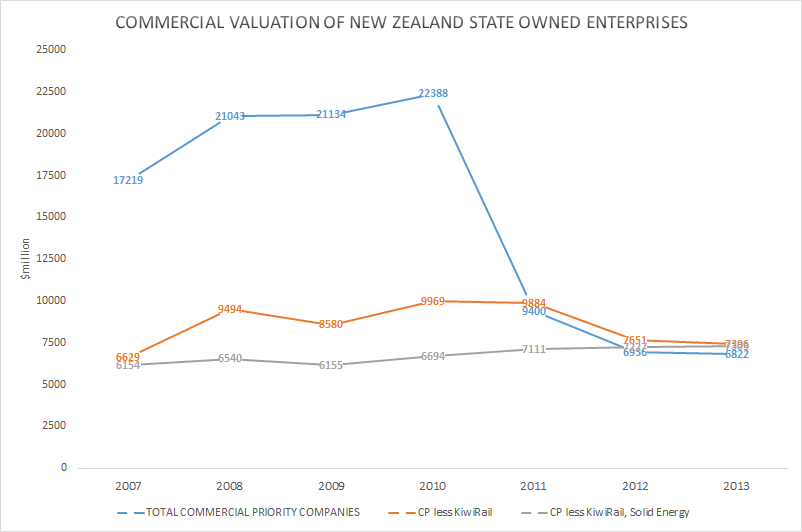
Source: The New Zealand Treasury – data released under the Official Information Act.
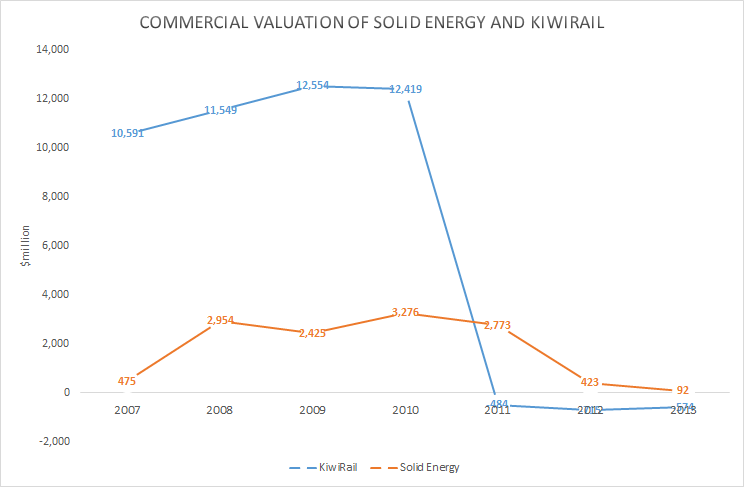
Source: The New Zealand Treasury – data released under the Official Information Act.
If the Panama Canal gets a rival
27 Sep 2015 Leave a comment
in transport economics Tags: Nicaragua, Panama, Panama Canal
#China is building a huge canal in Nicaragua bloom.bg/1Jrs7BQ http://t.co/oLT5wAknkN—
Bloomberg VisualData (@BBGVisualData) August 25, 2015
Roads of the Roman Empire
25 Sep 2015 Leave a comment
in economic history, transport economics Tags: Roman empire
Roads of the Roman Empire
– http://t.co/o0dU4dyF71—
Amazing Maps (@Amazing_Maps) July 14, 2015
 Utopia, you are standing in it!
Recent Comments