Speaking of chemtrails
08 Aug 2015 Leave a comment
in health economics, transport economics Tags: conspiracy theories, Quacks
Uber is most valuable start-up
06 Aug 2015 Leave a comment
in economics of regulation, entrepreneurship, industrial organisation, survivor principle, transport economics Tags: creative destruction, Uber

Darwin awards – Best improvised application
02 Aug 2015 Leave a comment
Darwin’s exceptions (11 Photos)!
bit.ly/1zxrock http://t.co/yOTs0LiEM1—
Amazing Facts (@KnowFactsDaily) July 31, 2015
Being an airline pilot or engineer is much more dangerous than I thought it was
02 Aug 2015 2 Comments
in discrimination, gender, health and safety, labour economics, occupational choice, transport economics Tags: aviation, gender fatalities gaps, occupational deaths and injuries, reverse gender gap
Dear "lumbersexuals": real loggers are 30x more likely to die on the job than the avg worker priceonomics.com/how-the-lumber… http://t.co/1BLTBI37da—
Zachary Crockett (@zzcrockett) June 12, 2015
Motor vehicle related death rates for males and females aged 15 to 24 by race since 1950 in the USA
01 Aug 2015 Leave a comment
in economic history, politics - USA, transport economics Tags: road accident rates, road safety
The large drop in white young white male deaths so dominates figure 1 that it conceals a halving in white female deaths. These measures in figure 1 are not related to propensity to drive a car. It must be hypothesised that women were driving more than they used to in the 1950s and 1960s. Nearly all of the decline in white young female road deaths has been since 1990.
Figure 1: motor vehicle related deaths of males and females aged 15 to 24 by race, USA, 1950 – 2013

Source: Centres for Disease Control and Prevention.
Deaths of black males young black males in the road actually increased in the 1980s before falling again. There has been no change at all really in the number of deaths of young black females since 1950.
How much would it take to achieve escape velocity?
01 Aug 2015 Leave a comment
in transport economics Tags: space, space exploration
Wondering if you can take your books with you to space? Check out this handy guide #escapeweek atlasobscura.com/articles/the-c… http://t.co/rUupoP9P6q—
Atlas Obscura (@atlasobscura) July 24, 2015
Would the reckless maritime protests of @Greenpeace be tolerated on land?
01 Aug 2015 Leave a comment
in economics of crime, environmental economics, environmentalism, law and economics, politics - Australia, politics - New Zealand, politics - USA, property rights, Rawls and Nozick, transport economics Tags: Greenpeace, John Rawls, peaceful protest
Were the Greenpeace runabouts observing maritime safety rules such as avoiding collisions and giving way? Any protester that behaved like that in a car would be immediately arrested and charged.
Why it is tolerated in the high seas is beyond me when it would never be tolerated on the road. No one would pretend reckless driving was peaceful protest. Is it okay to behave recklessly in a boat? No one would accept that in a car on land.
Central to the notion of peaceful protest is fidelity to democracy and the rule of law. The idea is not to impose your will upon others, but to persuade the majority to reconsider their position by showing the passionate extent to which you disagree with them and honestly believe they are mistaken.
The civil disobedient is attempting to appeal to the “sense of justice” of the majority and a willingness to accept arrest is proof of the integrity of the act says Rawls:
…any interference with the civil liberties of others tends to obscure the civilly disobedient quality of one’s act.
Rawls argues that the use or threat of violence is incompatible with a reasoned appeal to fellow citizens to move them to change a law. The actions are not a means of coercing or frightening others into conforming to one’s wishes. That is a breach of the principles of a just society.
Urban agglomeration and rent capitalisation explained
30 Jul 2015 Leave a comment
in applied price theory, applied welfare economics, transport economics, urban economics Tags: agglomeration economics, compensating differentials, equalising differences, land supply, rent capitalisation
What are the costs of prioritizing driving over transit? #infographic #cities #transit http://t.co/bOGG2kKwjX—
YouthfulCities (@youthfulcities) July 21, 2015
The death toll in high-speed police chases
30 Jul 2015 1 Comment
in economics of crime, law and economics, transport economics Tags: crime and punishment, law and order, law enforcement, police, trade-offs, unintended consequences
High-speed police chases kill 330 people per year, one-third of whom are innocent bystanders: priceonomics.com/the-case-for-b… http://t.co/uFmzxgcplk—
Zachary Crockett (@zzcrockett) July 22, 2015
A B-25 bomber crashed into the Empire State Building, today 1945
28 Jul 2015 Leave a comment
A B-25 bomber crashes into the Empire State Building on the morning of July 28, 1945. http://t.co/C2UcflEc36—
History Pictures (@CombinedHistory) April 21, 2015
More and more people are able to travel by air
20 Jul 2015 Leave a comment
More and more people are able to travel by air. buff.ly/1G4fMMT #progress http://t.co/Dgseo3FCJL—
HumanProgress.org (@humanprogress) June 18, 2015
The Amtrak and KiwiRail bailouts compared
18 Jul 2015 1 Comment
in economic history, economics of bureaucracy, politics - New Zealand, politics - USA, Public Choice, rentseeking, transport economics Tags: Amtrak, corporate welfare, expressive voting, industry policy, KiwiRail, privatisation, rational ignorance, rational irrationality, state owned enterprises
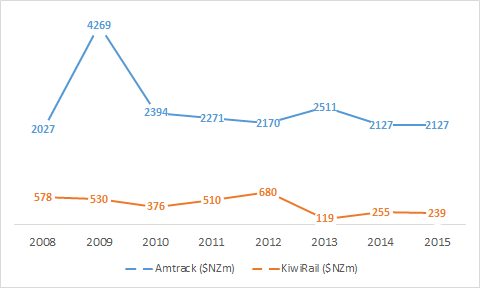
Figure 1: Amtrak and KiwiRail bailouts, (exchange rate US$1:NZ$1.53), 2008 – 2015
Sources: Federal Funding Received by Amtrak | Mercatus and New report: Corporate welfare in the 2015 budget – Taxpayers’ Union.
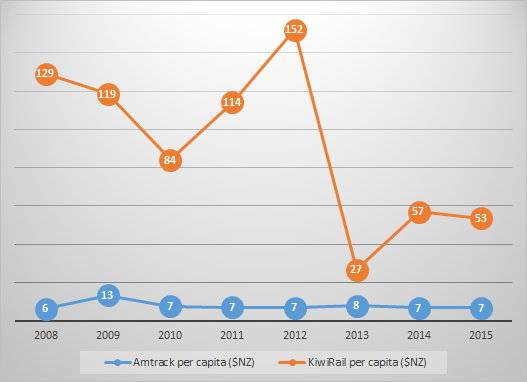
New Zealand with its KiwiRail does a good job of keeping up with the Amtrak bailout especially when you look at figure 2, which computes the bailouts on a per capita basis.
Figure 2: Amtrak and KiwiRail bailouts per capita (2014 populations), (exchange rate US$1:NZ$1.53), 2008 – 2015
Sources: Federal Funding Received by Amtrak | Mercatus and New report: Corporate welfare in the 2015 budget – Taxpayers’ Union.
And the rich got richer, who cares
16 Jul 2015 Leave a comment
in applied price theory, applied welfare economics, Austrian economics, comparative institutional analysis, constitutional political economy, development economics, economic history, economics of bureaucracy, economics of education, economics of regulation, economics of religion, energy economics, entrepreneurship, environmental economics, financial economics, growth disasters, growth miracles, income redistribution, industrial organisation, international economics, labour economics, labour supply, liberalism, poverty and inequality, Public Choice, rentseeking, survivor principle, transport economics, urban economics Tags: Deirdre McCloskey, entrepreneurial alertness, The Great Enrichment, The Great Escape, The Great Fact, top 1%
"The rich got richer, true. But…" —@DeirdreMcClosk buff.ly/1Imdv4o http://t.co/M3ERx3JTIn—
HumanProgress.org (@humanprogress) June 28, 2015
 Utopia, you are standing in it!
Recent Comments