
Should NZ stop issuing international licences for New Zealanders to drive overseas?
28 Mar 2015 Leave a comment
in applied welfare economics, transport economics
A big issue in New Zealand at the moment is tourist drivers having often fatal car accidents. They usually from countries that drive on the other side of the road.
These tourists fly in from the northern hemisphere after a long trip and are suffering jetlag. The accidents often happen soon after they leave the airport or on mountainous road conditions where driver fatigue and jetlag would be a dangerous brew.
Drive on left side of road: blue
Drive on right side of road: reden.wikipedia.org/wiki/Right-_an… http://t.co/JeZM2vjhWV—
Conrad Hackett (@conradhackett) March 27, 2015
The above map is a convenient summary of where New Zealanders would be pretty much the same risk. Long plane trips driving on the wrong side of the road while suffering from jetlag.
There are repeated calls in New Zealand to ban tourist drivers or require them to take some sort of test before being issued with a driving permit. A test would be pretty useless as the main problem is jetlag.
Perhaps New Zealand should lead the way and stop issuing international licences where the New Zealander would drive on the wrong side of the road.

Such a proposal has no chance of ever been adopted because New Zealanders don’t want to give up the right to drive a car when travelling abroad in the northern hemisphere.
That is the brutal calculus. New Zealanders tolerate road accidents in New Zealand as the price of been able to drive on the roads of other countries, often causing more road accidents than the average over there because of jetlag.
Teen drivers distracted big time by cellphones, talking in most crashes – LA Times
26 Mar 2015 Leave a comment
in transport economics Tags: cell phones
There are a lot fewer accidents than there used to be
25 Mar 2015 Leave a comment
in transport economics Tags: road accidents, road safety

It is not smart to subsidise electric cars
23 Mar 2015 Leave a comment
in energy economics, environmental economics, environmentalism, global warming, transport economics Tags: carbon credits, carbon trading, electic cars
The carbon footprint of the round the world solar flight should include its support planes
18 Mar 2015 Leave a comment
in environmental economics, global warming, technological progress, transport economics Tags: carbon footprint, climate alarmism, expressive voting, global warming, solar flight, solar power
Airline crash fatalities since 1947
15 Mar 2015 Leave a comment
in economics of regulation, transport economics
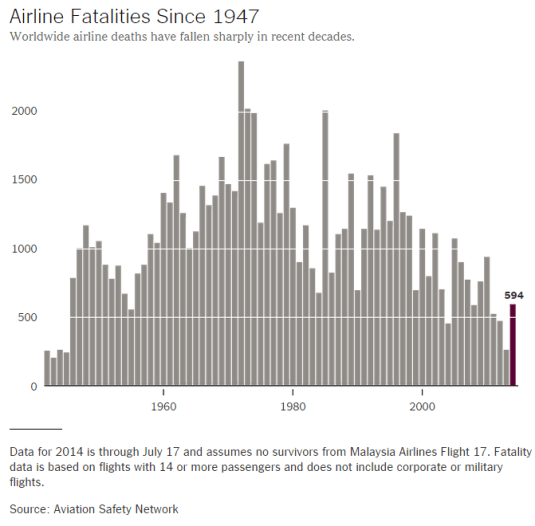
Via The String of ‘Safest Airline Years’ Is Over – NYTimes.com
Winston’s big port up North won’t have any business
10 Mar 2015 Leave a comment
in applied welfare economics, industrial organisation, politics - New Zealand, rentseeking, transport economics
In the first shot in the pork-barrelling for a by-election, veteran New Zealand populist Winston Peters wants to stop the expansion of the Port of Auckland and move the extra shipping traffic up north to the Port of Whangarei:
And we will upgrade the Auckland to Northland railway line and build the rail link to your port
The Port of Whangarei is about two hours north by car from Auckland. Auckland is a global city of approaching 2 million. Whangarei is the only city up North, with a population of 50,000.

45% of the import traffic to the Port of Auckland is cars. Around 90% of light vehicle imports in New Zealand come through the Port of Auckland. The rest may go through Littleton.

|
|
|
Jellicoe and Freyberg wharves are located between the two container terminals. |
Bledisloe multipurpose Wharf |

Striving to move some of this light vehicle imports from the Port of Auckland up north to the Port of Whangarei where they be unloaded from a ship onto trains for a short train ride to Auckland, unloaded again onto trucks all seems unnecessary expense.

Photo: Port of Whangarei.
Auckland appears to have spare container capacity up until at least 2035, so this port up North will simply not have much to do in terms of extra container traffic because it will have to compete on the basis of cost and proximity to markets.
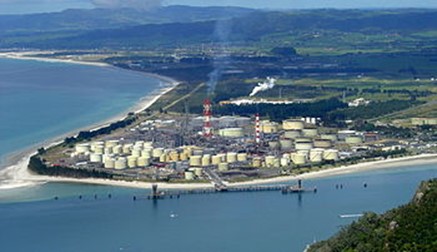
Photo: The Marsden Point Oil Refinery on the opposite shore of Whangarei Harbour.
The traffic that is coming under pressure regarding capacity of the Port of Auckland is multi-cargo traffic such as building materials, vegetables, wheat, vehicles and other goods. The situation is further aggravated by the rapid increase in the number and increased size of cruise ships.
As a good part of the market for the multi cargo traffic is in Auckland, landing them away from their main market just makes no sense and will not happen unless the port of Auckland is prohibited by law from expanding and ships are not allowed to divert to ports such as Wellington and Christchurch.
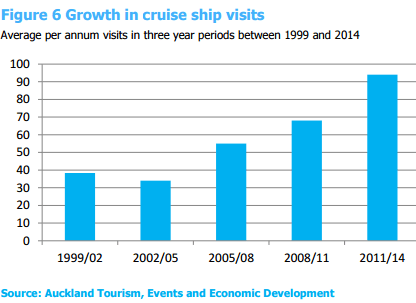
The number of cruise ships visiting Auckland in the last 10 years to about 90 and is expected to reach one 20 by 2020 and 150 by 2030. That traffic cannot be diverted up north to the Port of Whangarei.
Any export traffic that would be viable to send through the Port of Whangarei up north will already be going through it. Export competitiveness is highly sensitive to costs as exporters must simply take the going price in the international market.
What’s the point of buying a driverless Mercedes if you can’t be seen inside it (and driving it)!?
09 Mar 2015 Leave a comment
Charts showing there’s never been a better time to own a car
06 Mar 2015 Leave a comment
in population economics, technological progress, transport economics Tags: the good old days, The Great Enrichment


Why does food taste different on planes?
05 Mar 2015 Leave a comment

If you think the food airline companies serve up is bland or unappetising, it’s not necessarily their fault. Essentially, you leave your normal sense of taste behind at the airport departure gate.
Get on board a plane and cruise to a level of thousands of feet, and the flavour of everything from a pasta dish to a mouthful of wine becomes manipulated in a whole host of ways that we are only beginning to understand.
Taste buds and sense of smell are the first things to go at 30,000 feet…
The combination of dryness and low pressure reduces the sensitivity of your taste buds to sweet and salty foods by around 30%…
via BBC – Future – Why does food taste different on planes?.
Tourist driver accidents as the price for international reciprocity over international driving permits
02 Mar 2015 Leave a comment
in international economic law, international economics, transport economics
I am feuding with Gareth Morgan on Twitter on charging regimes for tourists. I raised the point about whether foreign countries would recognise international driver permits issued in New Zealand if we started imposing tests on international tourists before they could be issued with driver licences and therefore rent a car. Car rentals are a major form of tourist transport

When I pointed out other countries may retaliate and not recognise international driving permits issued in New Zealand, if we started imposing driving tests or other restrictions on tourist that come here, he thought that point was completely irrelevant. His responses show why he is the successor to Sir Bob Jones as the national contrarian and has an equal number of hits as well as big misses as Sir Bob.
Reciprocity is central to a large number of international concessions which New Zealanders enjoy overseas. These reciprocal arrangements include international driving permits as well as working holiday schemes, health insurance and old age pension reciprocal arrangements, double tax treaties and easy access to tourist and business visas to name but a few.
Who Drives on the Wrong Side of the Road? (blue = left) http://t.co/sblf6hgpXl—
Amazing Maps™ (@amazingmap) July 17, 2015
By the way, in common with the Cook Islands, China does not recognise international driving permits. A local licence must be obtained after a payment.
New Zealand recognises international driver permits issued in China because that such a huge and growing tourist market.
The price of having foreign tourists drive New Zealand roads is more accidents because of their inexperience, including because they are driving on the wrong side of the road and are tired from the international flight.
The benefit is New Zealanders can drive in other countries on international driving permits, including where they drive on the wrong side of the road and have more accidents because they are tired from the international flight. That’s the brutal calculus behind it that people prefer to ignore.
Should young women pay the same car insurance premiums as young men?
28 Feb 2015 Leave a comment
in applied welfare economics, economics of regulation, rentseeking, transport economics Tags: gender neutral insurance premiums, offsetting behaviour, sex discrimination
Thrill-seeking young men are prone to drive too fast, late at night, and cause horrific fatalities. Young males are 10 times more likely to be killed or injured than a driver aged over 35.

Young women’s car insurance premiums increased by 50% after insurers adjust their prices to comply with new European "gender neutral" rules on premiums.
.
 Utopia, you are standing in it!
Recent Comments