Where will land come from 4 @NZGreens housing plan? @GarethMP
05 Aug 2016 Leave a comment
in applied price theory, economics of regulation, politics - New Zealand, urban economics Tags: Auckland, housing affordability, land supply, New Zealand Greens, RMA, The fatal conceit, zoning
The Greens are at it again proposing to build 100,000 affordable houses without ever explaining where the additional new land will come from.

There would have to be an amendment to the proposed Auckland unitary plan to free up more land for there to be a net increase in the supply of land in Auckland.
Unless there is that such amendment, a government plan to build 100,000 affordable houses in Auckland and elsewhere will simply be competing for the same fixed supply of land. If the supply of land is constrained from expanding by much, the only thing that will happen is that the price will go up with more money chasing the same amount of land and housing.
@metiria house prices won’t drop 40% by raising taxes, banning foreigners
27 Jul 2016 Leave a comment
in applied price theory, economics of regulation, politics - New Zealand, urban economics Tags: housing affordability, land supply, New Zealand Greens, RMA, zoning
Just increase the supply of land. Extending the capital gains tax and banning foreigners from buying land will do no good. An average house price 10 times the average income in Auckland is not a demand-side problem.

Source: Is Your Town Building Enough Housing? – Trulia’s Blog.
There are plenty of examples of US cities with different land supply restrictions but common national surges in demand for housing such as prior to the GFC. Cities with liberal land supply experienced only small increases in house prices.

Source: Regionally, Housing Rebound Depends on Jobs, Local Supply Tightness – The Long-Awaited Housing Recovery – 2013 Annual Report – Dallas Fed from Federal Housing Finance Agency; Bureau of Economic Analysis; “The Geographic Determinants of Housing Supply,” by Albert Saiz, Quarterly Journal of Economics, vol. 125, no. 3, 2010, pp. 1253–96.
The Greens should follow ACT and the Labour Party in calling for the abolition of the Auckland urban limit and changes in council finances so they can fund the necessary infrastructure quickly.
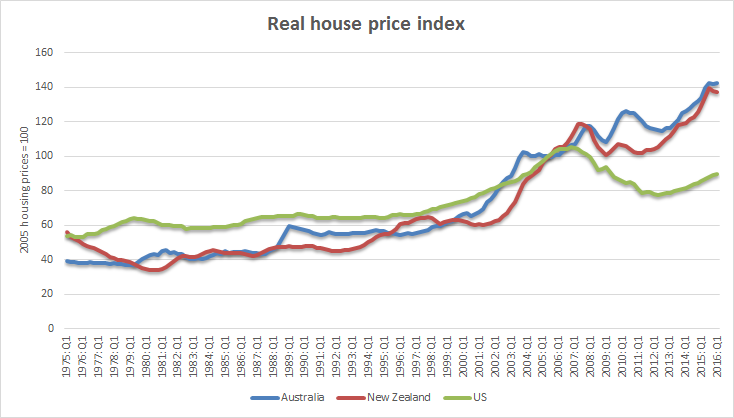
US, Australian and NZ real house prices, March 1975 to March 2016
17 Jul 2016 Leave a comment
in economics of regulation, politics - Australia, politics - New Zealand, politics - USA, urban economics Tags: Australia, housing affordability
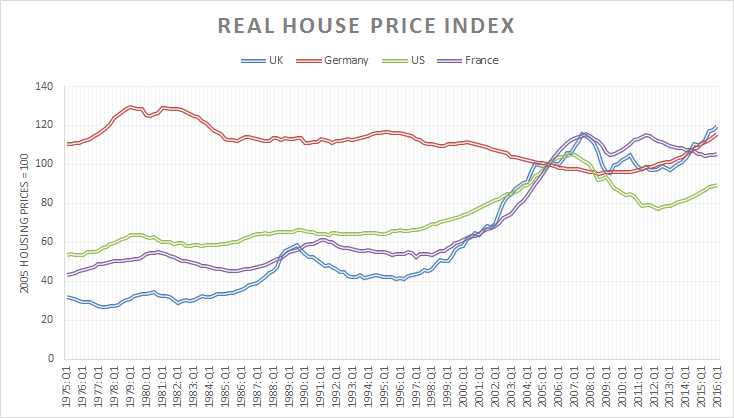
German, French, British, and US real housing prices, March 1975 to March 2016
15 Jul 2016 1 Comment
in economic history, economics of regulation, politics - USA, urban economics Tags: British economy, France, Germany, housing affordability
Still have not seen a decent explanation for why German housing prices seem to fall for decades on the trot.
.@NZlabour wants to crash house prices! @NZGreens take on the NIMBYs! @PhilTwyford
14 Jul 2016 Leave a comment
in economics of regulation, environmental economics, politics - New Zealand, transport economics, urban economics Tags: housing affordability, land supply, New Zealand Greens, New Zealand Labour Party, NIMBYs
There has been an unexpected outbreak of political courage on the left of New Zealand politics.
The Labour Party wants to crash housing prices by not only abolishing the Auckland urban limit, but ensuring councils can fund the necessary infrastructure to bring new land to the market:
Labour will remove the Auckland urban growth boundary and free up density controls. This will give Auckland more options to grow, as well as stopping land bankers profiteering and holding up development. New developments, both in Auckland and the rest of New Zealand, will be funded through innovative infrastructure bonds.
In response, the Greens want to take on the inner city NIMBYs by greatly increasing housing density and new developments in their pristine suburbs
Like Labour, we believe that people should have a choice about where they live. But a lot of people want to live close to the central city where they work or study. That means delivering more high-quality, inner city housing options, not endless sprawling new suburbs.
It’s often easier and cheaper to revitalise central suburbs than it is to build new suburbs on the city fringes. Infrastructure for new sprawling subdivisions is very expensive.
This outbreak of courage is surprising after the resolute opposition of these parties to any reform of the Resource Management Act to loosen up the land supply.
It is a breakthrough nonetheless because at least the Labour Party admits that housing affordability is about increasing land supply by removing the Auckland urban limit.
New Zealand tops world in growth in the housing price to income ratio
13 Jul 2016 Leave a comment
in economics of regulation, politics - New Zealand, urban economics Tags: housing affordability, land supply, zoning

Source: IMF Global Housing Watch.
New Zealand tops the developed world in housing price growth in 2015
13 Jul 2016 Leave a comment
in economics of regulation, politics - New Zealand, urban economics Tags: housing affordability, land supply, zoning
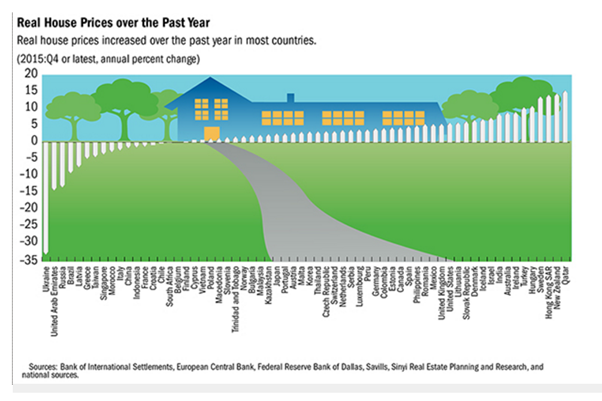
Source: IMF Global Housing Watch.
If it was 2007 again, what would @jamespeshaw @PhilTwyford do on housing affordability?
08 Jul 2016 Leave a comment
in applied price theory, economics of regulation, politics - New Zealand, urban economics

Source: Housing ‘challenge’ still not a ‘crisis’ | Radio New Zealand News.
Neither Labour nor the Greens have explained where the new land will come from inside the Auckland Metropolitan Limit to build their 100,000 additional houses nor why their proposals will be granted resource consents under existing resource management legislation.
The National Party is unwilling to push shared with resource management law reform despite having 61 votes to do so because of fear of losing votes in the centre.
Meet San Francisco’s YIMBYs @PhilTwyford @dbseymour
29 Jun 2016 Leave a comment
in economics, economics of regulation, law and economics, urban economics Tags: land supply, land use planning, NIMBYs, zoning
Desperately seeking to agree with @JulieAnneGenter on transport investment quality
11 Jun 2016 Leave a comment
in applied price theory, applied welfare economics, economics of bureaucracy, environmental economics, politics - New Zealand, Public Choice, transport economics, urban economics Tags: cost benefit analysis, KiwiRail, New Zealand Green Party, road pricing
I just wrote an op-ed for National Business Review online (pay-walled) agreeing with an op-ed last week by Green MP Julie Anne Genter on transport investment. My op-ed started
The Taxpayers’ Union welcomes the commitment of the Green Party yesterday to evaluating transport investments without any bias or favouritism to one transport mode over another.
The Taxpayers’ Union could not agree more with Julie Anne Genter when she said that the question ministers should always ask is “what is the best investment we can make?”
This op-ed was my rejoinder to her reply to my op-ed criticising a recent Green Party on national freight policy. That policy called for 25% of all freight by kilometres travelled to each go by rail and road. That would near double their freight market share from 30% currently to 50% when measured by kilometre.
For my troubles I got nothing but criticism and accusations in the comments section in National Business Review Online. A tweet by Genter was far more gracious.
There was no praise in the comment section at the National Business Review online for agreeing with the Green policy. In the first comment I was told I did not understand economics and that
When the policy default is “cut taxes and spending and let me selfishly keep my money” they miss out on the much larger benefit to everyone, including themselves, by nudging or economy to spend more on intrinsically more efficient transport – like rail – and less on alternatives.
No thanks at all for agreeing that transport investments should be the best we can make. After saying that in their recent freight policy, the Greens set targets were specific transport technologies they favour, which are rail and sea freight.

You cannot argue that transport investments should be the best we can make then declare a preference for a particular technology or mode of transport. But let us not quibble over that glaring contradiction.

The broader principle was agreed which is transport investments should be driven by cost benefit analysis and value for money. It should be technology neutral and transport mode neutral. That, of course, means the Greens cannot declare targets for the market shares of particular modes of freight shipment if they want to follow their own policy about value for money.
NZ House price index for selected territorial authority areas, 1989–2014
09 Jun 2016 Leave a comment
in economic history, economics of regulation, politics - New Zealand, urban economics

Homeless means living rough or in a car @DavidReiMiller @greencatherine @secondzeit
06 Jun 2016 Leave a comment
in politics - New Zealand, poverty and inequality, public economics, urban economics Tags: economics of housing, homelessness, social insurance, welfare state
Statistics New Zealand spent 21 pages trying to define the term homeless. How Orwellian.
When I first moved to Canberra and when I moved back, I stayed with friends. Some regard that as being homeless under the Statistics New Zealand definition, much to my own surprise.
I qualify because I shared accommodation . Having shared or short-term accommodation is not homeless. The descriptions shared and short-term accommodation quite adequate to the task.
People living in temporary accommodation including with friends are not homeless. Their situation is unsatisfactory but describing it does not justify butchering the English language by conflating their inconveniences with the few hundred people who live rough each night.
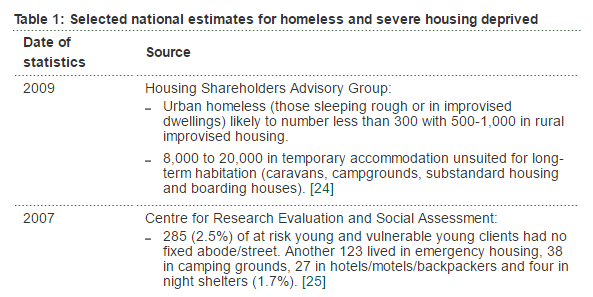
Source: New Zealand Parliament – Homelessness in New Zealand.
Those that conflate having a roof over your head tonight with living rough take advantage of the great sympathy people have for those living rough for people in far less dire situations.
@JulieAnneGenter doesn’t know what is shipped through ports
24 May 2016 Leave a comment
in environmental economics, global warming, politics - New Zealand, transport economics, urban economics Tags: celebrity technologies, New Zealand Greens
The Greens today announced a policy to double the amounts of cargo moved by train and shipping. It seems to have forgotten that most cargo moved by ship is bulk cargoes such as cars. Nothing can change the fact that once the ship is unloaded, the cars have to go by truck to the car yard.
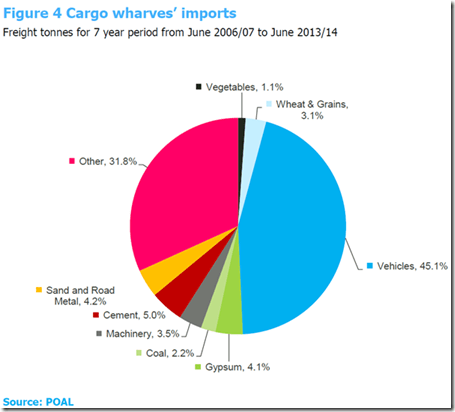
Source: New Zealand Institute of Economic Research. Port study 2 Final report NZIER report to Auckland Council (3 February 2015).


Recent Comments