
The reality of green investing
28 Sep 2014 Leave a comment
in environmental economics, environmentalism, financial economics Tags: green investing
Stern 2.0 takes climate policy analysis to a new level of exaggeration by Richard Tol
27 Sep 2014 2 Comments
in economics of climate change, environmental economics, environmentalism, global warming Tags: global warming, Nicholas Stern, Richard Tol, Stern 2.0, Stern report

Nick Stern is back with another report on climate change – colloquially known as Stern 2.0. It’s another offering from the Global Commission on the Economy and Climate. Since his 2006 review, Stern has been regularly in the news, claiming climate change is worse than we thought. The new report fits the mould.
The summary was released before the main report and we are invited to believe its findings without inspecting the evidence. It seems, though, that Stern has produced another far-fetched piece of work.
The new report makes three claims, none of which stand up: that climate policy stimulates economic growth; that climate change is a threat to economic growth; and an international treaty is the way forward.
Climate policy and economic growth
“Well-designed policies … can make growth and climate objectives mutually reinforcing,” the report claims.
The original Stern Review argued that it would cost about 1% of global GDP to stabilise the atmospheric concentrations of greenhouse gases around 525ppm CO2e. In its report last year the Intergovernmental Panel on Climate Change (IPCC) put the costs twice as high. The latest Stern report advocates a more stringent target of 450 ppm and finds that achieving this target would accelerate economic growth.
This is implausible. Renewable energy is more expensive than fossil fuels, and their rapid expansion is because they are heavily subsidised rather than because they are commercially attractive. The renewables industry collapsed in countries where subsidies were withdrawn, as in Spain and Portugal. Raising the price of energy does not make people better off and higher taxes, to pay for subsidies, are a drag on the economy.
Climate policy need not be expensive. Study after study has shown that it is possible to decarbonise at a modest cost and Stern has missed an opportunity to point this out.
But low-cost climate policy is far from guaranteed – it can also be very, very expensive. Europe has adopted a jumble of regulations that pose real costs for companies and households without doing much to reduce emissions. What is the point of the UK carbon price floor, for instance? Emissions are not affected because they are capped by the EU Emissions Trading Systems, but the price of electricity has gone up.
The subsidies and market distortions that typify climate policy do, of course, create opportunities for the well-connected to enrich themselves at the expense of the rest of society. Perhaps Stern 2.0 mistook rent seeking for wealth creation.
Climate change and economic growth
The report says that if, in the long run, “climate change is not tackled, growth itself will be at risk.”
The new report claims climate change would be a threat to economic growth. The original Stern Review argued that the damage would be 5-20% of global income. In the worst case, we would not be four times as rich by the end of the century, but only 3.8 times. The IPCC reckons Stern 1.0 exaggerated the impacts by a factor 10 or more, while the new Stern report agrees that the old Stern was off by an order of magnitude, but in the opposite direction.
Over the past two decades, economists have re-investigated the relationship between economic development and geography. This has not led to a revival of the climate determinism of Ellsworth Huntington – the Yale professor who argued that a nation’s prosperity could be predicted by its location and climate. On the contrary, most research finds that climate plays at most a minor role in economic growth, and that the impact of climate is moderated by technology and institutions. Just consider Iceland and Singapore. Stern 2.0 goes against the grain of a large body of literature.
International treaties
“A strong … international agreement is essential,” the Stern report says, calling for an international treaty with legally binding targets. Albert Einstein defined insanity as doing the same thing over and over again and expecting a different result. Since 1995, the parties to the UN Framework Convention on Climate Change have met year-after-year to try and agree on legally binding targets – and they have failed every time.
The reasons are simple. It is better if others reduce their emissions but you do not. No country likes to be bound by UN rules for its industrial, agricultural and transport policies. The international climate negotiations have been successful in creating new bureaucracies, but not in cutting emissions.
Stern also argues that “[d]eveloped countries will need to show leadership.” The EU has led international climate policy for two decades, but without winning any followers. The broken record that is Stern 2.0 is unlikely to inspire enthusiasm for more expensive energy.
A way forward
The Stone Age did not end because we ran out of stones, but because we found something better: bronze. The fossil fuel age will end when we find an alternative. The current renewables are simply not good enough – except for the happy few who profit from government largesse.
The environmental movement’s aversion to nuclear power and shale gas increases emissions and creates an impression of Luddism, whereas climate policy should focus on accelerating technological change in energy.
The unfounded claims in Stern’s new report do not build the confidence that investors and inventors need to take a punt on a carbon-free future. Exaggeration is great for headlines, but sober analysis is more convincing in the long run.
via theconversation.com under Creative Commons Licence

Environmental and Urban Economics: What Should Campus Environmentalists Do All Day Long?
21 Sep 2014 Leave a comment
in environmental economics, environmentalism Tags: activists, do gooders, Doing well while doing good


I knew it: killer green technologies alert – reusable grocery bags can kill (unless washed)
20 Sep 2014 1 Comment
in environmentalism, health economics Tags: do gooders, environmental movement, killer green technologies, offsetting behaviour, recycling, reusable grocery bags, unintended consequences
Reusable grocery bags often carry raw meat and are stored for convenience in the trunk of cars that sit outside in the sun. Reusable grocery bags are friendly breeding environment for E. coli bacteria, which can cause severe illness and death.
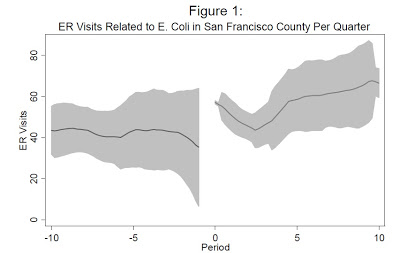
The above figure shows the number of emergency room visits in San Francisco County related to E. coli for the 10 quarters before and after the reusable grocery bags enactment of the ordinance: zero on the horizontal axis is the date the ordinance went into effect. The shaded area around the line is a 95% statistical confidence interval. There is a discontinuous jump in the number of emergency room visits immediately after the reusable grocery bags ordinance was enacted.
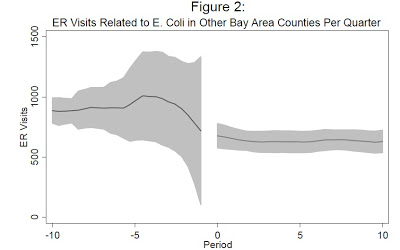
San Francisco experiences about 12 deaths per year from intestinal infections, and that the restrictions on plastic bags probably let to another 5-6 deaths per year in that city and several dozen additional hospitalisations.


Pollution is getting worse and worse alert: air pollution in Pittsburgh, 1940
13 Sep 2014 Leave a comment


Equal protection of birds under environmental law?
12 Sep 2014 Leave a comment
in environmental economics, environmentalism Tags: green hypocrisy, killer green technologies, solar power, wind farms

Exxon Mobil agreed to pay $600,000 in penalties after 85 migratory birds died of exposure to hydrocarbons at its natural gas facilities.
A common sight above the world’s largest solar thermal power plant is a streamer: a small plume of smoke that occurs without warning. The source is a bird that has inadvertently strayed into the white-hot heat above the plant’s many reflecting mirrors. No fines for the 28,000 birds killed in this way.

More than 573,000 birds are killed by U.S. wind farms each year. No fine.
the Obama administration issued an exemption in 2013 to allow wind power companies to kill or injure eagles without the fear of prosecution for up to three decades. The new rule is designed to address environmental consequences that stand in the way of the nation’s wind energy rush.
Who Is More Irrational – Consumers or Regulators?
08 Sep 2014 Leave a comment
in economics of regulation, energy economics, entrepreneurship, environmental economics, environmentalism, global warming Tags: Bjørn Lomborg, expressive voting, futile gestures, global warming, Kip Viscusi, nanny state, regulatory failure, The fatal conceit, The pretence to knowledge

A study by Ted Gayer and W. Kip Viscusi looked into this implied irrationality of consumers. They have found no empirical evidence to support the view that if consumers are so irrational that government agencies must prohibit certain energy consuming products for us to make the right choices:
Rather than accept the implications that consumers and firms are acting so starkly against their economic interest, a more plausible explanation is that there is something incorrect in the assumptions being made in the regulatory impact analyses.
Indeed, upon closer inspection it is apparent that there is no empirical evidence provided for the types of consumer failures alleged.
Even the EPA acknowledged this logical gap in its economic analysis of energy efficiency regulations:
it is a conundrum from an economic perspective that these large fuel savings have not been provided by automakers and purchased by consumers
Not surprisingly Kip Viscusi observed that
The regulatory impact analyses examined in this study contain virtually no empirical evidence to support the irrationality proposition.
• This proposition ignores the fact that consumers and firms purchase products based on a number of factors—only one of which is energy efficiency.
• Government agencies exhibit a parochial bias by ignoring all product attributes other than energy efficiency.


Recent Comments