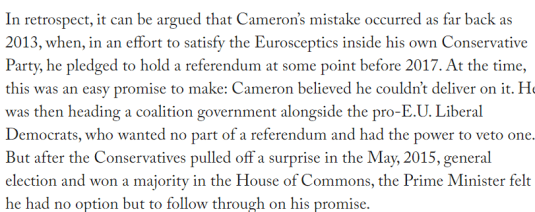
Source: Why the Remain Campaign Lost the Brexit Vote – The New Yorker
Celebrating humanity's flourishing through the spread of capitalism and the rule of law
25 Jun 2016 Leave a comment
in constitutional political economy, international economic law, international economics, International law
24 Jun 2016 Leave a comment
in constitutional political economy, economics, industrial organisation, international economic law, International law, liberalism Tags: Brexit, British economy, British politics, Common market, customs unions
22 Jun 2016 Leave a comment
in applied welfare economics, comparative institutional analysis, economics, international economic law, international economics, International law, Public Choice Tags: Brexit, British economy, British politics, Common market, European Union
16 Jun 2016 Leave a comment
in applied price theory, constitutional political economy, international economic law, international economics
I have not as yet decided on in or out. It is a close call. Best to divide the economic estimates of the cost of #Brexit by two and you get a more accurate estimate.
What made me move most towards leaving is the remark in the linked video by the Conservative Party Euro MP Daniel Hannan that the recent austerity cuts totalling £36 billion while British contributions to the European Union budget were £38 billion.
The snapshot tweet is the single most sensible comment on the economic costs when quantified as a percentage of GDP. The costs of leaving might well be small.
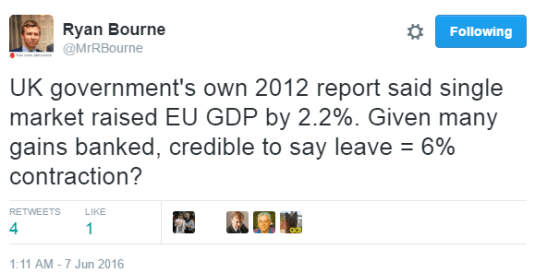
The Remain campaign is incompetent. It is unable to hit on good soundbites, much less the central case against leaving.
The main case to remain is it will preserve the current travel privileges of British citizens. British can go anywhere in the European Union as they like for business, pleasure, a job or to retire. No need for visas. If the British were to leave, they have to renegotiate visa access.
That renegotiation of these access will not be as easy as you might think because there are several secessionists minded provinces such as in Spain and Italy who are told that they will not be eligible for European Union membership if they succeed.
Spain has every intention of vetoing a European Union membership application from an independent Scotland to set an example to its own succession minded provinces.
Spain and Italy have every reason to be difficult over the British these are arrangements for the same reason. Signalling the costs of succession to the Lombard region of northern Italy, the Basque provinces and Catalonia
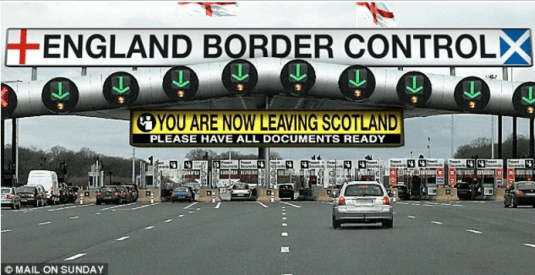
Scotland was told in no uncertain terms that if it left the United Kingdom, there would have to be border controls on the Scottish border, a new Hadrian’s Wall, because of EU law and border control agreements. Those border controls would have to remain until Scotland joined the European Union or otherwise made a deal.
The case to remain would be stronger if the British had stronger border controls against illegal immigration, and it just left the European Court of Justice and its increasingly silly decisions.
Much of the current wave of refugees arises from Turkey allowing illegal immigrants to cross its borders to go on to the European Union as a way of signalling that Turkey would be much more cooperative if it were a member of the European Union.
Number of asylum applications in EU has broken record set in 1992 – then and now compared: theguardian.com/world/ng-inter… http://t.co/qhpBagphGO—
Alberto Nardelli (@AlbertoNardelli) October 15, 2015
Turkey is increasingly undemocratic under the current president and there is always the background threat of a military coup. European Union member states must be democracies, which is why Turkey’s application for membership has stalled for many years.
How UK refugee commitment compares with other countries
bit.ly/1OuZamF http://t.co/LcnAsJePIN—
Guardian Data (@GuardianData) September 08, 2015
Parties ranging from UKIP to Alternative for Germany will get stronger and stronger unless control over borders is restored.
16 Jun 2016 Leave a comment
in applied price theory, development economics, environmental economics, global warming, international economic law, international economics, public economics
Oxfam joins others on the reactionary left in seeking to bully former colonies over their economic policies, in particular, their tax policies that promote tax havens.
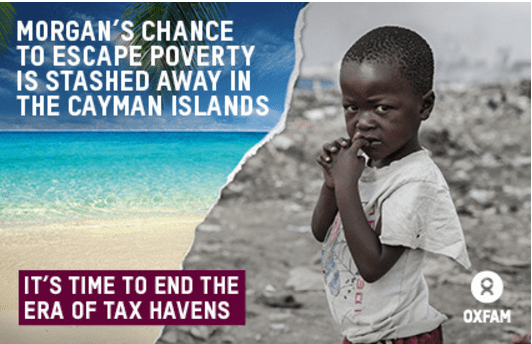
The Cayman Islands is a British overseas territory that chooses to stay British with limited self-government. If the British were to start bullying it over its tax haven and offshore financial centre policies, it would immediately seek independence.
This attempt by former colonial masters to bully small countries to toe their line on tax policies is not done in any way for the benefit of these former colonies and their economic development. It is old-fashioned imperialism with a new motivation, tax imperialism. The aim is to prevent capital flight and the erosion of the business tax base in developed countries.
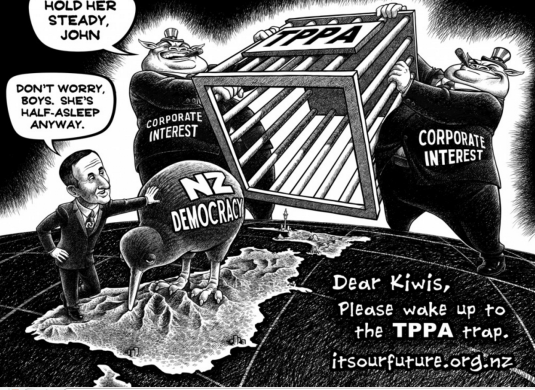
This is a seething hypocrisy given that Oxfam was all for #TPPANoWay. It is OK to go your own way on tariffs, intellectual property and investment and other economic regulations but not taxes. Countries have a tariff sovereignty but not a tax sovereignty.
This is a self-serving neo-colonial hypocrisy. The sovereignty arguments for #TPPANoWay are identical to those for the right of countries to act as tax havens. Identical. Tariffs deny other countries export markets; tax havens deny other countries tax revenue.
Small island states were left-wing and environmentalist heroes on climate change at the most recent conference on global warming in Paris but are villains regarding tax havens. In both cases, these small countries are exercising their sovereignty regarding their foreign policies and economic policies.
Oxfam believes that the democratic rights of former colonies do not extend to shaping their own economic policies. Oxfam wants them to be put on a neo-colonial leash.
10 Jun 2016 Leave a comment
in applied price theory, international economic law, international economics Tags: burden of geography, economics of borders
30 May 2016 Leave a comment
in Economics of international refugee law, international economic law, International law, labour economics, politics - Australia Tags: Australian Greens, avoiding difficult choices, economics of immigration, Leftover Left, rational irrationality
People who enter illegally by boat do not increase the number of refugees of Australia admits in any one year. They change who was granted asylum within the same fixed quota. Increasing the quota will not change incentives for illegal entry if illegal entry allows for settlement in Australia.
11 May 2016 Leave a comment
in applied price theory, development economics, economic history, growth disasters, growth miracles, income redistribution, international economic law, international economics, Public Choice, rentseeking Tags: antiforeign bias, Left-wing hypocrisy, neocolonialism, Oxfam, rational irrationality, reactionary left, tax havens, TPP
I hope none in this clip protesting against tax havens as short changing everybody else were fresh from protesting how international economic agreements such as the TPPA infringe on the sovereignty of countries.
If you standing up for national sovereignty that includes standing up for the right of other countries doing things that you do not like within their own country.
If countries have the right to set taxes and tariffs as high as they like, they have just the same right to set them as low as they like.
All that plucky rhetoric of TPPA no way and how international economic agreements violate the sovereignty of countries and developing countries in particular is forgotten in a flash by Oxfam.
Oxfam manages the blinding hypocrisy of opposing the Transpacific Partnership on national sovereignty grounds and at the same time call for international treaties to bully small countries about their tax policies, which overrides their economic sovereignty.
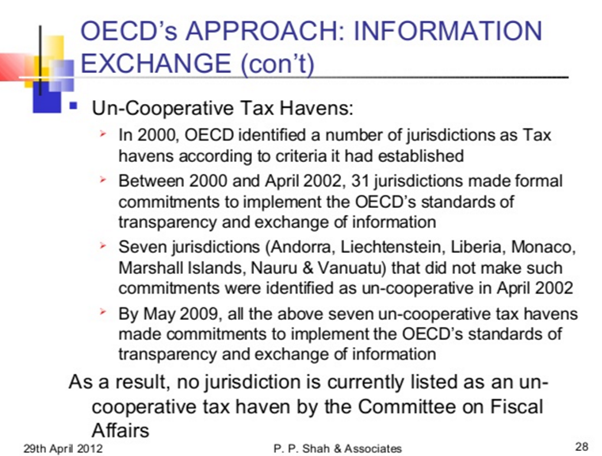
The sovereign rights of developing countries to find their own way does not extend to undermining the tax bases of the rich countries struggling to finance their welfare states.
The Pacific Islands, the once were heroes of the recent Paris climate talks, turn into pariahs once they start looking out for themselves and setting up offshore financial centres and tax havens.
Developing countries are free to impoverish themselves by embracing socialism, but if they decide to attract investment and jobs through low tax rates and offshore financial centres, a new form of colonialism is embraced by the reactionary left as embodied by Oxfam.
When my father was born, 7 in 10 people lived in absolute poverty.
Today, it's 1 in 10! https://t.co/1Caqku3AY1—
Tim Fernholz (@TimFernholz) October 21, 2015
19 Apr 2016 Leave a comment
in economics of climate change, economics of crime, economics of information, environmental economics, global warming, industrial organisation, international economic law, international economics, International law, law and economics, politics - New Zealand, survivor principle Tags: adverse selection, asymmetric information, carbon trading, climate alarmism, climate alarmists, credence goods, experience goods, inspection goods
Morgan Foundation yesterday put out a report pointing out that many of the carbon credits purchased from the Ukraine under the carbon trading scheme are fraudulent.
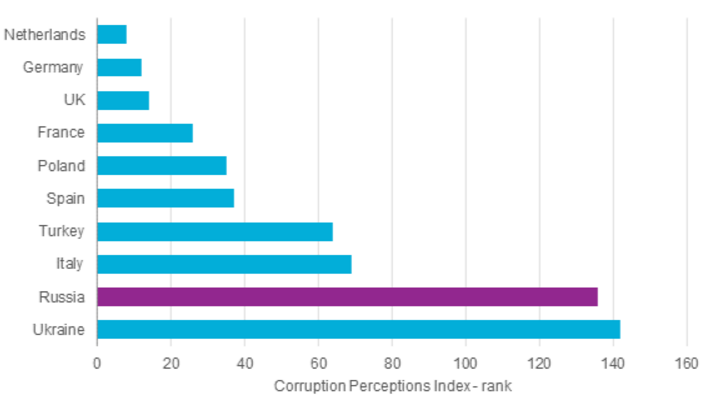
That comes with no surprise to anyone vaguely familiar with business conditions and the level of official corruption in the former Soviet Union. Russia is a more honest place to do business.

Carbon traders who buy from the Ukraine are not buying an inspection good. An inspection good is a good whose quality you can ascertain before purchase.

They are not buying an experience good. An experience good is a good whose quality is ascertained after purchase in the course of consumption.

Source: Russia, Ukraine dodgy carbon offsets cost the climate – study | Climate Home – climate change news.
What these carbon traders in New Zealand are doing is buying credence goods from the Ukraine. The credence goods are the carbon credits, which the Morgan Foundation and others have found often to be fraudulent.
A credence good is a good whose value is difficult or impossible for the consumer to ascertain. A classic example of a credence good is motor vehicle repairs.
You must trust the seller and their advice as to how much you need to buy of a credence good. Many forms of medical treatment also require you to trust the seller as to how much you need.
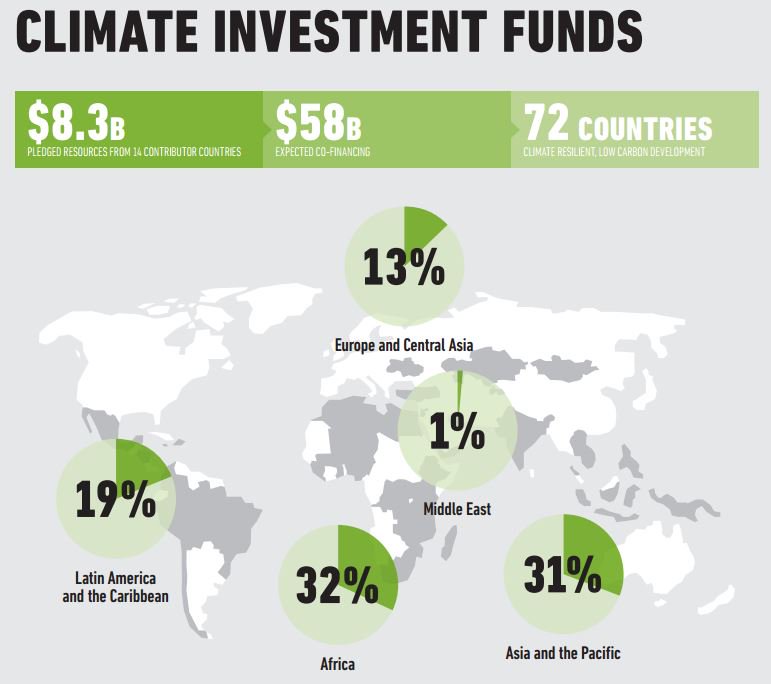
Carbon credits are such a credence good. You know there is corruption in the Ukraine and many other countries that supply them. You may never know at any reasonable cost whether the specific carbon credits you buy were legitimate.
The reason why carbon credits are purchased from such an unreliable source is expressive voting. As is common with expressive politics, what matters is whether the voters cheer or boo the policy. The fact whether it works or not does not matter too much.
The Greens are upset about this corruption in carbon trading. They did not mention the corruption in international carbon trading and climate aid when they welcomed the recent Paris treaty on global warming but that is for another day.
https://twitter.com/kadhimshubber/status/721831502372302849
Co-ordinated international action on global warming is rather pointless if some of the key countries with carbon emission caps are corrupt, which they are.
As Geoff Brennan has argued, CO2 reduction actions will be limited to modest unilateral reductions of a largely token character. There are many expressive voting concerns that politicians must balance to stay in office and the environment is but one of these.

Once climate change policies start to actually become costly to swinging voters, expressive voting support for these policies will fall away, and it has.
Networked Carbon Markets

Source: World Bank Networked Carbon Markets.
One way to stem that fading support is to buy carbon credits on the cheap and there is plenty of disreputable suppliers of cheap carbon credits. Buying dodgy carbon credits as a way of doing something on global warming without it costing more than expressive voters will pay.
One of the predictions of the adverse selection literature is that if consumers cannot differentiate good and bad goods from each other, such as with used cars, the market will contract sharply or even collapse because buyers cannot trust what is on offer. This risk of adverse selection undermining a market applies with clarity to carbon trading.

Source: How Can Your Vote Shape a Low Carbon Future? It Starts with Carbon Pricing.
14 Apr 2016 Leave a comment
in international economic law, international economics Tags: Left-wing hypocrisy, Oxfam, tax havens, TPPA
Oxfam has no interest in the sovereignty of small states. It supports a new form of colonialism – tax colonialism.
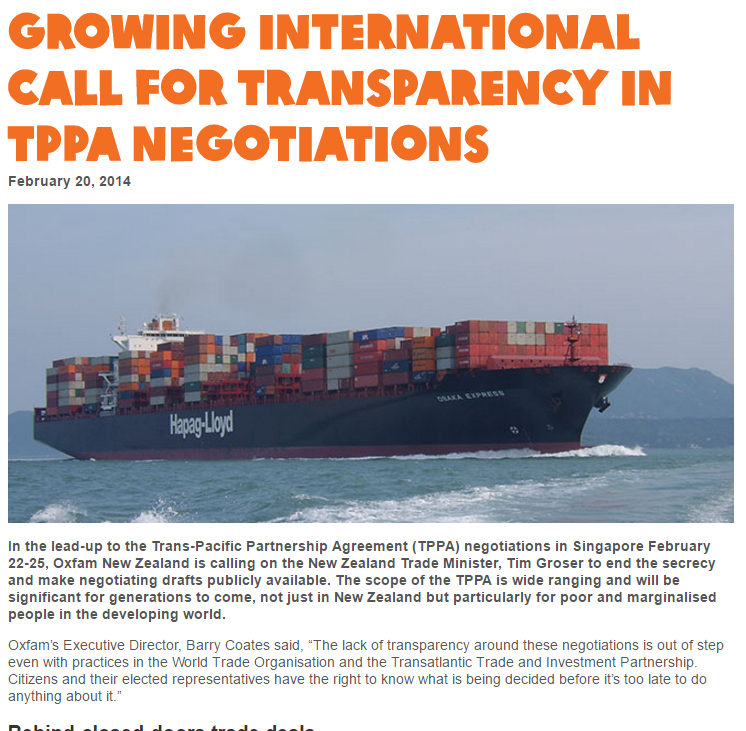
Source: Growing international call for transparency in TPPA negotiations | Oxfam New Zealand.
While Oxfam upholds the sovereign right of countries to regulate and expropriate, they do not defend the rights of those same countries to tax as they please, including to cut taxes to attract investment and offshore financial centres.
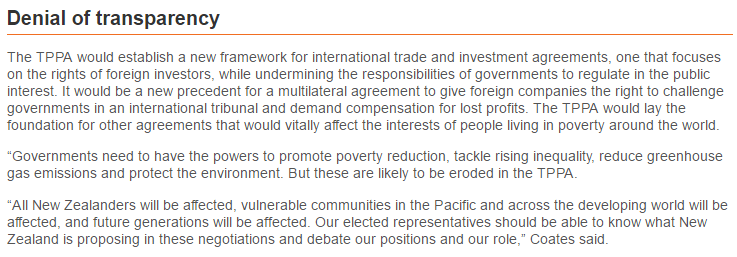
Source: Growing international call for transparency in TPPA negotiations | Oxfam New Zealand.
All that plucky rhetoric of TPPA no way and how international economic agreements violate the sovereignty of countries and developing countries in particular is forgotten in a flash.
<p>Oxfam manages to have the blinding hypocrisy of opposing the Transpacific Partnership on national sovereignty grounds and at the same time call for international treaties to bully small countries about their tax policies, which overrides their economic sovereignty.</p>  <p>Hyper inequality is out of control - sign the new petition - end the era of tax havens  ow.ly/Xc0T4 https://t.co/IzqBji6AmD—
Oxfam New Zealand (@oxfamnz) January 17, 2016
07 Apr 2016 Leave a comment
in defence economics, economics, international economic law, international economics, International law, law and economics Tags: economics of borders
16 Mar 2016 Leave a comment
in economics of bureaucracy, international economic law, international economics, law and economics, politics - New Zealand, property rights, Public Choice, rentseeking Tags: crony capitalism, customs unions, free trade agreements, international investment law, investor state dispute settlement, preferential trading agreements
09 Mar 2016 Leave a comment
in constitutional political economy, international economic law, International law, law and economics, unions Tags: Left-wing hypocrisy, union power
The unions are very much against investor state dispute settlement provisions of trade agreements, but are happy to be serial complainants to secretive International Labour Organisation (ILO) committees about employment law amendments they do not like. A fair defeat in the floor of parliament was not good enough for them.
As far back as 1993 the Council of Trade Unions has complained to secretive ILO committees about labour market deregulation in New Zealand. These secretive committees are formed under ILO conventions in New Zealand signed decades go.

The competence of these ILO committees are clearly in question if they hear an appeal under a convention New Zealand has not ratified. Imagine the outrage if an investor state dispute settlement panel heard on appeal despite New Zealand having a carve-out for the topic concerned. An example would be tobacco regulation.
Justice Scalia has a fine critique of those who believe in activist judges and living constitutions that applies just as well as to activist international adjudicators and living international treaties:
You think there ought to be a right to abortion? No problem. The Constitution says nothing about it. Create it the way most rights are created in a democratic society. Pass a law. And that law, unlike a Constitutional right to abortion created by a court can compromise. It can…I was going to say it can split the baby! …A Constitution is not meant to facilitate change. It is meant to impede change, to make it difficult to change.
Rather than use normal democratic means – trying to persuade each other and elections – the union movement threatened to go to a secretive ILO committee made up of members of uncertain competence and impartiality over the recent laws on collective bargaining.
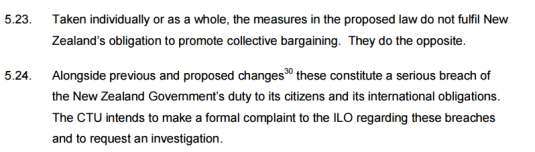
The union movement was outraged at the fact that New Zealand laws it likes could be questioned at international forums. It said this in a recent submission to the Health Select Committee of Parliament.
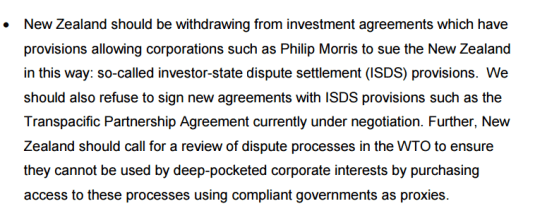
The unions were equally outraged about dispute settlement procedures in the recent free trade agreement with Korea. The unions were absolutely affronted at the idea that the sovereignty of the New Zealand Parliament could be challenged at a foreign forum.
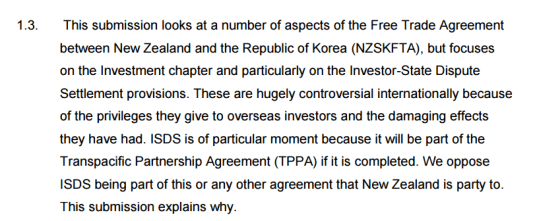
Source: Submission of the New Zealand Council of Trade Unions Te Kauae Kaimahi to the Foreign Affairs, Defence and Trade Select Committee on the Free Trade Agreement between New Zealand and the Republic of Korea, Wellington 24 April 2015.
These protestations of the union movement would have much more credibility if union did not run off to a UN or ILO committee every time they were on the losing side of a vote in parliament. The unions are happy with those parts of international economic law that serve its interests but behave hypocritical about the other parts that do not. As United States Supreme Court Justice Antonin Scalia said
The virtue of a democratic system [with a constitutionally guaranteed right to free speech] is that it readily enables the people, over time, to be persuaded that what they took for granted is not so and to change their laws accordingly.
Nothing stirs up the impassioned (and most other people as well) more than depriving them of their right to support or oppose what is important to them through political campaigns and at an election.
The losing side, and we all end up on the losing side at one time or another, are much more likely to accept an outcome if they had their say and simply lost the vote at the election or in Parliament. Power to the people as long as I am on the winning side instead is the motto of the union movement.
The unions losing on labour market deregulation is no different from any other political difference within New Zealand. Both sides passionately but respectfully attempt to persuade their fellow citizens to accept their views.
Win or lose, advocates for today’s losing causes can continued pressing their cases, secure in the knowledge that an electoral loss today can be negated by a later electoral win, which is democracy in action as Justice Kennedy explained recently in the US context:
…a democracy has the capacity—and the duty—to learn from its past mistakes; to discover and confront persisting biases; and by respectful, rationale deliberation to rise above those flaws and injustices…
It is demeaning to the democratic process to presume that the voters are not capable of deciding an issue of this sensitivity on decent and rational grounds.
The process of public discourse and political debate should not be foreclosed even if there is a risk that during a public campaign there will be those, on both sides, who seek to use racial division and discord to their own political advantage.
An informed public can, and must, rise above this. The idea of democracy is that it can, and must, mature. Freedom embraces the right, indeed the duty, to engage in a rational, civic discourse in order to determine how best to form a consensus to shape the destiny of the Nation and its people. These First Amendment dynamics would be disserved if this Court were to say that the question here at issue is beyond the capacity of the voters to debate and then to determine.
Celebrating humanity's flourishing through the spread of capitalism and the rule of law
Scholarly commentary on law, economics, and more
Beatrice Cherrier's blog
Celebrating humanity's flourishing through the spread of capitalism and the rule of law
Celebrating humanity's flourishing through the spread of capitalism and the rule of law
Celebrating humanity's flourishing through the spread of capitalism and the rule of law
Why Evolution is True is a blog written by Jerry Coyne, centered on evolution and biology but also dealing with diverse topics like politics, culture, and cats.
Celebrating humanity's flourishing through the spread of capitalism and the rule of law
Celebrating humanity's flourishing through the spread of capitalism and the rule of law
A rural perspective with a blue tint by Ele Ludemann
DPF's Kiwiblog - Fomenting Happy Mischief since 2003
Celebrating humanity's flourishing through the spread of capitalism and the rule of law
The world's most viewed site on global warming and climate change
Tim Harding's writings on rationality, informal logic and skepticism
A window into Doc Freiberger's library
Let's examine hard decisions!
Commentary on monetary policy in the spirit of R. G. Hawtrey
Thoughts on public policy and the media
Celebrating humanity's flourishing through the spread of capitalism and the rule of law
Politics and the economy
A blog (primarily) on Canadian and Commonwealth political history and institutions
Reading between the lines, and underneath the hype.
Economics, and such stuff as dreams are made on
"The British constitution has always been puzzling, and always will be." --Queen Elizabeth II
Celebrating humanity's flourishing through the spread of capitalism and the rule of law
Celebrating humanity's flourishing through the spread of capitalism and the rule of law
WORLD WAR II, MUSIC, HISTORY, HOLOCAUST
Undisciplined scholar, recovering academic
Celebrating humanity's flourishing through the spread of capitalism and the rule of law
Res ipsa loquitur - The thing itself speaks
Celebrating humanity's flourishing through the spread of capitalism and the rule of law
Researching the House of Commons, 1832-1868
Articles and research from the History of Parliament Trust
Reflections on books and art
Posts on the History of Law, Crime, and Justice
Celebrating humanity's flourishing through the spread of capitalism and the rule of law
Exploring the Monarchs of Europe
Cutting edge science you can dice with
Small Steps Toward A Much Better World
“We do not believe any group of men adequate enough or wise enough to operate without scrutiny or without criticism. We know that the only way to avoid error is to detect it, that the only way to detect it is to be free to inquire. We know that in secrecy error undetected will flourish and subvert”. - J Robert Oppenheimer.
The truth about the great wind power fraud - we're not here to debate the wind industry, we're here to destroy it.
Celebrating humanity's flourishing through the spread of capitalism and the rule of law
Celebrating humanity's flourishing through the spread of capitalism and the rule of law
Economics, public policy, monetary policy, financial regulation, with a New Zealand perspective
Celebrating humanity's flourishing through the spread of capitalism and the rule of law
Restraining Government in America and Around the World

 Utopia, you are standing in it!
Recent Comments