
Step Inside The Most Densely Populated Place on Earth
18 Jan 2017 Leave a comment
in constitutional political economy, development economics, international economic law, international economics, International law, urban economics Tags: Hong Kong
A.J.P. Taylor said something similar
15 Oct 2016 Leave a comment
in economic history, international economic law, international economics, labour economics, labour supply Tags: age of empires, age of migration, economics of immigration, George Orwell, great migrations
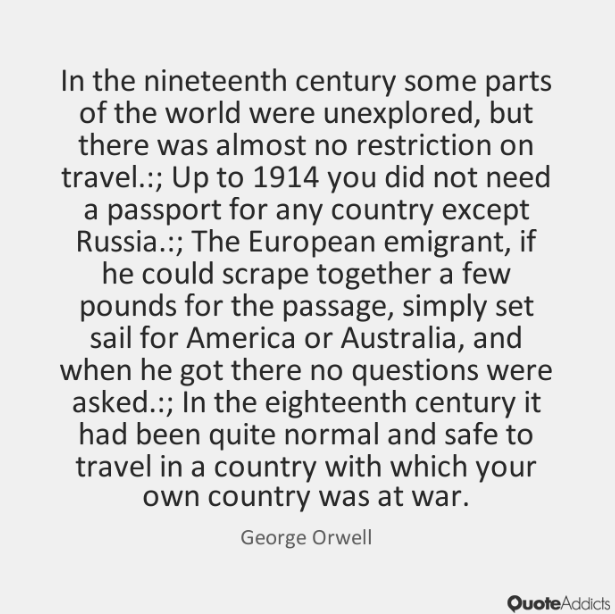
The Brexit vote is about the supremacy of Parliament
30 Jun 2016 Leave a comment
in economics, international economic law, international economics, International law Tags: British economy, British politics, Common market, European Union
Why did voters vote to Leave or Remain? @JulieAnneGenter @Income_Equality
28 Jun 2016 Leave a comment
in constitutional political economy, international economic law, international economics, International law, Public Choice Tags: British economy, British politics, Common market, European Union, pessimism bias, single market, Twitter left, voter demographics
There were few difference across the political spectrum as to why voters voted to Remain or Leave. This is according to Lord Ashcroft’s survey on referendum day of over 12,000 voters.

Source: How the United Kingdom voted on Thursday… and why – Lord Ashcroft Polls
Labour and Tory voters voted to leave to regain control over immigration and sovereignty.
Labour and Tory voters who wanted to remain thought the EU and its single market was a good deal not worth putting at risk. It is all about identity politics, not inequality.
Vote Leave voters are a grumpy lot who think things have been getting worse for 30 years:
Leavers see more threats than opportunities to their standard of living from the way the economy and society are changing, by 71% to 29% – more than twice the margin among remainers…
By large majorities, voters who saw multiculturalism, feminism, the Green movement, globalisation and immigration as forces for good voted to remain in the EU; those who saw them as a force for ill voted by even larger majorities to leave.
The ever astute @JohnCassidy nails why #Brexit occurred
25 Jun 2016 Leave a comment
in constitutional political economy, international economic law, international economics, International law
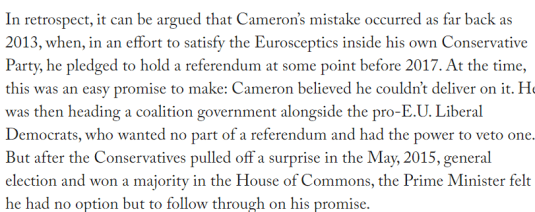
@JulieAnneGenter @NZGreens @LewisHoldenNZ @DanHannanMEP’s best single case for #Brexit
24 Jun 2016 Leave a comment
in constitutional political economy, economics, industrial organisation, international economic law, International law, liberalism Tags: Brexit, British economy, British politics, Common market, customs unions
Patrick Minford explains #Brexit
22 Jun 2016 Leave a comment
in applied welfare economics, comparative institutional analysis, economics, international economic law, international economics, International law, Public Choice Tags: Brexit, British economy, British politics, Common market, European Union
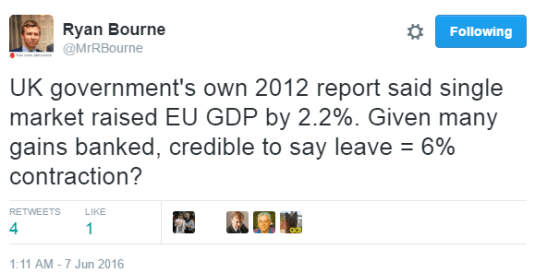
Should Britain stay or go after @MrRBourne’s best single #Brexit comment
16 Jun 2016 Leave a comment
in applied price theory, constitutional political economy, international economic law, international economics
I have not as yet decided on in or out. It is a close call. Best to divide the economic estimates of the cost of #Brexit by two and you get a more accurate estimate.
What made me move most towards leaving is the remark in the linked video by the Conservative Party Euro MP Daniel Hannan that the recent austerity cuts totalling £36 billion while British contributions to the European Union budget were £38 billion.
The snapshot tweet is the single most sensible comment on the economic costs when quantified as a percentage of GDP. The costs of leaving might well be small.
The Remain campaign is incompetent. It is unable to hit on good soundbites, much less the central case against leaving.
The main case to remain is it will preserve the current travel privileges of British citizens. British can go anywhere in the European Union as they like for business, pleasure, a job or to retire. No need for visas. If the British were to leave, they have to renegotiate visa access.
That renegotiation of these access will not be as easy as you might think because there are several secessionists minded provinces such as in Spain and Italy who are told that they will not be eligible for European Union membership if they succeed.
Spain has every intention of vetoing a European Union membership application from an independent Scotland to set an example to its own succession minded provinces.
Spain and Italy have every reason to be difficult over the British these are arrangements for the same reason. Signalling the costs of succession to the Lombard region of northern Italy, the Basque provinces and Catalonia
Scotland was told in no uncertain terms that if it left the United Kingdom, there would have to be border controls on the Scottish border, a new Hadrian’s Wall, because of EU law and border control agreements. Those border controls would have to remain until Scotland joined the European Union or otherwise made a deal.
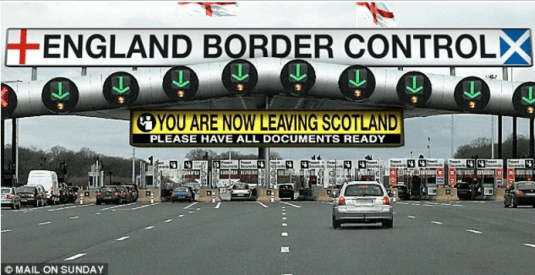
The case to remain would be stronger if the British had stronger border controls against illegal immigration, and it just left the European Court of Justice and its increasingly silly decisions.
Much of the current wave of refugees arises from Turkey allowing illegal immigrants to cross its borders to go on to the European Union as a way of signalling that Turkey would be much more cooperative if it were a member of the European Union.
Number of asylum applications in EU has broken record set in 1992 – then and now compared: theguardian.com/world/ng-inter… http://t.co/qhpBagphGO—
Alberto Nardelli (@AlbertoNardelli) October 15, 2015
Turkey is increasingly undemocratic under the current president and there is always the background threat of a military coup. European Union member states must be democracies, which is why Turkey’s application for membership has stalled for many years.
How UK refugee commitment compares with other countries
bit.ly/1OuZamF http://t.co/LcnAsJePIN—
Guardian Data (@GuardianData) September 08, 2015
Parties ranging from UKIP to Alternative for Germany will get stronger and stronger unless control over borders is restored.
Neo-colonial @oxfamnz continues to bully small island states
16 Jun 2016 Leave a comment
in applied price theory, development economics, environmental economics, global warming, international economic law, international economics, public economics
Oxfam joins others on the reactionary left in seeking to bully former colonies over their economic policies, in particular, their tax policies that promote tax havens.
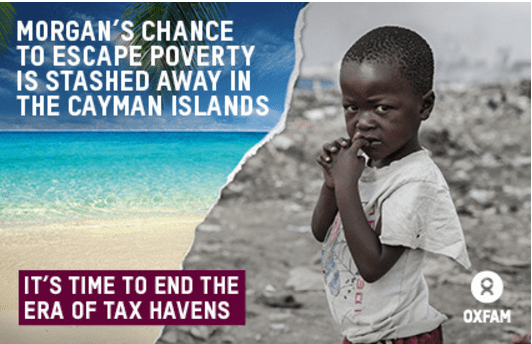
The Cayman Islands is a British overseas territory that chooses to stay British with limited self-government. If the British were to start bullying it over its tax haven and offshore financial centre policies, it would immediately seek independence.
This attempt by former colonial masters to bully small countries to toe their line on tax policies is not done in any way for the benefit of these former colonies and their economic development. It is old-fashioned imperialism with a new motivation, tax imperialism. The aim is to prevent capital flight and the erosion of the business tax base in developed countries.
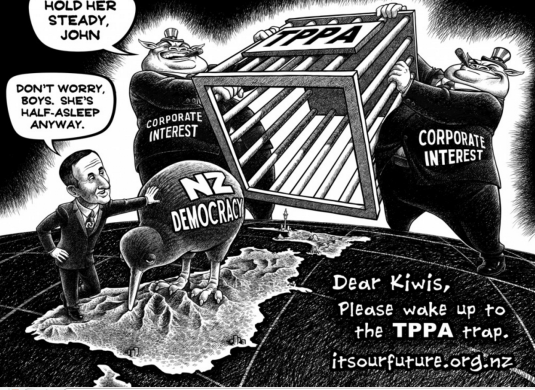
This is a seething hypocrisy given that Oxfam was all for #TPPANoWay. It is OK to go your own way on tariffs, intellectual property and investment and other economic regulations but not taxes. Countries have a tariff sovereignty but not a tax sovereignty.
This is a self-serving neo-colonial hypocrisy. The sovereignty arguments for #TPPANoWay are identical to those for the right of countries to act as tax havens. Identical. Tariffs deny other countries export markets; tax havens deny other countries tax revenue.
Small island states were left-wing and environmentalist heroes on climate change at the most recent conference on global warming in Paris but are villains regarding tax havens. In both cases, these small countries are exercising their sovereignty regarding their foreign policies and economic policies.
Oxfam believes that the democratic rights of former colonies do not extend to shaping their own economic policies. Oxfam wants them to be put on a neo-colonial leash.
Why are landlocked countries poorer?
10 Jun 2016 Leave a comment
in applied price theory, international economic law, international economics Tags: burden of geography, economics of borders
No @sarahinthesen8 this is not acceptable. Stopping the boats saved hundreds of lives
30 May 2016 Leave a comment
in Economics of international refugee law, international economic law, International law, labour economics, politics - Australia Tags: Australian Greens, avoiding difficult choices, economics of immigration, Leftover Left, rational irrationality
People who enter illegally by boat do not increase the number of refugees of Australia admits in any one year. They change who was granted asylum within the same fixed quota. Increasing the quota will not change incentives for illegal entry if illegal entry allows for settlement in Australia.
I hope no one in @OxfamGB’s #taxhaven clip were fresh from a #TPPANoWay march?
11 May 2016 Leave a comment
in applied price theory, development economics, economic history, growth disasters, growth miracles, income redistribution, international economic law, international economics, Public Choice, rentseeking Tags: antiforeign bias, Left-wing hypocrisy, neocolonialism, Oxfam, rational irrationality, reactionary left, tax havens, TPP
I hope none in this clip protesting against tax havens as short changing everybody else were fresh from protesting how international economic agreements such as the TPPA infringe on the sovereignty of countries.
If you standing up for national sovereignty that includes standing up for the right of other countries doing things that you do not like within their own country.
If countries have the right to set taxes and tariffs as high as they like, they have just the same right to set them as low as they like.
All that plucky rhetoric of TPPA no way and how international economic agreements violate the sovereignty of countries and developing countries in particular is forgotten in a flash by Oxfam.
Oxfam manages the blinding hypocrisy of opposing the Transpacific Partnership on national sovereignty grounds and at the same time call for international treaties to bully small countries about their tax policies, which overrides their economic sovereignty.
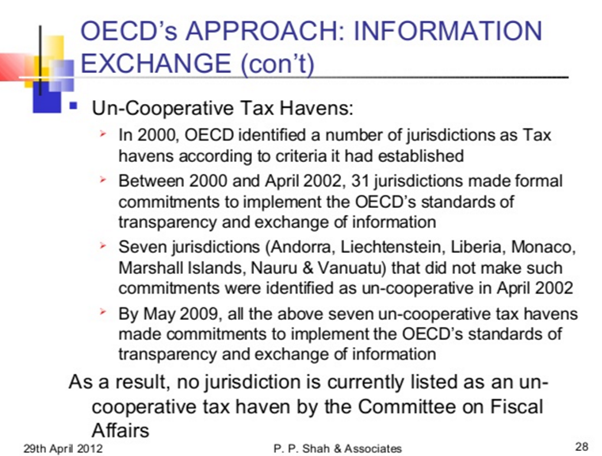
The sovereign rights of developing countries to find their own way does not extend to undermining the tax bases of the rich countries struggling to finance their welfare states.
The Pacific Islands, the once were heroes of the recent Paris climate talks, turn into pariahs once they start looking out for themselves and setting up offshore financial centres and tax havens.
Developing countries are free to impoverish themselves by embracing socialism, but if they decide to attract investment and jobs through low tax rates and offshore financial centres, a new form of colonialism is embraced by the reactionary left as embodied by Oxfam.
When my father was born, 7 in 10 people lived in absolute poverty.
Today, it's 1 in 10! https://t.co/1Caqku3AY1—
Tim Fernholz (@TimFernholz) October 21, 2015
#Morganfoundation discovers that #Ukraine is a dodgy place to buy credence goods
19 Apr 2016 Leave a comment
in economics of climate change, economics of crime, economics of information, environmental economics, global warming, industrial organisation, international economic law, international economics, International law, law and economics, politics - New Zealand, survivor principle Tags: adverse selection, asymmetric information, carbon trading, climate alarmism, climate alarmists, credence goods, experience goods, inspection goods
Morgan Foundation yesterday put out a report pointing out that many of the carbon credits purchased from the Ukraine under the carbon trading scheme are fraudulent.
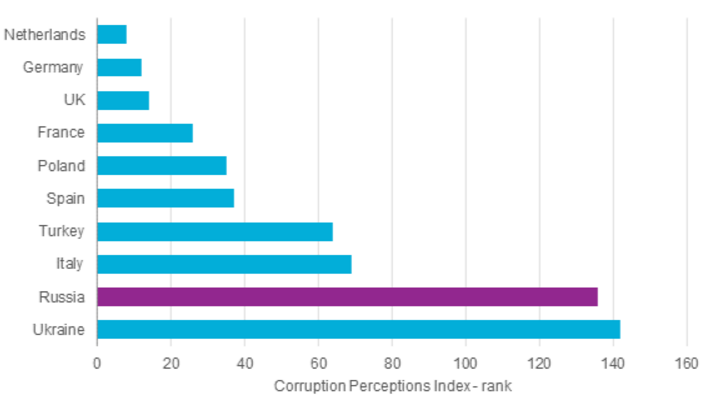
That comes with no surprise to anyone vaguely familiar with business conditions and the level of official corruption in the former Soviet Union. Russia is a more honest place to do business.

Carbon traders who buy from the Ukraine are not buying an inspection good. An inspection good is a good whose quality you can ascertain before purchase.

They are not buying an experience good. An experience good is a good whose quality is ascertained after purchase in the course of consumption.

Source: Russia, Ukraine dodgy carbon offsets cost the climate – study | Climate Home – climate change news.
What these carbon traders in New Zealand are doing is buying credence goods from the Ukraine. The credence goods are the carbon credits, which the Morgan Foundation and others have found often to be fraudulent.
A credence good is a good whose value is difficult or impossible for the consumer to ascertain. A classic example of a credence good is motor vehicle repairs.
You must trust the seller and their advice as to how much you need to buy of a credence good. Many forms of medical treatment also require you to trust the seller as to how much you need.
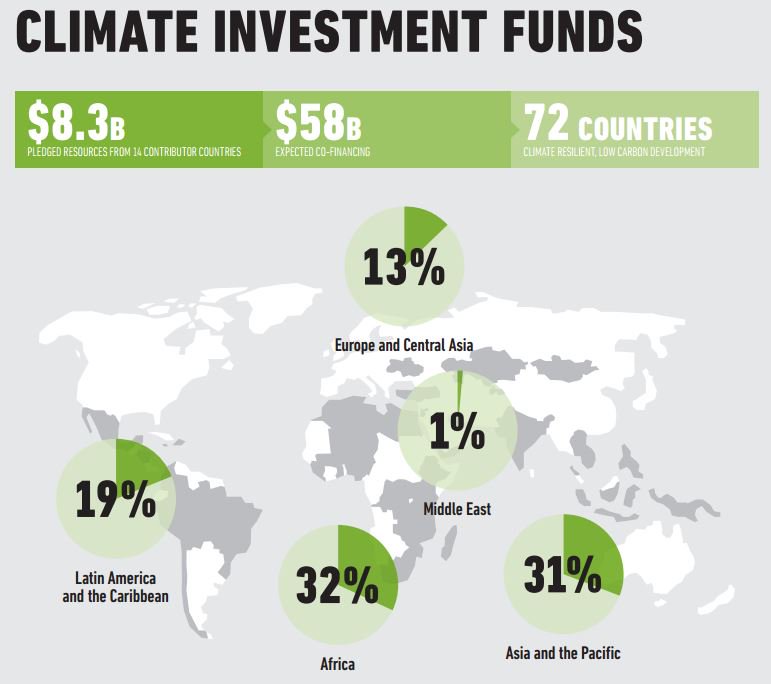
Carbon credits are such a credence good. You know there is corruption in the Ukraine and many other countries that supply them. You may never know at any reasonable cost whether the specific carbon credits you buy were legitimate.
The reason why carbon credits are purchased from such an unreliable source is expressive voting. As is common with expressive politics, what matters is whether the voters cheer or boo the policy. The fact whether it works or not does not matter too much.
The Greens are upset about this corruption in carbon trading. They did not mention the corruption in international carbon trading and climate aid when they welcomed the recent Paris treaty on global warming but that is for another day.
https://twitter.com/kadhimshubber/status/721831502372302849
Co-ordinated international action on global warming is rather pointless if some of the key countries with carbon emission caps are corrupt, which they are.
As Geoff Brennan has argued, CO2 reduction actions will be limited to modest unilateral reductions of a largely token character. There are many expressive voting concerns that politicians must balance to stay in office and the environment is but one of these.

Once climate change policies start to actually become costly to swinging voters, expressive voting support for these policies will fall away, and it has.
Networked Carbon Markets

Source: World Bank Networked Carbon Markets.
One way to stem that fading support is to buy carbon credits on the cheap and there is plenty of disreputable suppliers of cheap carbon credits. Buying dodgy carbon credits as a way of doing something on global warming without it costing more than expressive voters will pay.
One of the predictions of the adverse selection literature is that if consumers cannot differentiate good and bad goods from each other, such as with used cars, the market will contract sharply or even collapse because buyers cannot trust what is on offer. This risk of adverse selection undermining a market applies with clarity to carbon trading.

Source: How Can Your Vote Shape a Low Carbon Future? It Starts with Carbon Pricing.
@oxfam is shape shifter on national sovereignty #TPPANoWay #endtaxhavens
14 Apr 2016 Leave a comment
in international economic law, international economics Tags: Left-wing hypocrisy, Oxfam, tax havens, TPPA
Oxfam has no interest in the sovereignty of small states. It supports a new form of colonialism – tax colonialism.
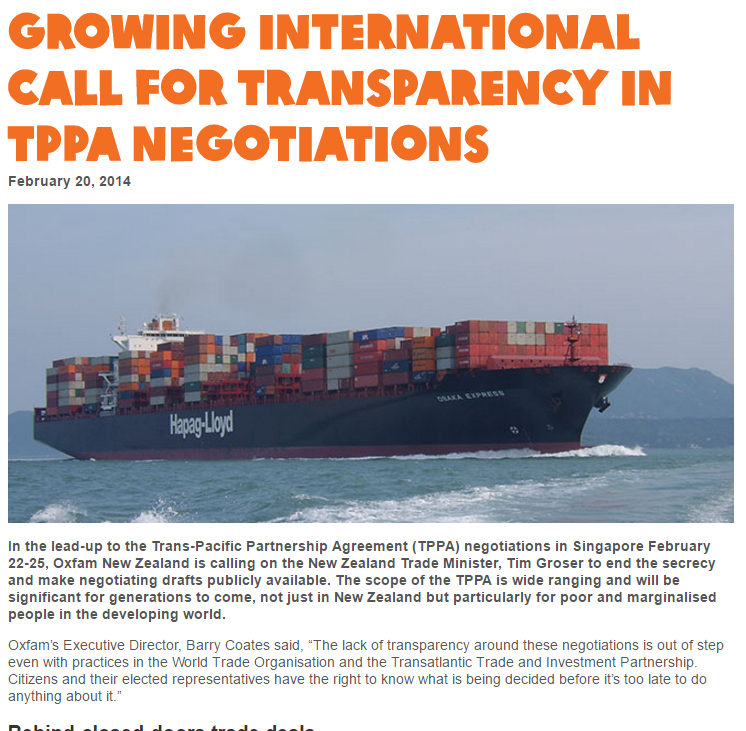
Source: Growing international call for transparency in TPPA negotiations | Oxfam New Zealand.
While Oxfam upholds the sovereign right of countries to regulate and expropriate, they do not defend the rights of those same countries to tax as they please, including to cut taxes to attract investment and offshore financial centres.
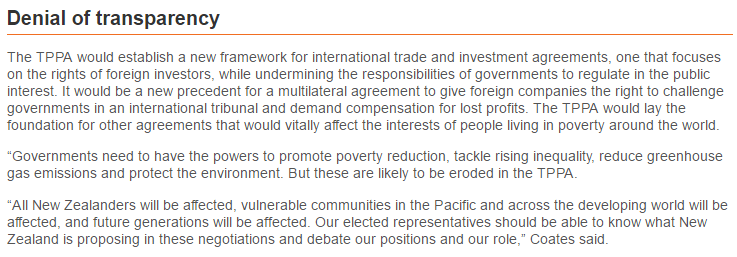
Source: Growing international call for transparency in TPPA negotiations | Oxfam New Zealand.
All that plucky rhetoric of TPPA no way and how international economic agreements violate the sovereignty of countries and developing countries in particular is forgotten in a flash.
<p>Oxfam manages to have the blinding hypocrisy of opposing the Transpacific Partnership on national sovereignty grounds and at the same time call for international treaties to bully small countries about their tax policies, which overrides their economic sovereignty.</p>  <p>Hyper inequality is out of control - sign the new petition - end the era of tax havens  ow.ly/Xc0T4 https://t.co/IzqBji6AmD—
Oxfam New Zealand (@oxfamnz) January 17, 2016


Recent Comments