
Exclusive economic zones around the world – New Zealand’s exclusive economic zone is rather large
08 Jan 2015 Leave a comment
in fisheries economics, international economic law, international economics, International law, resource economics Tags: exclusive economic zones, Law of the Sea, maps, national sovereignty
Report card on the Drone commander-in-chief
22 Dec 2014 Leave a comment
in International law, politics - USA, war and peace
The renegade Left and the laws of war
11 Dec 2014 Leave a comment
in International law, laws of war, war and peace Tags: Leftover Left, prisoners of war, renegade Left, Renegade liberals, war criminals, war on terror
The renegade Left is highly selective in its recall of international humanitarian law. On torture, perfect recall, strict construction and may the heavens fall. William Levi in the Yale Law Journal in 2009 argued that
- except for water-boarding, every interrogation technique authorized by the Bush Administration had been authorized before 9/11 and considered to fall within the legal constraints of the Geneva Conventions.
- Techniques such as sleep deprivation, and standing as a stress position that were understood at times before 9/11 to be lawful for use on prisoners of war.
When it comes to the reason for being for international humanitarian law, a stout ignorance infects the renegade Left and may innocent civilians be massacred.

The purpose of international humanitarian law is to ensure strict differentiation between civilians and combatants and to provide for the detention and treatment of those captured.
Humane detention to the end of the armed conflict increases both the incentive to give quarter and to surrender when the position is hopeless.
The requirement to carry weapons openly, dress in some sort of uniform etc. is to ensure that the enemy is easy to distinguish from afar so that troops do not get trigger happy around civilians and refugees. This is the fundamental purpose of international humanitarian law: trying to save civilians from the fighting.

The most severe punishments was allowed for spies, saboteurs, infiltrators, francs-tireurs and guerrillas so that not carrying their weapons openly and not dressing in some sort of recognisable uniform etc., was a self-inflected death sentence upon capture. Combatants who do not wear a uniform that is clearly distinguishable at the distance and do not carry their weapons openly are war criminals.
In the Battle of the Bulge, the Nazi infiltrators in American uniforms lost all interest in their missions once the first few who were captured were court-martialled and shot within 24 hours.

The Hostages Trial at Nuremburg dismissed some murder charges against some German commanders because partisan fighters in Southwest Europe could not be considered lawful belligerents under Article 1 of the 1907 Hague convention. The Tribunal stated:
We are obliged to hold that such guerrillas were francs tireurs who, upon capture, could be subjected to the death penalty.
Consequently, no criminal responsibility attaches to the defendant List because of the execution of captured partisans…
Four Distinct Foreign-Policy Orientations
03 Dec 2014 Leave a comment
in International law, liberalism, politics - New Zealand, politics - USA, war and peace Tags: non-interventionist foreign policy
|
Four Distinct Foreign-Policy Orientations |
||
| Internationalist: Willing to intervene in foreign affairs | Isolationist: Reluctant to intervene in foreign affairs | |
| Emphasis on the national interest as primary value in foreign policy | National-interest interventionism | National-interest isolationism |
| Significant emphasis on altruism in foreign policy | Altruistic interventionism | Altruistic isolationism |
|
Source: Reichley 2000. |
||
Egypt takes aim at Hamas’ terror tunnels | Where are the protestors?
23 Nov 2014 Leave a comment
in International law, laws of war, war and peace Tags: Gaza Strip, Hamas, Leftover Left

…Egypt is considering creating a huge, 1,000-meter buffer zone in the Sinai Peninsula – they have already evicted 10,000 people in the process of clearing the first 500 meters — and digging a deep-water trench that would flood any future efforts to carve subterranean routes for smuggling weapons and terrorists in and out of Gaza.
And unlike the fierce resistance and international public relations campaign Hamas mounted against Israel in August, the terrorist group that governs Gaza appears to not be seeking a head-on fight with Cairo.

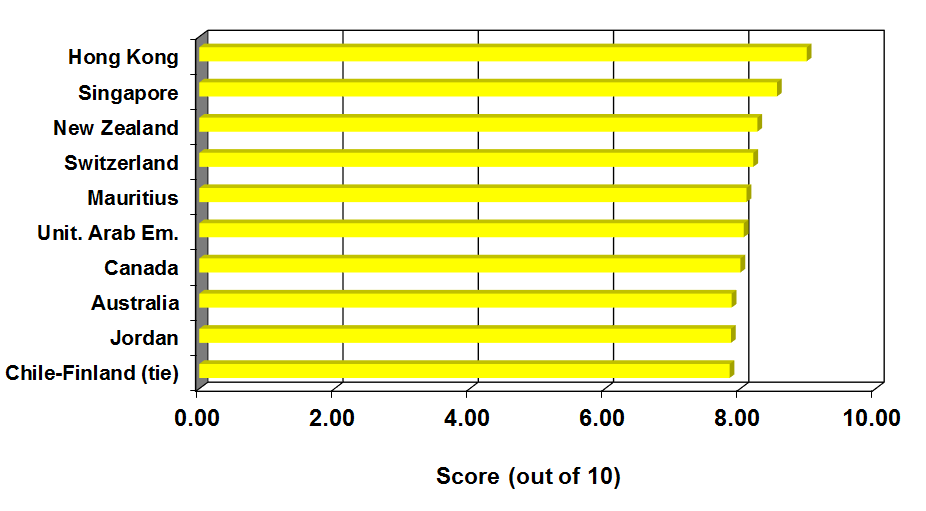
Fraser Institute Economic Freedom in the World Index 2014 – top 10 countries
13 Oct 2014 Leave a comment
If Scotland votes yes
07 Sep 2014 4 Comments
in constitutional political economy, international economic law, International law, law and economics Tags: English nationalism, Scottish independence


Murray Rothbard (1982) on Israeli settlements in the West Bank
10 Aug 2014 Leave a comment
in International law, libertarianism, Murray Rothbard, war and peace Tags: Israel, Murray Rothbard, revanchism, West Bank

To be fair, on the State of Israel, Murray Rothbard was an anti-Zionist warmongering revanchist. In 1969, for example, he argued that there are some wars that can be blamed more on one state than another and that the Israelis were to blame for most of the Israeli-Arab wars.
Israel and the West Bank
09 Aug 2014 Leave a comment
in International law, politics Tags: Israel, West Bank
 |
 |
| Israeli settlements cover about 2% of the West Bank and are linked by Israeli-controlled roads. There are also large tracts of Israeli-controlled land designated as military areas or nature reserves. | Military checkpoints allow Israel to monitor and control travel in much of the West Bank. |
HT: BBC
European time lapse map
28 Jun 2014 Leave a comment
in International law, war and peace Tags: fluid national borders, maps
The selectivity of the renegade left on international law
31 May 2014 Leave a comment
in international economic law, International law Tags: double standards
International human rights and humanitarian law is a common port of call for the Left in a great many domestic policy debates. This is despite international law being the product of nation-states pursuing their own interests on the international stage.

International law does not pull states towards compliance when this contrary to their national interests. What international law can achieve is therefore rather limited.
International law is a part of international politics. States enter into treaties and other international legal institutions when doing so serves their interests. Any cooperation among states is a by-product of that rational, self-interested act.
The laws of war are governed by reciprocity, which can produce self-enforcing patterns of behaviour. Eric Posner explains:
The laws of war have a simple economic explanation.
When two states go to war, they foresee an endpoint, which will typically involve certain concessions by one state—the transfer of territory, monetary reparations, etc.
Given that both states will end up at some new equilibrium in terms of territory or wealth or power, it is best for both states if they can reach that equilibrium cheaply rather than expensively.
Before the twentieth century, European states and other major powers would presumptively respect the laws of war in wars among themselves but not wars with tribal groups they aimed to subdue.
In World War II, the rules were respected on the western front but not on the eastern front. On the Eastern front, there were long supply lines and the massive number of prisoners who were taken—both of these factors made it extremely costly to hold POWs in humane conditions. The Nazis also regarded Russians as subhuman, when one side launches a total war, the other side has no reason to respect the laws of war.
Human rights laws attempts to produce public goods and is thus subject to collective action problems.
International law that has not been ratified by domestic political processes has a severe democracy deficit because it is not subject to any kind of democratic electoral accountability.
International law-making itself is generally less transparent than domestic political processes, which further undermines democratic control of its content.
The Left is keen on international law despite it being influenced by nondemocratic and even totalitarian nations.
The UN universal declaration of human rights was watered down on requiring multi-party democracy and on the scope of the definition of genocide to accommodate Stalin’s many crimes in the name of socialism.
If you want to scratch a Leftist to find an economic nationalist, start talking about duties under international economic law.
A legal internationalist on the Left quickly become legal xenophobes when it suits them.
International economic law is adopted by mutual agreement bilaterally or multilaterally on a no vote, no veto basis such as at the WTO. Member countries sign the final agreements as they please. Any new rules have no effect until domestic parliaments ratify the agreement and amend local trade and investment laws.
The Left complains about any lack of transparency in international law and their implications for national sovereignty only when trade treaties are under discussion.
When it comes to international human rights law or international environmental law, the most obscure or treaties ratified decades ago under different circumstances and often very limited purposes are holy writ.
These international laws trump national sovereignty without question and the will of the majority within a country and are open to the most free wheeling interpretations and private enforcement by busy bodies, do-gooders and activists with varying degrees of non-violence.
What is most disappointing about the Left and international law is their attempt to bully other countries over the tax rates.
If Sweden has the right to set high taxes, others have the equally sovereign right to set low taxes.
International law is not a cafeteria where you can pick what suits you. Just as there is international humanitarian law, there is international economic law. One in, all in?!
International economic law makes a far greater contribution to peace than any other part of international law. Free trade creates mutual dependencies among nations. Tariff walls do not promote peace.

 Utopia, you are standing in it!
Recent Comments