Last British Gitmo prisoner released
30 Oct 2015 Leave a comment
in International law, war and peace Tags: British politics, war on terror
Why this Bozo wanted to be put on trial is beyond me.

The usual sentence for a terrorist offence in a US court is life without parole. He had a much better deal being detained until either the end of hostilities or until the combatant status review tribunal determined he was no longer likely to rejoin the fight. The combatant status review tribunals have made a number of errors and up to 100 Gitmo detainees have rejoined their battle to destroy Western civilisation.
If he had been put on trial and convicted, that meant the rest of his life in prison in maximum-security. If found not guilty, he would have remained in Gitmo until the end of hostilities or until a combatant status review tribunal released him early.
Map of Palestine from a 1947 issue of National Geographic
12 Oct 2015 Leave a comment
Map of Palestine from a 1947 issue of National Geographic. http://t.co/jA1niGLMin—
Historical Pics (@HistoricalPics) October 11, 2014
@nzlabour @greencatherine @johnkeymp @actparty Australia and New Zealand country of asylum numbers since 1965
10 Oct 2015 1 Comment
in Economics of international refugee law, International law, politics - Australia, politics - New Zealand Tags: Australia, economics of migration, refugees
Australia and New Zealand at times has taken in a great many refugees from abroad according to the United Nation’s High Commissioner for Refugees data. Oddly enough these bursts of generosity coincided with a Liberal Country party government in Australia and National Party governments in New Zealand. The Left of New Zealand politics was too busy fighting to be nuclear free to make New Zealand a place of refuge for the victims of oppression when they had their hands on the wheels of power.
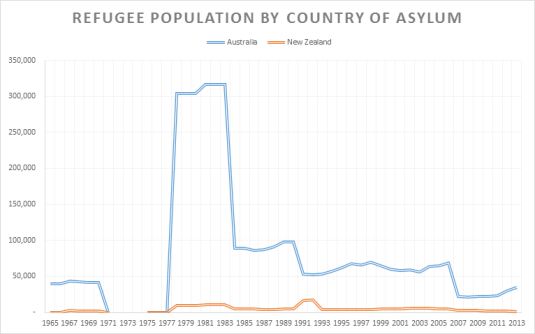
Source: UNHCR – UNHCR Statistical Online Population Database.
Because Australia took in so many hundreds of thousands of refugees, it is difficult to read the New Zealand data so I have reproduced the New Zealand data on refugees as a separate graph.

Source: UNHCR – UNHCR Statistical Online Population Database.
At times of crisis such as after the Vietnam War and the chaos in the Balkans, New Zealand has taken in a great many refugees – many times its current generosity.
@jamespshaw @nzlabour @actparty inflow of asylum seekers into Australia and New Zealand since 1987
08 Oct 2015 Leave a comment
in International law, politics - Australia, politics - New Zealand, war and peace Tags: asylum seekers, Australia, economics of migration, refugees
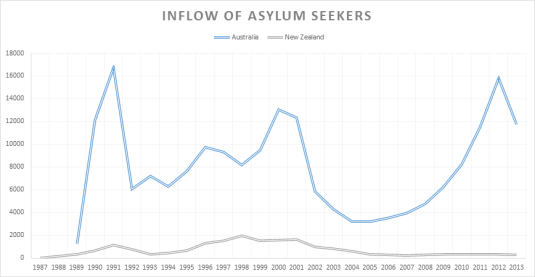
Data extracted on 08 Oct 2015 09:06 UTC (GMT) from OECD.Stat; Dataset: International Migration Database.
@NZNationalParty @nzlabour @NZGreens inflow of asylum seekers into #UK #Canada, #Australia and #NewZealand since 1980
08 Oct 2015 Leave a comment
in economic history, Economics of international refugee law, International law, politics - Australia, politics - New Zealand, population economics Tags: Australia, British politics, economics of migration, refugees
New Zealand’s intake of asylum seekers has been embarrassingly low. The left-wing parties in New Zealand should be ashamed of themselves given the way they wear their international consciences on their sleeves about New Zealand being above it all morally, nuclear free, and can lecture the rest about war, peace and compassion from on high.

Data extracted on 08 Oct 2015 09:06 UTC (GMT) from OECD.Stat; Dataset: International Migration Database.
The UK absorbed an immense number of asylum seekers in the 1990 as did Canada. The data stops in 2013.
Jane Kelsey oppose handcuffs on the democratic choices of future governments! Does she opposes labour and environmental standards in trade agreements too?
06 Oct 2015 Leave a comment
in development economics, international economic law, international economics, International law, politics - New Zealand, politics - USA Tags: colonialism, GATT, Leftover Left, preferential trading agreements, TPA, TPPA
What's in the #TPP? Robust enforceable environmental protections. Get the facts ustr.gov/tpp #LeadOnTrade http://t.co/hzapJwGaCa—
USTR (@USTradeRep) October 05, 2015What's in the #TPP? Protections for American workers. Get the facts: ustr.gov/tpp #MadeInAmerica http://t.co/VPeV70zaPT—
USTR (@USTradeRep) October 05, 2015https://twitter.com/JimRose69872629/status/651230008875220992
One of my policy essays for my Masters of Public Policy Degree in Japan was on the social clauses of the GATT. I described the labour and environmental clauses is a new form of colonialism.
My classmates were government officials from all around Asia, more than 20 countries. As they spoke English as a second language, they were pleased to learn of a new way of describing social clauses in trade agreements in English.
A Filipino friend had a blunter way of referring to social clauses in trade agreements: “the whites are back, telling us what to do”.
Environmentalists are praising wildlife measures in the Trans-Pacific Partnership trade deal nyti.ms/1hlu7hS http://t.co/ZLYarL9QE7—
The New York Times (@nytimes) October 05, 2015

Jane Kelsey in a television interview said she opposes the reductions in sovereignty in trade agreements that result from investor-state dispute settlement (ISDS) provisions because they limit the democratic choices of future governments.
If so, she must oppose environmental and labour standards in trade agreements and, more importantly, binding the hands of future governments with climate treaties. All international treaties are about restrictions on sovereignty.
Environmental and labour clauses in trade agreements and climate treaties all limit the powers of governments to legislate on environmental and employment law in accordance with the will of the people as expressed in the most recent election and change of government. Power to the people.
https://twitter.com/rorymccourt/status/625540621457960960
Jane Kelsey would do better focusing on those parts of the TPPA deal that lowers the net value of the deal such as those extending the term of patents over the drugs. All international treaties are about trade-offs.
View original post 212 more words
@jamespeshaw nails the #TPPA policy trade-off @NZGreens
06 Oct 2015 1 Comment
in applied price theory, applied welfare economics, comparative institutional analysis, economics of regulation, international economic law, international economics, International law, law and economics, politics - Australia, politics - New Zealand, politics - USA, property rights Tags: conspiracy theories, David Friedman, foreign direct investment, free trade agreements, FTI, international investment law, Leftover Left, New Zealand Greens, preferential trading agreements, TPPA, Twitter left
About 1% more GDP but higher drug prices.
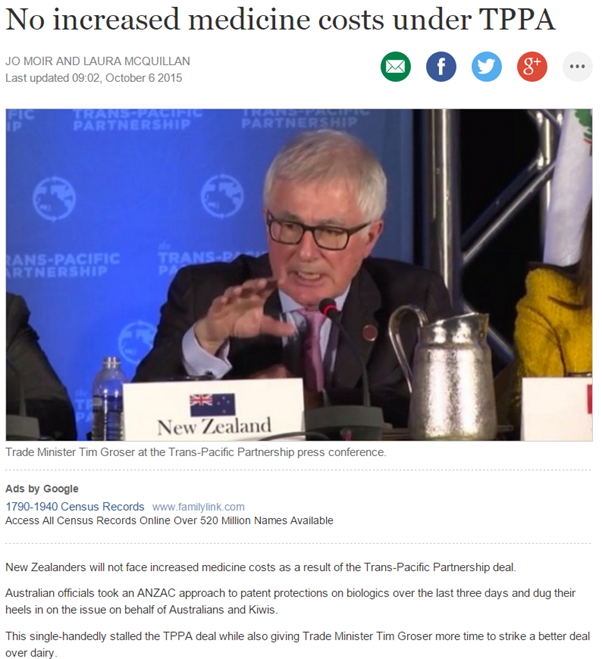
Source: No increased medicine costs under TPPA | Stuff.co.nz
.@MSF: Patients and treatment providers in developing countries the big losers of the #TPP bit.ly/TPPconcludes http://t.co/cbikANleyA—
MSF Access Campaign (@MSF_access) October 05, 2015
The next best arguments James Shaw made were xenophobia about foreign investment in land and some vast conspiracy theory regarding endangered dolphins.
When your next best argument is foreigners are coming to buy up all our land, you are playing from a weak populist hand. About half of million New Zealand born live in other countries.
About 80% of these live in Australia, the great majority as residents rather than as citizens. These New Zealanders living in Australia and elsewhere need protection under international agreements to ensure they are not the victim of populist outbreaks against the sale of land to foreigners.
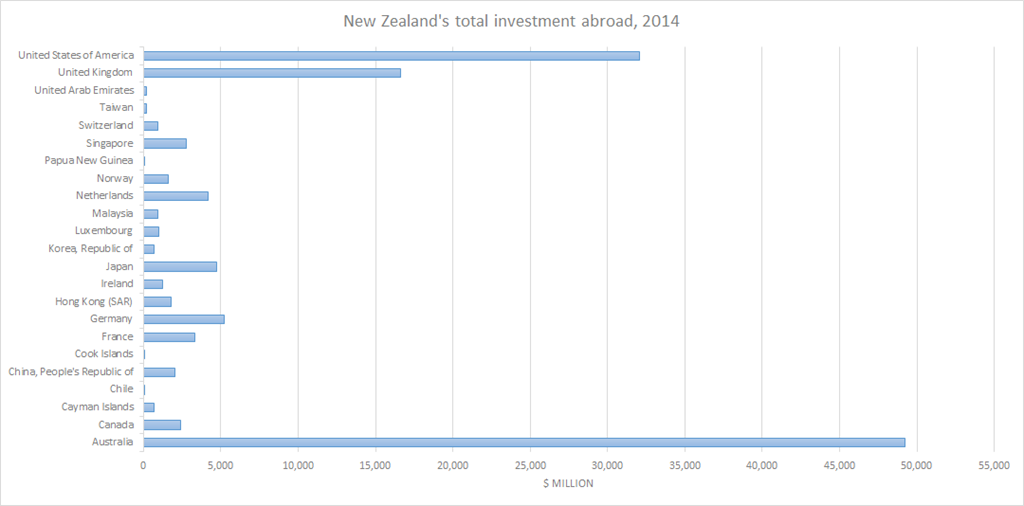
Source: Statistics New Zealand.
In addition, if a foreigner wants to pay over the odds for my house I am glad to separate a fool from his money.
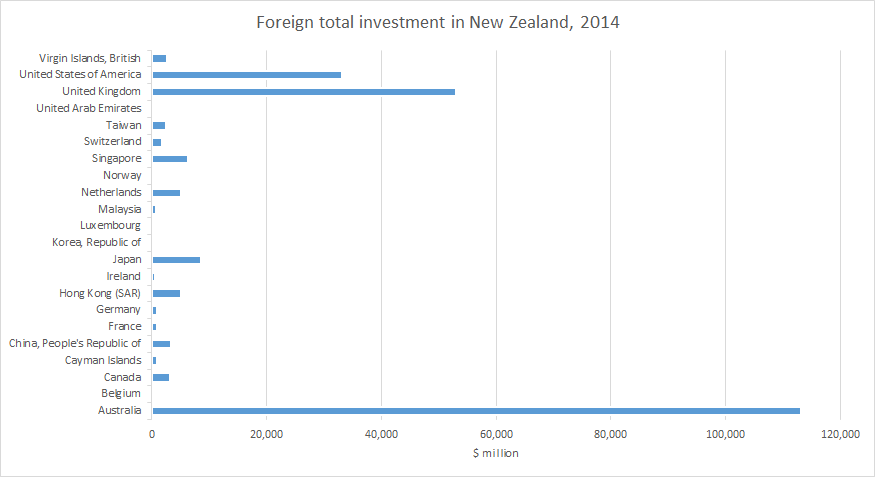
Source: Statistics New Zealand.
New Zealand has a strong interest in protecting the rights of its own expatriates as well as New Zealand foreign investors to buy land in other countries. As David Friedman explains:
Much more commonly, [economic imperialism] is used by Marxists to describe–and attack–foreign investment in “developing” (i.e., poor) nations. The implication of the term is that such investment is only a subtler equivalent of military imperialism–a way by which capitalists in rich and powerful countries control and exploit the inhabitants of poor and weak countries.
There is one interesting feature of such “economic imperialism” that seems to have escaped the notice of most of those who use the term. Developing countries are generally labour rich and capital poor; developed countries are, relatively, capital rich and labour poor. One result is that in developing countries, the return on labour is low and the return on capital is high–wages are low and profits high. That is why they are attractive to foreign investors.
To the extent that foreign investment occurs, it raises the amount of capital in the country, driving wages up and profits down. The effect is exactly analogous to the effect of free migration. If people move from labour-rich countries to labour-poor ones, they drive wages down and rents and profits up in the countries they go to, while having the opposite effect in the countries they come from.
If capital moves from capital-rich countries to capital-poor ones, it drives profits down and wages up in the countries it goes to and has the opposite effect in the countries it comes from. The people who attack “economic imperialism” generally regard themselves as champions of the poor and oppressed.
To the extent that they succeed in preventing foreign investment in poor countries, they are benefiting the capitalists of those countries by holding up profits and injuring the workers by holding down wages. It would be interesting to know how much of the clamour against foreign investment in such countries is due to Marxist ideologues who do not understand this and how much is financed by local capitalists who do.
@nzlabour @NZGreens @jamespeshaw cannot tell the crims from the injustice in the tough new Australian laws on deporting criminals
05 Oct 2015 Leave a comment
in economics of crime, International law, politics - Australia, politics - New Zealand
Australia is introduced tough new deportation laws for noncitizens of bad character that sweep up New Zealanders who may have lived in Australia since childhood.
The new laws provide for automatic deportation of noncitizen criminals. The Immigration Minister used to decide if a criminal who was not an Australian resident was to be deported. Deportations are now automatic, although there are some exemptions and the opportunity for the Minister to intervene in special cases.
Anyone sentenced to more than a year in prison, or for a child-sex related offence automatically loses their visa and is detained to await deportation. This can include cumulative sentences over decades. Anyone spends a total of more one year in a prison is not a petty offender.
If you are a guest in another country, that is not a citizen, you do not go around messing up the place and making a nuisance of yourself. Sooner or later your host will lose patience and send you on your way.
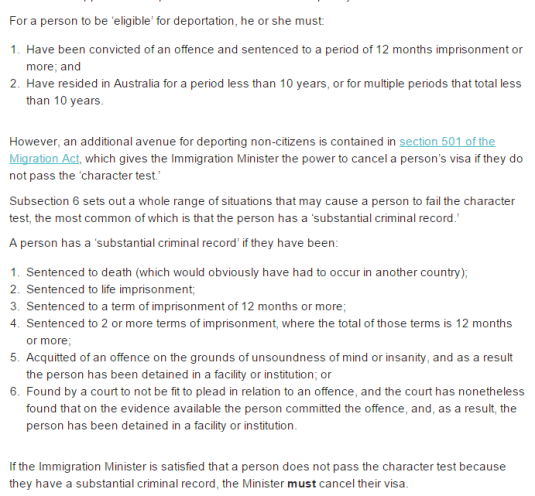
There are injustices in these deportation laws because of a quirk of the New Zealand citizenship law. Some New Zealanders living in Australia cannot pass on their New Zealand citizenship to their children through decent. You cannot become an Australian citizen simply by being born there.
The injustice therefore is some of these New Zealanders who are Samoans whose children spend most of their lives in Australia will be deported back to Samoa because they have Samoan citizenship. They have neither New Zealand nor Australian citizenship.
It is one thing for a criminal to be deported from Australia to New Zealand – both are developed countries. It is another to be deported to a backward Pacific island.
If the New Zealand Labor Party and the New Zealand Greens would take time out for standing up for New Zealand criminals at home and abroad, they might be able to plead with greater success for a deal for these children of New Zealanders who find themselves in a quirky citizenship status. For these children of New Zealanders, their deportation is unusually harsh because they end up back in Samoa, not New Zealand.
Hog heaven! More on exclaves, enclaves and unclaimed territories
19 Aug 2015 Leave a comment
in International law Tags: economics of borders, maps
The Most Complex International Borders in the World
18 Aug 2015 Leave a comment
in International law Tags: economics of borders, maps
Canada & The United States: Bizarre Borders
16 Aug 2015 Leave a comment
in International law, law and economics Tags: borders, economics of borders, maps
Explanation of the Greece Bailout in 90 Seconds
13 Aug 2015 Leave a comment
in budget deficits, business cycles, currency unions, economic growth, fiscal policy, international economic law, international economics, International law, macroeconomics Tags: credible commitments, Eurosclerosis, game theory, Greece, sovereign bailouts, sovereign defaults
Are Hong Kong & Macau Countries?
11 Aug 2015 Leave a comment
in International law Tags: geography, Hong Kong, Macau
Passports in Europe were abolished between 1861-1914
11 Aug 2015 Leave a comment
in international economic law, international economics, International law Tags: passports
@BrankoMilan Passports in Europe were abolished between 1861-1914 "History of Passports" bit.ly/1N5QSRo http://t.co/P97W2FCKJS—
Old Whig (@aClassicLiberal) August 04, 2015
 Utopia, you are standing in it!
Recent Comments