
Millennials Don’t Know What “Socialism” Means
11 Feb 2015 Leave a comment
in comparative institutional analysis, constitutional political economy, economics of media and culture, Marxist economics, politics - USA Tags: economics of socialism, rational ignorance, rational irrationality


The ruling class versus YouTube
06 Feb 2015 2 Comments
in Marxist economics, Public Choice Tags: conspiracy theories, conspiracy theorists, ruling class, YouTube
The Treason Of The Clerisy: Capitalism And The Intellectuals After 1848
02 Feb 2015 Leave a comment
in development economics, economic history, growth disasters, growth miracles, Marxist economics Tags: capitalism and freedom, Deirdre McCloskey, The Great Enrichment, The Great Fact
Deirdre McCloskey is of the view that the “the clerisy” has been, with notable exceptions, hostile to capitalism and downright contemptuous of the morals and attitudes of the middle class that has flourished under capitalism:
The Germans called it the Clerisei or later the Bildungsbürgertum, the cultivated and reading as against the commercial and bettering bourgeoisie. In the eighteenth century the members of the clerisy such as Voltaire and Tom Paine had courageously advocated our liberties.
But in the 1830s and 1840s a much enlarged clerisy, mostly the sons of bourgeois fathers, commenced sneering at the liberties the fathers exercised so vigorously in the market and the factory.
On the right the clerisy under the influence of Romance looked back with nostalgia to an imagined medieval time without markets, in which stasis and hierarchy ruled…
On the left, meanwhile, the clerisy, likewise influenced by Romance, and then by historical materialism, developed the illiberal idea that ideas do not matter.
What matters to progress, they declared, is the unstoppable tide of history, aided (they declared further, contradicting themselves) by protests or strikes or even violent revolutions directed at the thieving bourgeoisie, movements to be led of course by the clerisy.
Later, in European socialism and American progressivism, the left proposed to defeat bourgeois monopoly of markets by gathering under regulation or central planning or ownership of the means of production all the monopolies into one big monopoly of violence called the state.
Yet the commercial bourgeoisie so despised by the clerisy left and right made the Great Enrichment and the modern world.
The Enrichment gigantically improved our lives, showing that both social Darwinism and economic Marxism were mistaken. The genetically inferior races and classes and ethnicities proved not to be so. The exploited proletariat was not immiserised but enriched.
and
Forcing in an illiberal way the French style of equality of outcome, cutting down the tall poppies, treating people as sad children to be engineered by the experts of the clerisy, we have found, has often had a high cost in damaging liberty and slowing betterment. Not always, but often.
On the other hand, introducing the Scottish style of equality of liberty and dignity, as in Hong Kong and Norway and France itself, has regularly led to an astounding betterment and to a real equality of outcome—with even the poor acquiring automobiles and plumbing denied in earlier times even to the rich, and acquiring political rights and social dignity denied in earlier times to everyone except the rich
A great hard left critique of the Greens continued
31 Jan 2015 Leave a comment
in environmentalism, Marxist economics, politics - New Zealand Tags: activists, British politics, do gooders, environmental movement, expressive voting, Greens, Leftover Left

A great hard left critique of the Greens
30 Jan 2015 Leave a comment
in environmentalism, Marxist economics, politics - New Zealand Tags: activists, do gooders, expressive voting, Leftover Left, The Greens, UK politics


The Doomsday Clock is seriously awry
24 Jan 2015 Leave a comment
Things are worse than in the 1980s. What nonsense.
Paul Samuelson’s repeated predictions of the Soviet Union economy catching up with the USA
24 Jan 2015 1 Comment
in economic history, economics of bureaucracy, growth disasters, Marxist economics Tags: fall of communism, fall of the USSR, forecasting errors, Paul Samuelson, The fatal conceit, The pretence to knowledge
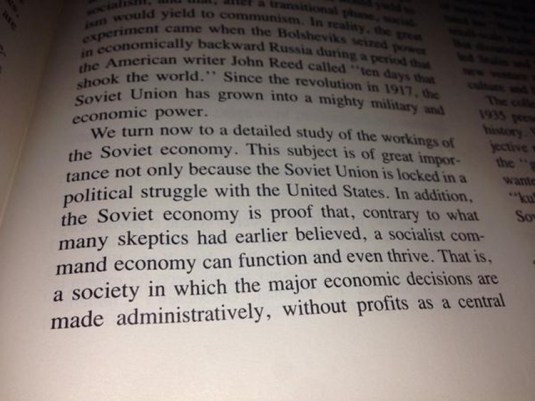
Paul Samuelson wrote in the 1961 edition of his famous economics textbook that GNP in the Soviet Union was about half that in the United States but the Soviet Union was growing faster.
Figure 1: Samuelson’s 1961 Forecast of Soviet catch up

Source: Levy and Peart (2006)
As a result, Soviet GNP would exceed that of the United States by as early as 1984 or perhaps by as late as 1997, depending on whether you were reading the early 1960s or later editions of Samuelson’s immensely popular textbook. In the 1980 edition there was little change in the analysis, though the two dates were delayed to 2002 and 2012
Samuelson predicted that the Soviet Union would catch up with the United States and kept predicting this until 1989 in every edition of his textbook of which there are at least 14. Levy and Peart were good enough to tabulate these predictions by Samuelsson of Soviet catch up with the USA over the editions of his textbook in the table below.
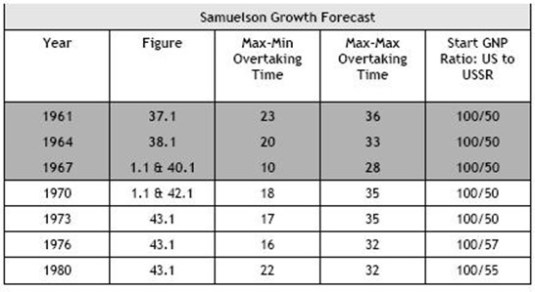
Source: Levy and Peart (2009)
Samuelson’s predictions of the Soviet Union catching up to and overtaking the United States were echoed in most other major economics textbooks of his time.
Plainly, they all got it wrong except for the Austrian economists, Eastern bloc émigrés and G. Warren Nutter.
From 1956 to 1961, Nutter undertook a massive study of the history of the economy of the Soviet Union and published The Growth of Industrial Production in the Soviet Union in 1962.
Nutter’s study concluded that Soviet economic growth over the first half of the 20th Century was indeed remarkable, and that there had been periods of growth spurts, but when the entire Soviet period was taken into consideration, Soviet growth lagged behind Western economies and Soviet economic capacity showed every sign of falling further behind rather than catching up with the West.
Nutter’s conclusions were certainly not welcomed by the Sovietologists of his time. As the fall of the Soviet Union revealed more realistic data, Nutter’s estimates of Soviet growth rates have been vindicated, and in fact, if anything Nutter overstated rather than understated Soviet economic performance.
Paul Craig Roberts found worse exaggeration with the Romanian economy in 1979. A World Bank report, Romania: The Industrialization of an Agrarian Economy under Socialist Planning, credited central planning with achieving a 9.8 annual rate of economic growth over the quarter century from 1950 to 1975. It should be added that in the 1970s, Romania was a western favourite because of its independent stance within the Eastern European bloc.
The World Bank did not realize that using these growth rates to project backward these growth figures on Romanian income per capita quickly produced a figure too low to sustain life. This mistake provoked the Wall Street Journal observation:
We have heard exaggerated claims made for central economic planning, but never that it resurrected a whole nation from the dead.
Samuelson never reflected in his later textbooks after 1989 about how wrong he was for many decades about Soviet economic performance. Few people, thank you for admitting that there you’re wrong – they are more likely to dance on the grave of your error.
In Paul Samuelson’s case, he had more reasons of most to learn from his failed predictions because as his predictions didn’t work out, he had to rewrite and update his book and charts predicting the USSR was going to overtake the USA in about 20 years.
Rather than the suspect that there something wrong with the Soviet economic system, Paul Samuelson looked for excuses – increasingly pathetic excuses. As Larry White explained:
In the seven editions of his textbook published from 1961 to 1980, Samuelson kept including a chart indicating that Soviet output was growing faster that U.S. output, and predicting a catch-up in about twenty-five years. He repeatedly had to move the predicted catch-up date forward from the previous edition because the gap had never actually begun to close. In several editions he blamed low realized Soviet growth on bad weather.
What is more puzzling is Samuelson did update his views on the merits of fiscal and monetary policy in stabilising the economy, and the effectiveness of each over the decades in light of experience and between the 1960s and 1980s. In the 1948 edition of his best-selling textbook, Economics, Samuelson wrote that:
few economists regard Federal Reserve monetary policy as a panacea for controlling the business cycle.
In 1967 Samuelson said that monetary policy had “an important influence” on total spending. His 1985 edition states;
“Money is the most powerful and useful tool that macroeconomic policymakers have,” adding that the Fed “is the most important factor” in making policy.
Samuelson’s 1967 edition said policymakers faced a trade-off between inflation and unemployment. His 1980 edition said there was less of a trade-off in the long run than in the short run. The 1985 edition, he said there is no long-run trade-off between unemployment and inflation.
Samuelson gave quite compelling reasons as to why Keynesianism declined:
- Keynesian macroeconomists and policymakers made the mistake of projecting the experience of the Great Depression onto the post-war era;
- it turned out that, contrary to what Keynes had said, monetary policy mattered a lot; and
- The final blow to Keynesianism was stagflation: There is nothing in Keynesian macroeconomics that would allow you to solve stagflation.
Samuelson did not learn in the same way from brute experience regarding the economics of socialism.
Via Why Were American Econ Textbooks So Pro-Soviet? Bryan Caplan | EconLog | Library of Economics and Liberty and Soviet Growth & American Textbooks.



Recent Comments