Piketty on inequality: views of the IGM economic experts
16 Oct 2014 Leave a comment
in applied price theory, applied welfare economics, comparative institutional analysis, constitutional political economy, discrimination, economic growth, entrepreneurship, gender, human capital, income redistribution, industrial organisation, labour economics, Marxist economics, Rawls and Nozick Tags: Daron Acemoglu, James Robinson, Piketty, poverty and inequality, The Great Enrichment
Question: The most powerful force pushing towards greater wealth inequality in the US since the 1970s is the gap between the after-tax return on capital and the economic growth rate?
Daron Acemoglu and James Robinson have a simple explanation for why Piketty is wrong:
But like Marx, Piketty goes wrong for a very simple reason. The quest for general laws of capitalism or any economic system is misguided because it is a-institutional.
It ignores that it is the institutions and the political equilibrium of a society that determine how technology evolves, how markets function, and how the gains from various different economic arrangements are distributed.
Despite his erudition, ambition, and creativity, Marx was ultimately led astray because of his disregard of institutions and politics. The same is true of Piketty.
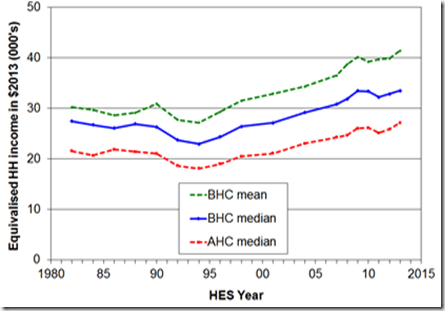
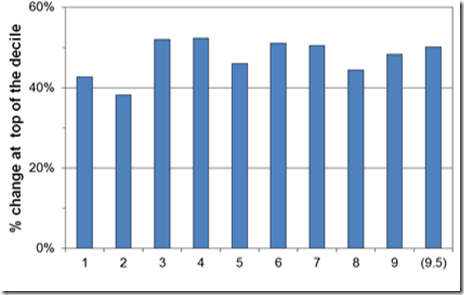
David Friedman on Director’s law and and poverty and inequality under capitalism
13 Oct 2014 Leave a comment
in applied welfare economics, comparative institutional analysis, David Friedman, Marxist economics Tags: David Friedman, Director's Law, poverty versus inequality, That Great Enrichment

HT: Cafe Hayek
Not Many People Got Past Page 26 Of Piketty’s Book
25 Sep 2014 Leave a comment
in economics of media and culture, Marxist economics Tags: Thomas Piketty
Professor Jordan Ellenberg looked at the five most popular book passages in a number of current best-sellers, according to data from Amazon Kindle readers. He determined the average page number readers highlighted and divided that by the total number of pages in the book.
A high number, according to Ellenberg, means that readers are reading until the end. Donna Tartt’s Pulitzer Prize-winning blockbuster, The Goldfinch, for example, earned a score of 98.5 percent on the index.
Piketty’s book scored a dismal 2.4 percent. The latest of the five most popular highlights in Piketty’s book is located on page 26, according to the Ellenberg.
The Putin Effect on transitional economies in the former Soviet union
14 Sep 2014 Leave a comment
in development economics, growth disasters, growth miracles, income redistribution, Marxist economics, Public Choice, rentseeking Tags: development, development miracles, disasters, former Soviet Union, Poland, The Great Enrichment, transitional economies, Ukraine

Poland was in the same position as Ukraine after the collapse of the Soviet empire, but it followed better policy and is now several times richer.
Fact check: conspiracy theories aren’t just for conservatives
29 Aug 2014 Leave a comment
in F.A. Hayek, Marxist economics, Milton Friedman, politics - USA Tags: Anti-Science left, conspiracy theories, conspiratorial left, FA Hayek, GMOs, Milton Friedman, Mont Pelerin Society, neoliberal conspiracies, neoliberalism, precautionary principle
Respondents were asked whether they agreed with four statements:
- “Much of our lives are being controlled by plots hatched in secret places,”
- “Even though we live in a democracy, a few people will always run things anyway,”
- “The people who really ‘run’ the country are not known to the voters.”
- “Big events like wars, the current recession, and the outcomes of elections are controlled by small groups of people who are working in secret against the rest of us.”

Source: monkey cage
American conservatives distrust science in part because they identify it with the regulatory state. When science means nuclear weapons, innovation and winning the space race, conservatives love it. When they associate science with the EPA, regulation, and global institutions, they hate it.
Just as climate science is unpalatable for the Right, the Left is uncomfortable with, for example, genetic modification and nuclear power. Research into risks and benefits of these technologies are met with suspicion by the Left.

I find it bizarre the right wing politics is considered more conspiratorial than the left wing – a left-wing that is currently obsessed with the comings and goings of the top 1%.

A gentleman by the name of Karl Marx had a conspiracy theory of history, that the bosses were conspiring against the workers, there is a ruling class pulling the strings from behind the scenes, and there is an inherent inequality of bargaining power between workers and employers because the bosses plot to keep wages down.
It should be mentioned in this connection that Karl Marx himself was one of the first to emphasize the importance, for the social sciences, of these unintended consequences.
In his more mature utterances, he says that we are all caught in the net of the social system. The capitalist is not a demoniac conspirator, but a man who is forced by circumstances to act as he does; he is no more responsible for the state of affairs than is the proletarian.
This view of Marx’s has been abandoned – perhaps for propagandist reasons, perhaps because people did not understand it – and a Vulgar Marxist Conspiracy theory has very largely replaced it. It is a come-down – the come-down from Marx to Goebbels.
But it is clear that the adoption of the conspiracy theory can hardly be avoided by those who believe that they know how to make heaven on earth. The only explanation for their failure to produce this heaven is the malevolence of the devil who has a vested interest in hell.
Karl Popper

Don’t let me start on how the Left over Left goes on about neoliberal conspiracy with Hayek and Friedman ruling the roost through the truly obscure Mont Pelerin Society.


The IMF, World Trade Organisation and trade negotiations are riddled with conspiracies if I am to believe my friends in the Left over Left.

Mention multinational corporations to a member of the Left of good standing and conspiracy theories pour fourth.

It would be unfair to bring up GMOs to remind the left of how anti-science it is. Don’t kick people when they’re down. The whole point of the precautionary principle is to allow the Left to reject good science.


At bottom, what call the barricades works if it’s not sexed-up with a conspiracy theory?
Paul Samuelson (1989) on the bright future of the Soviet Union
28 Jul 2014 Leave a comment
in comparative institutional analysis, Marxist economics Tags: fall of communism, forecasting, Paul Samuelson
Capitalists do not exploit workers
16 Jul 2014 Leave a comment
in applied price theory, entrepreneurship, Marxist economics Tags: marxist economics, Marxist exploitation, surplus value

Workers exploit capitalists who start businesses that fail. Workers are paid more than they add in labour value to failed start-ups.
- A self-employed farmer scraping a living with the help of a part-timer is exploiting that worker while a manager who owns no shares on a salary of $500,000 a year is a downtrodden and exploited member of the proletariat!
- Elite athletes, celebrities and TV and movie stars are the most exploited of all proletarians. Itinerant workers with no income security at all. At the mercy of the selectors, record companies and studios. 15 minutes of fame is fleeting.
- Many capitalists scrape a living and often go bankrupt and lose their house and marriage after business failures while many workers are highly paid.
- The university educated are well-paid proletarians with low unemployment rates.
- How is your superannuation portfolio going? Riding high on the fat of the working class?
- Pension fund socialism was never a promise of long-run super-normal profits.
- Despite the majority of labour surplus now going back into the hands of workers in their retirement savings, the share market is still a dog or is it?


Recent Comments