The Tobin tax or @RobinHoodTax makes those monetary cranks in the social credit movement look credible!

Sweden led the way with Tobin taxes in 1986: a 0.5% tax on the purchase or sale of an equity security. The revenues from the Tobin tax were initially expected to be 1,500 million Swedish kronor per year.

The actual revenues collected did not amount to more than 80 million Swedish kronor in any year and the average was closer to 50 million. Bond trading fell by more than 80 percent and the options market died. A lesson never learned by Tobin tax advocates. As taxable trading volumes fell, so did revenues from capital gains taxes, entirely offsetting the revenues from the equity transactions tax.

During the first week of the Swedish tax, the volume of bond trading fell by 85%; futures trading fell by 98%; and the options trading market disappeared. Trading for over 50% of Swedish equities moved to London by 1990. A true Robin Hood tax: the Tobin tax robbed from the Swedish capital gains taxman and gave to the British stamp duty taxman.

The Tobin tax is named after U.S. economist James Tobin who in 1972 suggested taxing foreign-exchange trades to limit currency speculation.

The Tobin tax on foreign-exchange transactions was to provide a disincentive for traders to make so many international transfers of money. Tobin in 1978 wrote that currency speculation can have ‘serious and painful internal economic consequences’. Tobin said his Tobin tax idea was unfeasible in practice.

Tobin and his idea of taxing of currency speculation improves market efficiency is total nonsense in theory as Milton Friedman explained:

The empirical generalization about the prevalence of destabilizing speculation, which is what gives the theoretical proposition its interest, seems to be one of those propositions that has gained currency the way a rumour does— each man believes it because the next man does, and despite the absence of any substantial body of well documented evidence for it.

Is the Tobin tax designed to raise 35 billion euros in revenue, as promised by EU Tax Commissioner Algirdas Semeta, or is it designed to curb speculation as was the original motivation by James Tobin to propose this tax?

Many have extolled such a tax as a potential source of earmarked revenues for a variety of purposes. Both left-wing and right wing populists have advocated the Tobin tax or Robin Hood tax to replace existing taxes or raise additional  revenue.

Both types of populist advocate replacing or augmenting the income tax with a stamp duty. Enough people are familiar when stamp duties to realise that such a tax won’t raise much revenue. But if you call the stamp duty a Robin Hood tax, the media release suspends critical judgement  and cheers them on.

Advocates of the Robin Hood tax blithely assert that the revenue raised will approximately equal 0.5% of the existing share and foreign exchange market turnover with few changes in behaviour or speculative activity, despite the imposition of a tax designed to curb speculation and reduce the total number of transactions significantly.

The $3.7 trillion-a-year Eurobond market came into being after JFK imposed an interest-equalization tax in 1963 to reduce investment in foreign securities by U.S. investors and to ease a so called balance of payments deficit.

What is the point of a Tobin tax if you already have a capital gains tax?. New Zealand doesn’t have a capital gains tax but it does have a tax on assets bought with the intention of resale rather than long-term income.

Why do share markets fall after the announcement of a Tobin tax? Trading in a more stable market should be value enhancing and increase share prices? Ditto exporters and more stable currency prices etc.? Exporter share prices should increase because of less need to hedge? Numerous studies find a significant reduction in equity turnover following a stamp duty introduction.

I am sure that with the City of London as a global financial centre, the British are cheering on efforts of other EU members to sabotage their own financial markets with a Tobin tax. FX turnover in the City of London reached over $1.8 trillion every day in 2010, accounting for 36.7% of the global total. About half of European investment banking activity is conducted through London.

Ed Prescott estimates a large quantity of intermediated borrowing-lending between households – several times GDP.  A large amount of resources is used in this intermediation – a conservative estimate is 4% of GNP.

Prescott also argued that the cost of transferring financial assets has fallen dramatically – from 2% towards zero on Vanguards Indexed ETF. The spread between borrowing and lending by households down – the spread on home mortgages was 3% in 1960s – now about 2%. None of these trends bode well for either a large tax base or growing tax base.

Another way to think about a Tobin tax is to consider it to be a tax on ATM withdrawals. There was such a debits tax on bank withdrawals of $.20 in my home State of Tasmania  in the 1980s.

Naturally, a Tobin tax on ATM withdrawals is not a tax on any sort of real economic activity. People would simply make fewer ATM withdrawals and look for other ways to not use ATMs. It is routine for cash balances to respond to the time and other costs of replenishing money balances, and the fixed cost of using deposits for purchases.

HT: Does a Tobin Tax Make Sense?

The most important aspect of monetary strategy is timing

The simplest statement to make about the lags in monetary policy is they are long and variable. This simple statement is also the key insight to understanding the actual implementation of monetary policy. Hence, how many months or years in advance must a central bank forecast to achieve its monetary goals? In 1994, the Economist said:

But [central banks] cannot afford to wait until inflation is actually rising before they act. Monetary policy does not change the speed of the economy instantly: it can take 18 months or more for a rise in interest rates to have its full impact on inflation. The target of policy ought therefore to be future not current inflation, in order to prevent a surge in 1996. The earlier interest rates are raised, the better the chances of engineering a smooth slowdown to a sustainable rate of growth before slack in the economy is exhausted.

Economists differ about the length of those lags. Uncertainty about the average length of those lags and the variability of those lags makes discretion most difficult. Activist policy can improve welfare only if the information about economic structure and economists’ ability to forecast is sufficiently accurate.

Early_sample

Friedman is the most famous and persuasive critic of Keynesianism on the grounds of lags. He has two main arguments: first, that there are “long and variable lags” between the identification of a problem and the effects of the designed remedy; second, that activist policy often itself becomes a source of instability since policy itself becomes a variable that the market must guess.

Friedman’s critique does not depend on the quantity theory of money. Keynesian policies do not necessarily follow even if the Keynesian theory of the business cycle were conclusively proved.

It must also be demonstrated that the government has the ability and willingness of the government to act as the theory prescribes. We are therefore further assuming that central banks have the incentive to stabilise the economy. If the government lacks the information required to stabilise the economy, issues of public choice incentives become fully redundant. Incentives to pursue an objective do not matter if the objective itself is unattainable.

Milton Friedman on the social responsibilities of business

Milton Friedman, social responsibility of business

Image

Competing visions of central banking

Economics: A Million Mutinies Now, Part Two - feat. image

The competing visions of central banks over monetary policy have been defined by Franco Modiglani and Milton Friedman respectively. Modiglani considers the Keynesian vision of macroeconomic policy to be:

a market economy is subject to fluctuations which need to be corrected, can be corrected, and therefore should be corrected.

The Keynesian claim implies that central banks have sufficient knowledge of the structure of the economy to be able to choose the policy mix appropriate to a given set of circumstances. It is possible to target unemployment, interest rates and inflation in such a way that they can be maintained (and hence made predictable) by constant adjustment of policy instruments to new shocks.

The Keynesian approach assumes that the economy can slip into recessions for all sorts of reasons (Barro 1989). Business fluctuations result from shocks to aggregate demand. The principal source of these shocks are expectations induced shifts in investment demand. The role of the central bank is to make prompt, frequent policy responses to counteract this instability.

The task of government is to discover the particular monetary and fiscal polices which can eliminate shocks emanating from the private sector. A key finding of recent macroeconomic research is that anticipated monetary policy has very different effects to unanticipated monetary policy.

The Keynesian vision thus presuppose that government can foresee shocks which are invisible to the private sector but at the same time it is unable to reveal this advance information in a credible way and hence defusing the shock because it is no longer unanticipated. In addition, the counter cyclical monetary policies of governments must themselves be unforeseeable by private agents, but at the same time systematically related to the state of the economy (Lucas and Sargent 1979)

Of course, the Keynesian view of central banking is also premised on a goodwill theory of government. Governments pursue policies that are in the public interest. That is a public interest that is well-defined and is free of conflicts over income distribution, electoral success and power the could lead policy-makers to pursue goals other than full employment, stable prices and efficiency. Thus, if the latest forecast is a recession, additional stimulus is the usual prescription. However, since most Keynesian economists accept the permanent income and natural rate hypotheses, more stimulus implies less later at some unknown time.

Friedman’s vision of central banking is far more circumspect:

The central problem is not designing a highly sensitive [monetary] instrument that offsets instability introduced by other factors[in the economy], but preventing monetary arrangements becoming a primary source of instability (Milton Friedman 1959).

Friedman considers that a key element in the case for policy discretion is whether the sufficient information is available that can be used to reduce variability and assist the economy’s adjustment the unforeseen. A well intentioned policy-maker will destabilise if he is mislead by incomplete or incorrect information.

From the monetarist standpoint, price stability can be approximately attained under a well chosen and predictable monetary policy rule. Under this view, the unemployment and interest rates are unpredictable and can manipulated only at a prohibitive cost. The Keynesian and monetarist views are mutually incompatible and lead to very different policy recommendations (Lucas 1981).

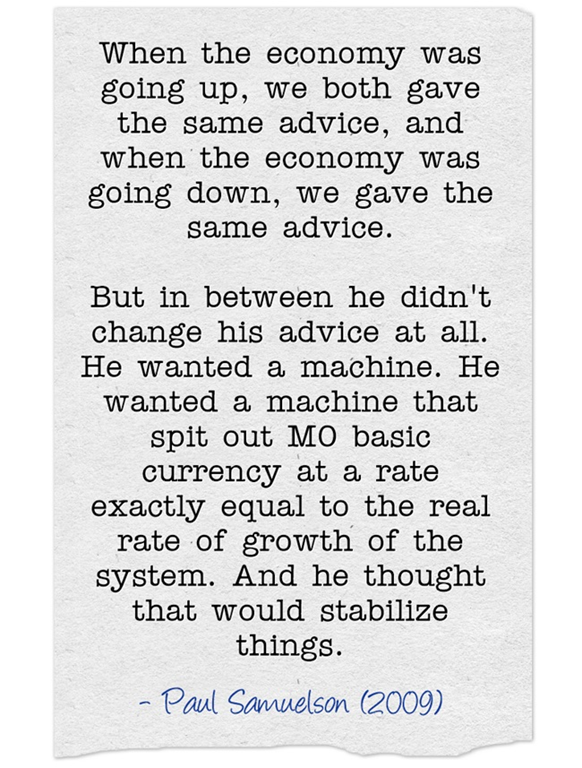
Paul Samuelson on where he disagreed with Milton Friedman on macroeconomic policy

Paul Samuelson on where he disagreed with Milton Friedman

via Samuelson vs. Friedman, David Henderson | EconLog | Library of Economics and Liberty and An Interview With Paul Samuelson, Part One — The Atlantic.

After reading the annual reports of the Fed, Milton Friedman noticed the following pattern

Milton Friedman reading fed annual reports

.

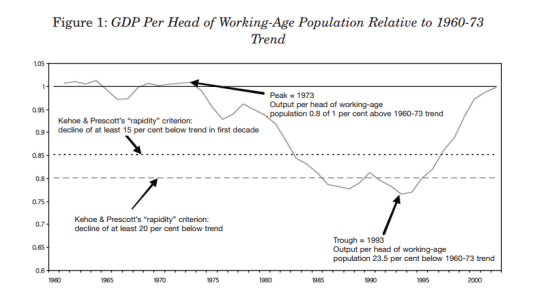
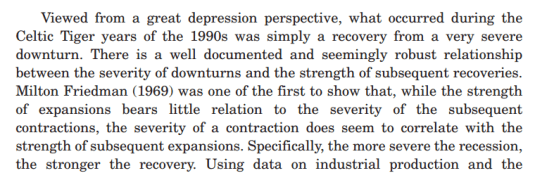
Finn Kydland on the myth of the Celtic Tiger

Finn Kydland has a simple explanation for the so-called Celtic Tiger. It was a recovery from a deep depression in the 1970s and 1980s in the Irish economy.

HT: “Ireland’s Great Depression,” Finn Kydland, Alan Ahearne and Mark A. Wynne, The Economic and Social Review 37(2), Summer/Autumn 2006, 215-243. (pdf)

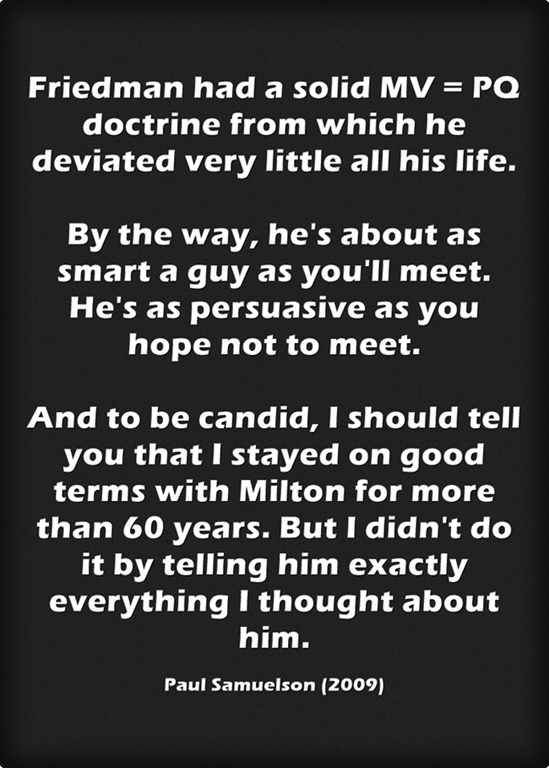
Paul Samuelson on Milton Friedman

Samuelson on Friedman Paul Samuelson on Milton Friedman

via Samuelson vs. Friedman, David Henderson | EconLog | Library of Economics and Liberty and An Interview With Paul Samuelson, Part One — The Atlantic.

Milton Friedman on the impact of brute experience on central bankers

Image

Milton Friedman on pre-Keynesian macroeconomics

Image

In crisis, there is opportunity

image

Image

Milton Friedman on how New Keynesian Macroeconomics is mostly monetarism

Image

Harry Johnson on what makes for an intellectual revolution

Image

Milton Friedman In Iceland in 1984–skip 1st 80 seconds

via Milton Friedman In Iceland in 1984.

The success of monetarism and the death of the correlation between monetary growth and inflation

The Velocity of Money

Monetarists blame fluctuations in inflation on excessively volatile growth in monetary aggregates. In 1982, Friedman defined monetarism in an essay on defining monetarism as follows:

Like many other monetarists, I have concluded that the most important thing is to keep monetary policy from doing harm.

We believe that a steady rate of monetary growth would promote economic stability and that a moderate rate of monetary growth would prevent inflation

The U.S. data supported this hypothesis about the volatility of monetary growth and inflationuntil 1982, but since 1983 monetary aggregates have been essentially uncorrelated with subsequent inflation in the U.S.

Levis Kochin pointed out in 1979 that a well designed monetary policy would lead to zero correlation between any measure of monetary policy and subsequent inflation. The reason for this is the correlation between any variable and a constant is zero.

If monetary growth is stable, say, a constant growth rate of 4% per year, as advocated by Milton Friedman, monetary growth will have no correlations with any variable:

Poole (1993, 1994) and Tanner (1993) also argue that one predictable consequence of optimal monetary policy is that the correlation between monetary policy instruments and policy goals will be driven to zero.

Poole further contends that it is obvious to any careful reader of Theil (1964) that optimally variable policy will give rise to a zero correlation between policy and goal variable…

In 1966 Alan Walters, a U.K. monetarist, observed:

If the [monetary] authority was perfectly successful then we should observe variations in the rate of change of the stock of money but not variations in the rate of change of income… [a]ssuming that the authority’s objective is to stabilize the growth of income.

Milton Friedman in 2003, wrote about how the Fed acquired a good thermostat:

The contrast between the periods before and after the middle of the 1980s is remarkable.

Before, it is like a chart of the temperature in a room without a thermostat in a location with very variable climate; after, it is like the temperature in the same room but with a reasonably good though not perfect thermostat, and one that is set to a gradually declining temperature.

Sometime around 1985, the Fed appears to have acquired the thermostat that it had been seeking the whole of its life…

Prior to the 1980s, the Fed got into trouble because it generated wide fluctuations in monetary growth per unit of output. Far from promoting price stability, it was itself a major source of instability as Chart 1 illustrates.

Yet since the mid ’80s, it has managed to control the money supply in such a way as to offset changes not only in output but also in velocity.

Nick Rowe explained the difficulty of causation and correlation under different policy regimes and Milton Friedman’s thermostat superbly as an econometric problem Nick Rowe:

If a house has a good thermostat, we should observe a strong negative correlation between the amount of oil burned in the furnace (M), and the outside temperature (V).

But we should observe no correlation between the amount of oil burned in the furnace (M) and the inside temperature (P). And we should observe no correlation between the outside temperature (V) and the inside temperature (P).

An econometrician, observing the data, concludes that the amount of oil burned had no effect on the inside temperature. Neither did the outside temperature. The only effect of burning oil seemed to be that it reduced the outside temperature. An increase in M will cause a decline in V, and have no effect on P.

A second econometrician, observing the same data, concludes that causality runs in the opposite direction. The only effect of an increase in outside temperature is to reduce the amount of oil burned. An increase in V will cause a decline in M, and have no effect on P.

But both agree that M and V are irrelevant for P. They switch off the furnace, and stop wasting their money on oil.

Subsequent work of Levis Kochin showed that if the effects of fluctuations in monetary aggregates were not precisely known then the optimal policy would produce negative correlations between monetary aggregates and inflation:

The negative correlation results from coefficient uncertainty because the less certain we are about the size of a multiplier, the more cautious we should be in the application of the associated policy instrument.

Therefore, although optimal policy leads to lack of correlation between the goal and control variables if the coefficient is known, it will lead to a negative relationship if there is coefficient uncertainty. The higher the uncertainty, the more cautious will be the optimal policy response. Also, if the control variable can’t be controlled perfectly then the correlation between the goal and the control variable becomes positive i.e., the control errors are random…

Uncertainty about the impact of a policy  will stay the hand of any bureaucrat , much less a central banker, as Kochin and his co-author explain:

Uncertainty should lead to less policy action by the policymakers. The less policymakers are informed about the relevant parameters, the less activist the policy should be. With poor information about the effects of policy, very active policy runs a higher danger of introducing unnecessary fluctuations in the economy.

Previous Older Entries Next Newer Entries

Libertarian Land

Celebrating humanity's flourishing through the spread of capitalism and the rule of law

Arin’s Substack

Celebrating humanity's flourishing through the spread of capitalism and the rule of law

David Andolfatto

Celebrating humanity's flourishing through the spread of capitalism and the rule of law

Monetary Non-Neutrality

Celebrating humanity's flourishing through the spread of capitalism and the rule of law

Reason Magazine

Celebrating humanity's flourishing through the spread of capitalism and the rule of law

Coyote Blog

Celebrating humanity's flourishing through the spread of capitalism and the rule of law

Thoughts from the North

Celebrating humanity's flourishing through the spread of capitalism and the rule of law

Fardels Bear

A History of the Alt-Right

Vincent Geloso

Econ Prof at George Mason University, Economic Historian, Québécois

Bassett, Brash & Hide

Celebrating humanity's flourishing through the spread of capitalism and the rule of law

Truth on the Market

Scholarly commentary on law, economics, and more

The Undercover Historian

Beatrice Cherrier's blog

Matua Kahurangi

Celebrating humanity's flourishing through the spread of capitalism and the rule of law

Temple of Sociology

Celebrating humanity's flourishing through the spread of capitalism and the rule of law

Velvet Glove, Iron Fist

Celebrating humanity's flourishing through the spread of capitalism and the rule of law

Why Evolution Is True

Why Evolution is True is a blog written by Jerry Coyne, centered on evolution and biology but also dealing with diverse topics like politics, culture, and cats.

NoTricksZone

Celebrating humanity's flourishing through the spread of capitalism and the rule of law

Homepaddock

A rural perspective with a blue tint by Ele Ludemann

Kiwiblog

DPF's Kiwiblog - Fomenting Happy Mischief since 2003

The Dangerous Economist

Celebrating humanity's flourishing through the spread of capitalism and the rule of law

Watts Up With That?

The world's most viewed site on global warming and climate change

The Logical Place

Tim Harding's writings on rationality, informal logic and skepticism

Doc's Books

A window into Doc Freiberger's library

The Risk-Monger

Let's examine hard decisions!

Uneasy Money

Commentary on monetary policy in the spirit of R. G. Hawtrey

Barrie Saunders

Thoughts on public policy and the media

Liberty Scott

Celebrating humanity's flourishing through the spread of capitalism and the rule of law

Point of Order

Politics and the economy

James Bowden's Blog

A blog (primarily) on Canadian and Commonwealth political history and institutions

Science Matters

Reading between the lines, and underneath the hype.

Peter Winsley

Economics, and such stuff as dreams are made on

A Venerable Puzzle

"The British constitution has always been puzzling, and always will be." --Queen Elizabeth II

The Antiplanner

Celebrating humanity's flourishing through the spread of capitalism and the rule of law

Bet On It

Celebrating humanity's flourishing through the spread of capitalism and the rule of law

History of Sorts

WORLD WAR II, MUSIC, HISTORY, HOLOCAUST

Roger Pielke Jr.

Undisciplined scholar, recovering academic

Offsetting Behaviour

Celebrating humanity's flourishing through the spread of capitalism and the rule of law

JONATHAN TURLEY

Res ipsa loquitur - The thing itself speaks

Conversable Economist

In Hume’s spirit, I will attempt to serve as an ambassador from my world of economics, and help in “finding topics of conversation fit for the entertainment of rational creatures.”

The Victorian Commons

Researching the House of Commons, 1832-1868

The History of Parliament

Articles and research from the History of Parliament Trust

Books & Boots

Reflections on books and art

Legal History Miscellany

Posts on the History of Law, Crime, and Justice

Sex, Drugs and Economics

Celebrating humanity's flourishing through the spread of capitalism and the rule of law

European Royal History

Exploring the Monarchs of Europe

Tallbloke's Talkshop

Cutting edge science you can dice with