The Flores Settlement is the Backbone of Detained Migrant Children’s Rights
03 Jul 2019 Leave a comment
in law and economics, politics - USA Tags: economics of immigration
Commie Con | Real Time with @BillMaher (HBO)
03 Jul 2019 Leave a comment
in politics - USA, television Tags: 2020 presidential election
Thomas Sowell and a Conflict of Visions
03 Jul 2019 Leave a comment
in comparative institutional analysis, discrimination, economic history, economics of bureaucracy, labour economics, politics - USA, Public Choice, Thomas Sowell
Criminals prefer the shadows @sst_nz
02 Jul 2019 Leave a comment
in economics of crime, law and economics, occupational choice, politics - USA Tags: crime and punishment, criminal deterrence, law and order

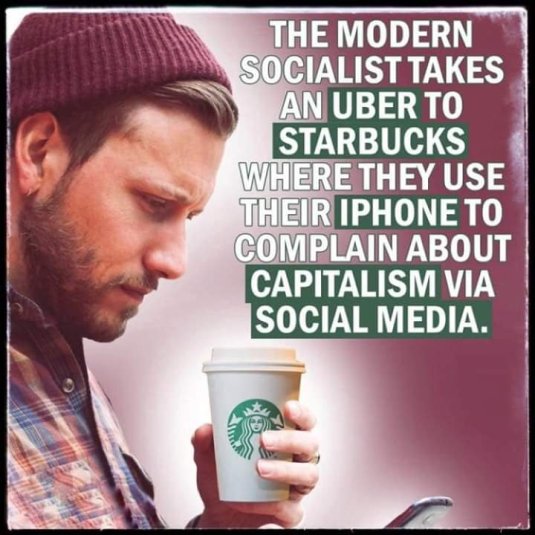
Is this fairly accurate?
02 Jul 2019 Leave a comment
in Marxist economics, politics - USA Tags: political correctness

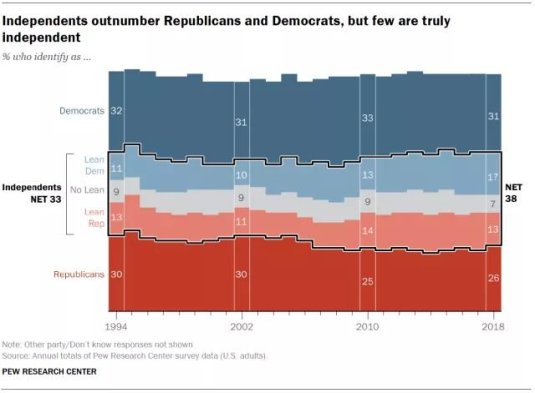
Who will challenge Donald Trump in 2020? | The Economist
02 Jul 2019 Leave a comment
in politics - USA Tags: 2020 presidential election
@paulkrugman on @ProfSteveKeen
01 Jul 2019 Leave a comment
in macroeconomics, politics - New Zealand
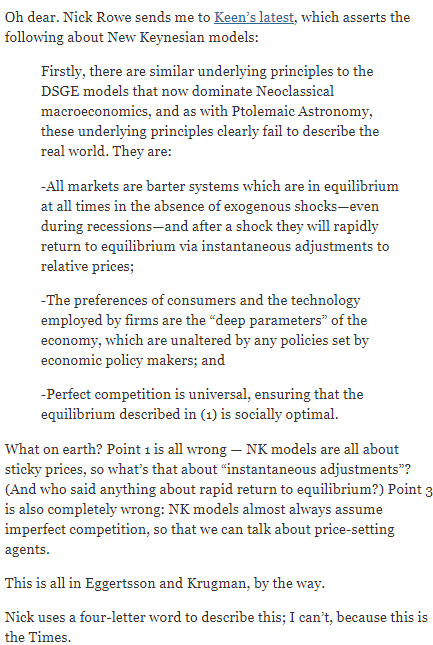
From https://krugman.blogs.nytimes.com/2012/04/02/oh-my-steve-keen-edition/ and see https://creditwritedowns.com/2012/04/banks-matter-krugmans-barter-mysticism.html for the text of broken link
Why am I reminded of Neoclassical Economics? Let me count the ways…
Firstly, there are similar underlying principles to the DSGE models that now dominate Neoclassical macroeconomics, and as with Ptolemaic Astronomy, these underlying principles clearly fail to describe the real world. They are:
- All markets are barter systems which are in equilibrium at all times in the absence of exogenous shocks—even during recessions—and after a shock they will rapidly return to equilibrium via instantaneous adjustments to relative prices;
- The preferences of consumers and the technology employed by firms are the “deep parameters” of the economy, which are unaltered by any policies set by economic policy makers; and
- Perfect competition is universal, ensuring that the equilibrium described in (1) is socially optimal.
If that were actually the real world, then not only would there not be a crisis now, there would never have been a Great Depression either—and recessions would simply be minor statistically unpredictable but inevitable events when the majority of shocks hitting the economy were negative, and they would rapidly be resolved by adjustments to relative prices (wages included, of course).
So economists like Krugman—who describe themselves as “New Keynesians”—have tweaked the base case to derive models that “ape” real-world data, with “sticky” prices rather than perfectly flexible ones, “frictions” that slow down quantity adjustments, and imperfect competition to generate less-than-optimal social outcomes.
This is Ptolemaic Economics: take a model that is utterly unlike the real world, and which in its pure form can’t possibly fit real world data, and then add “imperfections” so that it can appear to do so.
Free to Choose Part 5: Created Equal Featuring Thomas Sowell
01 Jul 2019 Leave a comment
in politics - USA, Thomas Sowell
Rugby sponsors draw the line in odd places
01 Jul 2019 Leave a comment
in economics of crime, economics of religion, labour economics, law and economics, politics - Australia, sports economics Tags: employment law

Unintended consequences of @eugeniesage’s #plasticbagfascism
01 Jul 2019 Leave a comment
in economics of regulation, environmental economics, politics - New Zealand Tags: offsetting behaviour, recycling, The fatal conceit, unintended consequences




Recent Comments