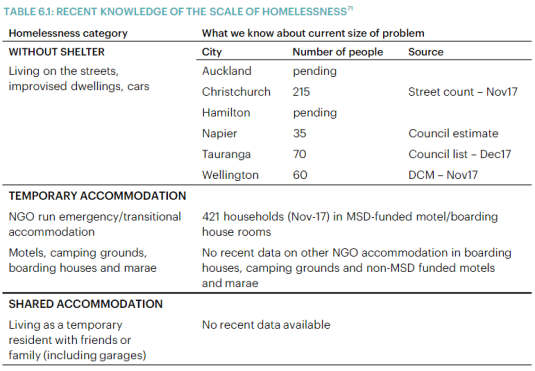
From https://www.scribd.com/document/371290734/A-Stocktake-of-New-Zealand-s-Housing#from_embed
Celebrating humanity's flourishing through the spread of capitalism and the rule of law
12 Feb 2018 Leave a comment
in politics - New Zealand, poverty and inequality, urban economics
09 Feb 2018 Leave a comment
in politics - New Zealand, urban economics Tags: affordable housing, land supply

04 Feb 2018 1 Comment
in economics of bureaucracy, economics of crime, politics - New Zealand
One of the first things I noticed after coming to New Zealand from Australia in 1998 was the petty veniality in government departments.

In my first week, I discovered employers pay for farewells. No chance in Canberra. We take our colleague out for lunch and have a whip-round to pay for their lunch. If it was a retirement function, such as for a long serving employee, the senior staff would pay for it out of their own pocket. The taxpayer never ever paid.
Then I noticed that public servants would charge lunches with each other to their government credit card. They would buy wine! By chance, I discovered when working at the Productivity Commission that the chairman was authorised to send out for sandwiches if a meeting ran over lunch time. He never did. The last time I remember a meeting running over lunch, the deputy chairman, who later went on to be the chairman, bought the sandwiches out of his own pocket.
It got worse when I noticed who went on overseas trips. When it was a more exotic location, a much more senior manager felt the need to represent his country. Enthusiasm in a minister’s office for going to a rather boring international meeting picked up no end when they discovered it was in Istanbul.
I thought most overseas travel was a waste of time in 1999 even with that so primitive an Internet back then so I actively avoided it and never proposed a trip. This became crystal clear when we were receiving cables from the embassy in Washington and London telling me what I had already read in the Washington Post and the London Times while they were sleeping. The Ministry of Foreign Affairs a couple years later installed desktop Internet access.
Then to my astonishment, I found that government employees would take holidays at the end of their business travel. If you tried that in Australia, you would be fired and hopefully your manager too for not setting the right tone. It would never be considered.
If you were on an interstate secondment, as some friends once were from Adelaide to Canberra for the Tax Office, they were entitled to take leave equal to the amount of time accrued while on that secondment. If they were away for one month, they were entitled to take one and a half days leave and receive travelling allowances and so forth for those one and a half days.
Clearly, it would give an appearance of bias when you are writing the business case if you could get it business class air ticket to the other side of the world and then take a long holiday on the way back. Appearances count, especially when you are thinking about taxpayers’ money.
New Zealand government departments seem to employ a lot of contractors as policy analysts. I have never heard of such things in Canberra when working at the Department of Finance, the Prime Minister’s Department and the Productivity Commission.
If a manager could not recruit and retain enough analysts to work through peaks and troughs in the workload, you were not a very good manager. If it was a real crisis, you found someone who was not busy from within the organisation and had them seconded to your team.
In more than a few places, these contractors seemed to be good friends of the manager. These contractors can be hired so quickly and in such number that a new manager can find no time to talk to his existing staff about what they do now, what they might do in the coming months or what skill sets they might have. Is always a bit odd that new managers can hire a couple of contractors but not have time to sign a performance agreement with any of his staff in that year.
I was talking to a colleague, also a migrant to this country from another state sector about how he would always refuse attempts by people to buy him lunch or a beer. Like me, he would be up the back eating his own sandwiches while the senior executives tucked into 3 course lunches plus wine provided by various lobby groups.
Until I came to New Zealand, the taxpayer had never bought me lunch or a beer. I was careful to refusal offers of hospitality. If an offer was made, I thought they were up to something.
But worst of all, worse than any of this veniality, the worst culture shock of all was until I came to Wellington, I had never been to a team meeting. When I was asked to go to my first team meeting, the 2nd day on the job, I just had to wing it.
In Australia, managers are expected to keep staff in the loop and staff are expected to talk to each other about what they are working on in case they can help each other. Managers and staff are expected to be frugal with their time as well as the taxpayers’ money paying their salaries.
04 Feb 2018 Leave a comment
in economics of religion, politics - USA Tags: political correctness
03 Feb 2018 Leave a comment
in politics - New Zealand, Public Choice, rentseeking
01 Feb 2018 Leave a comment
in economic history, politics - USA, poverty and inequality

30 Jan 2018 2 Comments
in constitutional political economy, politics - USA, Public Choice
Boston Mayor Curley had the rare distinction of winning his first election from prison and his last while under federal indictment for corruption which he was soon convicted of while in office.
Curley won his first election in 1904 as an alderman on the slogan “he did it for a friend”. He sat a civil service exam for a friend to get him a job. He quickly then handed out 700 patronage jobs once he once he got out of prison to serve as an alderman.
In 1945, he was re-elected mayor. Truman commuted his 6 to 18 month sentence after 5 months in 1948 at the behest of the Massachusetts congressional delegation and later (1950) granted him a full pardon.
Curley was then defeated by the acting mayor during his prison term in the subsequent Democratic party primary in part because of the high taxes under the Curley regime. Naturally, during his lame-duck period, Curley granted many tax abatements to sabotage the public finances of his successor.
30 Jan 2018 Leave a comment
in liberalism, politics - Australia Tags: Age of Enlightenment, Iran, women's liberation
28 Jan 2018 1 Comment
in applied welfare economics, politics - New Zealand, transport economics
It is not a case of under-investment denying buses and trains their day in the sun. The overseas evidence is rail cost estimates and passenger forecasts are much more politicised than those for roads because of the political pressures to invest in more public transport no matter what (Flyvbjerg et al. 2006).
There is more organised political support for buses and trains and considerable organised (often NIMBY based) opposition to road building. A major driver of cost blow-outs in the road projects reviewed by the Ministerial Advisory Group on Roading Costs (2006) was scope changes to appease local political pressures to mitigate community and environmental impacts. Community group driven litigation under the Resource Management Act to frustrate NZTA road projects is proliferating. Their High Court loss which prevented the building of the Basin Overpass in Wellington is a recent example.
In contrast, light rail proposals such as a billion-dollar proposal in Wellington City for a few kilometers of track including a $400 million tunnel were entertained for far longer than any sensible benefit cost analysis could justify. Quite fanciful fast-rail proposals costing many hundreds of millions of dollars are floated in by-elections and from time to time by the commentariat and rent seekers.
The proposed upgrade the Auckland to Northland railway line and the rail link to the port was costed by the Taxpayers’ Union (2015) at $198 million. Dreams of fast rail receives a generous hearing despite mind blowing costs and incredulous and sometimes impossible freight and passenger forecasts.
Buses and trains are not the forgotten children of urban transport policy. The Greens are passionate about massive investment in buses and trains at the expense of roads. Labour is also competing for the same urban middle-class votes so it too champions more public transport. In an MMP Parliament, all parties have an incentive respond to political pressures in a fine-tuned way when voting on budgets.
Public transport advocates do well in the scramble for taxpayers’ money. The road with the worst benefit-cost ratio of all in the post implementation reviews was the Auckland Northern Busway, which cost $182 million. It had a cost benefit ratio of a miserable 1.2 at approval and a no better 1.3 after its completion. With a benefit-cost ratio rounding down to one with ease, this bus network upgrade must have had political muscle behind it to dam the taxpayers, full steam ahead.
27 Jan 2018 Leave a comment
in politics - New Zealand, transport economics

27 Jan 2018 Leave a comment
in constitutional political economy, economics of crime, law and economics, politics - USA, Public Choice
26 Jan 2018 Leave a comment
in economic history, law and economics, politics - Australia
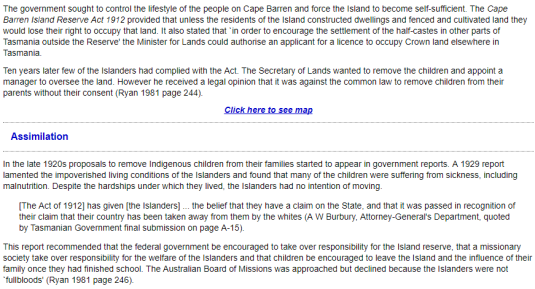
Source: Bringing them Home – Chapter 6 Human Rights and Equal Opportunity Commission Report, Bringing them Home, Report of the National Inquiry into the Separation of Aboriginal and Torres Strait Islander Children from Their Families April 1997.
26 Jan 2018 Leave a comment
in economic history, economics of crime, law and economics, politics - Australia
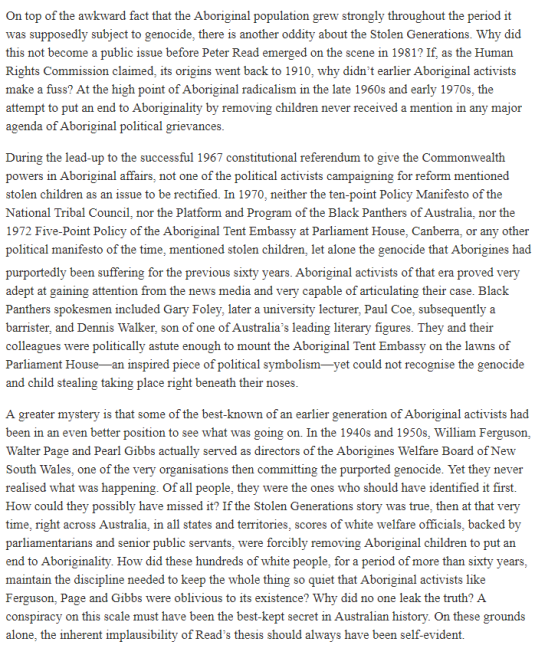
Source: KEITH WINDSCHUTTL Why There Were No Stolen Generations (Part Two). Quadrant (January 2010) at http://quadrant.org.au/magazine/2010/1-2/why-there-were-no-stolen-generations-part-two/
26 Jan 2018 Leave a comment
in economics of bureaucracy, entrepreneurship, industrial organisation, politics - New Zealand, Public Choice
Your picking loses detector is at maximum when governments are retrofitting infrastructure in the suburbs. We just had Chorus in to retrofit ultrafast broadband to our house. Our house is too big and complicated to rewire.

In addition to stringing a wire from the road to a ATC box, as with everybody, we need to rewire from that box to my office for another ultrafast broadband box next to my computer on the other side of the house 2 floors up. I was told I would need an electrician to do that as the house is already built, most of the wires will probably be external, ugly and I would have to pay for it and the drilling through my floors.
Seems like the political genius behind government paying for ultra fast broadband including fitting it into my house assumed everybody had a nice simple one story house where the office was near the ACT box so there would be minimal rewiring. That would involve minimal internal wiring.
If I want to proceed, I need to bring in an electrician and as the house is already been built, he will need to drill holes, string wires and then the chorus team will come back. The alternative was to have my modem just above the ATC box in the spare bedroom and the rest of the house operate including my desktop in my office on Wi-Fi which seems to very must defeat point of ultrafast broadband indeed.
Celebrating humanity's flourishing through the spread of capitalism and the rule of law
Celebrating humanity's flourishing through the spread of capitalism and the rule of law
Celebrating humanity's flourishing through the spread of capitalism and the rule of law
Celebrating humanity's flourishing through the spread of capitalism and the rule of law
Celebrating humanity's flourishing through the spread of capitalism and the rule of law
Celebrating humanity's flourishing through the spread of capitalism and the rule of law
A History of the Alt-Right
Econ Prof at George Mason University, Economic Historian, Québécois
Celebrating humanity's flourishing through the spread of capitalism and the rule of law
Scholarly commentary on law, economics, and more
Beatrice Cherrier's blog
Celebrating humanity's flourishing through the spread of capitalism and the rule of law
Celebrating humanity's flourishing through the spread of capitalism and the rule of law
Celebrating humanity's flourishing through the spread of capitalism and the rule of law
Why Evolution is True is a blog written by Jerry Coyne, centered on evolution and biology but also dealing with diverse topics like politics, culture, and cats.
Celebrating humanity's flourishing through the spread of capitalism and the rule of law
A rural perspective with a blue tint by Ele Ludemann
DPF's Kiwiblog - Fomenting Happy Mischief since 2003
Celebrating humanity's flourishing through the spread of capitalism and the rule of law
The world's most viewed site on global warming and climate change
Tim Harding's writings on rationality, informal logic and skepticism
A window into Doc Freiberger's library
Let's examine hard decisions!
Commentary on monetary policy in the spirit of R. G. Hawtrey
Thoughts on public policy and the media
Celebrating humanity's flourishing through the spread of capitalism and the rule of law
Politics and the economy
A blog (primarily) on Canadian and Commonwealth political history and institutions
Reading between the lines, and underneath the hype.
Economics, and such stuff as dreams are made on
"The British constitution has always been puzzling, and always will be." --Queen Elizabeth II
Celebrating humanity's flourishing through the spread of capitalism and the rule of law
Celebrating humanity's flourishing through the spread of capitalism and the rule of law
WORLD WAR II, MUSIC, HISTORY, HOLOCAUST
Undisciplined scholar, recovering academic
Celebrating humanity's flourishing through the spread of capitalism and the rule of law
Res ipsa loquitur - The thing itself speaks
In Hume’s spirit, I will attempt to serve as an ambassador from my world of economics, and help in “finding topics of conversation fit for the entertainment of rational creatures.”
Researching the House of Commons, 1832-1868
Articles and research from the History of Parliament Trust
Reflections on books and art
Posts on the History of Law, Crime, and Justice
Celebrating humanity's flourishing through the spread of capitalism and the rule of law
Exploring the Monarchs of Europe
Cutting edge science you can dice with
Small Steps Toward A Much Better World


Recent Comments