Debt repayment does not rule out tax cuts

The case for a tax cut is a distinct issue from repaying the recent large budget deficits and balancing the budget over the business cycle.

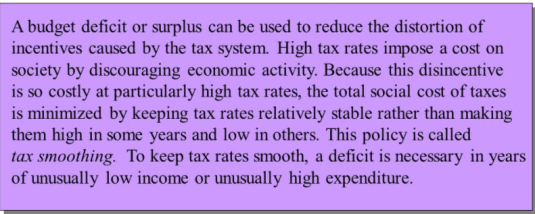
Ministers of Finance should pay more attention to the concept of tax smoothing. Unless something special is happening, income tax rates should be similar from one year to another. We should keep tax rates fairly smooth by borrowing during recessions and emergencies.
Instead, the Government not indexing the income tax thresholds for inflation collected $2.1 billion in extra revenue since 2008 according to Parliamentary Library calculations. Raising the income tax rate thresholds is becoming more pressing. Income growth is starting to push many ordinary taxpayers uncomfortably close to the next threshold and a much higher marginal tax rate. For example, 30% rather than the 17.5% income tax rate many taxpayers face.

New Zealand is already left behind on company tax rates; ours is currently 28%. The Australian company tax rate may drop to 25%; the British company tax rate is going down to 17% by 2020.

Large public deficits have their place

Prudent public debt management dictates that governments run temporary budget deficits in recessions and other emergencies such as the Canterbury earthquake and repay that debt as better times return. Recessions and natural disasters are infrequent so this extra debt should be paid down at a measured speed, not a frantic pace at the expense of other tax policy goals.

An increase in the budget deficit smooths over these bad times and avoids taxes going up and down like a Jack-in-the-Box over the business cycle. Who raises taxes in a recession?

Beware of foul-weather fiscal conservatives

After the start of the recession in 2009, foul weather fiscal conservatives wanted to do just that. The same usual suspects who always advocate bigger government argued for higher taxes rather than running a larger budget deficit, which New Zealand did. Imagine the massive income tax rises required every recession and in the last recession in particular if the large budget deficits were not run?

The large public debt from the temporary budget deficits that smoothed over the last recession is no special or additional reason to postpone income tax cuts. A sound long-term fiscal strategy has tax rates at levels that make up on the deficits in bad times with surpluses in the good times. Slowly repaying debts accumulated in a recession is a routine part of prudent public debt management.

There is room for tax cuts

Every budget allocates about $1.5 billion for new policy proposals that can be adopted without the Treasury thinking that they might harm long-term fiscal stability.

New Zealand budget allows for up to $1.5 billion on new policies every year. If this new spending was justified despite the large public debt from the recent recession, some tax cuts are too. They could start with raising the income tax rate thresholds to make up for past inflation.

Badge of honour: blocked by Morgan on Twitter and now Facebook @top_nz

Cannot comment on Gareth Morgan’s Facebook page anymore. Can’t handle the truth. I wrote an extensive critique of his universal basic income but he does not want to discuss the evidence or the logical flaws of his policy proposal. The only people who lose out from his universal basic income are those for whom the modern welfare state was founded to protect.

What set Gareth Morgan off on his Facebook page was when I commented pointing out that the optimal rate of tax on income from capital to zero. All I said was “optimal tax theory including that pioneered by Stiglitz and Merrlees, economists of impeccable left-wing credentials, show that taxes on the income from capital should be low because the deadweight social costs of taxes on capital are very high”. His response was anti-intellectualism.

Banned from r/ProtectAndServe

The American police subreddit did not want to know that there were a few bad apples in their rank ranks despite the overall good news about the use of lethal force.

Blacks are not shot dead out of proportion but there are more incidents of excessive force which is nonlethal. Racists are cowards. There is excessive force under the colour of authority but they chicken out when there are real consequences and serious investigations.

Are unilateral carbon emission cuts the next best thing to an effective multilateral agreement?

Carbon emission reductions are an international public good which will always be undersupplied. The benefits of emission cuts are available to all irrespective of whether they cut emissions or not so there is always the temptation to not cut your own emissions unless your reduction is decisive. It is agreed in the recent court case that New Zealand’s carbon emissions are trivial on the global scale.

Free riding is much more likely for international public goods because there is no effective mechanism for compelling nations to cut their carbon emissions short of a green tariff war. Even a green tariff war fails unless it is most countries ganging up on a few recalcitrant carbon emitters.

Even if the major emitters cut back, the developing countries have made it clear that they will not sacrifice their development for global climate objectives. Many developed countries are dragging their feet on cutting emissions and that is before we mention the Trump administration withdrawing from the relatively modest targets in the Paris agreement of 2 years ago.

In the absence of the provision of an international public good to a sufficient level, which are emission cutbacks of about 10 times the Paris targets, unilateral contributions to the provision of that global public good make NZ poorer. Will making ourselves unilaterally poorer help us adapt to the runaway climate change that has been foretold by so many?

What is even worse is handcuffing relatively efficient agricultural industries with a high carbon price. This will provide a good incentive for the export of dirty production to less enlightened countries. Our dairy exporters would lose market share to higher carbon emitting countries.

It can be argued that unilateral reductions by NZ because of a higher than the international average carbon price could quicken global warming. The point of carbon taxes is to encourage industries to migrate to the most efficient places of production and therefore lowest carbon emissions. 

Making our dairy industry less efficient because of unilaterally higher carbon taxes means more dairy is produced in other countries that are not restraining their carbon emissions. In consequence, carbon emissions globally may increase but New Zealand is poorer for its unilateral restraint.

The carbon tax is supposed to give people the right incentives about what to buy and where to produce. Making the world’s most efficient dairy producer produce less does not sit well with that.

The whole point of putting a price on carbon emissions is to shift the economy out of high carbon emission activities into low carbon emission activities. The risk of a even higher price on carbon in New Zealand relative to the rest of the world is the reverse will happen.

The most likely international scenario is not much is done at all about cutting carbon emissions. Things will be done here and there but as soon as cutting emissions becomes costly, political support will fade. Tony Abbott will not be the only politician to describe a carbon tax as a great big new tax.

In such a world, is it in anyone’s interest for the most efficient agricultural producers to be shooting themselves in the foot. Should not they be taking on as much production as they can because their efficiency reduces total global emissions.

Given this gloomy outlook, Greenpeace and the Greens should be born-again supply-side economists pushing every Rogernomics reform they can find to increase economic growth. Richer is safer, wealthier is healthier. A richer New Zealand is more able to roll with the punches of their foretold runaway climate change and make the necessary adaptations.

Climate change activists must swallow two dead rats rather than one if they really want to deal with the runaway climate change they foretell so often. Not only must they embrace nuclear power, they must go a 2nd ideological bridge too far and embrace a competitive market economy with gusto.

If there is no effective multilateral agreement to cut emissions, do not assume unilateral cutbacks are the next best thing. The best solutions call for strange bedfellows if there is no planet B.

8. The Future of Libertarianism – Murray N Rothbard

.@Greens karma

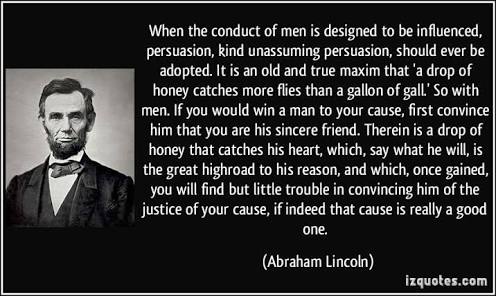
Abraham Lincoln on Listen up deplorables as a way to ask for votes

In the East, Islam silences us violently. In the West, Islam uses ‘Islamophobia’ to silence us

Attention @top_nz

Why won’t Trump use his best argument for his travel ban?

Trump promised to ban all Muslim immigration. He broke that promise on his first day of office by issuing a 90-day suspension of visa processing against Iran and 5 fail states or war zones already identified in Congressional legislation as countries of concern in terms of vetting.

Trump then said he was going to introduce enhanced vetting for migration from these Muslim majority countries. Clearly, his promise to ban all Muslim migrants is one of the many promises he has broken. Instead, he focused on a legitimate difference with the previous administration on the stringency of vetting from countries hostile to the USA and from failed states.

If the courts are to chill free speech by holding candidates to what they say in the campaign trail before they take the oath of office, they are equally bound to notice that Trump broke his flagship campaign promise to ban all Muslim immigrants immediately on entering office.

The appeal courts for many years after the 9/11 attacks upheld sweeping restrictions on male migrants from 24-muslim majority countries and North Korea. They were fingerprinted and photographed at the border; nationals of these countries already within the USA were required to attend Immigration and Customs enforcement offices to be fingerprinted and photographed on pain of deportation.

Was accused of mansplaining today so I looked up what it meant for the 1st time

To come out swinging against the motives of critics suggests you cannot handle criticism.

@NZGreens see a @geertwilderspvv fan as ready for office? #greenbaublesofoffice

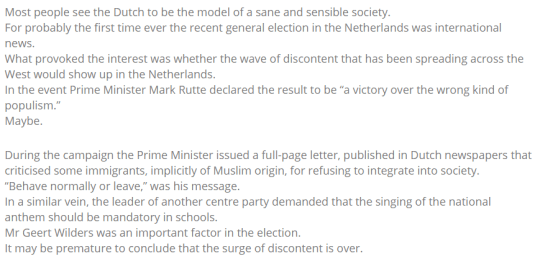
Source: Rt Hon Winston Peters speech to Asia Plus Group of Wellington: Making Sense Of Political Change – New Zealand First.

Christopher Hitchens on Michael Moore

The evolution of American protest music

How the Republican Party turned against climate science

Previous Older Entries Next Newer Entries

Arin’s Substack

Celebrating humanity's flourishing through the spread of capitalism and the rule of law

David Andolfatto

Celebrating humanity's flourishing through the spread of capitalism and the rule of law

Monetary Non-Neutrality

Celebrating humanity's flourishing through the spread of capitalism and the rule of law

Reason Magazine

Celebrating humanity's flourishing through the spread of capitalism and the rule of law

Coyote Blog

Celebrating humanity's flourishing through the spread of capitalism and the rule of law

Thoughts from the North

Celebrating humanity's flourishing through the spread of capitalism and the rule of law

Fardels Bear

A History of the Alt-Right

Vincent Geloso

Econ Prof at George Mason University, Economic Historian, Québécois

Bassett, Brash & Hide

Celebrating humanity's flourishing through the spread of capitalism and the rule of law

Truth on the Market

Scholarly commentary on law, economics, and more

The Undercover Historian

Beatrice Cherrier's blog

Matua Kahurangi

Celebrating humanity's flourishing through the spread of capitalism and the rule of law

Temple of Sociology

Celebrating humanity's flourishing through the spread of capitalism and the rule of law

Velvet Glove, Iron Fist

Celebrating humanity's flourishing through the spread of capitalism and the rule of law

Why Evolution Is True

Why Evolution is True is a blog written by Jerry Coyne, centered on evolution and biology but also dealing with diverse topics like politics, culture, and cats.

NoTricksZone

Celebrating humanity's flourishing through the spread of capitalism and the rule of law

Homepaddock

A rural perspective with a blue tint by Ele Ludemann

Kiwiblog

DPF's Kiwiblog - Fomenting Happy Mischief since 2003

The Dangerous Economist

Celebrating humanity's flourishing through the spread of capitalism and the rule of law

Watts Up With That?

The world's most viewed site on global warming and climate change

The Logical Place

Tim Harding's writings on rationality, informal logic and skepticism

Doc's Books

A window into Doc Freiberger's library

The Risk-Monger

Let's examine hard decisions!

Uneasy Money

Commentary on monetary policy in the spirit of R. G. Hawtrey

Barrie Saunders

Thoughts on public policy and the media

Liberty Scott

Celebrating humanity's flourishing through the spread of capitalism and the rule of law

Point of Order

Politics and the economy

James Bowden's Blog

A blog (primarily) on Canadian and Commonwealth political history and institutions

Science Matters

Reading between the lines, and underneath the hype.

Peter Winsley

Economics, and such stuff as dreams are made on

A Venerable Puzzle

"The British constitution has always been puzzling, and always will be." --Queen Elizabeth II

The Antiplanner

Celebrating humanity's flourishing through the spread of capitalism and the rule of law

Bet On It

Celebrating humanity's flourishing through the spread of capitalism and the rule of law

History of Sorts

WORLD WAR II, MUSIC, HISTORY, HOLOCAUST

Roger Pielke Jr.

Undisciplined scholar, recovering academic

Offsetting Behaviour

Celebrating humanity's flourishing through the spread of capitalism and the rule of law

JONATHAN TURLEY

Res ipsa loquitur - The thing itself speaks

Conversable Economist

In Hume’s spirit, I will attempt to serve as an ambassador from my world of economics, and help in “finding topics of conversation fit for the entertainment of rational creatures.”

The Victorian Commons

Researching the House of Commons, 1832-1868

The History of Parliament

Articles and research from the History of Parliament Trust

Books & Boots

Reflections on books and art

Legal History Miscellany

Posts on the History of Law, Crime, and Justice

Sex, Drugs and Economics

Celebrating humanity's flourishing through the spread of capitalism and the rule of law

European Royal History

Exploring the Monarchs of Europe

Tallbloke's Talkshop

Cutting edge science you can dice with

Marginal REVOLUTION

Small Steps Toward A Much Better World